


How World’s Most Precise Clock Could Transform Fundamental Physics

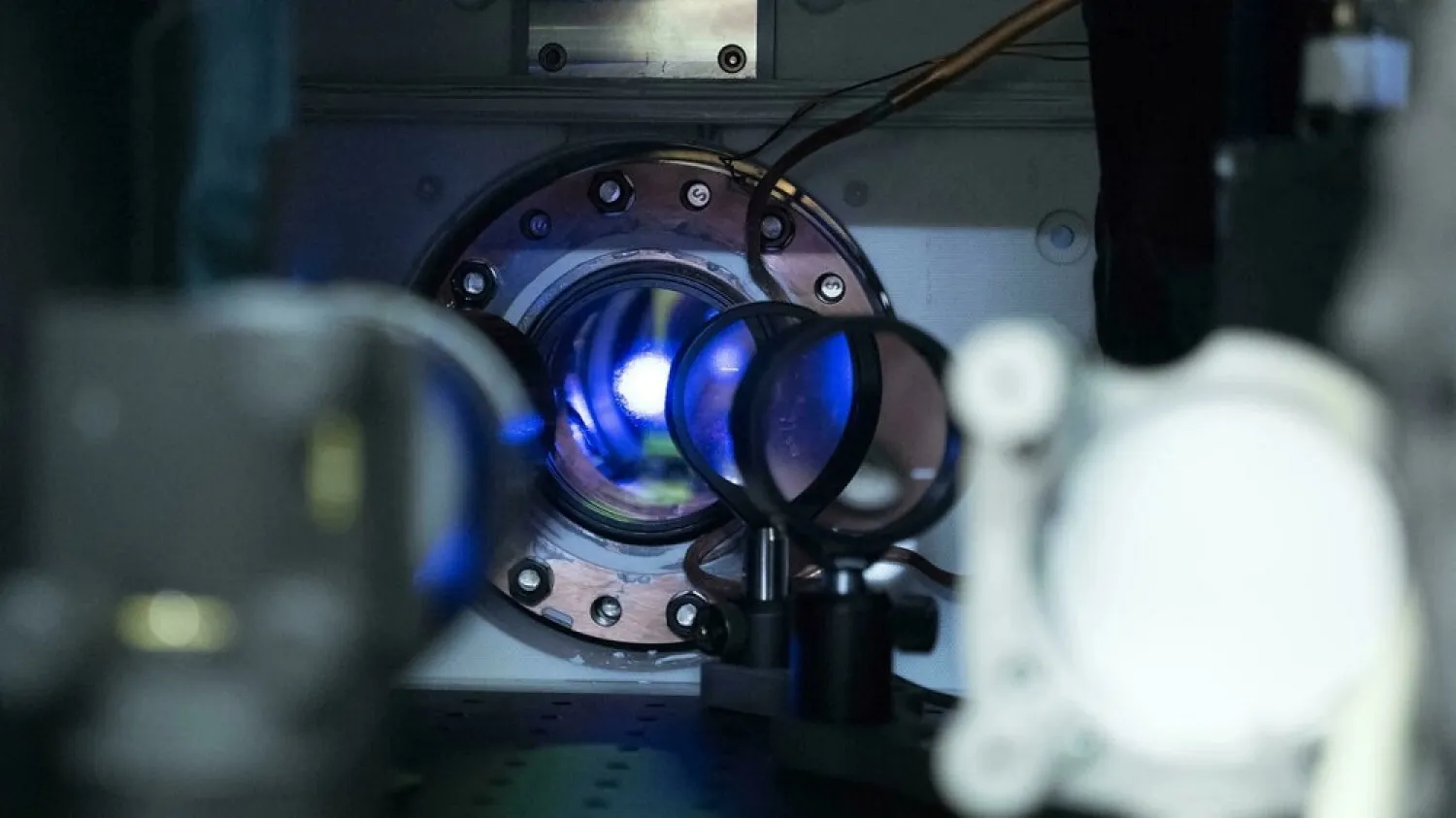
This handout photo provided by NIST shows a strontium atomic clock, one of the world's most accurate time-keeping pieces in the lab of Professor Jun Ye at the University of Colorado, in Boulder. (AFP)
TT

How World’s Most Precise Clock Could Transform Fundamental Physics

This handout photo provided by NIST shows a strontium atomic clock, one of the world's most accurate time-keeping pieces in the lab of Professor Jun Ye at the University of Colorado, in Boulder. (AFP)

US scientists have measured Albert Einstein's theory of general relativity -- which holds that gravity slows time down -- at the smallest scale ever, demonstrating that clocks tick at different rates when separated by fractions of a millimeter.

Jun Ye, of the National Institute of Standards and Technology (NIST) and the University of Colorado Boulder, told AFP it was "by far" the most precise clock ever built -- and could pave the way for new discoveries in quantum mechanics, the rulebook for the subatomic world.

Ye and colleagues published their findings in the prestigious journal Nature on Wednesday, describing the engineering advances that enabled them to build a device 50 times more precise than their previous best clock, itself a record-breaker, built in 2010.

It was more than a century ago, in 1915, that Einstein put forward his theory of general relativity, which held that the gravitational field of a massive object distorts space-time.

This causes time to move more slowly as one approaches closer to the object.

But it wasn't until the invention of atomic clocks -- which keep time by detecting the transition between two energy states inside an atom exposed to a particular frequency -- that scientists could prove the theory.

Early experiments included the Gravity Probe A of 1976, which involved a spacecraft 6,000 miles (10,000 kilometers) above Earth's surface and showed that an onboard clock was faster than an equivalent on Earth by one second every 73 years.

Since then, clocks have become more and more precise, and thus better able to detect the effects of relativity.

A decade ago, Ye's team set a record by observing time moving at different rates when their clock was moved 33 centimeters (just over a foot) higher.

Theory of everything

Ye's key breakthrough was working with webs of light, known as optical lattices, to trap atoms in orderly arrangements. This is to stop the atoms from falling due to gravity or otherwise moving, resulting in a loss of accuracy.

Inside Ye's new clock are 100,000 strontium atoms, layered on top of each other like a stack of pancakes, in total about a millimeter high.

The clock is so precise that when the scientists divided the stack into two, they could detect differences in time in the top and bottom halves.

At this level of accuracy, clocks essentially act as sensors.

"Space and time are connected," said Ye. "And with time measurement so precise, you can actually see how space is changing in real time -- Earth is a lively, living body."

Such clocks spread out over a volcanically-active region could tell geologists the difference between solid rock and lava, helping predict eruptions.

Or, for example, study how global warming is causing glaciers to melt and oceans to rise.

What excites Ye most, however, is how future clocks could usher in a completely new realm of physics.

The current clock can detect time differences across 200 microns -- but if that was brought down to 20 microns, it could start to probe the quantum world, helping bridge gaps in theory.

While relativity beautifully explains how large objects like planets and galaxies behave, it is famously incompatible with quantum mechanics, which deals with the very small, and holds that everything can behave like a particle and a wave.

The intersection of the two fields would bring physics a step closer to a unifying "theory of everything" that explains all physical phenomena of the cosmos.



Brazil to Get Satellite Internet from Chinese Rival to Starlink in 2026

Brazil's new Chief of Staff of the Presidency Rui Costa attends a ministerial meeting at the Planalto Palace in Brasilia, Brazil January 6, 2023. REUTERS/Adriano Machado
TT

Brazil to Get Satellite Internet from Chinese Rival to Starlink in 2026

Brazil's new Chief of Staff of the Presidency Rui Costa attends a ministerial meeting at the Planalto Palace in Brasilia, Brazil January 6, 2023. REUTERS/Adriano Machado

Chinese low Earth orbit satellite company SpaceSail will start providing internet access to remote areas in Brazil in the first half of 2026, President Luiz Inacio Lula da Silva's chief of staff, Rui Costa, said on Wednesday, Reuters reported.

SpaceSail and Brazil's state-owned telecom Telebras had signed a memorandum of understanding in late 2024 to offer satellite internet services for schools, hospitals and other essential services in the South American country.

SpaceSail competes directly with Elon Musk's Starlink in the satellite internet market.


Google Launches First Ever Co-branded Credit Card in India

FILE PHOTO: A Google logo is seen at a company research facility in Mountain View, California, US, May 13, 2025. REUTERS/Carlos Barria/File Photo
TT

Google Launches First Ever Co-branded Credit Card in India

FILE PHOTO: A Google logo is seen at a company research facility in Mountain View, California, US, May 13, 2025. REUTERS/Carlos Barria/File Photo

Alphabet Inc's Google Pay launched its first co-branded digital credit card in India on Wednesday in partnership with Axis Bank, intensifying efforts to monetize its massive user base in the country's crowded fintech sector.

WHY IT'S IMPORTANT

While Google Pay is a dominant player in India's popular domestic payments network, the Unified Payments Interface (UPI), its core service generates zero revenue from user-to-user payments due to government mandates. It, however, earns commissions for in-app services like bill payments and mobile recharges, Reuters reported.

The credit card launch opens a new avenue for Google to monetize its user base, mirroring strategies by domestic rivals Paytm and PhonePe to cross-sell lending products to payment users.

BY THE NUMBERS

India has just 50 million credit card holders, according to Google Pay, whereas its population exceeds 1.4 billion.

Google Pay meanwhile is the second top app in India by number of UPI transactions, having processed nearly 7.2 billion transactions in October alone.

HOW IT WORKS

Axis Bank manages the credit risk and issuance, while the digital-only card will be linked to the Google Pay app to make online and offline payments on the go.


UK Looks to Restart Cooperation after US Suspends Tech Deal

Pedestrians walk across Westminster Bridge as early morning fog covers the streets of London on December 17, 2025. (Photo by JUSTIN TALLIS / AFP)
TT

UK Looks to Restart Cooperation after US Suspends Tech Deal

Pedestrians walk across Westminster Bridge as early morning fog covers the streets of London on December 17, 2025. (Photo by JUSTIN TALLIS / AFP)

The UK government on Wednesday said it was focused on resuming talks promptly after the United States suspended implementation of a tech cooperation deal with Britain.

The deal was signed during US President Donald Trump's pomp-filled state visit to the UK in September.

But on Tuesday Michael Kratsios, head of the White House Office of Science and Technology Policy, said on X that the UK must make "substantial progress" on trade talks for the deal to resume.

The US and UK have been trying to implement the "Economic Prosperity Deal," agreed in May and one of the first international agreements signed after Trump threatened the world with punishing tariffs on goods entering the United States.

The US-UK Technology Prosperity Deal agreed in September 2025 was a non-binding agreement to sit alongside the broader Economic Prosperity Deal.

It was designed to align the two countries on tech innovation while spurring mostly private-sector investment, Agence France Presse reported.

Following the White House announcement, a UK government spokesperson said: "We look forward to resuming work on this partnership as quickly as possible... and working together to help shape the emerging technologies of the future."

Business and Trade Secretary Peter Kyle held trade talks with US counterparts in Washington DC last week to progress the Economic Prosperity Deal, the spokesperson said.

"They celebrated the success of the recent pharma deal and both sides agreed to continue further negotiations next year."

According to the Financial Times, US officials have become increasingly frustrated with Britain's lack of willingness to address non-tariff barriers, including rules and regulations governing food and industrial goods.