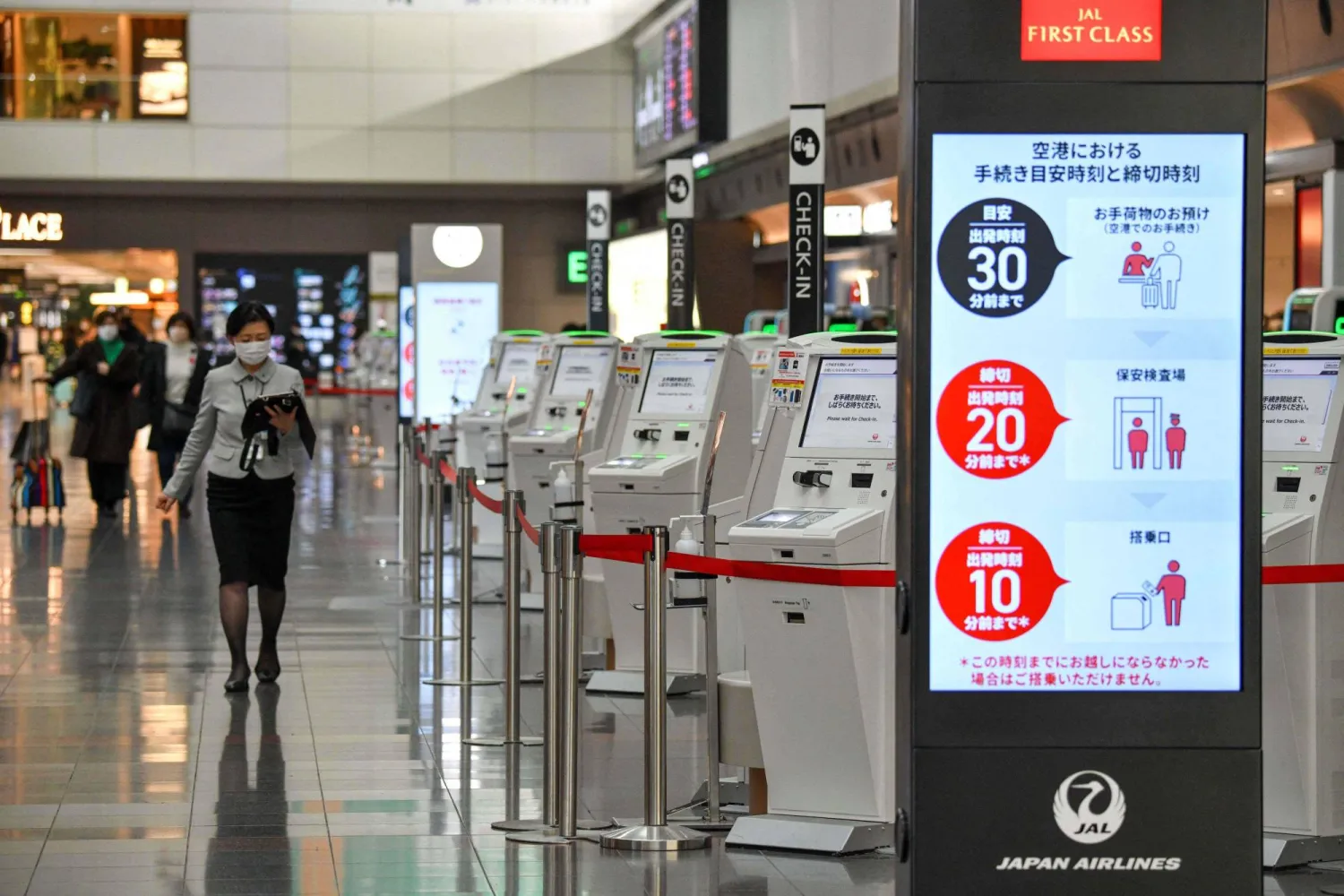
Japan Eases Border Controls amid Criticism as Exclusionist

Tokyo's Haneda airport on Wednesday | AFP-JIJI
TT

Japan Eases Border Controls amid Criticism as Exclusionist

Tokyo's Haneda airport on Wednesday | AFP-JIJI

Japan announced Thursday it will ease its tough COVID-19 border controls by increasing the number of people allowed to enter each day and reduce quarantine requirements following criticism that its current policy is unscientific and xenophobic.

Prime Minister Fumio Kishida said the daily entry cap will be raised to 5,000, including Japanese citizens and foreign residents, from the current 3,500 beginning March 1. The decision is good news for foreign scholars, exchange students and business travelers who have been unable to enter, but does not cover tourists, The Associated Press said.

He says quarantine requirements for entrants will be shortened to three days from the current seven, and those with proof of a negative COVID-19 test and a booster shot can skip self-isolation.

Japan has banned nearly all non-resident foreign entrants since early in the pandemic. The country, which saw a significant decrease in infections in the fall, briefly announced an easing in November but quickly reversed the decision after the omicron variant emerged in other countries.

Kishida on Saturday said he was considering easing border measures based on a scientific assessment of the omicron variant, infection levels in and outside Japan and quarantine measures taken by other countries.

Most of Japan is currently under virus-related restrictions. Infections only recently started to show signs of slowing, likely because of delayed booster shots.

Nationwide, Japan reported 91,006 new cases on Wednesday, down slightly from a week earlier, after cases exceeded 100,000 on Feb. 5.

But experts say the infections are continuing to burden Japan's medical systems, which tend to be overwhelmed easily because COVID-19 treatment is limited to public or major hospitals.

Japan has become one of the world’s most difficult countries to enter and critics compare it to the “sakoku” locked country policy of xenophobic warlords who ruled Japan in the 17th to 19th centuries.

The current border rules — scheduled to remain in place until the end of February — allow in only Japanese nationals and permanent foreign residents. The policy has raised protests from foreign students and scholars, about 150,000 of whom have been affected.

Japanese and foreign business groups have also protested the government, saying the prolonged border closure has affected investment, business deals, product development and deliveries.

Experts say the rules are hurting Japan’s national interest and further delaying recovery in Japan’s pandemic-hit economy.

Many of the Japanese public have been supportive of the tight border controls as they think troubles such as the pandemic come from outside their island nation.

Kishida’s stringent border controls are widely seen as politically motivated to gain public support for his governing party in the upcoming July parliamentary elections.
Kishida’s government, however, faces public criticisms over slow booster vaccine distribution due to a delayed decision to cut intervals between the first two shots and a third to six months from an initially planned eight.

Kishida has set a target to give 1 million doses a day by the end of February.

Only about 12% of Japan’s population have received their third jabs. Experts say the low vaccination rate contributes to a growing number of serious cases and deaths among elderly patients.

While fast-spreading omicron variant is less likely to cause serious cases among younger people, it is increasingly causing serious illness and death among the elderly by deteriorating their underlying illnesses, starting to overwhelm many hospitals.

Kishida is expected to announce other virus measures Thursday, including subsidies to hospitals that accept elderly patients and increased allowances for nursing homes treating their residents instead of sending them to hospitals.


Le Pen Says France Will No Longer Aid Ukraine ‘Financially’ if Elected

Marine Le Pen (C), the far-right National Rally (RN) party's candidate for the 2027 French presidential election, visits the "Made in France" fair at the Porte de Versailles exhibition center in Paris, France, 13 November 2026. (EPA)
TT

Le Pen Says France Will No Longer Aid Ukraine ‘Financially’ if Elected

Marine Le Pen (C), the far-right National Rally (RN) party's candidate for the 2027 French presidential election, visits the "Made in France" fair at the Porte de Versailles exhibition center in Paris, France, 13 November 2026. (EPA)

Marine Le Pen on Monday said that France would provide no further financial aid to Ukraine if she is elected president next year, after a meeting with Kyiv's ambassador in Paris.

"The state of France's public finances would no longer allow the country to provide financial assistance to Ukraine in the coming months," Le Pen said in a statement, while insisting France would honor existing commitments, including toward a 90-billion-euro ($100-billion) European Union loan.

Le Pen is currently ahead in polls in the race to succeed President Emmanuel Macron next year, as the war sparked by Russia's 2022 full-scale invasion of Ukraine grinds towards its fifth anniversary.

She has faced criticism over past links to Russia, which included a 2017 meeting in the Kremlin with President Vladimir Putin and her party taking a loan from a Russian bank that it paid off in full in 2023.

But she has opposed the invasion and, at her talks in Paris with Ukrainian ambassador Vadym Omelchenko, Le Pen made clear her "unwavering support for Ukraine since the beginning of the conflict".

The statement said the talks -- the first such between Le Pen and the Ukrainian ambassador -- were "cordial".

While financial aid would be cut, Le Pen told the ambassador that "France would continue to support Ukraine through donations of equipment, humanitarian aid and much more active diplomacy".

The statement said there was a "frank discussion" on the future of the conflict, with Le Pen stressing that "the pursuit of peace -- though a difficult goal to achieve -- must remain a priority for all".

She also asked the ambassador to tell President Volodymyr Zelensky she is ready to meet in "either Paris or Brussels". However, there was no mention of the candidate making the journey to Kyiv after Zelensky invited her to visit the Ukrainian capital.

Le Pen's opponents have expressed alarm that by emphasizing the importance of ending the war swiftly, she could force Ukraine to capitulate on unfavorable terms.

"If Russia imposes its will on a European nation through brutality, all of Europe is weakened," Macron wrote on Facebook at the weekend.

Taking aim at Le Pen, he said: "Let us be clear: those who seek to limit the resources available to Ukraine are, in effect, pushing for an unjust peace -- one that would leave Ukraine permanently vulnerable, and, by extension, leave Europe vulnerable as well."


Trump Says He Might Meet with North Korea’s Kim Jong Un in China

US President Donald Trump and North Korean leader Kim Jong Un shake hands before their one-on-one chat during the second US-North Korea summit at the Metropole Hotel in Hanoi, Vietnam February 27, 2019. (Reuters)
TT

Trump Says He Might Meet with North Korea’s Kim Jong Un in China

US President Donald Trump and North Korean leader Kim Jong Un shake hands before their one-on-one chat during the second US-North Korea summit at the Metropole Hotel in Hanoi, Vietnam February 27, 2019. (Reuters)

US President Donald Trump said on Monday he might meet with North Korean leader Kim Jong Un in China this week, an announcement that could dramatically reshape his upcoming trip through East Asia if it occurs.

The president, who met the North Korean leader several times during his 2017-2021 term, including once in the Korean Demilitarized Zone, has previously expressed ‌interest in ‌another meeting during his current term. Senior ‌US ⁠officials, however, have previously ⁠said he has no immediate plans to do so.

Moreover, Trump has repeatedly previewed meetings with Kim that never took place, including during a trip to Asia last year. North Korea, whose mission to the United Nations did not immediately respond to a ⁠request for comment, has publicly indicated it ‌has no intention of ‌meeting with the US president at this time.

Trump told reporters ‌while departing the White House en route to ‌the Philippines and China that any meeting would occur in China, and that the North Korean leader's presence was ultimately up to Chinese President Xi Jinping.

"(Xi) was here a ‌month ago, and we're also going to meet with (Russian) President Putin, and we ⁠may ⁠meet with Kim Jong Un also," Trump said.

"So that'll be good. We have a chance to accomplish a lot."

Trump has indicated he will meet with Putin and Xi during his trip, but US officials and analysts have played down the possibility of a meaningful agreement emerging from any trilateral sit-down.

Among the possible topics of conversation, Trump and others have said, are Russia's invasion of Ukraine, counterproliferation and the war in Iran.


Third US Aircraft Carrier Arrives in Middle East

This US Navy handout photograph released by US Naval Forces Central Command on November 4, 2026, shows the Nimitz-class aircraft carrier USS Theodore Roosevelt (CVN 71) sails alongside Royal Australian Navy Supply-class replenishment oiler HMAS Stalwart (A304). (AFP / NAVCENT Public Affairs / US Navy)
TT

Third US Aircraft Carrier Arrives in Middle East

This US Navy handout photograph released by US Naval Forces Central Command on November 4, 2026, shows the Nimitz-class aircraft carrier USS Theodore Roosevelt (CVN 71) sails alongside Royal Australian Navy Supply-class replenishment oiler HMAS Stalwart (A304). (AFP / NAVCENT Public Affairs / US Navy)

The USS Theodore Roosevelt aircraft carrier arrived in the Middle East on Sunday, media reports said, bringing the number of American carrier strike groups in the region to three.

The deployment, which was reported by the National News and Axios journalist Barak Ravid, comes as fighting reignites in the region, with Iran claiming a drone attack on Bahrain on Sunday, ending a lull in strikes in the war.

Iran also fired drones at Bahrain on Friday -- the first strikes since September against countries in the energy-rich Gulf, which has been targeted several times in the conflict that erupted in February.

US President Donald Trump plans to discuss the war at a trilateral meeting with his Chinese and Russian counterparts Xi Jinping and Vladimir Putin this week, an official said Friday.

Months of diplomacy have failed to resolve the war, which began with US-Israeli strikes that killed Iran's supreme leader Ali Khamenei.