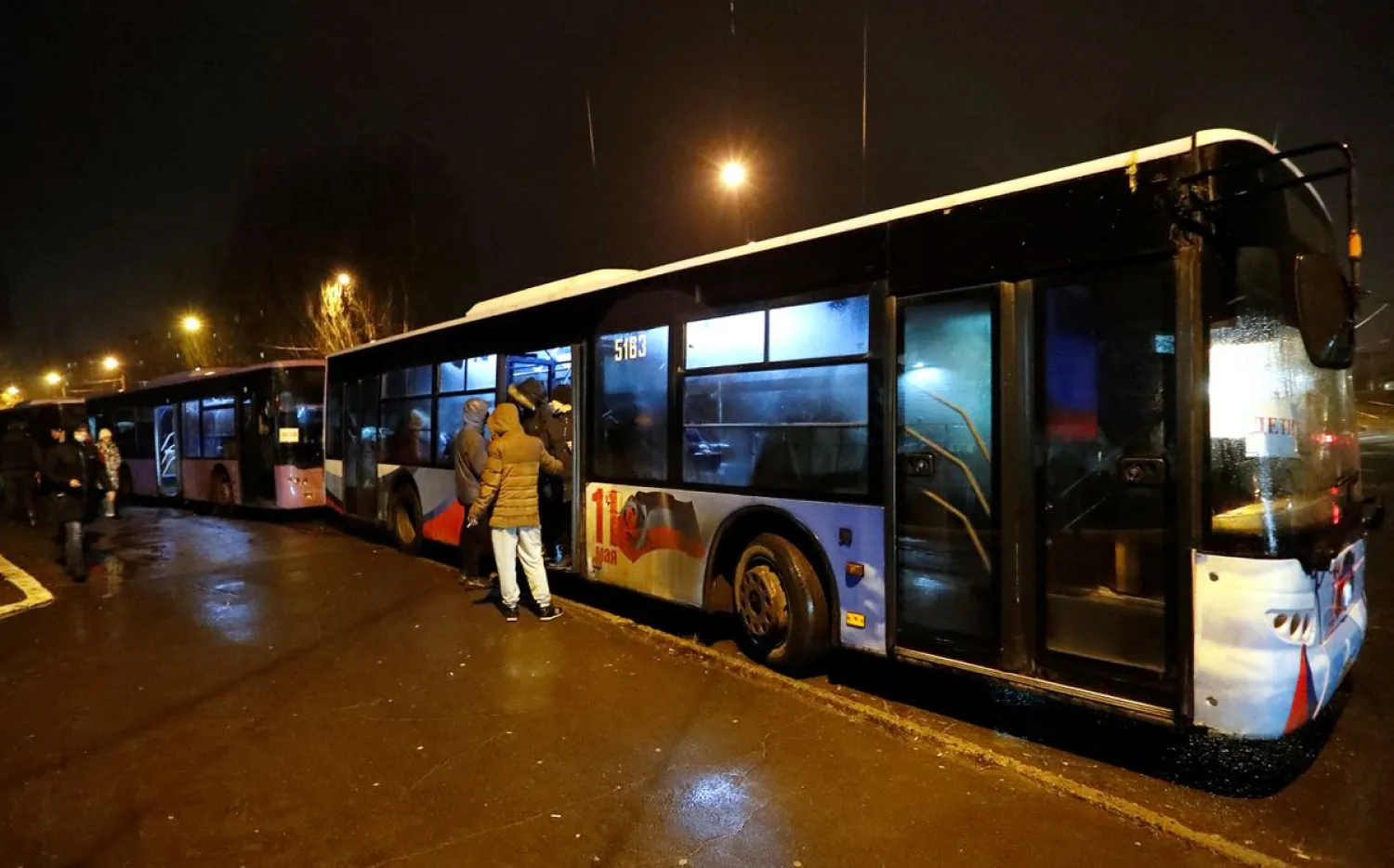
Ukrainian Rebels Evacuate Civilians to Russia amid Crisis

People board buses arranged to evacuate local residents, in the rebel-controlled city of Donetsk, Ukraine February 18, 2022. (Reuters)
TT

Ukrainian Rebels Evacuate Civilians to Russia amid Crisis

People board buses arranged to evacuate local residents, in the rebel-controlled city of Donetsk, Ukraine February 18, 2022. (Reuters)

Spiking tensions in eastern Ukraine on Friday aggravated Western fears of a Russian invasion and a new war in Europe, with a humanitarian convoy hit by shelling and pro-Russian rebels evacuating civilians from the conflict zone. A car bombing hit the eastern city of Donetsk, but no casualties were reported.

The Kremlin declared massive nuclear drills to flex its military muscle, and President Vladimir Putin pledged to protect Russia’s national interests against what it sees as encroaching Western threats. US and European leaders, meanwhile, grasped for ways to keep the peace and Europe’s post-Cold War security order.

While Putin held out the possibility of diplomacy, a cascade of developments this week have have further exacerbated East-West tensions and fueled war worries. This week's actions have fed those concerns: US and European officials, focused on an estimated 150,000 Russian troops posted around Ukraine’s borders, warn the long-simmering separatist conflict in eastern Ukraine could provide the spark for a broader attack.

Vice President Kamala Harris said the US still hopes Russia will de-escalate but is ready to hit it with tough sanctions in case of an attack. US leaders this week issued their most dire warnings yet that Moscow could order an invasion of Ukraine any day.

“We remain, of course, open to and desirous of diplomacy ... but we are also committed, if Russia takes aggressive action, to ensure there will be severe consequence,” Harris said at the annual Munich Security Conference.

While Russia snubbed this year's conference, lines of communication remain open: The US and Russian defense chiefs spoke Friday, and US Defense Secretary Lloyd Austin called for de-escalation, the return of Russian forces surrounding Ukraine to their home bases, and a diplomatic resolution, according to the Pentagon. Blinken and Russian Foreign Minister Sergey Lavrov agreed to meet next week.

Immediate worries focused on eastern Ukraine, where Ukrainian forces have been fighting pro-Russia rebels since 2014 in a conflict that has killed some 14,000 people.

A bombing struck a car outside the main government building in the major eastern city of Donetsk, according to an Associated Press journalist there. The head of the separatists' forces, Denis Sinenkov, said the car was his, the Interfax news agency reported.

There were no reports of casualties and no independent confirmation of the circumstances of the blast. Uniformed men inspected the burned-out car. Broken glass littered the area.

Shelling and shooting are common along the line that separates Ukrainian forces and the rebels, but targeted violence is unusual in rebel-held cities like Donetsk.

However, the explosion and the announced evacuations were in line with US warnings of so-called false-flag attacks that Russia would use to justify an invasion. The US State Department noted that Secretary of State Antony Blinken had warned of “this type of false-flag operation” on Thursday at the UN Security Council.

Separatists in the Luhansk and Donetsk regions that form Ukraine's industrial heartland known as the Donbas said they are evacuating civilians to Russia. The announcement appeared to be part of Moscow’s efforts to counter Western warnings of a Russian invasion, and paint Ukraine as the aggressor instead.

Denis Pushilin, head of the Donetsk rebel government, said women, children and the elderly would go first, and that Russia has prepared facilities for them. Pushilin alleged in a video statement that Ukrainian President Volodymyr Zelenskyy was going to order an imminent offensive in the area.

Authorities began moving children from an orphanage in Donetsk, and other residents boarded buses for Russia. Long lines formed at gas stations as more people prepared to leave on their own.

Putin ordered his emergencies minister to fly to the Rostov region bordering Ukraine to help organize the exodus and ordered the government to offer a payment of 10,000 rubles (about $130) to each evacuee, equivalent to about half of an average monthly salary in the war-ravaged Donbas.

Ukraine denied planning any offensive, with Foreign Minister Dmytro Kuleba saying that “Ukraine does not conduct or plan any such actions in the Donbas.”

“We are fully committed to diplomatic conflict resolution only,” he tweeted.

Around the volatile line of contact, a UNCHR convoy came under rebel shelling in the Luhansk region, Ukraine’s military chief said. No casualties were reported. Rebels denied involvement and accused Ukraine of staging a provocation.

Separatist authorities reported more shelling by Ukrainian forces along the line. Kremlin spokesman Dmitry Peskov said the situation is “potentially very dangerous.” A surge of shelling Thursday tore through the walls of a kindergarten, injuring two, and basic communications were disrupted. Both sides accused each other of opening fire.

US and European officials have been on high alert for any Russian attempts at a so-called false-flag operation. A Western official familiar with intelligence findings said Ukrainian government officials shared intelligence that suggested the Russians might try to shell the areas in the Luhansk region controlled by separatists, as part of an effort to create a false reason to take military action. The official was not authorized to comment publicly.

UN Secretary-General Antonio Guterres said the threat to global security is “more complex and probably higher” than during the Cold War. He told the Munich conference that a small mistake or miscommunication between major powers could have catastrophic consequences.

While Russia announced this week it is pulling back forces from vast military exercises that had sparked fears of an invasion, US officials have said they see no sign of a pullback — and instead saw more troops moving toward the border with Ukraine.

Austin said the US believes Russia could launch an attack “any time.”

The US government released new estimates Friday of how many military personnel Russia has in and around Ukraine. It said there are between 169,000 and 190,000 personnel, up from about about 100,000 on Jan. 30, according to Michael Carpenter, the permanent US representative to the Organization for Security and Cooperation in Europe.

The new estimate includes military troops along the border, in Belarus, and in occupied Crimea; Russian National Guard and other internal security units deployed to these areas; and Russian-backed forces in eastern Ukraine. The separatists inside Ukraine, the Russian National Guard and troops in Crimea were not included in the previous US estimate of 150,000.

The Kremlin sent a reminder to the world of its nuclear might, announcing drills of its nuclear forces for the weekend. Putin will monitor the sweeping exercise Saturday that will involve multiple practice missile launches.

The move overshadowed Russian offers of continued diplomacy to defuse the Ukraine crisis.

While the Kremlin insists it has no plans to invade, it has urged the West to keep Ukraine out of NATO and roll back alliance forces from Eastern Europe — demands roundly rejected by Western allies.

Asked about Western warnings of a possible Russian invasion on Wednesday that didn’t materialize, Putin said, “There are so many false claims, and constantly reacting to them is more trouble than it's worth."

“We are doing what we consider necessary and will keep doing so,” he said. “We have clear and precise goals conforming to national interests.”

Putin reaffirmed that Russia was open for dialogue on confidence-building measures with the West on condition that they will be discussed in conjunction with Moscow’s main security demands.

NATO allies are also flexing their might, bolstering military forces around Eastern Europe, but insist the actions are purely defensive and to show unity in the face of Russian threats.

The US announced the $6 billion sale of 250 tanks to Poland, a NATO member that has been occupied or attacked by Russia in the past.

World leaders meeting in Munich warned that Europe’s security balance is under threat. German Foreign Minister Annalena Baerbock said the situation is “calling into question the basic principles of the European peace order.”

Biden planned to speak by phone Friday with trans-Atlantic leaders about the crisis and continued efforts at deterrence and diplomacy, and to give a speech about the situation.


Le Pen Says France Will No Longer Aid Ukraine ‘Financially’ if Elected

Marine Le Pen (C), the far-right National Rally (RN) party's candidate for the 2027 French presidential election, visits the "Made in France" fair at the Porte de Versailles exhibition center in Paris, France, 13 November 2026. (EPA)
TT

Le Pen Says France Will No Longer Aid Ukraine ‘Financially’ if Elected

Marine Le Pen (C), the far-right National Rally (RN) party's candidate for the 2027 French presidential election, visits the "Made in France" fair at the Porte de Versailles exhibition center in Paris, France, 13 November 2026. (EPA)

Marine Le Pen on Monday said that France would provide no further financial aid to Ukraine if she is elected president next year, after a meeting with Kyiv's ambassador in Paris.

"The state of France's public finances would no longer allow the country to provide financial assistance to Ukraine in the coming months," Le Pen said in a statement, while insisting France would honor existing commitments, including toward a 90-billion-euro ($100-billion) European Union loan.

Le Pen is currently ahead in polls in the race to succeed President Emmanuel Macron next year, as the war sparked by Russia's 2022 full-scale invasion of Ukraine grinds towards its fifth anniversary.

She has faced criticism over past links to Russia, which included a 2017 meeting in the Kremlin with President Vladimir Putin and her party taking a loan from a Russian bank that it paid off in full in 2023.

But she has opposed the invasion and, at her talks in Paris with Ukrainian ambassador Vadym Omelchenko, Le Pen made clear her "unwavering support for Ukraine since the beginning of the conflict".

The statement said the talks -- the first such between Le Pen and the Ukrainian ambassador -- were "cordial".

While financial aid would be cut, Le Pen told the ambassador that "France would continue to support Ukraine through donations of equipment, humanitarian aid and much more active diplomacy".

The statement said there was a "frank discussion" on the future of the conflict, with Le Pen stressing that "the pursuit of peace -- though a difficult goal to achieve -- must remain a priority for all".

She also asked the ambassador to tell President Volodymyr Zelensky she is ready to meet in "either Paris or Brussels". However, there was no mention of the candidate making the journey to Kyiv after Zelensky invited her to visit the Ukrainian capital.

Le Pen's opponents have expressed alarm that by emphasizing the importance of ending the war swiftly, she could force Ukraine to capitulate on unfavorable terms.

"If Russia imposes its will on a European nation through brutality, all of Europe is weakened," Macron wrote on Facebook at the weekend.

Taking aim at Le Pen, he said: "Let us be clear: those who seek to limit the resources available to Ukraine are, in effect, pushing for an unjust peace -- one that would leave Ukraine permanently vulnerable, and, by extension, leave Europe vulnerable as well."


Trump Says He Might Meet with North Korea’s Kim Jong Un in China

US President Donald Trump and North Korean leader Kim Jong Un shake hands before their one-on-one chat during the second US-North Korea summit at the Metropole Hotel in Hanoi, Vietnam February 27, 2019. (Reuters)
TT

Trump Says He Might Meet with North Korea’s Kim Jong Un in China

US President Donald Trump and North Korean leader Kim Jong Un shake hands before their one-on-one chat during the second US-North Korea summit at the Metropole Hotel in Hanoi, Vietnam February 27, 2019. (Reuters)

US President Donald Trump said on Monday he might meet with North Korean leader Kim Jong Un in China this week, an announcement that could dramatically reshape his upcoming trip through East Asia if it occurs.

The president, who met the North Korean leader several times during his 2017-2021 term, including once in the Korean Demilitarized Zone, has previously expressed ‌interest in ‌another meeting during his current term. Senior ‌US ⁠officials, however, have previously ⁠said he has no immediate plans to do so.

Moreover, Trump has repeatedly previewed meetings with Kim that never took place, including during a trip to Asia last year. North Korea, whose mission to the United Nations did not immediately respond to a ⁠request for comment, has publicly indicated it ‌has no intention of ‌meeting with the US president at this time.

Trump told reporters ‌while departing the White House en route to ‌the Philippines and China that any meeting would occur in China, and that the North Korean leader's presence was ultimately up to Chinese President Xi Jinping.

"(Xi) was here a ‌month ago, and we're also going to meet with (Russian) President Putin, and we ⁠may ⁠meet with Kim Jong Un also," Trump said.

"So that'll be good. We have a chance to accomplish a lot."

Trump has indicated he will meet with Putin and Xi during his trip, but US officials and analysts have played down the possibility of a meaningful agreement emerging from any trilateral sit-down.

Among the possible topics of conversation, Trump and others have said, are Russia's invasion of Ukraine, counterproliferation and the war in Iran.


Third US Aircraft Carrier Arrives in Middle East

This US Navy handout photograph released by US Naval Forces Central Command on November 4, 2026, shows the Nimitz-class aircraft carrier USS Theodore Roosevelt (CVN 71) sails alongside Royal Australian Navy Supply-class replenishment oiler HMAS Stalwart (A304). (AFP / NAVCENT Public Affairs / US Navy)
TT

Third US Aircraft Carrier Arrives in Middle East

This US Navy handout photograph released by US Naval Forces Central Command on November 4, 2026, shows the Nimitz-class aircraft carrier USS Theodore Roosevelt (CVN 71) sails alongside Royal Australian Navy Supply-class replenishment oiler HMAS Stalwart (A304). (AFP / NAVCENT Public Affairs / US Navy)

The USS Theodore Roosevelt aircraft carrier arrived in the Middle East on Sunday, media reports said, bringing the number of American carrier strike groups in the region to three.

The deployment, which was reported by the National News and Axios journalist Barak Ravid, comes as fighting reignites in the region, with Iran claiming a drone attack on Bahrain on Sunday, ending a lull in strikes in the war.

Iran also fired drones at Bahrain on Friday -- the first strikes since September against countries in the energy-rich Gulf, which has been targeted several times in the conflict that erupted in February.

US President Donald Trump plans to discuss the war at a trilateral meeting with his Chinese and Russian counterparts Xi Jinping and Vladimir Putin this week, an official said Friday.

Months of diplomacy have failed to resolve the war, which began with US-Israeli strikes that killed Iran's supreme leader Ali Khamenei.