Putin Mulls Recognizing Separatist Eastern Ukrainian Regions

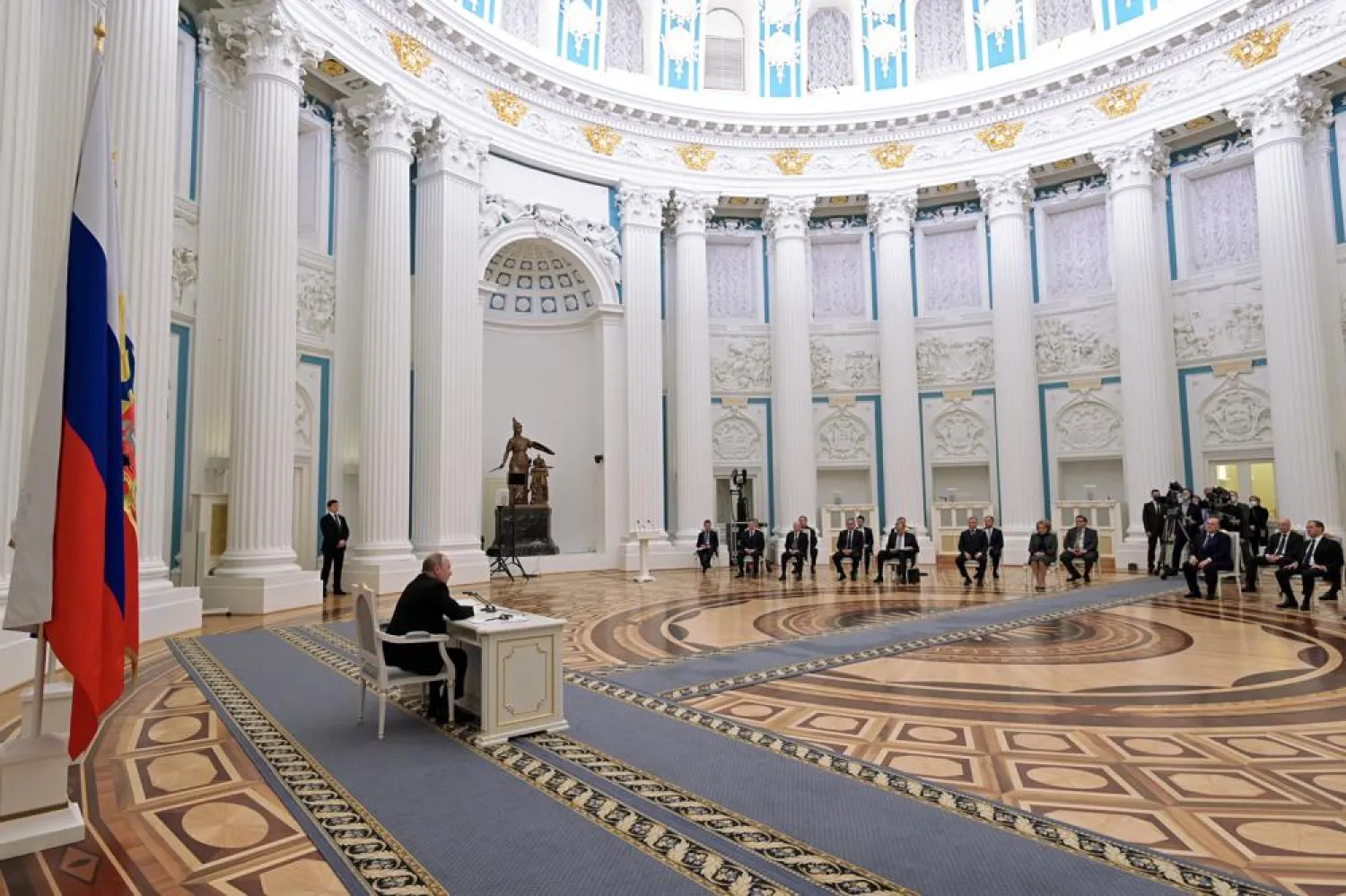
Russian President Vladimir Putin, left, chairs a Security Council meeting in the Kremlin in Moscow, Russia, Monday, Feb. 21, 2022. (Sputnik, Kremlin Pool Photo via AP)
TT

Putin Mulls Recognizing Separatist Eastern Ukrainian Regions

Russian President Vladimir Putin, left, chairs a Security Council meeting in the Kremlin in Moscow, Russia, Monday, Feb. 21, 2022. (Sputnik, Kremlin Pool Photo via AP)

Russian President Vladimir Putin said he will decide later Monday whether to recognize the independence of separatist regions in eastern Ukraine, a move that would ratchet up tensions with the West amid fears that Moscow could launch an invasion of Ukraine imminently.

At the carefully orchestrated, pre-recorded meeting of the presidential Security Council, a stream of top Russian officials argued for recognizing the separatist regions' independence, though some suggested Putin didn’t have to do it immediately. It came amid a spike in skirmishes in those regions that Western powers believe Russia could use as a pretext for an attack on the western-looking democracy that has defied Moscow’s attempts to pull it back into its orbit.

With an estimated 150,000 Russian troops massed on three sides of Ukraine, the US has warned that Moscow has already decided to invade. Still, the American and Russian presidents tentatively agreed to a possible meeting in a last-ditch effort to avoid war.

If Russia moves in, the meeting will be off, but the prospect of a face-to-face summit resuscitated hopes that diplomacy could prevent a devastating conflict, which would result in massive casualties and huge economic damage across Europe, which is heavily dependent on Russian energy.

Even as the diplomatic efforts inched forward, potential flashpoints multiplied. Sustained shelling continued Monday in Ukraine's east. Unusually, Russia said it had fended off an “incursion” from Ukraine — which Ukrainian officials denied. And Russia decided to prolong military drills in Belarus, which could offer a staging ground for an attack on the Ukrainian capital, Kyiv.

If Russia recognizes the separatist regions, that will fuel tensions further since Moscow could use the move to openly send its troops and weapons there. Until now, Ukraine and the West have accused Russia of supporting the separatists, but Moscow has denied that, saying that Russians who fought there were volunteers.

At Monday's meeting, Putin's top defense and security officials paraded before him one by one to outline arguments for recognizing the regions as independent to protect civilians there. At one point, one slipped up and said he favored including them as part of Russian territory — but Putin quickly corrected him.

Some suggested, however, that Russia give the West a few more days to press Ukraine to fulfill a peace agreement that halted major fighting in 2015.

Earlier Monday, leaders of the regions released televised statements pleading with Putin to recognize them and sign treaties that would allow for military aid to protect them from what they described as an ongoing Ukrainian military offensive. Russia’s lower house of parliament made the same plea last week.

Ukrainian authorities deny launching an offensive and accuse Russia of provocation.

Russia similarly recognized two breakaway regions of the former Soviet republic of Georgia in 2008 after a brief war, and expanded its military presence in both South Ossetia and Abkhazia on the Black Sea.

But the Kremlin initially signaled its reluctance to recognize the regions in eastern Ukraine, arguing that would effectively shatter the peace deal, which marked a major diplomatic coup for Moscow, requiring Ukrainian authorities to offer a broad self-rule to the rebel regions.

The deal was resented by many in Ukraine who saw it as a capitulation, a blow to the country’s integrity and a betrayal of national interests. Putin and other officials argued Monday that Ukrainian authorities have shown no appetite for implementing it.

With the prospect of war looming, French President Emmanuel Macron scrambled to broker a meeting between US President Joe Biden and Putin, who denies he has any plans to attack Ukraine.

Russia says it wants Western guarantees that NATO won’t allow Ukraine and other former Soviet countries to join as members — and Putin said Monday a simple moratorium on Ukraine's accession wouldn't be enough. Moscow has also demanded the alliance halt weapons deployments to Ukraine and roll back its forces from Eastern Europe — demands flatly rejected by the West.

Macron's office said both leaders had “accepted the principle of such a summit,” to be followed by a broader meeting that would include other “relevant stakeholders to discuss security and strategic stability in Europe.”

The language from Moscow and Washington was more cautious, but neither side denied a meeting is under discussion.

During the Kremlin meeting, several top officials spoke skeptically about a possible summit, saying it was unlikely to yield any results.

US national security adviser Jake Sullivan, meanwhile, said the administration has always been ready to talk to avert a war — but was also prepared to respond to any attack.

“So when President Macron asked President Biden yesterday if he was prepared in principle to meet with President Putin, if Russia did not invade, of course President Biden said yes," he told NBC's “Today” show on Monday. "But every indication we see on the ground right now in terms of the disposition of Russian forces is that they are, in fact, getting prepared for a major attack on Ukraine.”

Macron’s office said that US Secretary of State Antony Blinken and Russian Foreign Minister Sergei Lavrov are set to lay the groundwork for the potential summit when they meet Thursday.

Amid the hopeful signs, there were also worrying ones. Starting Thursday, shelling spiked along the tense line of contact that separates Ukrainian forces and Russian-backed rebels in Ukraine's eastern industrial heartland of Donbas. Over 14,000 people have been killed since conflict erupted there in 2014, shortly after Moscow annexed Ukraine's Crimean Peninsula.

Ukraine and the separatist rebels have traded blame for massive cease-fire violations with hundreds of explosions recorded daily.

While Russia-backed separatists have charged that Ukrainian forces were firing on residential areas, Associated Press journalists reporting from several towns and villages in Ukrainian-held territory along the line of contact have not witnessed any notable escalation from the Ukrainian side and have documented signs of intensified shelling by the separatists that destroyed homes and ripped up roads.

Some residents of the main rebel-held city of Donetsk described sporadic shelling by Ukrainian forces, but they added that it wasn’t on the same scale as earlier in the conflict.

The separatist authorities said Monday that at least four civilians were killed by Ukrainian shelling over the past 24 hours and several others were wounded. Ukraine’s military said two Ukrainian soldiers were killed over the weekend, and another serviceman was wounded Monday.

Ukrainian military spokesman Pavlo Kovalchyuk said the separatists were “cynically firing from residential areas using civilians as shields.” He insisted that Ukrainian forces weren’t returning fire.

In the village of Novognativka on the Ukraine government-controlled side, 60-year-old Ekaterina Evseeva, said the shelling was worse than at the height of fighting early in the conflict.

“We are on the edge of nervous breakdowns. And there is nowhere to run,” she said, her voice trembling.

In another worrying sign, the Russian military said it killed five suspected “saboteurs” who crossed from Ukraine into Russia’s Rostov region and also destroyed two armored vehicles. Ukrainian Border Guard spokesman Andriy Demchenko dismissed the claim as “disinformation.”

Amid the heightened invasion fears, the US administration sent a letter to the United Nations human rights chief claiming that Moscow has compiled a list of Ukrainians to be killed or sent to detention camps after the invasion. The letter, first reported by the New York Times, was obtained by the AP.

Kremlin spokesman Dmitry Peskov said the claim was a lie and no such list exists.

Meanwhile, the European Union’s top diplomat, foreign policy chief Josep Borrell, said the 27-nation bloc has finalized its package of sanctions for use if Putin orders an invasion.


Le Pen Says France Will No Longer Aid Ukraine ‘Financially’ if Elected

Marine Le Pen (C), the far-right National Rally (RN) party's candidate for the 2027 French presidential election, visits the "Made in France" fair at the Porte de Versailles exhibition center in Paris, France, 13 November 2026. (EPA)
TT

Le Pen Says France Will No Longer Aid Ukraine ‘Financially’ if Elected

Marine Le Pen (C), the far-right National Rally (RN) party's candidate for the 2027 French presidential election, visits the "Made in France" fair at the Porte de Versailles exhibition center in Paris, France, 13 November 2026. (EPA)

Marine Le Pen on Monday said that France would provide no further financial aid to Ukraine if she is elected president next year, after a meeting with Kyiv's ambassador in Paris.

"The state of France's public finances would no longer allow the country to provide financial assistance to Ukraine in the coming months," Le Pen said in a statement, while insisting France would honor existing commitments, including toward a 90-billion-euro ($100-billion) European Union loan.

Le Pen is currently ahead in polls in the race to succeed President Emmanuel Macron next year, as the war sparked by Russia's 2022 full-scale invasion of Ukraine grinds towards its fifth anniversary.

She has faced criticism over past links to Russia, which included a 2017 meeting in the Kremlin with President Vladimir Putin and her party taking a loan from a Russian bank that it paid off in full in 2023.

But she has opposed the invasion and, at her talks in Paris with Ukrainian ambassador Vadym Omelchenko, Le Pen made clear her "unwavering support for Ukraine since the beginning of the conflict".

The statement said the talks -- the first such between Le Pen and the Ukrainian ambassador -- were "cordial".

While financial aid would be cut, Le Pen told the ambassador that "France would continue to support Ukraine through donations of equipment, humanitarian aid and much more active diplomacy".

The statement said there was a "frank discussion" on the future of the conflict, with Le Pen stressing that "the pursuit of peace -- though a difficult goal to achieve -- must remain a priority for all".

She also asked the ambassador to tell President Volodymyr Zelensky she is ready to meet in "either Paris or Brussels". However, there was no mention of the candidate making the journey to Kyiv after Zelensky invited her to visit the Ukrainian capital.

Le Pen's opponents have expressed alarm that by emphasizing the importance of ending the war swiftly, she could force Ukraine to capitulate on unfavorable terms.

"If Russia imposes its will on a European nation through brutality, all of Europe is weakened," Macron wrote on Facebook at the weekend.

Taking aim at Le Pen, he said: "Let us be clear: those who seek to limit the resources available to Ukraine are, in effect, pushing for an unjust peace -- one that would leave Ukraine permanently vulnerable, and, by extension, leave Europe vulnerable as well."


Trump Says He Might Meet with North Korea’s Kim Jong Un in China

US President Donald Trump and North Korean leader Kim Jong Un shake hands before their one-on-one chat during the second US-North Korea summit at the Metropole Hotel in Hanoi, Vietnam February 27, 2019. (Reuters)
TT

Trump Says He Might Meet with North Korea’s Kim Jong Un in China

US President Donald Trump and North Korean leader Kim Jong Un shake hands before their one-on-one chat during the second US-North Korea summit at the Metropole Hotel in Hanoi, Vietnam February 27, 2019. (Reuters)

US President Donald Trump said on Monday he might meet with North Korean leader Kim Jong Un in China this week, an announcement that could dramatically reshape his upcoming trip through East Asia if it occurs.

The president, who met the North Korean leader several times during his 2017-2021 term, including once in the Korean Demilitarized Zone, has previously expressed ‌interest in ‌another meeting during his current term. Senior ‌US ⁠officials, however, have previously ⁠said he has no immediate plans to do so.

Moreover, Trump has repeatedly previewed meetings with Kim that never took place, including during a trip to Asia last year. North Korea, whose mission to the United Nations did not immediately respond to a ⁠request for comment, has publicly indicated it ‌has no intention of ‌meeting with the US president at this time.

Trump told reporters ‌while departing the White House en route to ‌the Philippines and China that any meeting would occur in China, and that the North Korean leader's presence was ultimately up to Chinese President Xi Jinping.

"(Xi) was here a ‌month ago, and we're also going to meet with (Russian) President Putin, and we ⁠may ⁠meet with Kim Jong Un also," Trump said.

"So that'll be good. We have a chance to accomplish a lot."

Trump has indicated he will meet with Putin and Xi during his trip, but US officials and analysts have played down the possibility of a meaningful agreement emerging from any trilateral sit-down.

Among the possible topics of conversation, Trump and others have said, are Russia's invasion of Ukraine, counterproliferation and the war in Iran.


Third US Aircraft Carrier Arrives in Middle East

This US Navy handout photograph released by US Naval Forces Central Command on November 4, 2026, shows the Nimitz-class aircraft carrier USS Theodore Roosevelt (CVN 71) sails alongside Royal Australian Navy Supply-class replenishment oiler HMAS Stalwart (A304). (AFP / NAVCENT Public Affairs / US Navy)
TT

Third US Aircraft Carrier Arrives in Middle East

This US Navy handout photograph released by US Naval Forces Central Command on November 4, 2026, shows the Nimitz-class aircraft carrier USS Theodore Roosevelt (CVN 71) sails alongside Royal Australian Navy Supply-class replenishment oiler HMAS Stalwart (A304). (AFP / NAVCENT Public Affairs / US Navy)

The USS Theodore Roosevelt aircraft carrier arrived in the Middle East on Sunday, media reports said, bringing the number of American carrier strike groups in the region to three.

The deployment, which was reported by the National News and Axios journalist Barak Ravid, comes as fighting reignites in the region, with Iran claiming a drone attack on Bahrain on Sunday, ending a lull in strikes in the war.

Iran also fired drones at Bahrain on Friday -- the first strikes since September against countries in the energy-rich Gulf, which has been targeted several times in the conflict that erupted in February.

US President Donald Trump plans to discuss the war at a trilateral meeting with his Chinese and Russian counterparts Xi Jinping and Vladimir Putin this week, an official said Friday.

Months of diplomacy have failed to resolve the war, which began with US-Israeli strikes that killed Iran's supreme leader Ali Khamenei.