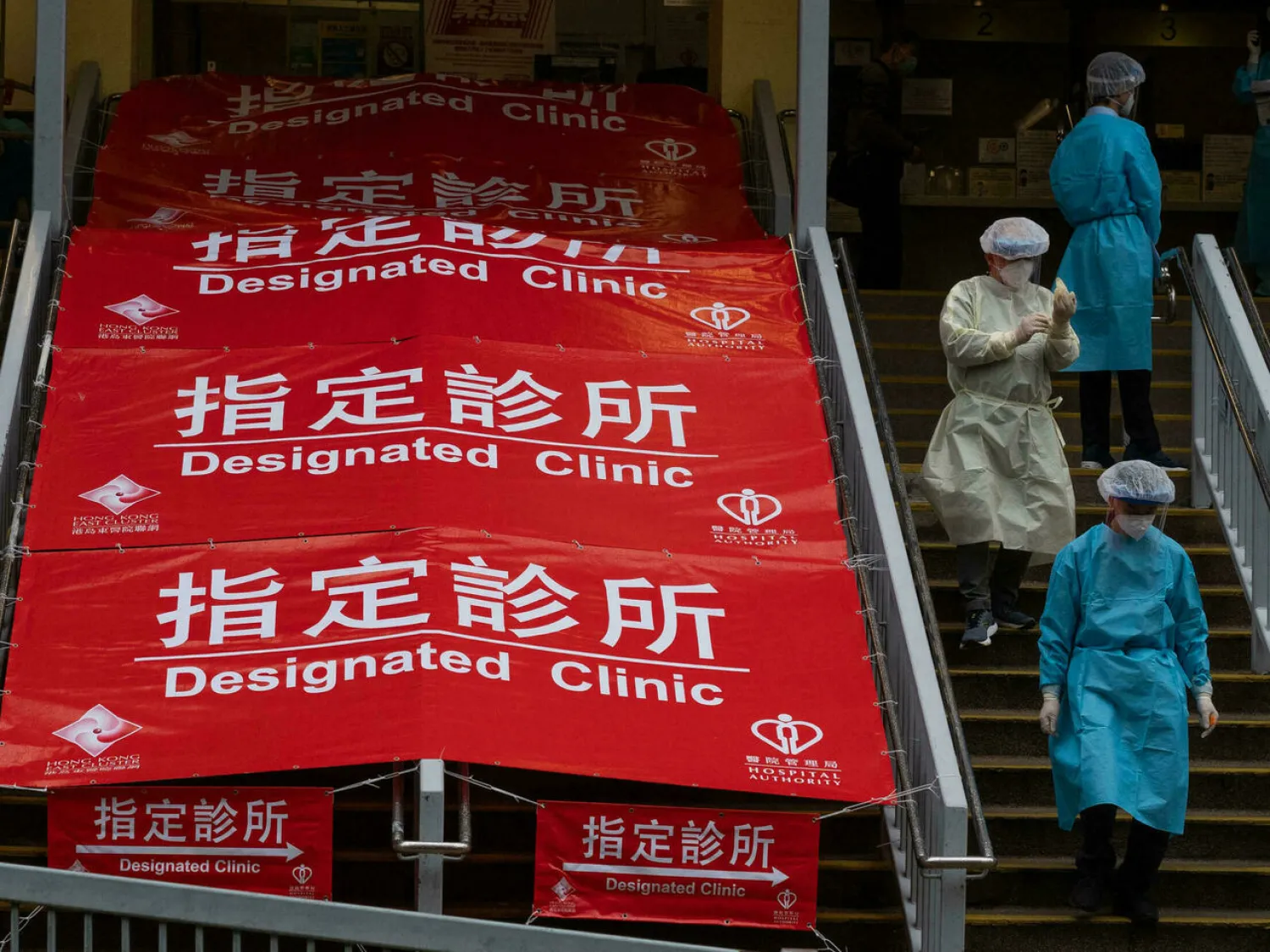
Virus-hit Hong Kong Invokes Emergency Powers to Allow in China Medics

Chinese mainland medics are not currently allowed to operate in Hong Kong without passing local exams and licensing regulations. Bertha WANG AFP
TT

Virus-hit Hong Kong Invokes Emergency Powers to Allow in China Medics

Chinese mainland medics are not currently allowed to operate in Hong Kong without passing local exams and licensing regulations. Bertha WANG AFP

Hong Kong's government invoked emergency powers on Thursday to allow doctors, nurses and other personnel from the Chinese mainland to help combat a spiraling coronavirus outbreak.

The densely populated metropolis is in the throes of its worst-ever Covid wave, registering thousands of cases every day, overwhelming hospitals and government efforts to isolate all infected people in dedicated units, AFP said.

Hong Kong authorities have followed a zero-Covid strategy similar to mainland China that kept infections mostly at bay throughout the pandemic.

But they were caught flat-footed when the highly infectious Omicron variant broke through those defenses, and have since increasingly called on the Chinese mainland for help.

"Hong Kong is now facing a very dire epidemic situation which continues to deteriorate rapidly," the government said in its statement announcing the use of emergency powers.

Chinese mainland medics are not currently allowed to operate in Hong Kong without passing local exams and meeting licensing regulations.

The emergency powers "exempt certain persons or projects from all relevant statutory requirements... to increase Hong Kong's epidemic control capacity for containing the fifth wave within a short period of time," the statement said.

The move came after Chinese President Xi Jinping last week ordered Hong Kong to take "all necessary measures" to bring the outbreak under control, signaling Hong Kong would not be allowed to move towards living with the virus-like much of the rest of the world.

Allowing mainland medics to work in Hong Kong has been a source of debate for years.

Even before the pandemic, supporters argued it could alleviate shortages in the city's stretched healthcare system.

Local medical practitioners in the past have objected, citing issues such as language and cultural barriers -– though critics have dismissed such talk as protectionism.

Hong Kong was supposed to operate as a semi-autonomous region from China, after the territory returned from British colonial rule in 1997.

But that autonomy was eroded in recent years as China crushed a democracy movement.

- Manpower 'exhausted' -
Hong Kong has recorded more than 62,000 Covid cases in the current wave, compared with just 12,000 during the two years before.

Health experts fear the real number is far higher because of a testing backlog and people avoiding testing for fear of being forced into isolation units if they are positive.

Over the last fortnight, stories have emerged of parents being separated from children and babies who test positive, as well as elderly patients lying on gurneys outside hospitals.

Around 1,200 healthcare workers have been infected as of Wednesday, according to the Hospital Authority.

The authority's chairman Henry Fan told state media Monday he hoped the mainland government would send over doctors and nurses, because local manpower had been "exhausted".

Hong Kong has ordered all 7.4 million residents to go through three rounds of mandatory coronavirus testing next month.

China is helping to build a series of isolation units and temporary hospital wards but it is unclear whether enough can be constructed in time.

Local modelling predicts the city might see as many as 180,000 infections and 100 deaths daily by mid-March.

Local authorities have increasingly resorted to emergency orders in recent years.

During the 2019 protests, authorities used such powers to ban mask-wearing.

The following year, emergency orders were used to make mask-wearing mandatory during the pandemic.

The city's disease prevention law has also been invoked to forbid public gatherings and a host of strict social distancing measures and business closure orders that have been in place on and off for two years.

City leader Carrie Lam has defended her approach, citing the intensity of the virus crisis.

"In an environment as urgent as this, we cannot let existing laws stop us from doing what we should do," she said Tuesday.

"This is not the mentality for fighting a war."


Le Pen Says France Will No Longer Aid Ukraine ‘Financially’ if Elected

Marine Le Pen (C), the far-right National Rally (RN) party's candidate for the 2027 French presidential election, visits the "Made in France" fair at the Porte de Versailles exhibition center in Paris, France, 13 November 2026. (EPA)
TT

Le Pen Says France Will No Longer Aid Ukraine ‘Financially’ if Elected

Marine Le Pen (C), the far-right National Rally (RN) party's candidate for the 2027 French presidential election, visits the "Made in France" fair at the Porte de Versailles exhibition center in Paris, France, 13 November 2026. (EPA)

Marine Le Pen on Monday said that France would provide no further financial aid to Ukraine if she is elected president next year, after a meeting with Kyiv's ambassador in Paris.

"The state of France's public finances would no longer allow the country to provide financial assistance to Ukraine in the coming months," Le Pen said in a statement, while insisting France would honor existing commitments, including toward a 90-billion-euro ($100-billion) European Union loan.

Le Pen is currently ahead in polls in the race to succeed President Emmanuel Macron next year, as the war sparked by Russia's 2022 full-scale invasion of Ukraine grinds towards its fifth anniversary.

She has faced criticism over past links to Russia, which included a 2017 meeting in the Kremlin with President Vladimir Putin and her party taking a loan from a Russian bank that it paid off in full in 2023.

But she has opposed the invasion and, at her talks in Paris with Ukrainian ambassador Vadym Omelchenko, Le Pen made clear her "unwavering support for Ukraine since the beginning of the conflict".

The statement said the talks -- the first such between Le Pen and the Ukrainian ambassador -- were "cordial".

While financial aid would be cut, Le Pen told the ambassador that "France would continue to support Ukraine through donations of equipment, humanitarian aid and much more active diplomacy".

The statement said there was a "frank discussion" on the future of the conflict, with Le Pen stressing that "the pursuit of peace -- though a difficult goal to achieve -- must remain a priority for all".

She also asked the ambassador to tell President Volodymyr Zelensky she is ready to meet in "either Paris or Brussels". However, there was no mention of the candidate making the journey to Kyiv after Zelensky invited her to visit the Ukrainian capital.

Le Pen's opponents have expressed alarm that by emphasizing the importance of ending the war swiftly, she could force Ukraine to capitulate on unfavorable terms.

"If Russia imposes its will on a European nation through brutality, all of Europe is weakened," Macron wrote on Facebook at the weekend.

Taking aim at Le Pen, he said: "Let us be clear: those who seek to limit the resources available to Ukraine are, in effect, pushing for an unjust peace -- one that would leave Ukraine permanently vulnerable, and, by extension, leave Europe vulnerable as well."


Trump Says He Might Meet with North Korea’s Kim Jong Un in China

US President Donald Trump and North Korean leader Kim Jong Un shake hands before their one-on-one chat during the second US-North Korea summit at the Metropole Hotel in Hanoi, Vietnam February 27, 2019. (Reuters)
TT

Trump Says He Might Meet with North Korea’s Kim Jong Un in China

US President Donald Trump and North Korean leader Kim Jong Un shake hands before their one-on-one chat during the second US-North Korea summit at the Metropole Hotel in Hanoi, Vietnam February 27, 2019. (Reuters)

US President Donald Trump said on Monday he might meet with North Korean leader Kim Jong Un in China this week, an announcement that could dramatically reshape his upcoming trip through East Asia if it occurs.

The president, who met the North Korean leader several times during his 2017-2021 term, including once in the Korean Demilitarized Zone, has previously expressed ‌interest in ‌another meeting during his current term. Senior ‌US ⁠officials, however, have previously ⁠said he has no immediate plans to do so.

Moreover, Trump has repeatedly previewed meetings with Kim that never took place, including during a trip to Asia last year. North Korea, whose mission to the United Nations did not immediately respond to a ⁠request for comment, has publicly indicated it ‌has no intention of ‌meeting with the US president at this time.

Trump told reporters ‌while departing the White House en route to ‌the Philippines and China that any meeting would occur in China, and that the North Korean leader's presence was ultimately up to Chinese President Xi Jinping.

"(Xi) was here a ‌month ago, and we're also going to meet with (Russian) President Putin, and we ⁠may ⁠meet with Kim Jong Un also," Trump said.

"So that'll be good. We have a chance to accomplish a lot."

Trump has indicated he will meet with Putin and Xi during his trip, but US officials and analysts have played down the possibility of a meaningful agreement emerging from any trilateral sit-down.

Among the possible topics of conversation, Trump and others have said, are Russia's invasion of Ukraine, counterproliferation and the war in Iran.


Third US Aircraft Carrier Arrives in Middle East

This US Navy handout photograph released by US Naval Forces Central Command on November 4, 2026, shows the Nimitz-class aircraft carrier USS Theodore Roosevelt (CVN 71) sails alongside Royal Australian Navy Supply-class replenishment oiler HMAS Stalwart (A304). (AFP / NAVCENT Public Affairs / US Navy)
TT

Third US Aircraft Carrier Arrives in Middle East

This US Navy handout photograph released by US Naval Forces Central Command on November 4, 2026, shows the Nimitz-class aircraft carrier USS Theodore Roosevelt (CVN 71) sails alongside Royal Australian Navy Supply-class replenishment oiler HMAS Stalwart (A304). (AFP / NAVCENT Public Affairs / US Navy)

The USS Theodore Roosevelt aircraft carrier arrived in the Middle East on Sunday, media reports said, bringing the number of American carrier strike groups in the region to three.

The deployment, which was reported by the National News and Axios journalist Barak Ravid, comes as fighting reignites in the region, with Iran claiming a drone attack on Bahrain on Sunday, ending a lull in strikes in the war.

Iran also fired drones at Bahrain on Friday -- the first strikes since September against countries in the energy-rich Gulf, which has been targeted several times in the conflict that erupted in February.

US President Donald Trump plans to discuss the war at a trilateral meeting with his Chinese and Russian counterparts Xi Jinping and Vladimir Putin this week, an official said Friday.

Months of diplomacy have failed to resolve the war, which began with US-Israeli strikes that killed Iran's supreme leader Ali Khamenei.