Ukraine’s Capital under Threat as Russia Presses Invasion

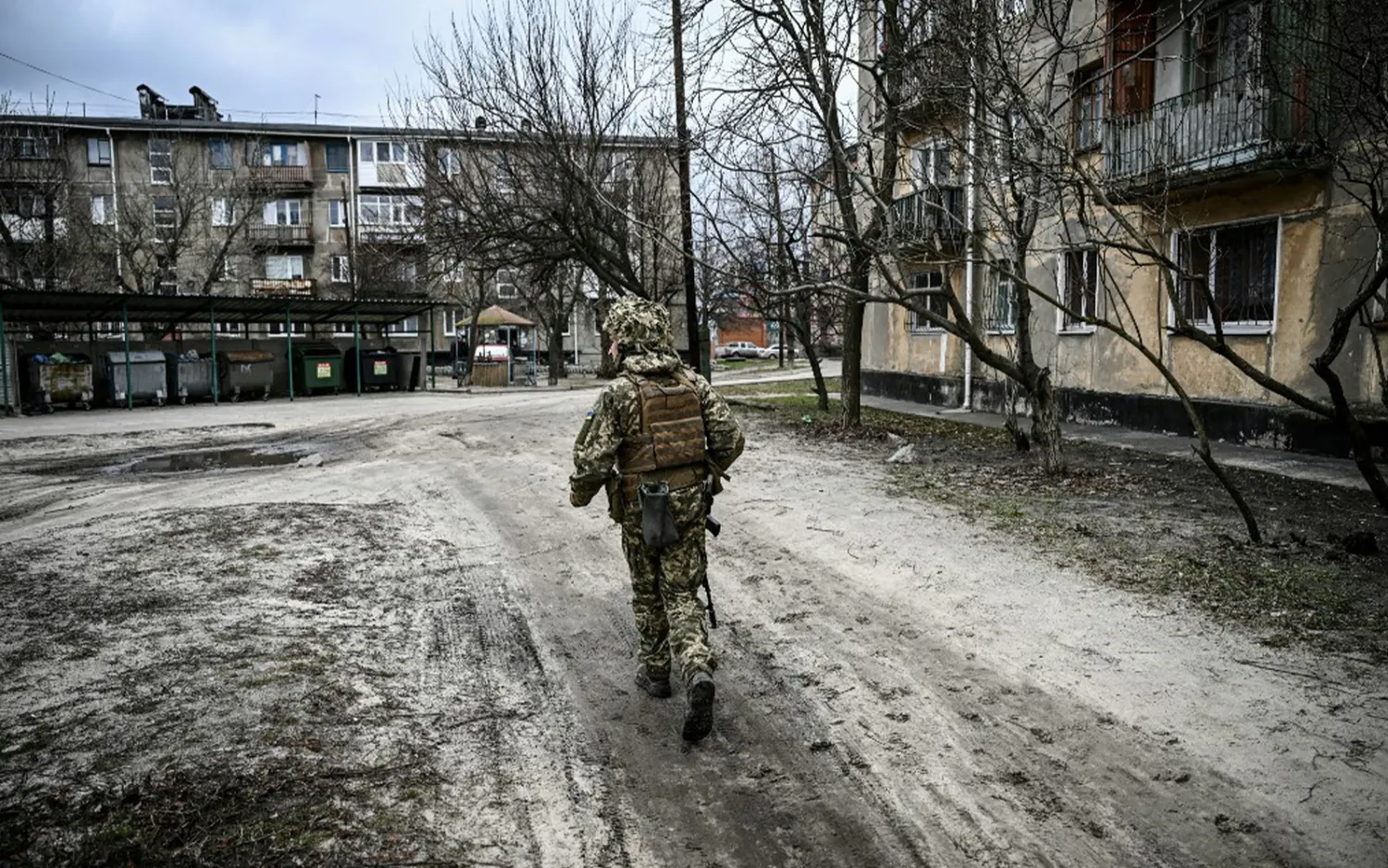
A Ukrainian soldier in the town of Schastia, near the eastern city of Lugansk, on February 22, 2022. (Aris Messinis/AFP)
TT

Ukraine’s Capital under Threat as Russia Presses Invasion

A Ukrainian soldier in the town of Schastia, near the eastern city of Lugansk, on February 22, 2022. (Aris Messinis/AFP)

Russia pressed its invasion of Ukraine to the outskirts of the capital Friday after unleashing airstrikes on cities and military bases and sending in troops and tanks from three sides in an attack that could rewrite the global post-Cold War security order.

Explosions sounded before dawn in Kyiv and gunfire was reported in several areas, as Western leaders scheduled an emergency meeting and Ukraine's president pleaded for international help to fend off an attack that could topple his democratically elected government, cause massive casualties and ripple out damage to the global economy.

Among the signs that the Ukrainian capital was increasingly threatened, the military said Friday that a group of Russian spies and saboteurs was seen in a district on the outskirts of Kyiv, and police told people not to exit a subway station in the city center because there was gunfire in the area. Elsewhere in the capital, soldiers established defensive positions at bridges, and armored vehicles rolled down the streets, while many residents stood uneasily in doorways of their apartment buildings.

US Secretary of State Antony Blinken said Kyiv “could well be under siege" in what US officials believe is a brazen attempt by Russian President Vladimir Putin to install his own regime.

The assault, anticipated for weeks by the US and Western allies, amounts to the largest ground war in Europe since World War II. After repeatedly denying plans to invade, the autocratic Putin launched his attack on the country, which has increasingly tilted toward the democratic West and away from Moscow’s sway.

Ukrainian President Volodymyr Zelenskyy, whose grasp on power was increasingly tenuous, appealed to global leaders for even more severe sanctions than the ones imposed by Western allies and for defense assistance.

“If you don’t help us now, if you fail to offer a powerful assistance to Ukraine, tomorrow the war will knock on your door,” said the leader, who cut diplomatic ties with Moscow, declared martial law and ordered a full military mobilization that would last 90 days.

Zelenskyy said he’s the No. 1 target for the invading Russians but that he planned to remain in Kyiv. Swedish Prime Minister Magdalena Andersson said early Friday that the Ukrainian attended a meeting of European Union leaders via video link from what appeared to be some sort of bunker.

As air raids sirens sounded in the capital early Friday, guests of a hotel in the city center were directed to a makeshift basement shelter, lined with piles of mattresses and bottles of water. Workers, all local university students, served tea and cookies to the guests. Some people ducked out to a courtyard to smoke or get fresh air.

“We’re all scared and worried. We don’t know what to do then, what’s going to happen in a few days,” said one of the workers, Lucy Vashaka, 20.

The invasion began early Thursday with a series of missile strikes on cities and military bases, and then quickly followed with a multi-pronged ground assault that rolled troops in from several areas in the east; from the southern region of Crimea, which Russia annexed in 2014; and from Belarus to the north.

After Ukrainian officials said they lost control of the decommissioned Chernobyl nuclear power plant, scene of the world’s worst nuclear disaster, Russia said Friday it was working with the Ukrainians to secure the plant. There was no corroboration of such cooperation from the Ukrainian side.

Zelenskyy said that 137 “heroes,” including 10 military officers, had been killed, and one of his advisers said about 400 Russian forces had died. Moscow has given no casualty count. Neither claim could be independently verified.

Fearing a Russian attack on the capital city, thousands of people went deep underground as night fell, jamming Kyiv's subway stations.

At times it felt almost cheerful. Families ate dinner. Children played. Adults chatted. People brought sleeping bags or dogs or crossword puzzles — anything to alleviate the waiting and the long night ahead.

“Nobody believed that this war would start and that they would take Kyiv directly,” said Anton Mironov, waiting out the night in one of the old Soviet metro stations. “I feel mostly fatigue. None of it feels real.”

Many who spent the night in makeshift bunkers, emerged in the early hours of Friday to a relatively quiet city. Some traffic and cars moved along highways, along with columns of military. The lines at fuel stations the day before had evaporated.

With social media amplifying a torrent of military claims and counter-claims, it was difficult to determine exactly what was happening on the ground.

Russia said it was not targeting cities, but journalists saw destruction in many civilian areas and Kyiv Mayor Vitaly Klitschko said a rocket hit a multistory apartment building in the city on Friday, starting a fire. Meanwhile, the mayor of the city in the rebel-controlled east said Ukrainian shelling hit a school building.

The Ukrainian military on Friday reported significant fighting near Ivankiv, about 60 kilometers (40 miles) northwest of Kyiv, as Russian forces apparently tried to advance on the capital from the north. Russian troops also entered the city of Sumy, near the border with Russia that sits on a highway leading to Kyiv from the east.

Later came the reports of at least some forces much closer.

“The hardest day will be today. The enemy’s plan is to break through with tank columns from the side of Ivankiv and Chernihiv to Kyiv,” Interior Ministry adviser Anton Gerashchenko said on Telegram.

Hours after the invasion began, Russian forces seized control of the now-decommissioned Chernobyl plant and its surrounding exclusion zone, presidential adviser Myhailo Podolyak told The Associated Press.

The Vienna-based International Atomic Energy Agency said it was told by Ukraine of the takeover, adding that there had been “no casualties or destruction at the industrial site.”

The conflict shook global financial markets: Stocks plunged and oil prices soared amid concerns that heating bills and food prices would skyrocket. Condemnation came not only from the U.S. and Europe, but from South Korea, Australia and beyond — and many governments readied new sanctions. Even friendly leaders like Hungary’s Viktor Orban sought to distance themselves from Putin.

US President Joe Biden announced new sanctions that will target Russian banks, oligarchs, state-controlled companies and high-tech sectors, saying Putin “chose this war” and had exhibited a “sinister” view of the world in which nations take what they want by force. He added that the measures were designed not to disrupt global energy markets. Russian oil and natural gas exports are vital energy sources for Europe.

Biden was to meet Friday morning with fellow leaders of NATO governments in what the White House described as an “extraordinary virtual summit” to discuss Ukraine.

British Prime Minister Boris Johnson said he aimed to cut off Russia from the UK’s financial markets as he announced sanctions, freezing the assets of all large Russian banks and planning to bar Russian companies and the Kremlin from raising money on British markets.

“Now we see him for what he is — a bloodstained aggressor who believes in imperial conquest,” Johnson said of Putin.

Zelenskyy urged the US and West to go further and cut the Russians from the SWIFT system, a key financial network that connects thousands of banks around the world. The White House has been reluctant to do that, worried it could cause enormous economic problems in Europe and elsewhere in the West.

While some nervous Europeans speculated about a possible new world war, the US and its NATO partners have shown no indication they would send troops into Ukraine, fearing a larger conflict. NATO reinforced its members in Eastern Europe as a precaution, and Biden said the US was deploying additional forces to Germany to bolster NATO.

Ukrainians were urged to shelter in place and not to panic.

“Until the very last moment, I didn’t believe it would happen. I just pushed away these thoughts,” said a terrified Anna Dovnya in Kyiv, watching soldiers and police remove shrapnel from an exploded shell. “We have lost all faith.”


Le Pen Says France Will No Longer Aid Ukraine ‘Financially’ if Elected

Marine Le Pen (C), the far-right National Rally (RN) party's candidate for the 2027 French presidential election, visits the "Made in France" fair at the Porte de Versailles exhibition center in Paris, France, 13 November 2026. (EPA)
TT

Le Pen Says France Will No Longer Aid Ukraine ‘Financially’ if Elected

Marine Le Pen (C), the far-right National Rally (RN) party's candidate for the 2027 French presidential election, visits the "Made in France" fair at the Porte de Versailles exhibition center in Paris, France, 13 November 2026. (EPA)

Marine Le Pen on Monday said that France would provide no further financial aid to Ukraine if she is elected president next year, after a meeting with Kyiv's ambassador in Paris.

"The state of France's public finances would no longer allow the country to provide financial assistance to Ukraine in the coming months," Le Pen said in a statement, while insisting France would honor existing commitments, including toward a 90-billion-euro ($100-billion) European Union loan.

Le Pen is currently ahead in polls in the race to succeed President Emmanuel Macron next year, as the war sparked by Russia's 2022 full-scale invasion of Ukraine grinds towards its fifth anniversary.

She has faced criticism over past links to Russia, which included a 2017 meeting in the Kremlin with President Vladimir Putin and her party taking a loan from a Russian bank that it paid off in full in 2023.

But she has opposed the invasion and, at her talks in Paris with Ukrainian ambassador Vadym Omelchenko, Le Pen made clear her "unwavering support for Ukraine since the beginning of the conflict".

The statement said the talks -- the first such between Le Pen and the Ukrainian ambassador -- were "cordial".

While financial aid would be cut, Le Pen told the ambassador that "France would continue to support Ukraine through donations of equipment, humanitarian aid and much more active diplomacy".

The statement said there was a "frank discussion" on the future of the conflict, with Le Pen stressing that "the pursuit of peace -- though a difficult goal to achieve -- must remain a priority for all".

She also asked the ambassador to tell President Volodymyr Zelensky she is ready to meet in "either Paris or Brussels". However, there was no mention of the candidate making the journey to Kyiv after Zelensky invited her to visit the Ukrainian capital.

Le Pen's opponents have expressed alarm that by emphasizing the importance of ending the war swiftly, she could force Ukraine to capitulate on unfavorable terms.

"If Russia imposes its will on a European nation through brutality, all of Europe is weakened," Macron wrote on Facebook at the weekend.

Taking aim at Le Pen, he said: "Let us be clear: those who seek to limit the resources available to Ukraine are, in effect, pushing for an unjust peace -- one that would leave Ukraine permanently vulnerable, and, by extension, leave Europe vulnerable as well."


Trump Says He Might Meet with North Korea’s Kim Jong Un in China

US President Donald Trump and North Korean leader Kim Jong Un shake hands before their one-on-one chat during the second US-North Korea summit at the Metropole Hotel in Hanoi, Vietnam February 27, 2019. (Reuters)
TT

Trump Says He Might Meet with North Korea’s Kim Jong Un in China

US President Donald Trump and North Korean leader Kim Jong Un shake hands before their one-on-one chat during the second US-North Korea summit at the Metropole Hotel in Hanoi, Vietnam February 27, 2019. (Reuters)

US President Donald Trump said on Monday he might meet with North Korean leader Kim Jong Un in China this week, an announcement that could dramatically reshape his upcoming trip through East Asia if it occurs.

The president, who met the North Korean leader several times during his 2017-2021 term, including once in the Korean Demilitarized Zone, has previously expressed ‌interest in ‌another meeting during his current term. Senior ‌US ⁠officials, however, have previously ⁠said he has no immediate plans to do so.

Moreover, Trump has repeatedly previewed meetings with Kim that never took place, including during a trip to Asia last year. North Korea, whose mission to the United Nations did not immediately respond to a ⁠request for comment, has publicly indicated it ‌has no intention of ‌meeting with the US president at this time.

Trump told reporters ‌while departing the White House en route to ‌the Philippines and China that any meeting would occur in China, and that the North Korean leader's presence was ultimately up to Chinese President Xi Jinping.

"(Xi) was here a ‌month ago, and we're also going to meet with (Russian) President Putin, and we ⁠may ⁠meet with Kim Jong Un also," Trump said.

"So that'll be good. We have a chance to accomplish a lot."

Trump has indicated he will meet with Putin and Xi during his trip, but US officials and analysts have played down the possibility of a meaningful agreement emerging from any trilateral sit-down.

Among the possible topics of conversation, Trump and others have said, are Russia's invasion of Ukraine, counterproliferation and the war in Iran.


Third US Aircraft Carrier Arrives in Middle East

This US Navy handout photograph released by US Naval Forces Central Command on November 4, 2026, shows the Nimitz-class aircraft carrier USS Theodore Roosevelt (CVN 71) sails alongside Royal Australian Navy Supply-class replenishment oiler HMAS Stalwart (A304). (AFP / NAVCENT Public Affairs / US Navy)
TT

Third US Aircraft Carrier Arrives in Middle East

This US Navy handout photograph released by US Naval Forces Central Command on November 4, 2026, shows the Nimitz-class aircraft carrier USS Theodore Roosevelt (CVN 71) sails alongside Royal Australian Navy Supply-class replenishment oiler HMAS Stalwart (A304). (AFP / NAVCENT Public Affairs / US Navy)

The USS Theodore Roosevelt aircraft carrier arrived in the Middle East on Sunday, media reports said, bringing the number of American carrier strike groups in the region to three.

The deployment, which was reported by the National News and Axios journalist Barak Ravid, comes as fighting reignites in the region, with Iran claiming a drone attack on Bahrain on Sunday, ending a lull in strikes in the war.

Iran also fired drones at Bahrain on Friday -- the first strikes since September against countries in the energy-rich Gulf, which has been targeted several times in the conflict that erupted in February.

US President Donald Trump plans to discuss the war at a trilateral meeting with his Chinese and Russian counterparts Xi Jinping and Vladimir Putin this week, an official said Friday.

Months of diplomacy have failed to resolve the war, which began with US-Israeli strikes that killed Iran's supreme leader Ali Khamenei.