




Twenty million dollars in UN humanitarian funds, and a planned infusion of 1.5 billion euros ($1.68 billion) in EU economic aid for Ukraine. A raft of new, stronger sanctions against Russia from Japan, Europe, Australia, Taiwan and others. And a cascade of condemnation from the highest levels.
As Russian bombs and troops pounded Ukraine during the invasion’s first full day, world leaders on Friday began to fine-tune a response meant to punish the Russian economy and its leaders, including President Vladimir Putin’s inner circle.
While there’s an acute awareness that a military intervention is unlikely, for now, the strength, unity and speed of the financial sanctions — with the striking exception of China, a strong Russian supporter — signal a growing global determination to make Moscow reconsider its attack.
French Finance minister Bruno Le Maire said Friday that France and its European allies are determined to inflict great damage on Russian economy and punish Russia for the “foolish decisions of Vladimir Putin” with “massive and immediate sanctions."
“We want to isolate Russia financially,” Le Maire said. “We want to cut all ties between Russia and the global financial system. We will dry up the financing of the Russian economy.”
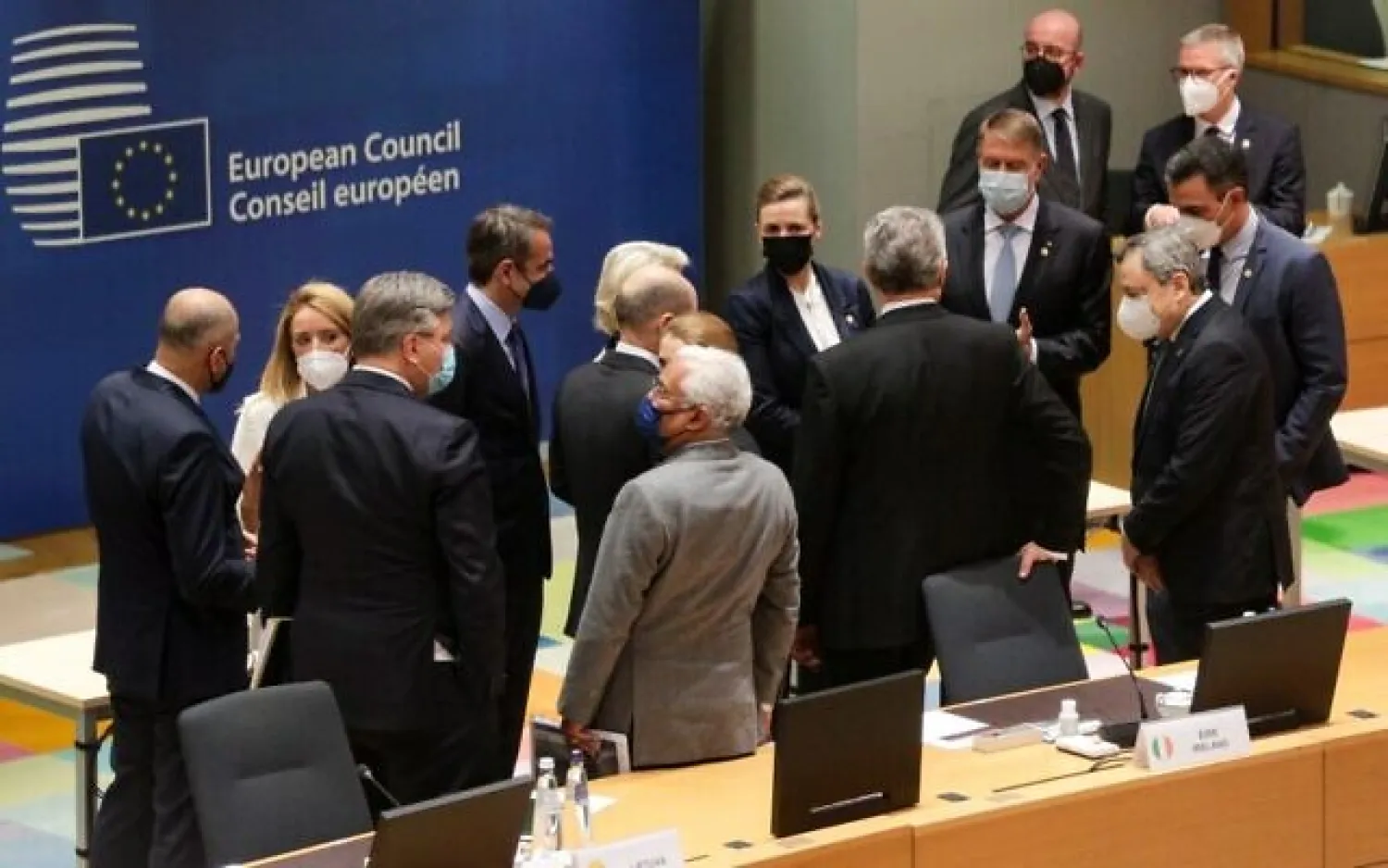
France and its allies have decided to further sanction individuals, as well as impose penalties targeting finance, energy and other sectors, French President Emmanuel Macron said Friday. The legal texts for the sanctions will be finalized and submitted for approval to EU foreign ministers later Friday.
Macron also said that the EU has decided on economic aid for Ukraine in the “unprecedented” amount of 1.5 billion euros ($1.68 billion).
Russia’s civil aviation authority has banned UK flights to and over Russia in retaliation to the British ban on Aeroflot flights. Rosaviatsiya said that all flights by UK carriers to Russia as well as transit flights are banned starting Friday. It said the measure was taken in response to the “unfriendly decisions” by the British authorities who banned flights to the UK by the Russian flag carrier Aeroflot as part of sanctions over Russia’s invasion of Ukraine.
Countries in Asia and the Pacific have joined the United States, the 27-nation European Union and others in the West in piling on punitive measures against Russian banks and leading companies. The nations have also set up export controls aimed at starving Russia’s industries and military of semiconductors and other high-tech products.
“Japan must clearly show its position that we will never tolerate any attempt to change the status quo by force,” Prime Minister Fumio Kishida told reporters Friday while announcing new punitive measures that included freezing the visas and assets of Russian groups, banks and individuals, and the suspension of shipments of semiconductors and other restricted goods to Russian military-linked organizations.
“Russia’s invasion of Ukraine is an extremely grave development that affects the international order, not only for Europe but also for Asia,” Kishida said.
The moves follow Russia’s full-scale invasion of Ukraine. Putin’s forces conducted airstrikes on cities and military bases, and his troops and tanks rolled into the nation from three sides. Ukraine’s government pleaded for help as civilians fled. Scores of Ukrainians, civilians and service members alike, were killed.
“An unthinkable number of innocent lives could be lost because of Russia’s decision,” New Zealand Prime Minister Jacinda Ardern said. She announced targeted travel bans against Russian officials and other measures.
UK Defense Secretary Ben Wallace rejected Russian claims of success on the first day of its invasion, telling Sky News that it had “failed to deliver” on its major objectives and is behind on its timetable for advance.
Wallace also said that imposing a no-fly zone over Ukraine would put British pilots in direct conflict with Russian forces, and enforcing it would effectively require NATO to declare war on Russia and broaden the conflict in Ukraine.
“I’m not putting British troops directly to fight Russian troops,” Wallace told the BBC.
At the United Nations, officials set aside $20 million to boost UN humanitarian operations in Ukraine. Separately, the UN Security Council is expected to vote Friday on a resolution condemning Russia and demanding the immediate withdrawal of all its forces. Moscow, however, is certain to veto it.
UN humanitarian chief Martin Griffiths said the $20 million from the UN’s Central Emergency Response Fund will support emergency operations along the contact line in eastern Donetsk and Luhansk and in other areas of the country, and will “help with health care, shelter, food, and water and sanitation to the most vulnerable people affected by the conflict.”
The West and its allies have shown no inclination to send troops into Ukraine — a non-member of NATO — and risk a wider war on the continent. But NATO reinforced its member states in Eastern Europe as a precaution against an attack on them, too.
The European Union Aviation Safety Agency extended to 200 nautical miles the airspace it considers risky, and warned of “the threat of missile launches to and from Ukraine.”
Protests by Ukrainians and their supporters were planned Friday across Asia. Public buildings, sports stadiums and landmarks in the Australian city of Melbourne were illuminated in Ukraine’s national colors of blue and yellow.
Japan’s new sanctions follow an earlier set of measures that include the suspension of distributing and issuing new Russian government bonds in Japan — a move aimed at cutting funding for Russia’s military — a trade ban with two Ukrainian separatist regions and the freezing of their assets and visas.
Japan, which has long sought to regain control of Russian-held northern islands seized at the end of World War II, took a milder stance toward Moscow during Russia’s 2014 Crimea annexation. Tokyo’s response to the current invasion has been considered tougher and faster, something that may be linked to a deep worry in Tokyo over China’s increasingly assertive military actions in the region.
South Korean President Moon Jae-in said his nation will join international sanctions, but won’t consider unilateral sanctions.
South Korea’s comparative caution is likely because its economy is heavily dependent on international trade. It also worries that strained ties with Moscow could undermine efforts to resolve the North Korean nuclear crisis. Russia is South Korea’s 10th largest trading partner, and Moscow is a veto-wielding member of the UN Security Council and maintains friendly ties with North Korea.
Indian Prime Minister Narendra Modi phoned Putin late Thursday and appealed for an “immediate cessation of violence,” his office said in a statement.
India’s permanent UN representative pushed for “urgent de-escalation” through “sustained and focused diplomacy,” but stopped short of either condemning Russia or acknowledging Ukraine’s sovereignty.
The cautious statement reflects India’s delicate position. It relies heavily on Russia, a historic partner, for military equipment but has sought to strengthen ties with the West over the years.
Taiwan announced Friday that it would join in economic sanctions against Russia, although it did not specify what type of measures those would be. Sanctions could potentially be focused on export control of semiconductor chips, local media reported. Taiwan is the dominant manufacturer of such chips, a critical component used in technologies from cars to laptops to cellphones.
While most nations in Asia rallied to support Ukraine, China has continued to denounce sanctions against Russia and blamed the United States and its allies for provoking Moscow. Beijing, worried about US power in Asia, has increasingly aligned its foreign policy with Russia to challenge the West.
“At a time when Australia, together with the United Kingdom, together with the United States and Europe and Japan, are acting to cut off Russia, the Chinese government is following through on easing trade restrictions with Russia and that is simply unacceptable,” Australian Prime Minister Scott Morrison said Friday.
“You don’t go and throw a lifeline to Russia in the middle of a period when they’re invading another country,” he added, referring to a report in The South China Morning Post that China had announced it was fully open to Russian wheat imports.
In Tokyo, Ukraine’s top diplomat for Japan urged China to join international efforts to stop the Russian invasion.
“We would very much welcome that China will exercise its connection with Russia and talk to Putin and explain to him it is inappropriate in the 21st century to do this massacre in Europe,” Ambassador Sergiy Korsunsky told reporters.


