

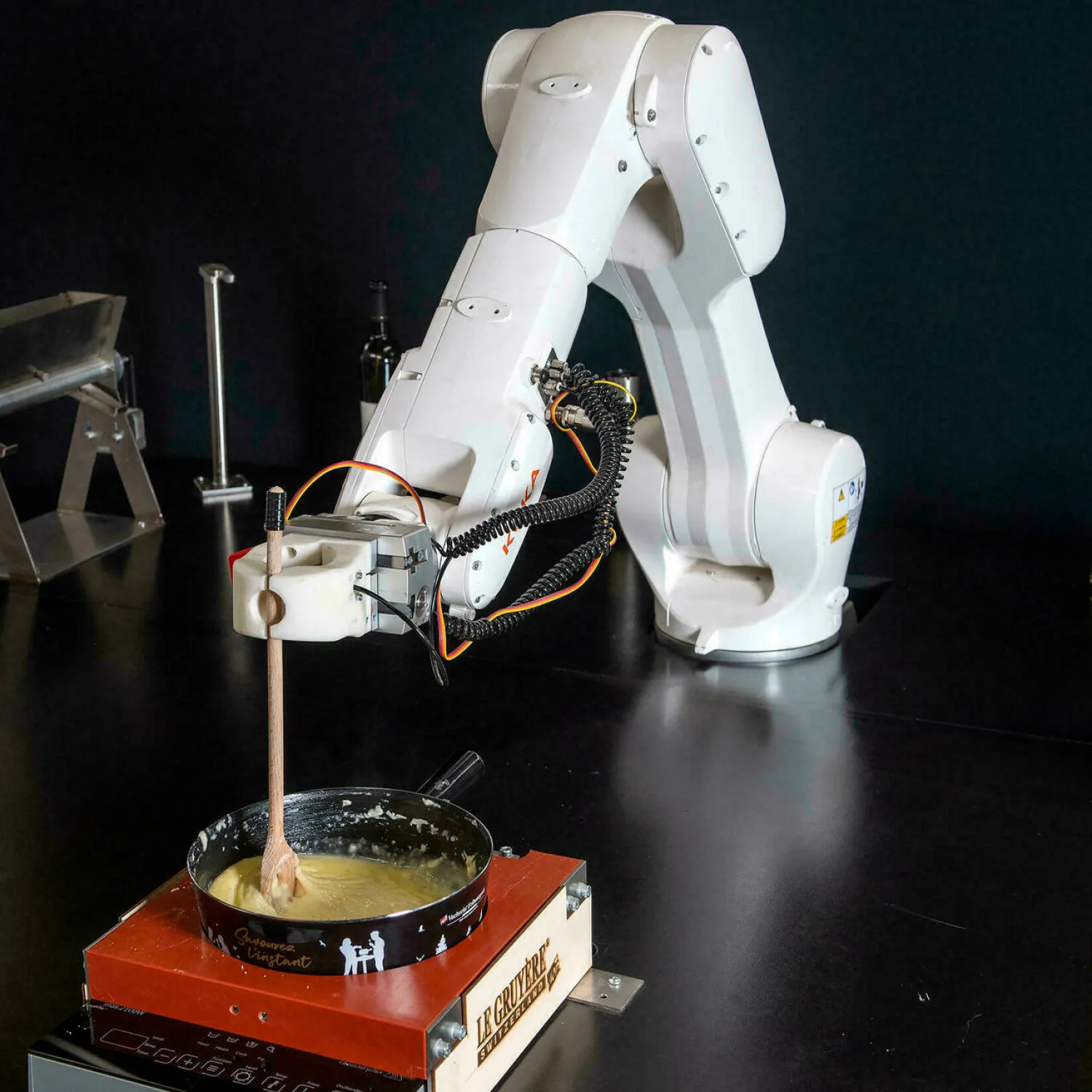

Swiss Fondue Robot Out to Cause a Stir in Paris

'Bouebot' has taken nearly two years to develop and is still not ready for the shops. Jean-Guy Python AFP
TT

Swiss Fondue Robot Out to Cause a Stir in Paris

'Bouebot' has taken nearly two years to develop and is still not ready for the shops. Jean-Guy Python AFP

Switzerland's national dish is fondue, a simmering pot of heartwarming melted cheese -- that can now be prepared, stirred up and served by a robot, thanks to some hi-tech wizardry.

A Swiss team has been beavering away on Bouebot, the robotic creation putting a futuristic twist on an Alpine tradition, AFP said.

Outside in the Rhone glacial valley bisecting Switzerland's southern Wallis region, crisp mountain air blows down from the glistening snowy peaks.

But inside Workshop 4.0's headquarters in Sierre, below the Crans-Montana ski resort, the air is hot from Bouebot's whirring servers and thick with the smell of melted cheese.

The robot is set to make its grand debut at the Paris International Agricultural Show, one of the world's major food production trade fairs, which runs from February 26 to March 6.

Bouebot is for demonstration purposes only and is far from appearing in kitchenware stores.

The entire project cost 250,000 to 300,000 Swiss francs ($270,000 to $325,000, 235,000 to 285,000 euros), with the robot arm alone costing 80,000 francs.

'Cheese passion'
Workshop 4.0 co-director Nicolas Fontaine, 30, who wears a black baseball cap reading "cheese passion", said Bouebot had been nearly two years in the making.

"We wanted to do a... project that combined innovation with Swiss tradition, and fondue was the perfect choice," Fontaine told AFP.

"For the Swiss, fondue is emblematic. It's something very emotional too because it's part of our identity, our know-how.

"Fondue is something convivial... it's a nice opportunity to draw people in to talk about robotics and how it can be used."

Whether at home, in a restaurant or in an Alpine cabin, sharing a fondue remains the heart of Swiss social life.

Bouebot is named after the bouebos: teenage boys who spent the summer up in the mountain chalets, helping herdsmen while they took care of making cheese.

Grate, stir, eat, repeat
Pivoting on six different axes, Bouebot swings into action.

It glugs the right amount of white wine into the "caquelon" pot, then places it under the cheese grater.

The classic fondue mix is called a half-and-half -- an even amount of Vacherin Fribourgeois and Gruyere cheese.

The project's technical manager Ludovic Aymon, using his control pad, maneuvers the robot arm down towards each cheese triangle, which is lifted up by creating a vacuum on the top.

After shearing off the rind on a circular blade, it starts swiping the underside down the grater.

Back on the heater, Bouebot does some vigorous figure-of-eight stirring as the cheese melts, then wipes off the spoon and sprinkles in some pepper.

It then picks up a metal spike, pierces a piece of bread, swipes it around the caquelon before placing it in a holder for fondue-lovers to try before the gooey cheese drips down.

Aymon said the biggest challenge was to get a precision mechanical robot to cope with imprecise organic material.

The cheese wedges are not perfectly flat, nor the same height, while Vacherin is much softer than Gruyere.

However, there is no chance of the traditional duo being changed for more robot-friendly cheeses -- not if the creators wants to stay alive, jokes Aymon.

Rise of the robots
When seeing Bouebot at work, some onlookers are thrilled by the future possibilities for such technology, while others worry about machines encroaching into the human sphere.

"The effect I find the most interesting is fear... that fear of being replaced by something more powerful," Aymon told AFP.

"Robotics should not be to the detriment of human beings. It should help humans.

"It could help someone cook in the future. It shows that it could be done, for people who can't do it themselves."

With each run-through, Aymon spots tiny modifications to make, requiring yet more slabs from the cheese-stuffed fridge.

"I can't just work with a 3D simulation, like I could with lots of industrial processes. I have to do real tests," the 35-year-old said.

And with every fondue made, the end result must be eaten quickly.

"I think I'll never be sick of fondue, but there are times when I just can't stand the smell of cheese in here any longer," Aymon said.




China Approves First Two Level-3 Autonomous Driving Cars from State-owned Automakers

People pass by the entrance to Volkswagen (China) Technology Company, a 3 billion euros ($3.5 billion) R&D center in Hefei in eastern China's Anhui province, on Feb. 25, 2025. (AP Photo/Ken Moritsugu)
TT

China Approves First Two Level-3 Autonomous Driving Cars from State-owned Automakers

People pass by the entrance to Volkswagen (China) Technology Company, a 3 billion euros ($3.5 billion) R&D center in Hefei in eastern China's Anhui province, on Feb. 25, 2025. (AP Photo/Ken Moritsugu)

China's industry regulator on Monday approved two Chinese cars with level-3 autonomous driving capabilities, marking the first time such vehicles have been cleared by the national regulator as legitimate products ready for mass adoption.

The Ministry of Industry and Information Technology approved the two electric sedans from state-owned automakers Changan Auto and BAIC Motor in its latest automobile product entry category, said Reuters.

The two models are allowed to activate conditional autonomous driving in designated areas of Chongqing and Beijing with speed limits of 50km/h and 80km/h, respectively, the ministry said in a statement. The automakers will conduct trial operation with the cars on the specific roads via their ride-hailing units, it added.

The auto industry has defined five levels of autonomous driving, from cruise control at level one to fully self-driving cars at level five, and level three allows drivers to take their eyes and hands off the road in certain situations.

The move underscored China's ambition to lead the development and adoption of autonomous driving, a technology poised to disrupt the auto industry globally. Last year, China lined up nine automakers for public tests to advance the adoption of self-driving cars.

Chinese regulators earlier this year had sharpened scrutiny of the assisted driving technologies following an accident involving a Xiaomi SU7 sedan in March. That incident killed three occupants when their car crashed seconds after the driver took control from the assisted-driving system.

But government officials are pressing Chinese automakers to rapidly deploy even more advanced systems. In their level-3 push, Chinese regulators also are upping the regulatory ante by holding automakers and parts suppliers liable if their systems fail and cause an accident.

Autonomous driving developers such as Pony AI and WeRide have been testing their level-4 cars with licenses granted by local governments across China.

Tesla's Full Self-Driving, a level-2 driver assistance system, has been partially approved in China since February and falls short of its capabilities in the United States.


Elm Company Named Strategic Partner for International Data and AI Conference

Elm Company Named Strategic Partner for International Data and AI Conference
TT

Elm Company Named Strategic Partner for International Data and AI Conference

Elm Company Named Strategic Partner for International Data and AI Conference

The Saudi Data and Artificial Intelligence Authority (SDAIA) announced a strategic partnership with Elm Company for the International Conference on Data and AI Capacity Building (ICAN 2026), enhancing collaboration to empower the data and artificial intelligence ecosystem and promote innovation in education and human capacity development.

This partnership comes as part of preparations for ICAN 2026, organized by SDAIA from January 28 to 29 at King Saud University in Riyadh, with the participation of a select group of specialists and experts from around the world, SPA reported.

The step represents a qualitative addition that contributes to enriching the conference’s knowledge content and expanding partnerships with leading national entities.

Elm Company brings extensive experience in designing digital solutions and building technical capabilities, reinforcing its role as a strategic partner in supporting the conference. It contributes by developing training tracks and digital empowerment programs, participating in the technology exhibition, and presenting qualitative initiatives that help empower national competencies in the fields of data and artificial intelligence.


Foxconn to Invest $510 Million in Kaohsiung Headquarters in Taiwan

Construction is scheduled to start in 2027, with completion targeted for 2033. Reuters
TT

Foxconn to Invest $510 Million in Kaohsiung Headquarters in Taiwan

Construction is scheduled to start in 2027, with completion targeted for 2033. Reuters

Foxconn, the world’s largest contract electronics maker, said on Friday it will invest T$15.9 billion ($509.94 million) to build its Kaohsiung headquarters in southern Taiwan.

That would include a mixed-use commercial and office building and a residential tower, it said. Construction is scheduled to start in 2027, with completion targeted for 2033.

Foxconn said the headquarters will serve as an important hub linking its operations across southern Taiwan, and once completed will house its smart-city team, software R&D teams, battery-cell R&D teams, EV technology development center and AI application software teams.

The Kaohsiung city government said Foxconn’s investments in the city have totaled T$25 billion ($801.8 million) over the past three years.