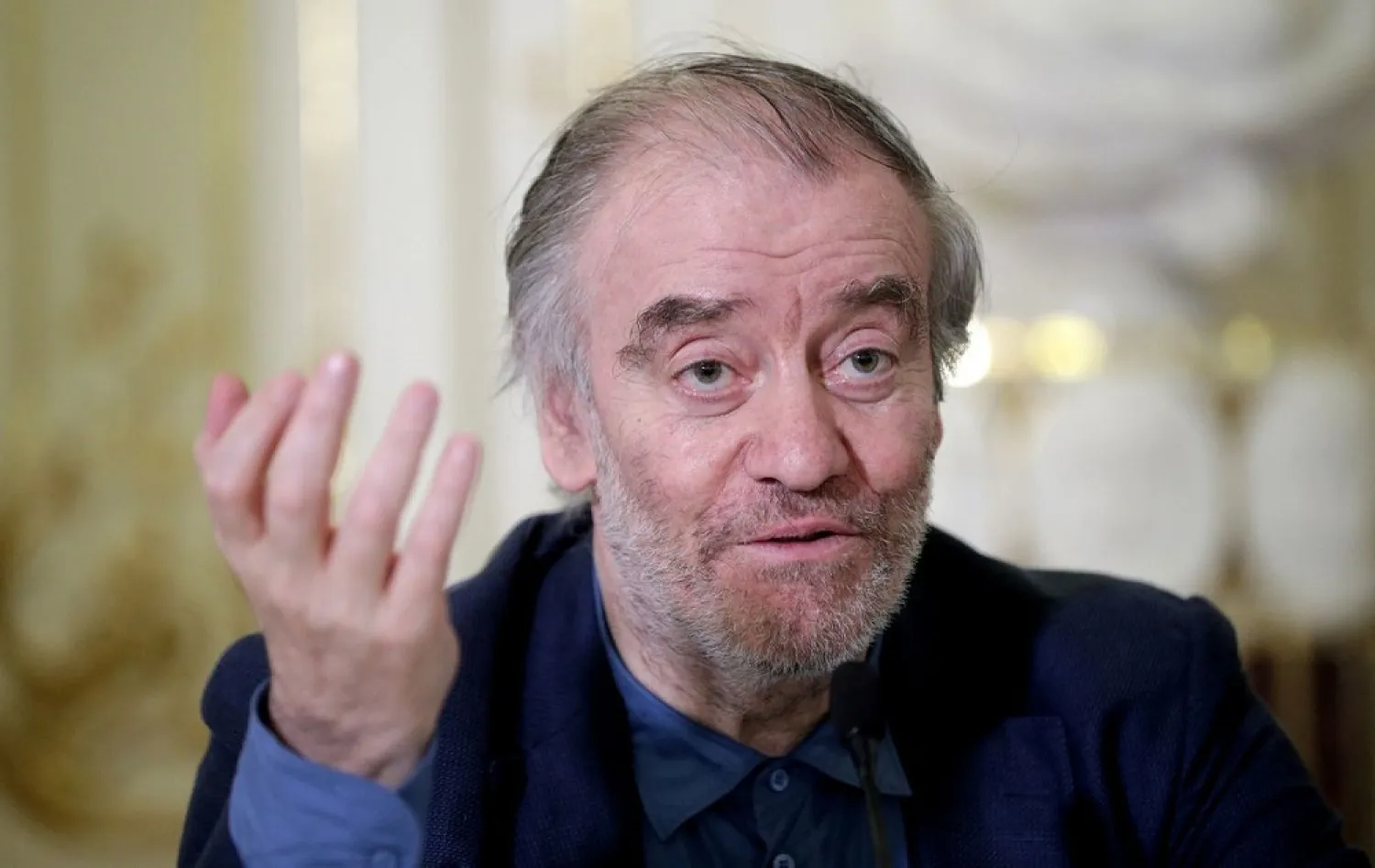
Russian Conductor Gergiev Shunned by La Scala, Other Venues

Russian conductor Valery Gergiev attends a news conference in Vienna, Austria, May 30, 2018. (Reuters)
TT

Russian Conductor Gergiev Shunned by La Scala, Other Venues

Russian conductor Valery Gergiev attends a news conference in Vienna, Austria, May 30, 2018. (Reuters)

Russian Valery Gergiev will not conduct at Milan's La Scala this week after he failed to condemn Russia's invasion of Ukraine, and he is also set to be sidelined from roles in Munich and Rotterdam.

Gergiev - general director of the St. Petersburg Mariinsky Theater and regarded as close to Russian President Vladimir Putin - conducted "The Queen of Spades," an opera based on Alexander Pushkin's novel, at La Scala on Feb. 23.

The show will run until March 15 and the next performance is scheduled for Saturday.

"I don't think he will be there, I think at this point we can rule it out," Giuseppe Sala, La Scala theater board chairman and mayor of Milan, told reporters on Monday.

"The maestro did not reply to us," he added, referring to requests for Gergiev to comment on the Ukraine crisis.

The Mariinsky Theater did not respond to a request for comment.

The Rotterdam Philharmonic Orchestra also said it was suspending its work with Gergiev, who is an honorary conductor in the Dutch city, and would cancel a Gergiev Festival planned for September unless he distances himself from Putin's actions.

Munich Mayor Dieter Reiter last week gave Gergiev a deadline of Monday to speak out or be removed as principal conductor of the Munich Philharmonic Orchestra.

The Moscow-born Gergiev, 68, has performed in the most famous theaters around the world. In 2013, Putin awarded him the first title of Hero of Labor of Russia.

But those ties have rebounded on him as Western nations react to Russia's invasion of Ukraine, the biggest assault on a European nation since World War Two.

Gergiev had been due to conduct three concerts at New York's Carnegie Hall leading the Vienna Philharmonic Orchestra from Feb. 25-27.

But the Russian conductor has been replaced by Yannick Nézet-Séguin, according to the theater's website.

Separately, the Venice La Biennale art exhibition said the curator and artists of the Pavilion of the Russian Federation had pulled out of the event in protest at the war in Ukraine.

"La Biennale expresses its complete solidarity for this noble act of courage," it said in a statement.


Can DC Blend Horror with a Superhero Movie? ‘Clayface’ Wants to Blur Genres

 This image released by Warner Bros. Pictures shows Tom Rhys Harries in a scene from "Clayface." (Warner Bros. Pictures via AP)
This image released by Warner Bros. Pictures shows Tom Rhys Harries in a scene from "Clayface." (Warner Bros. Pictures via AP)
TT

Can DC Blend Horror with a Superhero Movie? ‘Clayface’ Wants to Blur Genres

 This image released by Warner Bros. Pictures shows Tom Rhys Harries in a scene from "Clayface." (Warner Bros. Pictures via AP)
This image released by Warner Bros. Pictures shows Tom Rhys Harries in a scene from "Clayface." (Warner Bros. Pictures via AP)

The dominant movie genres of the past decade, superhero films and horror, have usually stayed, like bashful teenagers on the dance floor, on separate sides of the multiplex.

But when James Gunn and Peter Safran were plotting the projects with which they wanted to launch their era of DC Studios, writer-director Mike Flanagan came in with a pitch that would fuse both genres.

Neither Safran nor Gunn were looking for a standalone movie about Clayface, a lesser-known villain from the Batman comics. But they were won over by Flanagan’s vision, which eventually became a script by Flanagan and Hossein Amini.

“It fit within the broader framework of how James and I saw the broad spectrum of film and television shows we want to make,” says Safran. “But it really was Mike Flanagan’s passion and pitch. You always look for volunteers and not recruits.”

Not many studios would push “Clayface” to the front of the pack, but Gunn, who started in horror, and Safran, who helped launch “The Conjuring” franchise, made “Clayface” — with James Watkins eventually coming on to direct — part of their first wave of DCU films, following “Superman” and “Supergirl.”

“Clayface” is a darker detour for DC. And, if it proves successful, it just might open up a darker frontier for comic book movies.

“From the get-go, this was not designed to be a traditional superhero movie,” Safran says. “It was always supposed to be a character-driven story that uses the DC mythology. If you took the DC elements out of it, it would just be a great horror movie.”

That makes “Clayface” something unusual in the normally calculated realm of superhero movies. It’s R-rated. It’s modestly budgeted at $40 million. And it stars the relatively unknown Tom Rhys Harries as a little-known DC villain.

“A lot of people wouldn’t necessarily know who Clayface is, but they wouldn’t need to,” says Watkins, the Welsh filmmaker of “Speak No Evil” and “The Woman in Black.” “It’s its own movie.”

‘Supergirl’ disappointment puts pressure on ‘Clayface’

That, Safran says, is by design. He and Gunn have emphasized filmmaker-first projects at DC, carving a more idiosyncratic, multi-genre path that has won them fans but also added some degree of risk.

“Clayface,” which opens in theaters Oct. 22, will debut shortly after Skydance and David Ellison’s takeover of Warner Bros. Ellison is keeping Gunn and Safran to lead DC, even though they’re coming off a misfire in the box-office disappointment of “Supergirl.” That puts more pressure on “Clayface” to perform.

“If you look at the cumulative choices that we’ve made, I think it’s pretty clear we’re trying to do things differently,” says Safran. “Not everything is going to work. The pressure we feel for ‘Clayface’ is honestly the pressure we feel for everything we put into the world.”

There have been a few movies to meld horror and superheroes together, including Wes Craven’s “Swamp Thing” (1982), Sam Raimi’s “Darkman” (1990) and “Brightburn” (2019), a sinister twist on the “Superman” origin story that Gunn produced.

But Clayface, a Batman villain created in 1940 by Bill Finger and Bob Kane, is still an unlikely character to put center stage. In the comics, he began as Basil Karlo, a B-list actor who, furious that he wasn’t cast in a horror remake he had previously starred in, wears the movie’s Clayface costume to kill the film's actors.

Winning over skeptical DC fans

Some fan skepticism has followed “Clayface.” Last week, Gunn defended the choice on the social media platform Threads after a user asked, “Who the (expletive) asked for a ‘Clayface’ movie?”

Gunn replied: “Although it may seem like it, Hollywood isn’t a place where the only way to make a movie is the public voting on what IP they want to see that they’ve seen countless times before.”

Watkins’ film, taking inspiration from the two-part episode “Feat of Clay” from “Batman: The Animated Series,” twists the original Clayface story slightly. Rising movie star Matt Hagen (Harries) is disfigured by a mob boss (Eddie Marsan) and rapidly falls out of Hollywood. After numerous unsuccessful surgeries, he resorts to an experimental process created by the scientist Dr. Caitlyn Corr (Naomi Ackie) that uses an untested, claylike living organism to rehabilitate his face.

“Part of the joy was being surprised at what’s looking back at me in the mirror every day,” says Harries, smiling.

To a large degree, “Clayface” progresses as a character study, one of an actor whose livelihood falls away from him and whose attempts to get back on the red carpet turn increasingly dark. His journey, though, hinges less on vanity than on his relationship with Caitlyn.

“I was approaching it the whole time like: Matt thinks he’s in a romantic comedy,” says Harries. “The fulcrum of the whole thing is his relationship with Caitlyn Corr. Without that, you don’t get the propulsion for Matt to be doing what he decides he needs to.”

Shape-shifting in genre and body

As “Clayface” devolves, Matt’s face and body increasingly shape-shift in chilling body horror transformations. That can include his own body changing or Matt taking the form of other characters around him. While CGI and visual effects were used, Watkins leaned into practical effects.

“I like horror when it’s most relatable, when it actually gets under the skin,” Watkins says.

In the third act of “Clayface,” that’s taken to body-changing extremes as Matt dons the appearance of those around him. Often, actors were swapping into scenes moment to moment with Harries.

“We’d often play a scene with Tom and then someone else would play the same scene,” says Watkins. “Sometimes Tom would copy them, sometimes they would copy Tom.”

If the superhero movie has sometimes been too rigidly formulaic, “Clayface” proves the genre has more elasticity than it's been shown to have. In “Clayface,” even the lead role was an ensemble piece.

“I won’t mention any actor’s name because it’s a bit of a spoiler,” Watkins says. “But one of the cast members was saying to me his son asked, ‘So who are you in the movie?’ And he said, ‘I’m Clayface.’”


Bollywood Actor Tiger Shroff Shot at in Mumbai, Three Suspects Held

Bollywood actor Tiger Shroff at the screening of 'Ikkis' in Mumbai in December 2025. Sujit JAISWAL / AFP/File
TT

Bollywood Actor Tiger Shroff Shot at in Mumbai, Three Suspects Held

Bollywood actor Tiger Shroff at the screening of 'Ikkis' in Mumbai in December 2025. Sujit JAISWAL / AFP/File

Indian actor Tiger Shroff was shot at in Mumbai on Sunday, police said, adding that three suspects have been detained.

Shooters opened fire at the 36-year-old actor as he was leaving a private event in the city's upscale Juhu area on Sunday evening, according to Police official Mohit Garg.

Aside from being India's financial capital, Mumbai is also the heart of Bollywood, the country's Hindi-language film industry, said AFP.

"Tiger Shroff is safe and Mumbai police has deployed different teams to investigate further," Garg told reporters.

Two people were injured in the incident, including the actor's driver, though Shroff did not sustain gunshot wounds, police said.

Three suspects have been rounded up in Rajasthan, another Indian state.

"Preliminary questioning revealed that two of them have one case each against them, one related to theft and the other under the Arms Act," police official Tejaswani Gautam told reporters.

Police have yet to establish a motive for the shooting.

Shroff is known for action films including the "Baaghi" franchise and "War".


Jesse Eisenberg, Julianne Moore Bring Curtain Down on London Film Festival with ‘The Debut’

US actors Jesse Eisenberg (L) and Julianne Moore (R) attend the premiere of "The Debut" and the closing night of the BFI London Film Festival 2026 in London, Britain, 18 October 2026. (EPA)
TT

Jesse Eisenberg, Julianne Moore Bring Curtain Down on London Film Festival with ‘The Debut’

US actors Jesse Eisenberg (L) and Julianne Moore (R) attend the premiere of "The Debut" and the closing night of the BFI London Film Festival 2026 in London, Britain, 18 October 2026. (EPA)

Actor-filmmaker Jesse Eisenberg said he wrote the lead role in his musical comedy "The Debut" with Julianne Moore in mind, praising the Oscar-winning star as "the greatest actress in the world" as the film closed the London Film Festival on Sunday.

"I just thought, this is Julianne Moore, and I will write every scene with her in mind and what she likes to do and what she's great at," Eisenberg, who wrote the screenplay and directed the film, told Reuters on the red carpet.

Moore stars as Mona, a shy New Jersey housewife who is thrilled ‌to land a ‌role in a community theater musical.

Drawn to the experience ‌by ⁠a longing for ⁠something missing in her life, Mona finds purpose and community through the show.

"She's moving towards something, knowing that there's something that she needs in her life," Moore said. "Then that thing leads you towards yourself and towards community, which is really the most valuable thing of all."

The film, which marks Eisenberg's latest directing effort following his BAFTA-winning screenplay for "A Real Pain", features seven original songs written by the filmmaker. The numbers appear in the fictional stage ⁠production "Nosy Neighbors", a deliberately light-hearted, 1990s-inspired musical performed by a cast ‌including "The Little Mermaid" star Halle Bailey.

"I love songwriting, I ‌love musical theater music and I wrote these songs in earnest," Eisenberg said.

Mona's early struggles ‌on stage test the patience of director Jerry, played by "The Holdovers" star Paul Giamatti, prompting ‌her to adopt an increasingly committed method acting approach.

Eisenberg said Moore's interpretation of Mona allowed him to make a "weird movie" that still felt grounded.

"She is so unusual, she's so strange," he said. "It allowed me to make a movie that wasn't realistic."

While Mona takes method acting to ‌extremes, the "Now You See Me" star said all actors, including himself, draw on some version of the technique.

"I always wind up ⁠feeling whatever the ⁠character feels," he said. "So if my character is miserable, I spend the shoot just miserable. But I don't realize it's for the character. I just think, 'Oh God, I must be doing terribly in the movie'."

Eisenberg, who plays a minor role in "The Debut", said the story was inspired by his own childhood experiences in community theater, where he discovered "a family and a home and a life" he liked.

Patrick Fabian, who plays Mona's husband in the film, said theater offers something increasingly rare: a chance for people to connect in person with one another.

"It brings people together, and these days, it gets them out of their screens and into the dark together to watch whatever is going on," Fabian said. "I think that's a real bonding thing."

"The Debut" brought the curtain down on the 70th London Film Festival, where Ukrainian filmmaker Sergei Loznitsa's "Imperium" won Best Film in the Official Competition.