


Russian Forces Step up Attacks on Ukraine’s Civilian Areas

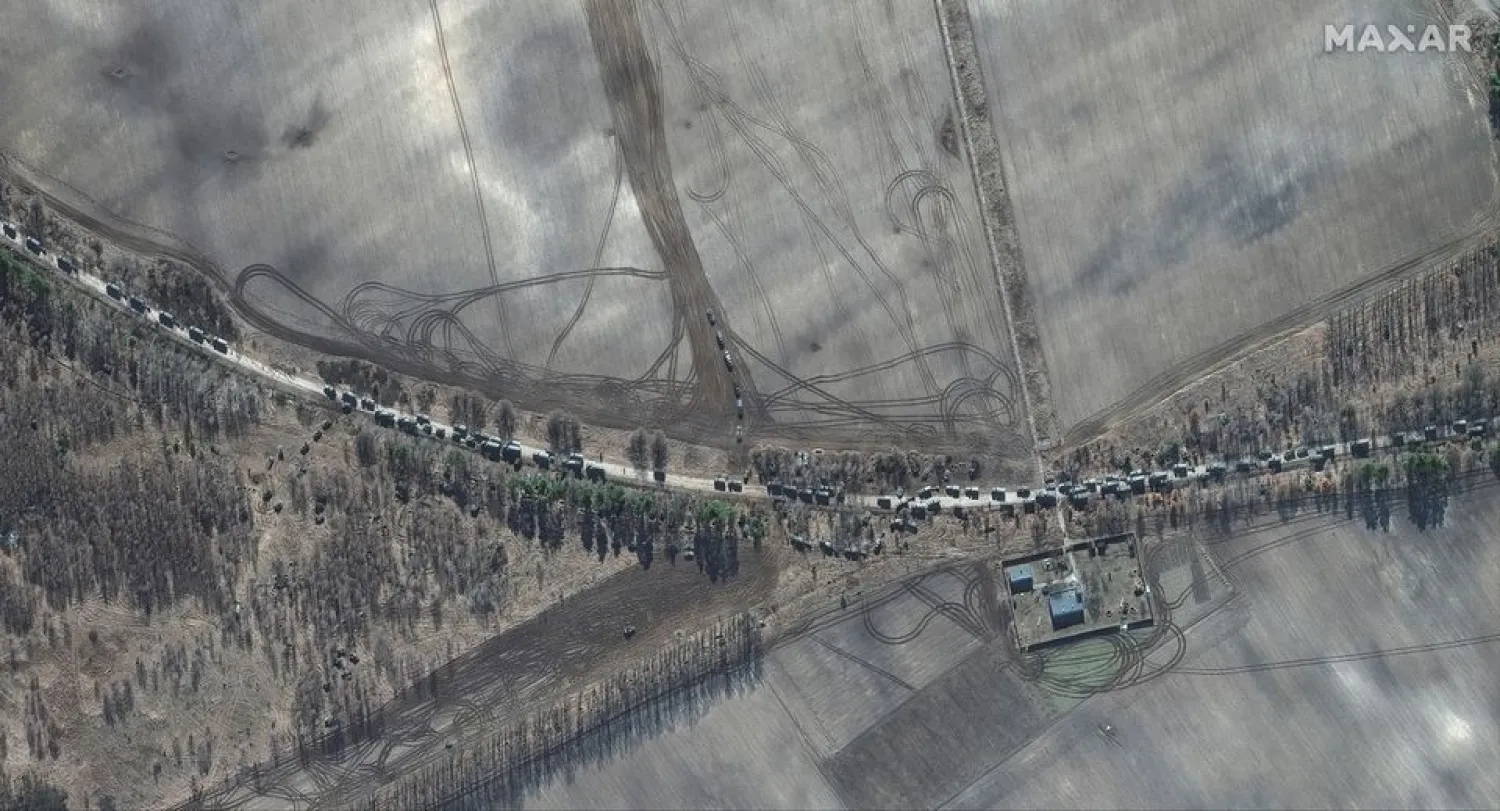
A satellite image shows southern end of convoy armor towed artillery trucks, east of Antonov airport, Ukraine, February 28, 2022. Satellite image ©2022 Maxar Technologies/Handout via REUTERS
TT

Russian Forces Step up Attacks on Ukraine’s Civilian Areas

A satellite image shows southern end of convoy armor towed artillery trucks, east of Antonov airport, Ukraine, February 28, 2022. Satellite image ©2022 Maxar Technologies/Handout via REUTERS

Russian forces stepped up their attacks on crowded urban areas Tuesday, bombarding the central square in Ukraine’s second-biggest city and Kyiv's main TV tower in what the country's president called a blatant campaign of terror.

“Nobody will forgive. Nobody will forget,” President Volodymyr Zelenskyy vowed after the bloodshed on the square in Kharkiv.

Ukrainian authorities said five people were killed in the attack on the TV tower, which is a couple of miles from central Kyiv and a short walk from numerous apartment buildings. A TV control room and power substation were hit, and at least some Ukrainian channels briefly stopped broadcasting, officials said.

Zelenskyy’s office also reported a powerful missile attack on the site of the Babyn Yar Holocaust memorial, near the tower.

At the same time, a 40-mile (64-kilometer) convoy of hundreds of Russian tanks and other vehicles advanced slowly on Kyiv in what the West feared was a bid by Russian President Vladimir Putin to topple Ukraine's government and install a Kremlin-friendly regime.

Russian forces pressed their assault on other towns and cities across the country, including the strategic ports of Odesa and Mariupol in the south.

Day 6 of the biggest ground war in Europe since World War II found Russia increasingly isolated, beset by tough sanctions that have thrown its economy into turmoil and left the country practically friendless, apart from a few countries like China, Belarus and North Korea.

Many military experts worry that Russia may be shifting tactics. Moscow’s strategy in Chechnya and Syria was to use artillery and air bombardments to pulverize cities and crush fighters’ resolve.

The bombing on the TV tower came after Russia’s Defense Ministry announced it would target transmission facilities in the capital used by Ukraine’s intelligence agency. It urged people living near such places to leave their homes.

Overall death tolls from the fighting remained unclear, but a senior Western intelligence official estimated Tuesday that more than 5,000 Russian soldiers had been captured or killed.

Britain’s Defense Ministry said it had seen an increase in Russian air and artillery strikes on populated urban areas over the past two days. The ministry also said three cities — Kharkiv, Kherson and Mariupol —were encircled by Russian forces.

In Kharkiv, with a population of about 1.5 million, at least six people were killed when the region's Soviet-era administrative building on Freedom Square was hit with what was believed to be a missile.

The attack on Freedom Square — Ukraine’s largest plaza, and the nucleus of public life in the city — was seen by many Ukrainians as brazen evidence that the Russian invasion wasn’t just about hitting military targets but also about breaking their spirits.

The bombardment blew out windows and walls of buildings that ring the massive square, which was piled high with debris and dust. Inside one building, chunks of plaster were scattered, and doors, ripped from their hinges, lay across hallways.

“People are under the ruins. We have pulled out bodies,” said Yevhen Vasylenko, an emergency official.

Zelenskyy pronounced the attack on the square “frank, undisguised terror” and a war crime. “This is state terrorism of the Russian Federation,” he said.

In an emotional appeal to the European Parliament later, Zelenskyy said: “We are fighting also to be equal members of Europe. I believe that today we are showing everybody that is what we are.”

He said 16 children had been killed around Ukraine on Monday, and he mocked Russia's claim that it is going after only military targets.

“Where are the children? What kind of military factories do they work at? What tanks are they going at?” Zelenskyy said.

Human Rights Watch said it documented a cluster bomb attack outside a hospital in Ukraine’s east in recent days. Local residents also reported the use of the weapons in Kharkiv and the village of Kiyanka, The Kremlin denied using cluster bombs.

If the allegations are confirmed, that would represent a new level of brutality in the war and could lead to even further isolation of Russia.

Unbowed by Western condemnation, Russian officials upped their threats of escalation, days after raising the specter of nuclear war. A top Kremlin official warned that the West's “economic war” against Russia could turn into a “real one.”

More than a half-million people have fled the country, and countless others have taken shelter underground. Bomb damage to water pipes and other basic services have left hundreds of thousands of families without drinking water, UN humanitarian coordinator Martin Griffiths said.

“It is a nightmare, and it seizes you from the inside very strongly. This cannot be explained with words,” said Kharkiv resident Ekaterina Babenko, taking shelter in a basement with neighbors for a fifth straight day. “We have small children, elderly people, and frankly speaking it is very frightening.”

The UN human rights office said it has recorded 136 civilian deaths. The real toll is believed to be far higher.

A Ukrainian military official said Belarusian troops joined the war Tuesday in the Chernihiv region in the north, without providing details. But just before that, Belarusian President Alexander Lukashenko said his country had no plans to join the fight.

In Kharkiv, explosions burst one after another through a residential area in a video verified by The Associated Press. In the background, a man pleaded with a woman to leave, and a woman cried.

Hospital workers moved a Kharkiv maternity ward to a bomb shelter. Amid mattresses piled up against the walls, pregnant women paced the crowded space, accompanied by the cries of dozens of newborns.

Russia’s goals in hitting central Kharkiv were not immediately clear. Western officials speculated that it is trying to pull in Ukrainian forces to defend the city while a larger Russian force encircles Kyiv.

Russian troops continued to press toward the capital, a city of nearly 3 million. The leading edge of the convoy was 17 miles (25 kilometers) from the center of the city, according to satellite imagery from Maxar Technologies.

A senior US defense official described the long convoy as “bogged down,” saying Russia appeared to be pausing and regrouping to re-evaluate how to retake the momentum in the fighting.

Overall, the Russian military has been been stalled by fierce resistance on the ground and a surprising inability to completely dominate Ukraine’s airspace.

The immense convoy, packed together along narrow roads, would seemingly be “a big fat target” for Ukrainian forces, the senior Western intelligence official said on condition of anonymity.

“But it also shows you that the Russians feel pretty comfortable being out in the open in these concentrations because they feel that they’re not going to come under air attack or rocket or missile attack,” the official said.

Ukrainians used whatever they had to try to stop the Russian advance. On a highway between Odesa and Mykolaiv in southern Ukraine, residents piled tractor tires filled with sand and topped with sandbags to block convoys.



Nigeria's President to Make a Sate Visit to the UK in March

Nigeria’s President Bola Tinubu gives a joint statement with Brazil’s President Luiz Inacio Lula da Silva, at the Planalto presidential palace, in Brasilia, Brazil, Aug. 25, 2025. (AP Photo/Eraldo Peres, File)
TT

Nigeria's President to Make a Sate Visit to the UK in March

Nigeria’s President Bola Tinubu gives a joint statement with Brazil’s President Luiz Inacio Lula da Silva, at the Planalto presidential palace, in Brasilia, Brazil, Aug. 25, 2025. (AP Photo/Eraldo Peres, File)

Nigeria’s president is set to make a state visit to the UK in March, the first such trip by a Nigerian leader in almost four decades, Britain’s Buckingham Palace said Sunday.

Officials said President Bola Tinubu and first lady Oluremi Tinubu will travel to the UK on March 18 and 19, The AP news reported.

King Charles III and Queen Camilla will host them at Windsor Castle. Full details of the visit are expected at a later date.

Charles visited Nigeria, a Commonwealth country, four times from 1990 to 2018 before he became king. He previously received Tinubu at Buckingham Palace in September 2024.m

Previous state visits by a Nigerian leader took place in 1973, 1981 and 1989.

A state visit usually starts with an official reception hosted by the king and includes a carriage procession and a state banquet.

Last year Charles hosted state visits for world leaders including US President Donald Trump, French President Emmanuel Macron and German President Frank-Walter Steinmeier.


Iran Strikes Hard Line on US Talks, Saying Tehran's Power Comes From Saying 'No'

Traffic moves through a street in Tehran on February 7, 2026. (Photo by ATTA KENARE / AFP)
TT

Iran Strikes Hard Line on US Talks, Saying Tehran's Power Comes From Saying 'No'

Traffic moves through a street in Tehran on February 7, 2026. (Photo by ATTA KENARE / AFP)

Iran's top diplomat insisted Sunday that Tehran's strength came from its ability to “say no to the great powers," striking a maximalist position just after negotiations with the United States over its nuclear program and in the wake of nationwide protests.

Foreign Minister Abbas Araghchi, speaking to diplomats at a summit in Tehran, signaled that Iran would stick to its position that it must be able to enrich uranium — a major point of contention with President Donald Trump, who bombed Iranian atomic sites in June during the 12-day Iran-Israel war.

Iran will never surrender the right to enrich uranium, even if war "is imposed on us,” he noted.

"Iran has paid a very heavy price for its peaceful nuclear program and for uranium enrichment." 

Israeli Prime Minister Benjamin Netanyahu is expected to travel to Washington this week, with Iran expected to be the major subject of discussion, his office said.

While Iranian President Masoud Pezeshkian praised the talks Friday in Oman with the Americans as “a step forward,” Araghchi's remarks show the challenge ahead. Already, the US moved the aircraft carrier USS Abraham Lincoln, ships and warplanes to the Middle East to pressure Iran into an agreement and have the firepower necessary to strike the Islamic Republic should Trump choose to do so, according to The AP news.

“I believe the secret of the Islamic Republic of Iran’s power lies in its ability to stand against bullying, domination and pressures from others," Araghchi said.

"They fear our atomic bomb, while we are not pursuing an atomic bomb. Our atomic bomb is the power to say no to the great powers. The secret of the Islamic Republic’s power is in the power to say no to the powers.”

‘Atomic bomb’ as rhetorical device Araghchi's choice to explicitly use an “atomic bomb” as a rhetorical device likely wasn't accidental. While Iran has long maintained its nuclear program is peaceful, the West and the International Atomic Energy Agency say Tehran had an organized military program to seek the bomb up until 2003.

Iran had been enriching uranium up to 60% purity, a short, technical step to weapons-grade levels of 90%, the only non-weapons state to do so. Iranian officials in recent years had also been increasingly threatening that Tehran could seek the bomb, even while its diplomats have pointed to Iranian Supreme Leader Ali Khamenei’s preachings as a binding fatwa, or religious edict, that Iran wouldn’t build one.

Pezeshkian, who ordered Araghchi to pursue talks with the Americans after likely getting Khamenei's blessing, also wrote on X on Sunday about the talks.

“The Iran-US talks, held through the follow-up efforts of friendly governments in the region, were a step forward,” the president wrote. “Dialogue has always been our strategy for peaceful resolution. ... The Iranian nation has always responded to respect with respect, but it does not tolerate the language of force.”

It remains unclear when and where, or if, there will be a second round of talks. Trump, after the talks Friday, offered few details but said: “Iran looks like they want to make a deal very badly — as they should.”

Aircraft carrier in the Arabian Sea During Friday's talks, US Navy Adm. Brad Cooper, the head of the American military's Central Command, was in Oman. Cooper's presence was apparently an intentional reminder to Iran about US military power in the region. Cooper later accompanied US special envoy Steve Witkoff and Jared Kushner, Trump's son-in-law, to the Lincoln out in the Arabian Sea after the indirect negotiations.

Araghchi appeared to be taking the threat of an American military strike seriously, as many worried Iranians have in recent weeks. He noted that after multiple rounds of talks last year, the US “attacked us in the midst of negotiations."

“If you take a step back (in negotiations), it is not clear up to where it will go,” Araghchi said.


Russia: Man Suspected of Shooting Top General Detained in Dubai

An investigator works outside a residential building where the assassination attempt on Russian Lieutenant General Vladimir Alexeyev took place in Moscow, Russia February 6, 2026. REUTERS/Anastasia Barashkova
TT

Russia: Man Suspected of Shooting Top General Detained in Dubai

An investigator works outside a residential building where the assassination attempt on Russian Lieutenant General Vladimir Alexeyev took place in Moscow, Russia February 6, 2026. REUTERS/Anastasia Barashkova

Russia's Federal Security Service (FSB) said on Sunday that the man suspected of shooting top Russian military intelligence officer Vladimir Alexeyev in Moscow has been detained in Dubai and handed over to Russia.

Lieutenant General Vladimir Alexeyev, deputy head of the GRU, ⁠Russia's military intelligence arm, was shot several times in an apartment block in Moscow on Friday, investigators said. He underwent surgery after the shooting, Russian media ⁠said.

The FSB said a Russian citizen named Lyubomir Korba was detained in Dubai on suspicion of carrying out the shooting.

Russian Foreign Minister Sergei Lavrov accused Ukraine of being behind the assassination attempt, which he said was designed to sabotage peace talks. ⁠Ukraine said it had nothing to do with the shooting.

Alexeyev's boss, Admiral Igor Kostyukov, the head of the GRU, has been leading Russia's delegation in negotiations with Ukraine in Abu Dhabi on security-related aspects of a potential peace deal.