

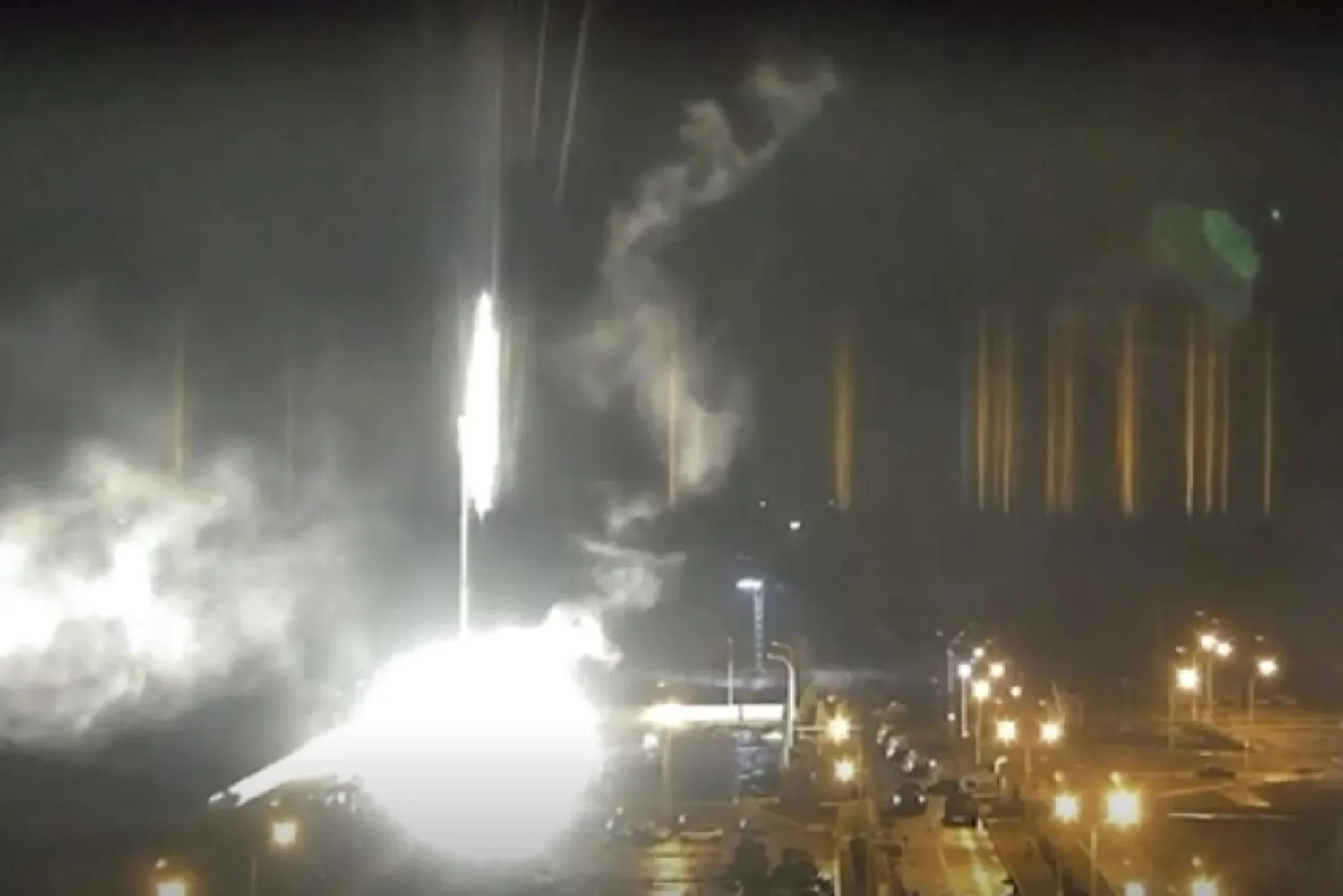

Russians Take Ukraine Nuclear Plant; No Radiation after Fire

This image made from a video released by Zaporizhzhia nuclear power plant shows bright flaring object landing in grounds of the nuclear plant in Enerhodar, Ukraine Friday, March 4, 2022. (Zaporizhzhia nuclear power plant via AP)
TT

Russians Take Ukraine Nuclear Plant; No Radiation after Fire

This image made from a video released by Zaporizhzhia nuclear power plant shows bright flaring object landing in grounds of the nuclear plant in Enerhodar, Ukraine Friday, March 4, 2022. (Zaporizhzhia nuclear power plant via AP)

Russian troops Friday seized the biggest nuclear power plant in Europe after a middle-of-the-night attack that set it on fire and briefly raised worldwide fears of a catastrophe in the most chilling turn in Moscow's invasion of Ukraine yet.

Firefighters put out the blaze, and no radiation was released, UN and Ukrainian officials said, as Russian forces pressed on with their week-old offensive on multiple fronts and the number of refugees fleeing the country topped 1.2 million.

While the vast Russian armored column threatening Kyiv remained stalled outside the capital, President Vladimir Putin’s military has launched hundreds of missiles and artillery attacks on cities and other sites around the country, and made significant gains on the ground in the south in an apparent bid to cut off Ukraine's access to the sea.

In the attack on the Zaporizhzhia nuclear plant in the southeastern city of Enerhodar, the chief of the UN's International Atomic Energy Agency, Rafael Mariano Grossi, said a Russian “projectile” hit a training center, not any of its six reactors.

The attack triggered global alarm and fear of a catastrophe that could dwarf the world’s worst nuclear disaster, at Ukraine’s Chernobyl in 1986. In an emotional nighttime speech, Ukrainian President Volodymyr Zelenskyy said he feared an explosion that would be “the end for everyone. The end for Europe. The evacuation of Europe.”

But nuclear officials from Sweden to China said no radiation spikes had been reported, as did Grossi.

Authorities said that Russian troops had taken control of the overall site but that the plant staff continued to run it. Only one reactor was operating, Grossi said in the aftermath of the attack.

Two people were injured in the fire, Grossi said. Ukraine’s state nuclear plant operator Enerhoatom said three Ukrainian soldiers were killed and two wounded.

The crisis at Zaporizhzhia unfolded after Grossi earlier in the week expressed grave concern that the fighting could cause accidental damage to Ukraine's 15 nuclear reactors at four plants around the country.

Nuclear safety expert Edwin Lyman of the Union of Concerned Scientists in Washington said the presence of reactors in the war zone adds a new and highly dangerous dimension to the crisis in Ukraine.

“These plants are now in a situation that few people ever seriously contemplated when they were originally built, and that is the potential that they would be in the middle of a war zone,” he said. "No nuclear plant has been designed to withstand a potential threat of a full-scale military attack, and the plants in Ukraine are no exception.”

In the wake of the attack, Zelenskyy appealed again to the West to enforce a no-fly zone over his country. But NATO Secretary-General Jens Stoltenberg ruled out that possibility, citing the risk of a much wider war in Europe. He said that to enforce a no-fly zone, NATO planes would have to shoot down Russian aircraft.

“We understand the desperation, but we also believe that if we did that, we would end up with something that could end in a full-fledged war in Europe,” Stoltenberg said.

The UN Security Council scheduled an emergency meeting Friday on the plant attack.

Russian forces, meanwhile, pressed their offensive in the southern part of the country. Severing Ukraine's access to the Black Sea and the Sea of Azov would deal a severe blow to its economy and could worsen an already dire humanitarian situation.

A round of talks between Russia and Ukraine yielded a tentative agreement Thursday to set up safe corridors to evacuate citizens and deliver food and medicine. But the necessary details still had to be worked out.

The UN human rights office said 331 civilians had been confirmed killed in the invasion but that the true number is probably much higher.

In Romania, one newly arrived refugee, Anton Kostyuchyk, struggled to hold back tears as he recounted leaving everything behind in Kyiv and sleeping in churches with his wife and three children during their journey out.

“I’m leaving my home, my country. I was born there, and I lived there," he said. "And what now?”

The plant fire was the second time since the invasion began that concerns about a potential nuclear accident arose, following a battle at the heavily contaminated site of the now-decommissioned Chernobyl plant.

Facing worldwide indignation, Russia sought to deflect blame and crack down on dissent at home.

Without producing evidence, Defense Ministry spokesman Igor Konashenkov claimed that a Ukrainian “sabotage group” had set the fire at Zaporozhizhia.

Russia's parliament unanimously approved a draft law making it a crime to intentionally spread what is deemed to be fake news. Russians could get up to 15 years in prison for disseminating information that goes against the official government line on the war.

Authorities also raided the offices of Russian human rights organizations.

Inside Ukraine, frequent shelling could be heard in the center of Kyiv, though more distant than in recent days, with loud thudding every 10 minutes resonating over the rooftops.

Ukrainian presidential adviser Oleksiy Arestovich said battles involving airstrikes and artillery continued northwest of Kyiv, and the northeastern cities of Kharkiv and Okhtyrka came under heavy fire.

He said Ukrainian forces were still holding the northern city of Chernihiv and had prevented Russian efforts to take the important southern city of Mykolaiv. Ukrainian artillery also defended Odessa from repeated attempts by Russian ships to fire on the Black Sea port, Arestovic said. Odessa is Ukraine's biggest port city and home to a large naval base.

The Ukrainian Navy scuttled its flagship at the shipyard where it was undergoing repairs to keep the frigate from being seized by the Russians, authorities said.

Another strategic port, Mariupol, on the Sea of Azov, was “partially under siege,” and Ukrainian forces were pushing back efforts to surround the city, Arestovich said.

“The humanitarian situation is tense,” he said, adding that Ukrainian authorities were in talks with Russian representatives and international organizations to set up a humanitarian corridor to evacuate residents and supply food.

Battles have knocked out the city’s electricity, heat and water systems, as well as most phone service, officials said.

Amid the warfare, there were occasional signs of hope.

As explosions sounded on the fringes of Kyiv, Dmytro Shybalov and Anna Panasyk smiled and blushed at the civil registry office where they married Friday. They fell in love in 2015 in Donetsk amid the fighting between pro-Russian separatists and Ukrainian forces that was a precursor to the countrywide war.

“It’s 2022 and the situation hasn’t changed," Shybalov said. “It’s scary to think what will happen when our children will be born.”



Explosion Hits Pro-Israel Center in the Netherlands

Rotterdam Police officers. (Getty Images/AFP)
TT

Explosion Hits Pro-Israel Center in the Netherlands

Rotterdam Police officers. (Getty Images/AFP)

A blast hit a pro-Israeli center in the Netherlands, police said Saturday, adding it caused minimal damage and no injuries.

A police spokeswoman told AFP no one was inside the site run by Christians for Israel, a non-profit, in the central city of Nijkerk when the explosion went off outside its gate late on Friday.

An investigation was ongoing.

The incident comes after a string of similar night-time attacks on Jewish sites in the Netherlands and neighboring Belgium in recent weeks that has heightened concerns in the wake of the war in the Middle East.


Iran Says Strike Hit Close to Its Bushehr Nuclear Facility, Killing a Guard and Damaging a Building

Iran's Bushehr nuclear reactor (Reuters)
TT

Iran Says Strike Hit Close to Its Bushehr Nuclear Facility, Killing a Guard and Damaging a Building

Iran's Bushehr nuclear reactor (Reuters)

Iran’s atomic agency says an airstrike has hit near its Bushehr nuclear facility, killing a security guard and damaging a support building. It is the fourth time the facility has been targeted during the war.

The agency announced Saturday’s attack on social media.

The US AP’s military pressed ahead Saturday in a frantic search for a missing pilot after Iran shot down an American warplane, as Iran called on people to turn the pilot in, promising a reward.

The plane, identified by Iran as a US F-15E Strike Eagle, was one of two attacked on Friday, with one service member rescued and at least one missing. It was the first time the United States lost aircraft in Iranian territory during the war, now in its sixth week, and could mark a new turning point in the campaign.

The conflict, launched by the US and Israel on Feb. 28, has rippled across the region. It has so far killed thousands, upended global markets, cut off key shipping routes, spiked fuel prices and shows no signs of slowing as Iran responds to US and Israeli airstrikes with attacks across the region.


Trump Seeks $152 Mn to Revive Alcatraz as Federal Prison

FILE PHOTO: A view of Alcatraz prison complex located on Alcatraz Island in San Francisco Bay near San Francisco, California, US July 17, 2025. REUTERS/Carlos Barria/File Photo
TT

Trump Seeks $152 Mn to Revive Alcatraz as Federal Prison

FILE PHOTO: A view of Alcatraz prison complex located on Alcatraz Island in San Francisco Bay near San Francisco, California, US July 17, 2025. REUTERS/Carlos Barria/File Photo

US President Donald Trump asked Congress on Friday for $152 million to begin rebuilding the notorious Alcatraz prison, pressing ahead with his vision to return the former island lockup to active use.

The funding request, included in the White House's proposed 2027 budget, would cover the first year of converting the San Francisco Bay site into what officials describe as a "state-of-the-art secure prison facility."

Trump has pushed for reopening Alcatraz since last year, portraying it as a symbol of a tougher approach to crime, said AFP.

In a social media post at the time, he called for a "substantially enlarged and rebuilt" facility to house the country's most dangerous offenders.

The proposal comes as part of a broader Justice Department budget that emphasizes prison investment and law enforcement, though such requests are ultimately subject to approval by Congress.

Political news outlet Axios, citing administration officials, reported that any "supermax" prison complex at the site would have to be built from scratch -- putting the total cost at somewhere around $2 billion.

Alcatraz, which opened as a federal penitentiary in 1934, was once considered among the most secure prisons in the United States due to its isolated island location and the strong currents surrounding it.

It held a relatively small number of prisoners, including high-profile inmates such as Al Capone.

The island fortress entered American cultural lore after a 1962 escape by three inmates, which became an inspiration for the film "Escape from Alcatraz" starring Clint Eastwood.

It was closed in 1963 after officials determined it was too costly to maintain.

According to the Federal Bureau of Prisons, operating expenses were nearly three times higher than at other federal facilities, largely because all supplies -- including fresh water -- had to be transported to the island.

Since the early 1970s, Alcatraz has been managed by the National Park Service as part of the Golden Gate National Recreation Area and has become one of San Francisco's most popular tourist attractions, drawing more than a million visitors annually.

The White House argues that rebuilding the site would help modernize the federal prison system and expand capacity for high-risk inmates.

But critics have questioned both the practicality and cost of the plan, noting that the island's infrastructure would likely require extensive reconstruction.

Feasibility studies have already been conducted by federal agencies to assess whether a modern correctional facility could be established on the site, though no final decision has been made.

Any move to proceed could face political resistance given competing budget priorities and the site's current status as a major tourism and historical landmark.