Putin Threatens Ukraine 'Statehood' as Moscow Sanctions Tighten

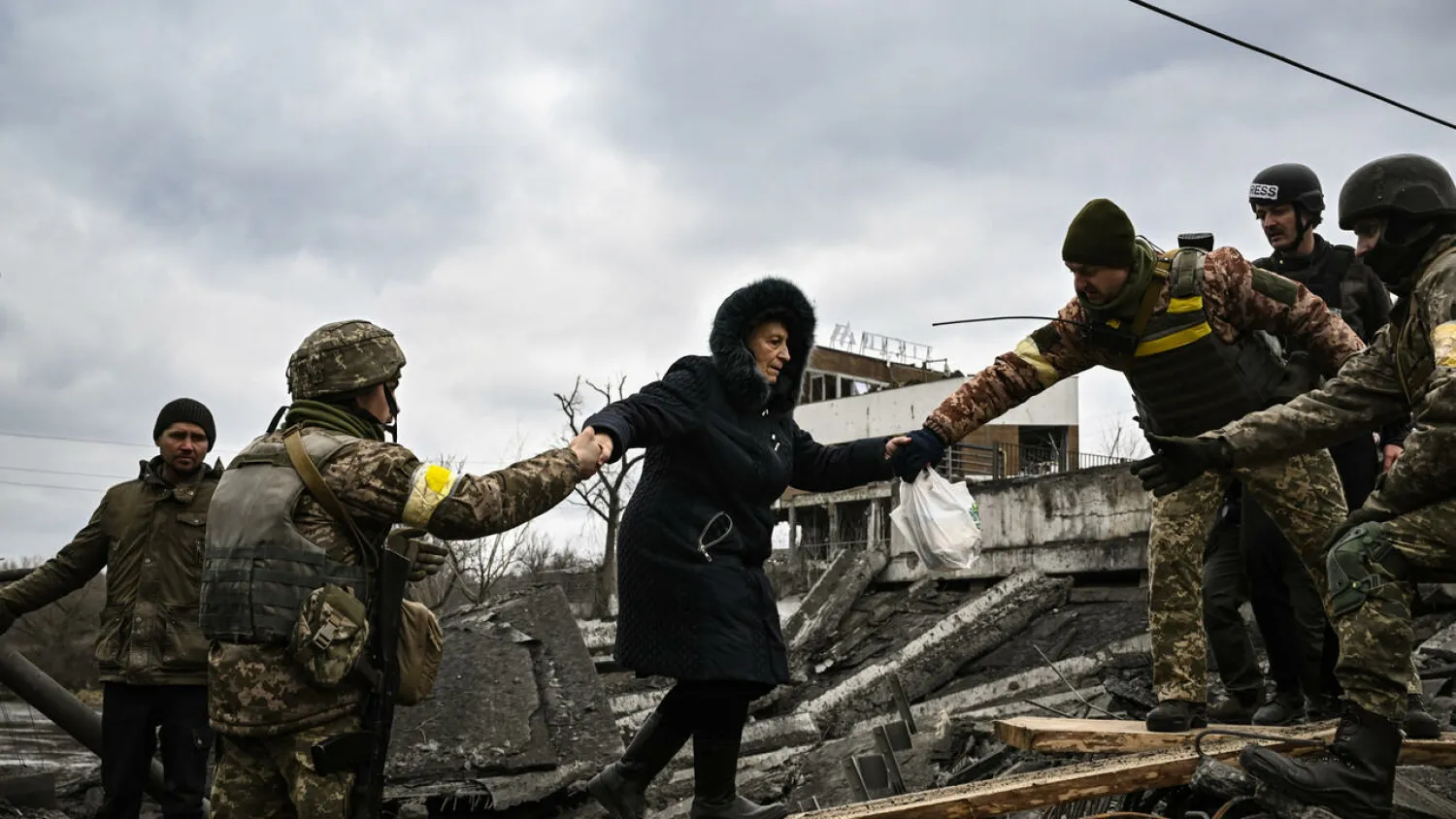
Since Russia's invasion 10 days ago, the economic and humanitarian toll of the war has spiraled. Aris Messinis AFP
TT

Putin Threatens Ukraine 'Statehood' as Moscow Sanctions Tighten

Since Russia's invasion 10 days ago, the economic and humanitarian toll of the war has spiraled. Aris Messinis AFP

Russian President Vladimir Putin threatened the existence of Ukrainian statehood as his army's invasion of the neighbor faces stiff resistance Sunday and his economy is increasingly asphyxiated by sanctions.

In the latest efforts to freeze Moscow out of the world economy, US-based card payment giants Visa and Mastercard announced they will suspend operations in Russia, while world leaders vowed to act over the intensifying onslaught, AFP said.

"The current (Ukrainian) authorities must understand that if they continue to do what they are doing, they are putting in question the future of Ukrainian statehood," Putin said on Saturday. 

"And if this happens, they will be fully responsible." 

Since Russia's invasion 10 days ago, the economic and humanitarian toll of the war has spiraled, sending more than one million people fleeing Ukraine. Officials have reported hundreds of civilians killed. 

In a Facebook post on Sunday the Ukraine military said it was engaged in "fierce battles" with Russian forces for the control of borders at the southern city of Mykolaiv and the Chernihiv in the north.

"The main efforts are focused on defending the city of Mariupol," it said, adding an operation by Ukrainian forces was also under way in the eastern part of the Donetsk region.

Kyiv has urged the West to boost military assistance to the besieged country, including warplanes, with President Volodymyr Zelensky pleading for Eastern European neighbors to provide Russian-made planes that his citizens are trained to fly.

Putin meanwhile escalated warnings against NATO, threatening a wider war if a no-fly zone is set up, as his forces resumed their offensive against a key Ukrainian city where security fears stalled a planned evacuation.

While Zelensky criticized NATO for ruling out the no-fly zone, Putin spoke of "colossal and catastrophic consequences not only for Europe but also the whole world" if such a step was taken.

"Any movement in this direction will be considered by us as participation in an armed conflict by that country," Putin said.

Hitting out at stiffening Western sanctions, the Russian leader said: "A lot of what we're coming up against right now is a way of waging war against Russia. 

"The sanctions against Russia are akin to a declaration of war. But thank God we're not at that point yet."

Putin also dismissed rumors that the Kremlin was planning to declare martial law in Russia.

- Cards cut -
Visa and Mastercard both announced they will suspend operations in Russia, the latest major American firms to join the business freeze-out of Moscow.

Mastercard said it made the decision over the "unprecedented nature of the current conflict and the uncertain economic environment". 

Visa meanwhile said that "effective immediately" it would "work with its clients and partners within Russia to cease all Visa transactions over the coming days".

Visa and Mastercard had already announced that they were complying with US and international sanctions imposed on Russia in the wake of its attack.

But Russia's major banks -- including its largest lender Sberbank and the Russia Central Bank -- downplayed the effects that the cards' suspensions would have on their clients.

The war has already had serious global economic impacts, with the IMF warning that its effects would be "all the more devastating" should the conflict escalate.

Russia's business and other contacts with the West have been steadily cut. Moscow has suspended all flights by flagship carrier Aeroflot, effective Tuesday.

- Frenzied diplomacy -
As frantic, top-level diplomatic talks continued, President Zelensky announced on Sunday that he spoke by phone with his US counterpart Joe Biden to discuss financial support and sanctions against Russia.

"The agenda included the issues of security, financial support for Ukraine and the continuation of sanctions against Russia," Zelensky tweeted.

Hours earlier, the Ukrainian leader had addressed US lawmakers by video call, pleading for further funding and an embargo on Russian oil imports.

The American legislators promised an additional $10 billion aid package, but the White House has so far ruled out an oil ban, fearing it would ratchet up prices and hurt US consumers already stung by record inflation. 

Weapons, ammunition and funds have poured into Ukraine from Western allies as they seek to bolster Kyiv against Moscow's invasion.

Washington last week authorized $350 million of military equipment -- the largest such package in US history.

While visiting Ukrainian refugees on the Polish border over the weekend, US Secretary of State Antony Blinken said Washington was seeking $2.75 billion for the unfurling humanitarian crisis as nearly 1.4 million civilians have fled. 

Israeli Prime Minister Naftali Bennett made a surprise visit to the Kremlin Saturday for three hours of talks -- Putin's first face-to-face meeting with a foreign leader since the invasion began.

The Israeli leader later spoke with Zelensky.

Kyiv had asked Israel -- which has strong relations with both Russia and Ukraine -- to launch a dialogue with Moscow.

Meanwhile, British Prime Minister Boris Johnson's office said he is to launch an international "plan of action" to ensure Russia's invasion of Ukraine fails, including a flurry of diplomatic meetings next week.

- City under siege -
The strategic city of Mariupol on the Azov Sea has for days been under siege and without electricity, food and water.

After Russia declared a ceasefire to open a humanitarian corridor, city officials said the population of 450,000 could begin to leave by bus and private cars.

But the officials then delayed the evacuation, saying, "The Russian side does not adhere to the ceasefire and has continued shelling both Mariupol itself and its environs".

A Russian Defense Ministry spokesman later announced the assault was back on, citing "the unwillingness of the Ukrainian side to... extend the ceasefire".

Ukraine's military said Sunday Russian forces around Mariupol were still bombarding its civilian infrastructure.

The city's mayor Vadim Boitchenko said in an interview published on YouTube "Mariupol no longer exists" and that thousands of people have been wounded. 

"The situation is very difficult," he said. "I ask our American and European partners: help us, save Mariupol."

- Closer to Kyiv -
The siege of the city came as Russian forces inched closer to the capital Kyiv in an assault that has become ever-more indiscriminate -- and deadly. 

Working-class towns such as Bucha and Irpin are in the line of fire, and air raids Friday broke many people's resolve to stay. 

"They are bombing residential areas -- schools, churches, big buildings, everything," said accountant Natalia Dydenko, glancing back at the destruction she was leaving behind.

Dozens of civilians have been killed in Chernihiv. Those remaining live in craters or among ruins.

"There were corpses all over the ground," a man who gave his name only as Sergei told AFP, as air raid sirens wailed. "They were queueing here for the pharmacy that's just there, and they're all dead."

AFP reporters saw scenes of devastation -- despite Moscow's insistence it is not targeting civilian areas.

A defiant Zelensky said Saturday that Ukrainian forces were counterattacking around Kharkiv, the country's second-largest city, inflicting "such losses on the invaders that they have not seen even in their worst dream".

Foreign Minister Dmytro Kuleba was equally defiant, saying, "Ukraine is bleeding, but Ukraine has not fallen, and stands both feet on the ground... The myth of the unbeatable and almighty Russian army is already ruined."


Le Pen Says France Will No Longer Aid Ukraine ‘Financially’ if Elected

Marine Le Pen (C), the far-right National Rally (RN) party's candidate for the 2027 French presidential election, visits the "Made in France" fair at the Porte de Versailles exhibition center in Paris, France, 13 November 2026. (EPA)
TT

Le Pen Says France Will No Longer Aid Ukraine ‘Financially’ if Elected

Marine Le Pen (C), the far-right National Rally (RN) party's candidate for the 2027 French presidential election, visits the "Made in France" fair at the Porte de Versailles exhibition center in Paris, France, 13 November 2026. (EPA)

Marine Le Pen on Monday said that France would provide no further financial aid to Ukraine if she is elected president next year, after a meeting with Kyiv's ambassador in Paris.

"The state of France's public finances would no longer allow the country to provide financial assistance to Ukraine in the coming months," Le Pen said in a statement, while insisting France would honor existing commitments, including toward a 90-billion-euro ($100-billion) European Union loan.

Le Pen is currently ahead in polls in the race to succeed President Emmanuel Macron next year, as the war sparked by Russia's 2022 full-scale invasion of Ukraine grinds towards its fifth anniversary.

She has faced criticism over past links to Russia, which included a 2017 meeting in the Kremlin with President Vladimir Putin and her party taking a loan from a Russian bank that it paid off in full in 2023.

But she has opposed the invasion and, at her talks in Paris with Ukrainian ambassador Vadym Omelchenko, Le Pen made clear her "unwavering support for Ukraine since the beginning of the conflict".

The statement said the talks -- the first such between Le Pen and the Ukrainian ambassador -- were "cordial".

While financial aid would be cut, Le Pen told the ambassador that "France would continue to support Ukraine through donations of equipment, humanitarian aid and much more active diplomacy".

The statement said there was a "frank discussion" on the future of the conflict, with Le Pen stressing that "the pursuit of peace -- though a difficult goal to achieve -- must remain a priority for all".

She also asked the ambassador to tell President Volodymyr Zelensky she is ready to meet in "either Paris or Brussels". However, there was no mention of the candidate making the journey to Kyiv after Zelensky invited her to visit the Ukrainian capital.

Le Pen's opponents have expressed alarm that by emphasizing the importance of ending the war swiftly, she could force Ukraine to capitulate on unfavorable terms.

"If Russia imposes its will on a European nation through brutality, all of Europe is weakened," Macron wrote on Facebook at the weekend.

Taking aim at Le Pen, he said: "Let us be clear: those who seek to limit the resources available to Ukraine are, in effect, pushing for an unjust peace -- one that would leave Ukraine permanently vulnerable, and, by extension, leave Europe vulnerable as well."


Trump Says He Might Meet with North Korea’s Kim Jong Un in China

US President Donald Trump and North Korean leader Kim Jong Un shake hands before their one-on-one chat during the second US-North Korea summit at the Metropole Hotel in Hanoi, Vietnam February 27, 2019. (Reuters)
TT

Trump Says He Might Meet with North Korea’s Kim Jong Un in China

US President Donald Trump and North Korean leader Kim Jong Un shake hands before their one-on-one chat during the second US-North Korea summit at the Metropole Hotel in Hanoi, Vietnam February 27, 2019. (Reuters)

US President Donald Trump said on Monday he might meet with North Korean leader Kim Jong Un in China this week, an announcement that could dramatically reshape his upcoming trip through East Asia if it occurs.

The president, who met the North Korean leader several times during his 2017-2021 term, including once in the Korean Demilitarized Zone, has previously expressed ‌interest in ‌another meeting during his current term. Senior ‌US ⁠officials, however, have previously ⁠said he has no immediate plans to do so.

Moreover, Trump has repeatedly previewed meetings with Kim that never took place, including during a trip to Asia last year. North Korea, whose mission to the United Nations did not immediately respond to a ⁠request for comment, has publicly indicated it ‌has no intention of ‌meeting with the US president at this time.

Trump told reporters ‌while departing the White House en route to ‌the Philippines and China that any meeting would occur in China, and that the North Korean leader's presence was ultimately up to Chinese President Xi Jinping.

"(Xi) was here a ‌month ago, and we're also going to meet with (Russian) President Putin, and we ⁠may ⁠meet with Kim Jong Un also," Trump said.

"So that'll be good. We have a chance to accomplish a lot."

Trump has indicated he will meet with Putin and Xi during his trip, but US officials and analysts have played down the possibility of a meaningful agreement emerging from any trilateral sit-down.

Among the possible topics of conversation, Trump and others have said, are Russia's invasion of Ukraine, counterproliferation and the war in Iran.


Third US Aircraft Carrier Arrives in Middle East

This US Navy handout photograph released by US Naval Forces Central Command on November 4, 2026, shows the Nimitz-class aircraft carrier USS Theodore Roosevelt (CVN 71) sails alongside Royal Australian Navy Supply-class replenishment oiler HMAS Stalwart (A304). (AFP / NAVCENT Public Affairs / US Navy)
TT

Third US Aircraft Carrier Arrives in Middle East

This US Navy handout photograph released by US Naval Forces Central Command on November 4, 2026, shows the Nimitz-class aircraft carrier USS Theodore Roosevelt (CVN 71) sails alongside Royal Australian Navy Supply-class replenishment oiler HMAS Stalwart (A304). (AFP / NAVCENT Public Affairs / US Navy)

The USS Theodore Roosevelt aircraft carrier arrived in the Middle East on Sunday, media reports said, bringing the number of American carrier strike groups in the region to three.

The deployment, which was reported by the National News and Axios journalist Barak Ravid, comes as fighting reignites in the region, with Iran claiming a drone attack on Bahrain on Sunday, ending a lull in strikes in the war.

Iran also fired drones at Bahrain on Friday -- the first strikes since September against countries in the energy-rich Gulf, which has been targeted several times in the conflict that erupted in February.

US President Donald Trump plans to discuss the war at a trilateral meeting with his Chinese and Russian counterparts Xi Jinping and Vladimir Putin this week, an official said Friday.

Months of diplomacy have failed to resolve the war, which began with US-Israeli strikes that killed Iran's supreme leader Ali Khamenei.