
Ukraine Says Russia Bombed Children’s Hospital in Besieged Mariupol

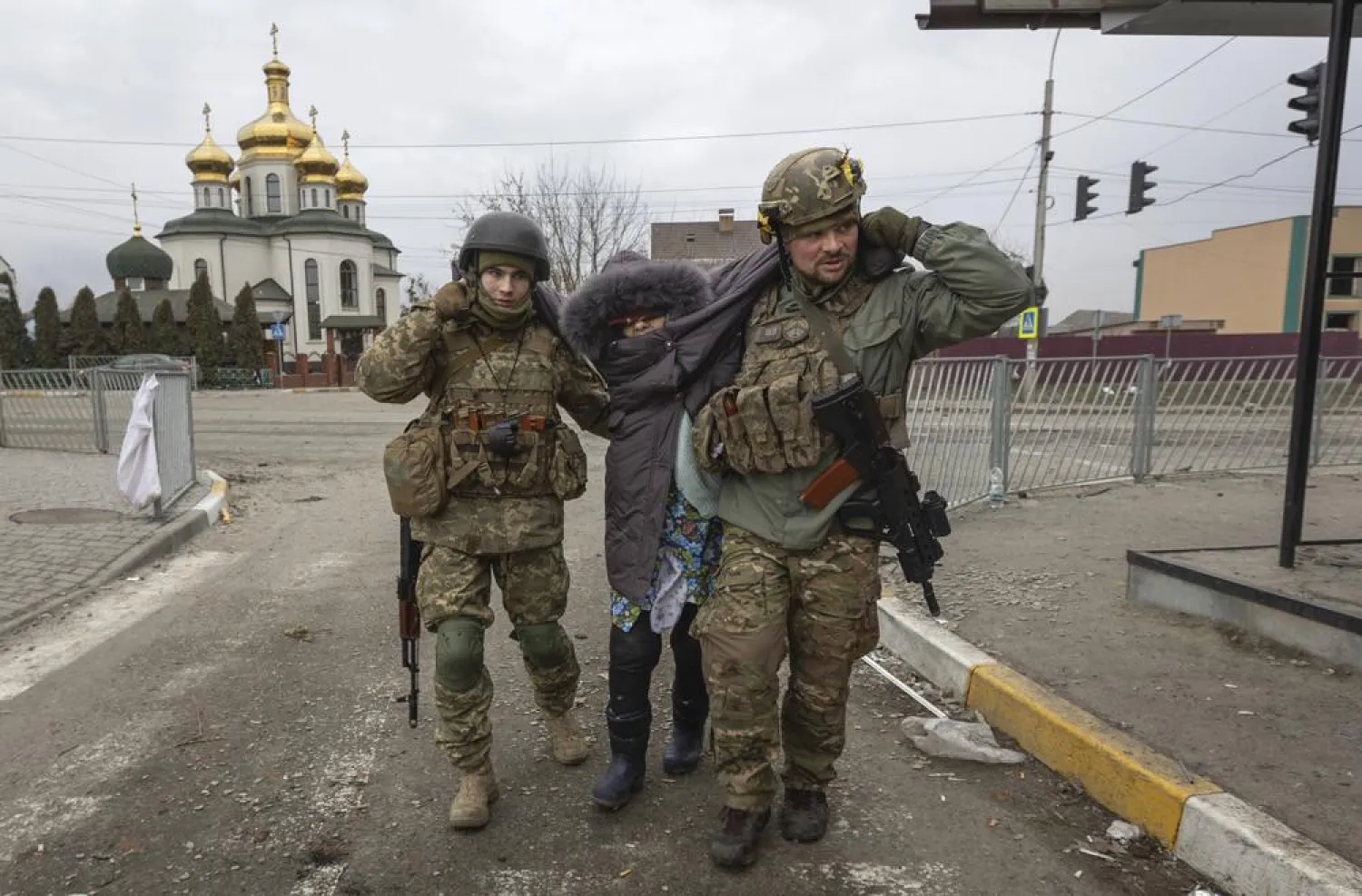
Ukrainian servicemen help an elderly woman, in the town of Irpin, Ukraine, March 6, 2022. (AP)
TT

Ukraine Says Russia Bombed Children’s Hospital in Besieged Mariupol

Ukrainian servicemen help an elderly woman, in the town of Irpin, Ukraine, March 6, 2022. (AP)

Ukraine accused Russia on Wednesday of bombing a children's hospital in the besieged port of Mariupol during an agreed ceasefire to enable civilians trapped in the city to escape.

Russia had said it would hold fire to let thousands of civilians flee Mariupol and other besieged cities on Wednesday. But the city council said the hospital had been hit several times by an air strike.

"The destruction is colossal," it said in an online post.

President Volodymyr Zelenskiy called it an "atrocity".

"Direct strike of Russian troops at the maternity hospital. People, children are under the wreckage," he said on Twitter.

Kremlin spokesman Dmitry Peskov, asked by Reuters for comment on the reported bombing, said: "Russian forces do not fire on civilian targets."

The Ukrainian Foreign Ministry posted video footage of what it said was the hospital showing holes where windows should have been in a three-storey building. Huge piles of smouldering rubble littered the scene.

The Donetsk region's governor said 17 people were wounded, including women in labor. The reports could not immediately be verified.

Earlier Ukraine's Foreign Minister Dmytro Kuleba said Russia had broken the ceasefire around the southern port, which lies between Russian-backed separatist areas of eastern Ukraine and Crimea, annexed by Moscow from Ukraine in 2014.

"Russia continues holding hostage over 400,000 people in Mariupol, blocks humanitarian aid and evacuation. Indiscriminate shelling continues," he wrote on Twitter. "Almost 3,000 newborn babies lack medicine and food."

Ukraine said at least 1,170 civilians had been killed in Mariupol since the start of the invasion, and 47 were buried in a mass grave on Wednesday. It was not possible to verify the figures.

Russia's defense ministry blamed Ukraine for the failure of the evacuation and said that the situation faced by civilians in Mariupol had reached a "catastrophic scale".

A senior US defense official said there were indications Russia's military was using so-called "dumb" bombs that are not precision-guided and that Washington had observed "increasing damage to civilian infrastructure and civilian casualties".

Local officials in other cities said some civilians had left on Wednesday through safe corridors, including out of Sumy in eastern Ukraine and Enerhodar in the south.

However, Russian forces were preventing a convoy of 50 buses from evacuating civilians from Bucha town outside Kyiv, local authorities said. Talks continued to allow the convoy to leave, they said.

"In just two weeks, homes have been reduced to rubble," the International Committee of the Red Cross (ICRC) said of the situation in Ukraine.

"Families are huddled underground for hours on end to seek refuge from fighting. Hundreds of thousands of people have no food, no water, no heat, no electricity and no medical care."

More than 2 million people have fled Ukraine since President Vladimir Putin launched the land, sea and air invasion on Feb 24. Moscow calls its action a "special military operation" to disarm its neighbor and dislodge leaders it calls "neo-Nazis."

Russian forces hold territory stretching along Ukraine's northeast border, the east and the southeast. Fighting has taken place in the outskirts of the capital Kyiv, while Ukraine's second city Kharkiv is under bombardment.

The United Nations human rights office in Geneva, just prior to the reports of the hospital attack, said it had verified 516 civilian deaths and 908 people wounded since the conflict began.

Chernobyl

Kyiv and its Western allies say Russia is inventing pretexts to justify an unprovoked war against a democratic country of 44 million people. Moscow has accused Ukraine of having tried to develop biological or nuclear weapons.

On Wednesday, the Kremlin said Washington must explain "Ukrainian biological weapons labs", a suggestion Washington has already dismissed as "absurd propaganda".

Ukraine's nuclear power plant operator said it was concerned for safety at Chernobyl, mothballed site of the world's worst nuclear disaster, where it said a power cut caused by fighting meant spent nuclear fuel could not be cooled.

Foreign minister Kuleba said reserve diesel generators had a 48-hour capacity. "After that, cooling systems of the storage facility for spent nuclear fuel will stop, making radiation leaks imminent," he said.

The International Atomic Energy Agency said the heat generated by the spent fuel and the volume of cooling water were such that it was "sufficient for effective heat removal without need for electrical supply".

'Retaliatory measures'

The war has swiftly cast Russia into economic isolation as well as drawing almost universal international condemnation.

The United States on Tuesday banned imports of Russian oil, while Western companies are rapidly pulling out from the Russian market. The ruling United Russia party said it proposed seizing the assets of foreign companies that leave.

Both Ukraine and Russia are huge exporters of food and metals. Together they account for nearly a third of the global grain trade. Prices of food staples have soared worldwide, punishing far-flung countries in the Middle East, Africa and Asia.

Ukraine said on Wednesday it was halting key agricultural exports for the rest of the year. Russia too said it needed to maintain domestic supplies of grain.

In the latest sign of what was rapidly becoming a global food crisis, Indonesia said it would curb sales of palm oil after global prices surged.

Surprise resistance

Western countries believe Moscow had aimed to quickly topple the Kyiv government in a lightning strike and is being forced to adjust after underestimating Ukrainian resistance. Russia has taken substantial territory in the south but has yet to capture any big cities in northern or eastern Ukraine, with an assault force stalled on a highway north of Kyiv.

Russia is desperate for some kind of victory in cities like Mariupol and Kyiv, before it negotiates, Vadym Denysenko, an adviser to Ukraine's interior minister, said on Wednesday.

"Therefore, our task is to withstand for the next 7-10 days," he said.


UN Security Council Delays Vote on Authorizing Force to Protect Hormuz

With oil and gas shipments severely restricted due to the US-Israeli war against Iran, the UN Security Council is meeting to consider authorizing the use of 'defensive' force as a way to open the vital Strait of Hormuz. FADEL SENNA / AFP/File
TT

UN Security Council Delays Vote on Authorizing Force to Protect Hormuz

With oil and gas shipments severely restricted due to the US-Israeli war against Iran, the UN Security Council is meeting to consider authorizing the use of 'defensive' force as a way to open the vital Strait of Hormuz. FADEL SENNA / AFP/File

The UN Security Council has postponed a vote scheduled for Friday on authorizing the use of "defensive" force to protect shipping in the Strait of Hormuz from Iranian attacks, according to the official program.

The 15-member body was set to vote Friday morning on a draft resolution brought by Bahrain, but by Thursday night the schedule shifted.

The reason given was that the United Nations observes Good Friday as a public holiday, according to diplomatic sources -- despite this fact being known when the vote was first announced.

No new date has been given for voting on the draft.

Iran has placed a stranglehold on the key shipping lane -- threatening fuel supplies and roiling the global economy -- in retaliation for US-Israeli strikes that triggered the month-old Middle East war.

"We cannot accept economic terrorism affecting our region and the world, the whole world is being affected by the developments," Bahrain's United Nations ambassador Jamal Alrowaiei said this week.

He said the text, which has gone through several amendments and is supported by the United States, "comes at a critical juncture."

President Donald Trump on Wednesday called for countries struggling with fuel shortages to "go get your own oil" in the Strait of Hormuz, adding that US forces would not help them.

A sixth and final draft, seen by AFP, greenlights member states -- either unilaterally or as "voluntary multinational naval partnerships" -- to use "all defensive means necessary and commensurate with the circumstances."

It applies to the strait and adjacent waters to "secure transit passage and to deter attempts to close, obstruct or otherwise interfere with international navigation through the Strait of Hormuz."

The measure would last for a period of at least six months.

The draft resolution has been molded in a bid to rally several countries that have appeared skeptical, including Russia, China and France.

Revised wording no longer explicitly invokes Chapter 7 of the UN Charter, which allows the Security Council to authorize armed force to restore peace.

The latest version, which was scheduled to be voted on at 11:00 am (1500 GMT) Friday before the postponement, also emphasizes the defensive nature of any intervention -- a stipulation that seems to have alleviated French concerns.

'Tall odds'

Jerome Bonnafont, France's UN ambassador, said Thursday that "it is up to the Council to quickly devise the necessary defensive response" after members voted in March to condemn Iran's blocking of the Strait of Hormuz.

President Emmanuel Macron earlier said a military operation to free the waterway is "unrealistic."

It is not certain that Russia and China -- who both wield veto powers -- will back the draft resolution.

"Authorizing member states to use force would amount to legitimizing the unlawful and indiscriminate use of force, which would inevitably lead to further escalation of the situation and lead to serious consequences," said Chinese ambassador Fu Cong.

Russia, a long-time ally of Tehran, has denounced what it calls one-sided measures.

Considering the possible Russian and Chinese vetos, the text "faces tall odds to make it through the Security Council," Daniel Forti, an analyst at International Crisis Group, told AFP.

"It is hard to see them supporting a resolution that treats stability in the strait exclusively as a security issue, instead of one that also grapples with the need for a durable political end to the hostilities," he said.

Normally, around a fifth of the world's oil and liquefied natural gas passes through the Strait of Hormuz.

Its near-total closure is impacting global supplies of important commodities including oil, liquefied natural gas and fertilizer and leading to sharp rises in energy prices.

Security Council mandates authorizing member states to use force are relatively rare.


Man Arrested After Setting off Pyrotechnics on German Train, Injuring 12

A police officer stands on a platform at Siegburg station where a Deutsche Bahn ICE train is parked, in Siegburg, Germany, early Friday, April 3, 2026, after a man was arrested on Thursday after threatening an attack on a high-speed train. (Roberto Pfeil/dpa via AP)
TT

Man Arrested After Setting off Pyrotechnics on German Train, Injuring 12

A police officer stands on a platform at Siegburg station where a Deutsche Bahn ICE train is parked, in Siegburg, Germany, early Friday, April 3, 2026, after a man was arrested on Thursday after threatening an attack on a high-speed train. (Roberto Pfeil/dpa via AP)

A man armed with knives was arrested after setting off pyrotechnics on a high-speed train in Germany, injuring 12 people, police said Friday.

The incident occurred late Thursday on an Intercity Express train, the German equivalent of France's TGV, bound for Frankfurt in western Germany, with around 180 passengers evacuated.

The suspect was locked in a bathroom by passengers after setting off the pyrotechnics, police said in a statement, adding that the man was carrying two knives.

Police said they were investigating the suspect's motives, but German media reported he allegedly threatened to carry out an attack and said he wanted to kill people.

Public radio station Deutschlandfunk reported, citing witness statements, that the man threw pyrotechnic devices filled with plastic pellets.

At least 12 passengers were slightly injured, including one who was taken to hospital but was released after treatment, police said.

Police said they searched the train for dangerous objects, but did not find anything.


North Korea to Hold Burial Ceremony for Troops Killed in Ukraine War

North Korean leader Kim Jong Un visits the Memorial Museum of Combat Feats, in Pyongyang, North Korea, in this picture released by North Korea's official Korean Central News Agency on April 3, 2026. (KCNA via Reuters)
TT

North Korea to Hold Burial Ceremony for Troops Killed in Ukraine War

North Korean leader Kim Jong Un visits the Memorial Museum of Combat Feats, in Pyongyang, North Korea, in this picture released by North Korea's official Korean Central News Agency on April 3, 2026. (KCNA via Reuters)

North Korea will hold a ceremony this month to bury the remains of its soldiers killed while fighting overseas alongside Russia against Ukraine, state media said Friday.

Pyongyang has sent thousands of troops -- as well as missiles and munitions -- to support Russia's war in Ukraine. Seoul estimates about 2,000 North Koreans have been killed.

In return, analysts say North Korea is receiving financial aid, military technology, food and energy from Russia, helping Pyongyang circumvent heavy international sanctions over its banned nuclear programs.

The isolated country is building a museum honoring the fallen troops, with state media saying Friday the project is 97 percent complete.

A ceremony of "burying the remains of the martyrs there would be solemnly held in mid-April and the museum be inaugurated", KCNA said.

It will be held "on the occasion of the first anniversary of the concluded operations for liberating Kursk", it added.

North Korean leader Kim Jong Un visited the site and inspected final stages of the project, including the arrangement of exhibits, sculptures and symbolic memorials and "highly appreciated" the progress, KCNA said.

Kim described the museum as a monument to the era, praising the "great heroism" of the late soldiers and calling the facility "a seat for education in patriotism".

North Korea confirmed it had deployed troops to support Russia's war in Ukraine in April last year and admitted that its soldiers had been killed in combat.

Kim has since held various ceremonies to honor the fallen troops.

At one such event last year, images released by KCNA showed an emotional Kim embracing a returned solider who appeared overwhelmed, burying his face in the leader's chest.

The leader was also seen kneeling before a portrait of a fallen soldier to pay his respects and placing medals and flowers beside images of the dead.

In early July, state media again showed a visibly emotional Kim honoring flag-draped coffins, apparently of the deceased soldiers returning home.