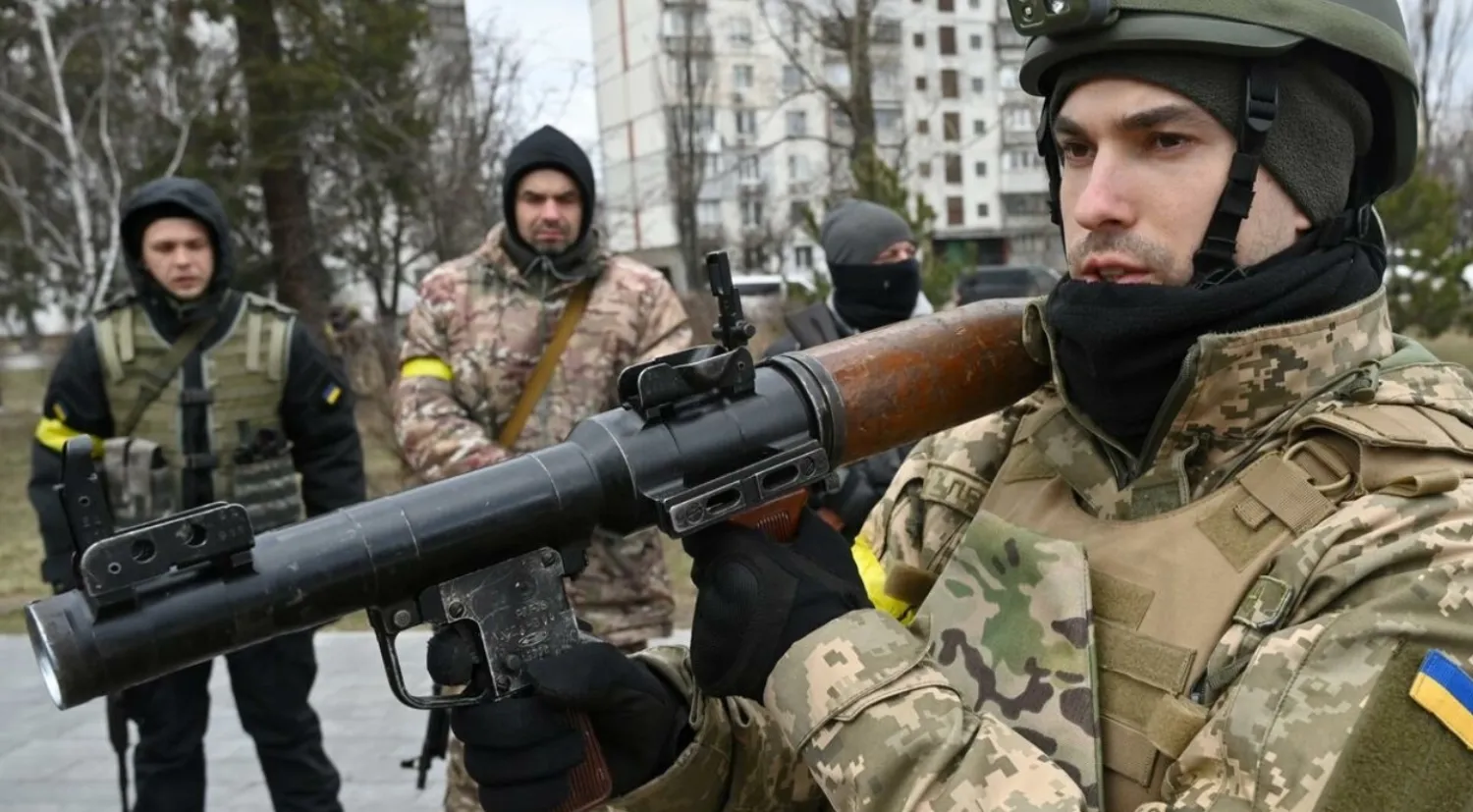
Russian Airstrike Hits Base in Western Ukraine, Kills 35

Ukrainian soldiers defending Kyiv hope the enemy forces, which have struggled to take large cities, will eventually get bogged down GENYA SAVILOV AFP
TT

Russian Airstrike Hits Base in Western Ukraine, Kills 35

Ukrainian soldiers defending Kyiv hope the enemy forces, which have struggled to take large cities, will eventually get bogged down GENYA SAVILOV AFP

Waves of Russian missiles pounded a military training base close to Ukraine’s western border with NATO member Poland, killing 35 people. The strike followed Russian threats to target foreign weapon shipments that are helping Ukrainian fighters defend their country against Russia's grinding invasion.

More than 30 Russian cruise missiles targeted the sprawling training facility that is less than 25 kilometers (15 miles) from the closest border point with Poland, according to the governor of Ukraine’s western Lviv region. Poland is a key location for routing Western military aid to Ukraine.

Since Russia invaded Ukraine, Lviv had largely been spared the scale of destruction unfolding further east and become a destination for residents escaping bombarded cities and for many of the nearly 2.6 million refugees who have fled the country.

The training center in Yavoriv appears to be the most westward target struck so far in the 18-day invasion. The facility, also known as the International Peacekeeping and Security Center, has long been used to train Ukrainian military personnel, often with instructors from the United States and other NATO countries.

It has also hosted international NATO drills. As such, the site symbolizes what has long been a Russian complaint: That the NATO alliance of 30 member countries is moving ever closer to Russia’s borders. Russian has demanded that Ukraine drop its ambitions to join NATO.

Lviv governor Maksym Kozytskyi said most of the missiles fired Sunday “were shot down because the air defense system worked.” The ones that got through through killed at least 35 people and wounded 134, he said, The Associated Press reported.

Russian fighters also fired at the airport in the western city of Ivano-Frankivsk, which is less than 150 kilometers (94 miles) north of Romania and 250 kilometers (155 miles) from Hungary, countries that also are NATO allies. The airport, which includes a military airfield as well as a runway for civilian flights, also was targeted Friday.

Fighting also raged in multiple areas of the country overnight. Ukrainian authorities said Russian airstrikes on a monastery and a children's resort in the eastern Donetsk region hit spots where monks and refugees were sheltering, wounding 32 people.

Another airstrike hit a westward-bound train evacuating people from the east, killing one person and injuring another, Donetsk's chief regional administrator said.

To the north, in the city of Chernihiv, one person was killed and another injured in a Russian airstrike that destroyed a residential block, emergency services said.

Around the capital, Kyiv, a major political and strategic target for the invasion, fighting also intensified, with overnight shelling in the northwestern suburbs and a missile strike Sunday that destroyed a warehouse to the east.

In Irpin, a suburb about 12 miles (20 kilometers) northwest of central Kyiv, bodies lay out in the open Saturday on streets and in a park.

“When I woke up in the morning, everything was covered in smoke, everything was dark. We don’t know who is shooting and where,” resident Serhy Protsenko said as he walked through his neighborhood. Explosions sounded in the distance. “We don’t have any radio or information.”

Chief regional administrator Oleksiy Kuleba said Russian forces appeared to be trying to blockade and paralyze the capital with day and night shelling of the suburbs. Kuleba said Russian agents were in the capital and its suburbs, marking out possible future targets.

He vowed that any all-out assault would meet stiff resistance, saying: “We’re getting ready to defend Kyiv, and we’re prepared to fight for ourselves.”

Talks aimed at reaching a cease-fire again failed Saturday, and the US announced plans to provide another $200 million to Ukraine for weapons. Russian Deputy Foreign Minister Sergei Ryabkov warned other nations that sending equipment to bolster Ukraine's military was "an action that makes those convoys legitimate targets.”

Russian soldiers pillaged a humanitarian convoy that was trying to reach the battered and encircled port city of Mariupol, where more than 1,500 people have died, a Ukrainian official said. Ukraine’s military said Russian forces captured Mariupol’s eastern outskirts, tightening their siege of the strategic port. Taking Mariupol and other ports on the Azov Sea could allow Russia to establish a land corridor to Crimea, which it seized from Ukraine in 2014.

Ukrainian President Volodymyr Zelenskyy accused Russia of trying to break his country apart, as well as starting “a new stage of terror” with the alleged detention of a mayor from a city west of Mariupol.
“Ukraine will stand this test. We need time and strength to break the war machine that has come to our land,” Zelenskyy said during his nightly address to the nation Saturday.
Zelenskyy reported that 1,300 Ukrainian soldiers had died since the Russian invasion began Feb. 24.

The first major city to fall, earlier this month, was Kherson, a vital Black Sea port of 290,000 residents. Zelenskyy said Saturday that Russians were using blackmail and bribery in an attempt to force local officials to form a “pseudo-republic” in the southern Kherson region, much like those in Donetsk and Luhansk, two eastern regions where pro-Russian separatists began fighting Ukrainian forces in 2014. One of the pretexts Russia used to invade was that it had to protect the separatist regions.

Zelenskyy again deplored NATO’s refusal to declare a no-fly zone over Ukraine and said Ukraine has sought ways to procure air defense assets, though he didn't elaborate. US President Joe Biden announced another $200 million in aid to Ukraine, with an additional $13 billion included in a bill that has passed the House and should pass the Senate within days. NATO has said that imposing a no-fly zone could lead to a wider war with Russia.

Moscow has said it would establish humanitarian corridors out of conflict zones, but Ukrainian officials have accused Russia of disrupting those paths and firing on civilians. Russian forces have hit at least two dozen hospitals and medical facilities, according to the World Health Organization.

Ukrainian Deputy Prime Minister Iryna Vereshchuk said just nine of 14 agreed-upon corridors were open on Saturday, and that about 13,000 people had used them to evacuate around the country.

The leaders of France and Germany spoke Saturday with Russian President Vladimir Putin in a failed attempt to reach a cease-fire. To end the war, Moscow has demanded that Ukraine drop its bid to join NATO and adopt a neutral status; acknowledge the Russian sovereignty over Crimea, which it annexed from Ukraine in 2014; recognize the independence of separatist regions in the country’s east; and agree to demilitarize.

Thousands of soldiers on both sides are believed to have been killed along with many civilians, including at least 79 Ukrainian children, the government said.

The Russian invaders appear to have struggled more than expected against determined Ukrainian fighters. Still, Russia’s stronger military threatens to grind down Ukrainian forces. The United Nations has said the fighting has displaced millions of Ukrainians within the country on top of the millions who have left.

Elena Yurchuk, a nurse from the northern city of Chernihiv, was in a Romanian train station Saturday with her teenage son, Nikita, unsure whether their home was still standing.

“We have nowhere to go back to,” said Yurchuk, 44, a widow who hopes to find work in Germany. “Nothing left.”


Iran Warns of Domestic Gas Shortages from War This Winter

 People walk through the rain near Tehran's traditional main bazaar in Tehran, Iran, Saturday, Nov. 7, 2026. (AP)
People walk through the rain near Tehran's traditional main bazaar in Tehran, Iran, Saturday, Nov. 7, 2026. (AP)
TT

Iran Warns of Domestic Gas Shortages from War This Winter

 People walk through the rain near Tehran's traditional main bazaar in Tehran, Iran, Saturday, Nov. 7, 2026. (AP)
People walk through the rain near Tehran's traditional main bazaar in Tehran, Iran, Saturday, Nov. 7, 2026. (AP)

Iran's government has ‌warned of worsening internal gas shortages this winter as a result of damage to processing facilities in the war with the United States that could lead to cuts in supply.

"If the level of consumption is high it is possible that gas cuts will occur all over the country including in Tehran," government spokesperson Fatemeh Mohajerani said in a news conference in Tehran on Tuesday.

Iran, a major oil producer, controls part of the world's biggest natural gas ‌field but has ‌sometimes faced difficulty meeting domestic demand ‌because ⁠of outdated equipment, worsened by ⁠international sanctions. It is now subject to a US blockade of its ports.

The country faced some gas shortages and power cuts even before the conflict that began with a US and Israeli air campaign on February 28, a situation which has now worsened.

Mohajerani forecast a ⁠shortfall of 430 million cubic meters in gas ‌supply this year, compared ‌to about 300 million cubic meters in previous years.

National Iranian Gas ‌Company managing director Saeed Tavakoli said this month there ‌had been damage to four processing plants during the first phase of the conflict early this year, which initially reduced capacity by 230 million cubic meters, of which around 100 million ‌had so far been restored.

Last week the company warned that 11 of Iran's 31 ⁠provinces could ⁠face supply difficulties this winter, naming Mazandaran on the Caspian coast, and Golestan and North Khorasan along Iran's border with Turkmenistan, as most vulnerable.

Political leaders have urged Iranians to use less gas. Parliament Speaker Mohammad Baqer Qalibaf on Sunday called on Iranians to cut their gas use by 10% ahead of the winter.

Iran's First Vice President Mohammad Reza Aref was cited by state news agency IRNA on Monday as saying gas prices could rise as a result of the reduced supply if consumption was excessive.


Iran Slams US’s ‘Repugnant’ $20Mn Reward for Nuclear Info

Iran's Foreign Minister Abbas Araghchi looks on after a session of the United Nations Conference on Disarmament, on the sideline of a second round of US-Iranian nuclear negotiations in Geneva, on Feb. 17, 2026. (AFP/Getty Images)
TT

Iran Slams US’s ‘Repugnant’ $20Mn Reward for Nuclear Info

Iran's Foreign Minister Abbas Araghchi looks on after a session of the United Nations Conference on Disarmament, on the sideline of a second round of US-Iranian nuclear negotiations in Geneva, on Feb. 17, 2026. (AFP/Getty Images)

Iran hit out at the United States' $20 million reward for information on its nuclear program on Wednesday, calling it "repugnant and regrettable".

Foreign Minister Abbas Araghchi urged the United Nations' atomic energy agency and the Security Council to condemn the reward, which was announced last week.

Last Friday, the US military said up to $20 million and "possible relocation" were available for information about the program's "facilities, equipment, and associated personnel".

"Iran calls upon the UN Secretary-General, the Security Council, and the Director General of the IAEA to condemn this repugnant announcement explicitly and unequivocally," Araghchi wrote in a letter addressed to all three.

He repeated Iran's insistence that its nuclear program is peaceful.

US President Donald Trump has repeatedly said Iran's nuclear program was effectively obliterated by the brief US strikes on key Iranian nuclear facilities during the 12-day war between Iran and Israel in June 2025.

Since that war, Iran has blocked International Atomic Energy Agency inspectors from visiting bombed facilities at Fordow, Natanz and Isfahan.

War broke out between Iran and the United States on February 28 when US-Israeli strikes killed the country’s supreme leader Ali Khamenei.

During the war's most intense phase, US-Israeli strikes hit Iranian nuclear sites again, but the scale of the damage remains unclear.

Diplomatic efforts, led by Qatar and Pakistan, have been underway to negotiate an end to the war.

Tehran has insisted Washington accepts a raft of demands including unfreezing assets and lifting sanctions in return for reopening the Strait of Hormuz, the vital energy conduit it has blockaded since the start of the conflict.

Araghchi previously said that talks over Iran's nuclear program would come at a later stage.

Iran's nuclear program has been at the center of tensions for years. In 2018, during Trump's first term, the US withdrew from an agreement struck under Barack Obama that aimed to stop it developing nuclear weapons in return for sanctions relief.


German Military Bans Chinese-Made Drones

 Chinese-manufactured EHANG-E216 passenger drone taxi flies over the Colombo Port city during its first test flight in Colombo on November 11, 2026. (AFP)
Chinese-manufactured EHANG-E216 passenger drone taxi flies over the Colombo Port city during its first test flight in Colombo on November 11, 2026. (AFP)
TT

German Military Bans Chinese-Made Drones

 Chinese-manufactured EHANG-E216 passenger drone taxi flies over the Colombo Port city during its first test flight in Colombo on November 11, 2026. (AFP)
Chinese-manufactured EHANG-E216 passenger drone taxi flies over the Colombo Port city during its first test flight in Colombo on November 11, 2026. (AFP)

The German military has banned the use of Chinese-made drones, including for training, and is replacing them with European models, the defense ministry said on Wednesday.

Citing the need for data and IT security, the ministry said that "Chinese-made models will no longer be used ... and existing systems will be replaced by products from domestic or, where applicable, European sources".

News magazine Der Spiegel first reported on the decision, based on worries the drones could transmit data on military exercises, training grounds or weapons systems to Chinese intelligence services.

The ministry said the armed forces, the Bundeswehr, had used "inexpensive, off-the-shelf drones for training purposes", buying them "with minimal bureaucratic effort".

"To strengthen the Bundeswehr's self-sufficiency and technological sovereignty, Chinese-made models will no longer be used for target or training purposes," its statement said.