

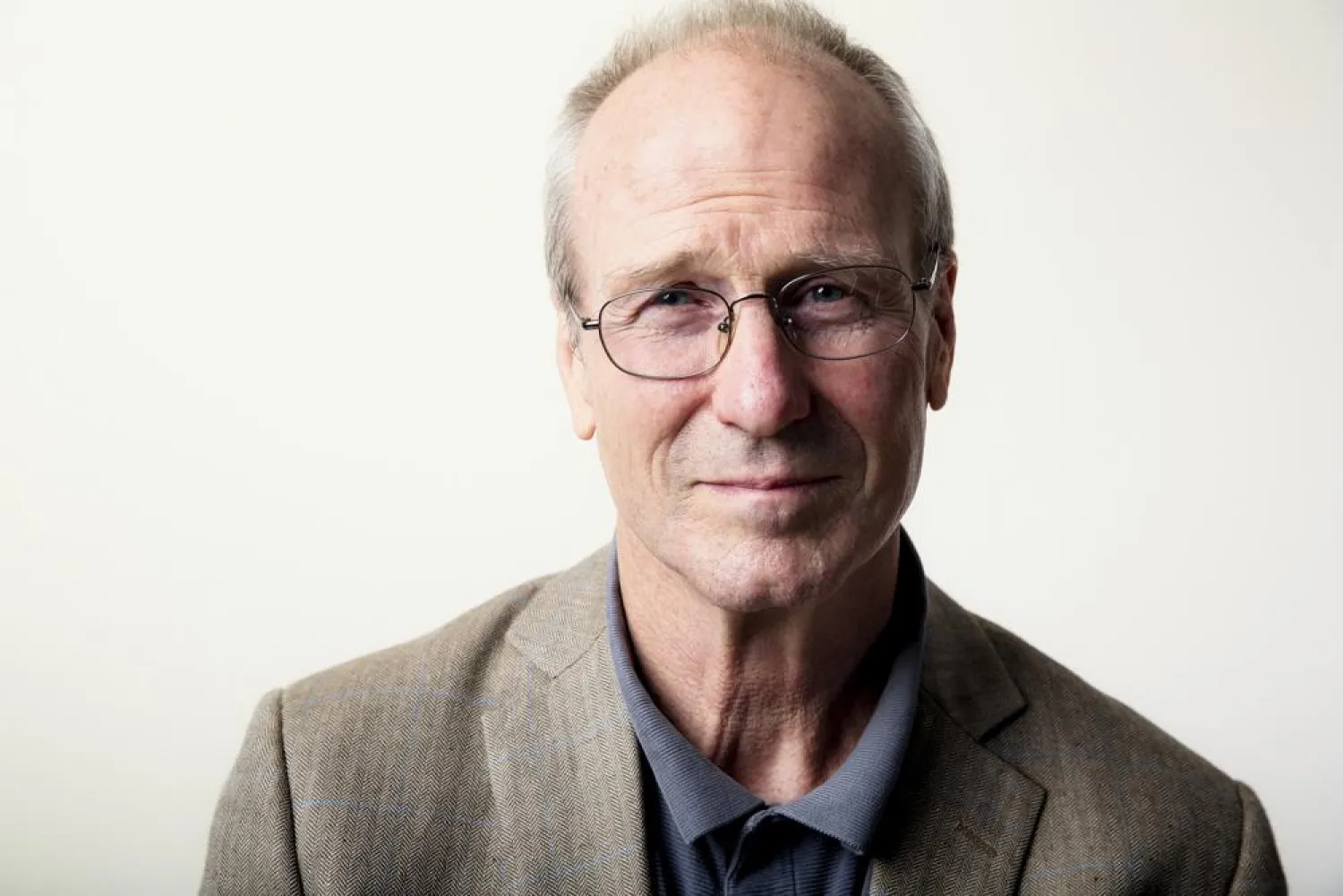

William Hurt, Star of 'Broadcast News,' 'Body Heat,' Dies

William Hurt, a cast member in the Amazon series "Goliath," poses for a portrait during the 2016 Television Critics Association Summer Press Tour at the Beverly Hilton on Sunday, Aug. 7, 2016, in Beverly Hills, Calif. (AP)
TT

William Hurt, Star of 'Broadcast News,' 'Body Heat,' Dies

William Hurt, a cast member in the Amazon series "Goliath," poses for a portrait during the 2016 Television Critics Association Summer Press Tour at the Beverly Hilton on Sunday, Aug. 7, 2016, in Beverly Hills, Calif. (AP)

William Hurt, whose laconic charisma and self-assured subtlety as an actor made him one of the 1980s foremost leading men in movies such as “Broadcast News,” “Body Heat” and “The Big Chill,” has died. He was 71.

Hurt’s son, Will, said in a statement that Hurt died Sunday of natural causes. Hurt died peacefully, among family, his son said. The Hollywood Reporter said he died at his home in Portland, Oregon. Deadline first reported Hurt’s death. Hurt was previously diagnosed with prostate cancer that had spread to the bone in 2018.

In a long-running career, Hurt was four times nominated for an Academy Award, winning for 1985′s “Kiss of the Spider Woman.” After his breakthrough in 1980’s Paddy Chayefsky-scripted “Altered States” as a psychopathologist studying schizophrenia and experimenting with sensory deprivation, Hurt quickly emerged as a mainstay of the ’80s.

In Lawrence Kasdan’s 1981 steamy neo noir “Body Heat,” Hurt starred alongside Kathleen Turner as a lawyer coaxed into murder. In 1983’s “The Big Chill,” again with Kasdan, Hurt played the brooding Vietnam War veteran Nick Carlton, one of a group of college pals who gather for their friend’s funeral.

Hurt, whose father worked for the State Department, was born in Washington DC and traveled widely as a child while attending boarding school in Massachusetts. His parents divorced when he was young. When Hurt was 10, his mother married Henry Luce III, son of the Time magazine founder. Hurt studied acting at Julliard and first emerged on the New York stage with the Circle Repertory Company. After “The Big Chill,” he returned to the stage to star on Broadway in David Rabe’s “Hurlyburly,” for which he was nominated for a Tony.

Shortly after came “Kiss of the Spider Woman,” which won Hurt the best actor Oscar for his performance as a prisoner in a repressive South American dictatorship.

“I am very proud to be an actor,” Hurt said, accepting the award.

In 1986′s “Children of a Lesser God,” it was his co-star, Marlee Matlin, who took the Oscar for her performance as a custodian at a school for the deaf. Hurt played a speech teacher. For Hurt and Matlin, their romance was off-screen, as well — but it wasn’t Hurt’s first experience with his private life finding notoriety.

Hurt was first married to actor Mary Beth Hurt (also a “Big Chill” co-star) from 1971 to 1982. While he was married, he began a relationship with Sandra Jennings, whose pregnancy with their son precipitated Hurt’s divorce from Mary Beth Hurt. A high-profile court case ensued six years later in which Jennings claimed she had been Hurt’s common-law wife under South Carolina law and thus entitled to a share of his earnings. A New York court ruled in Hurt’s favor, but the actor continued to have a strained relationship with fame.

“Acting is a very intimate and private thing,” Hurt told The New York Times in 1983. “The art of acting requires as much solitude as the art of writing. Yeah, you bump up against other people, but you have to learn a craft, technique. It’s work. There’s this odd thing that my acting is assumed to be this clamor for attention to my person, as if I needed so much love or so much attention that I would give up my right to be a private person.”

In her 2009 memoir, Matlin detailed physical and emotional abuse during their relationship. At the time of its publishing, Hurt issued an apology saying: “My own recollection is that we both apologized and both did a great deal to heal our lives.”

In those years, Hurt also struggled with drug and alcohol abuse, and attended rehabilitation clinics. He also developed a reputation for not always being an easy collaborator. The New Yorker called him “notoriously temperamental.” In 1989, Hurt married to Heidi Henderson, who he met at rehab. They had two children together. Hurt also had a daughter with French actress and filmmaker Sandrine Bonnaire, whom he met while making the straight-to-video 1992 Albert Camus adaptation “The Plague.”

Among Hurt’s greatest performances was James L. Brooks’ 1987 comedy “Broadcast News,” as a slick but lightweight anchorman who symbolized the emerging fusion of entertainment and journalism.

Albert Brooks, Hurt’s “Broadcast News” co-star, was among the many who responded to Hurt’s passing Sunday. “So sad to hear this news,” wrote Brooks on Twitter. “Working with him on ‘Broadcast News’ was amazing. He will be greatly missed.”

After his torrid ’80s run, Hurt fell increasingly out of favor with filmmakers in the ’90s, and some reasoned that it was because of his reputation. Hurt, however, continued to defend his approach, telling The Los Angeles Times in 1994 that “I give more by solving the truth than by pandering to expectations and facile hopes.”

“If a director tells me to make the audience think or feel a certain thing, I am instantaneously in revolt,” Hurt said. “I’m not there to make anyone else think or feel anything specific. I have agreed to something the whole piece says. Beyond that it is my only obligation to solve the truth of the piece. I don’t owe anybody anything — including the director.”

Nevertheless, Hurt never slowed down, piling up credits in the ’90s and ’00s — Woody Allen’s “Alice,” Wayne Wong’s “Smoke,” Nora Ephron’s “Michael,” Franco Zeffirelli’s “Jane Eyre.”

Hurt, always a intelligent screen presence, gradually morphed into a character actor. He received his fourth Oscar nomination for his small but potent role in David Cronenberg’s 2005 thriller “A History of Violence.”

Hurt continued to work constantly in the years leading up to his death: 10 episodes of “Damages”; a string of Marvel films, including “Avengers: Endgame” and “Black Widow,” as the military officer Thaddeus Ross; 14 episodes on Amazon’s “Goliath.”

Often, Hurt suggested that his fabled run in the ’80s was more the outlier to what defined him as an actor.

“Success is isolating,” he told The Telegraph in 2004. “Certainly the Oscar was isolating. In some ways, it was antithetical to what I was aiming at. I didn’t want to be isolated. I didn’t want some big target on my chest saying: ‘He’s an Oscar-winner, he’s the one to be.’ I wanted to be an actor, so I was very confused about it. Sometimes I’m still confused about it.”



Over 80 Berlin Film Festival Alumni Sign Open Letter Urging Organizers to Take Stance on Gaza 

12 February 2026, Berlin: President of the Berlinale jury Wim Wenders waves to the audience on the opening night of the 76th Berlin International Film Festival, before the premiere of the opening film "No Good Men" at the Berlinale Palast. (dpa)
TT

Over 80 Berlin Film Festival Alumni Sign Open Letter Urging Organizers to Take Stance on Gaza 

12 February 2026, Berlin: President of the Berlinale jury Wim Wenders waves to the audience on the opening night of the 76th Berlin International Film Festival, before the premiere of the opening film "No Good Men" at the Berlinale Palast. (dpa)

More than 80 actors, directors and other ‌artists who have taken part in the Berlin Film Festival, including Tilda Swinton and Javier Bardem, signed an open letter to the organizers published on Tuesday calling for them to take a clear stance on Israel's war in Gaza.

"We call on the Berlinale to fulfil its moral duty and clearly state its opposition to Israel's genocide, crimes against humanity and war crimes against Palestinians," said the open letter, which was published in full in entertainment industry magazine Variety.

Multiple human rights experts, scholars and a UN inquiry say Israel's assault on Gaza amounts to genocide. Israel calls its actions self-defense after Hamas' October 2023 attack on Israel.

"We are appalled by Berlinale's institutional silence," ‌said the letter, which ‌was also signed by actors Adam McKay, Alia Shawkat and ‌Brian ⁠Cox, and director ⁠Mike Leigh.

It said organizers had not met demands to issue a statement affirming Palestinians' right to life and committing to uphold artists' right to speak out on the issue.

"This is the least it can - and should - do," the letter said.

The festival did not immediately respond to an emailed request for comment.

THE MOST POLITICAL FESTIVAL

The Berlin Film Festival is considered the most political of its peers, Venice and Cannes, and ⁠prides itself on showing cinema from under-represented communities and young ‌talent. However, it has been repeatedly criticized by pro-Palestinian activists ‌for not taking a stand on Gaza, in contrast to the war in Ukraine ‌and the situation in Iran.

Calls have also previously been made for the ‌entertainment industry to take a stance on Gaza.

Last year, over 5,000 actors, entertainers, and producers, including some Hollywood stars, signed a pledge to not work with Israeli film institutions that they saw as being complicit in the abuse of Palestinians by Israel.

Paramount studio later condemned that ‌pledge and said it did not agree with such efforts.

ROY PULLS OUT

Tuesday's letter also condemned statements by this year's ⁠jury president, German director ⁠Wim Wenders, that filmmakers should stay out of politics, writing: "You cannot separate one from the other."

Wenders' comments prompted Indian novelist Arundhati Roy, winner of the Booker Prize in 1997 for her novel "The God of Small Things", to pull out of the festival earlier this week.

Roy, who had been due to present "In Which Annie Gives It Those Ones", a 1989 film which she wrote, in the Berlinale's Classics section, characterized Wenders' comments as "unconscionable."

In response, festival director Tricia Tuttle issued a note on Saturday defending artists' decision not to comment on political issues.

"People have called for free speech at the Berlinale. Free speech is happening at the Berlinale," she said.

"But increasingly, filmmakers are expected to answer any question put to them," she wrote, and are criticized if they do not answer, or answer "and we do not like what they say."


‘Godfather’ and ‘Apocalypse Now’ Actor Robert Duvall Dead at 95 

Actor Robert Duvall arrives at the 72nd Golden Globe Awards in Beverly Hills, California January 11, 2015. (Reuters)
TT

‘Godfather’ and ‘Apocalypse Now’ Actor Robert Duvall Dead at 95 

Actor Robert Duvall arrives at the 72nd Golden Globe Awards in Beverly Hills, California January 11, 2015. (Reuters)

Robert Duvall, who played the smooth mafia lawyer in "The Godfather" and stole the show with his depiction of a surfing-crazed colonel in "Apocalypse Now," has died at the age of 95, his wife said Monday.

His death Sunday was confirmed by his wife Luciana Duvall.

"Yesterday we said goodbye to my beloved husband, cherished friend, and one of the greatest actors of our time. Bob passed away peacefully at home," she wrote.

Blunt-talking, prolific and glitz-averse, Duvall won an Oscar for best actor and was nominated six other times. Over his six decades-long career, he shone in both lead and supporting roles, and eventually became a director. He kept acting in his 90s.

"To the world, he was an Academy Award-winning actor, a director, a storyteller. To me, he was simply everything," Luciana Duvall said. "His passion for his craft was matched only by his deep love for characters, a great meal, and holding court."

Duvall won his Academy Award in 1983 for playing a washed-up country singer in "Tender Mercies."

But his most memorable characters also included the soft-spoken, loyal mob consigliere Tom Hagen in the first two installments of "The Godfather" and the maniacal Lieutenant Colonel William Kilgore in Francis Ford Coppola's 1979 Vietnam War epic "Apocalypse Now."

"It was an honor to have worked with Robert Duvall," Oscar winner Al Pacino, who acted alongside Duvall in "The Godfather" films, said in a statement.

"He was a born actor as they say, his connection with it, his understanding and his phenomenal gift will always be remembered. I will miss him."

As Colonel Kilgore, Duvall earned an Oscar nomination and became a bona fide star after years playing lesser roles, in a performance where he utters what is now one of cinema's most famous lines.

"I love the smell of napalm in the morning," his war-loving character -- bare chested, cocky and sporting a big black cowboy hat -- muses as low-flying US warplanes bomb a beachfront tree line where he wants to go surfing.

That character was originally created to be even more over the top -- his name was at first supposed to be Colonel Carnage -- but Duvall had it toned down, demonstrating his meticulous approach to acting.

"I did my homework," Duvall told veteran talk show host Larry King in 2015. "I did my research."

Cinema giant Francis Ford Coppola -- who directed Duvall in "Apocalypse Now" and "The Godfather" -- called his loss "a blow."

"Such a great actor and such an essential part of American Zoetrope from its beginning," Coppola said in a statement on Instagram.

- A 'vast career' -

Duvall was sort of a late bloomer in Hollywood -- he was already 31 when he delivered his breakout performance as the mysterious recluse Boo Radley in the 1962 film adaptation of Harper Lee's novel "To Kill a Mockingbird."

He would go on to play myriad roles -- a bullying corporate executive in "Network" (1976), a Marine officer who treats his family like soldiers in "The Great Santini" (1979), and then his star turn in "Tender Mercies."

Duvall often said his favorite role, however, was one he played in a 1989 TV mini-series -- the grizzled, wise-cracking Texas Ranger-turned-cowboy Augustus McCrae in "Lonesome Dove," based on the novel by Larry McMurtry.

British actress Jane Seymour, who worked with Duvall on the 1995 film "The Stars Fell on Henrietta," took to Instagram to share a heartfelt tribute to the star.

"We were able to share in his love of barbecue and even a little tango," Seymour captioned a photo of herself with Duvall. "Those moments off camera were just as memorable as the work itself."

US actor Alec Baldwin made a short video tribute to Duvall, speaking about the star's "vast career."

"When he did 'To Kill A Mockingbird' he just destroyed you with his performance of Boo Radley, he used not a single word of dialogue, not a single word, and he just shatters you," Baldwin said.

Film critic Elaine Mancini once described Duvall as "the most technically proficient, the most versatile, and the most convincing actor on the screen in the United States."


Songwriter Billy Steinberg Dies at 75

Grammy-winning songwriter Billy Steinberg (L) was behind several top hits of the 1980s and 1990s including Madonna's 'Like A Virgin'. Paul A. Hebert / GETTY IMAGES NORTH AMERICA/AFP/File
TT

Songwriter Billy Steinberg Dies at 75

Grammy-winning songwriter Billy Steinberg (L) was behind several top hits of the 1980s and 1990s including Madonna's 'Like A Virgin'. Paul A. Hebert / GETTY IMAGES NORTH AMERICA/AFP/File

Award-winning US songwriter Billy Steinberg, who wrote several top hit songs including Madonna's "Like a Virgin," died Monday at age 75, according to media reports.

Steinberg wrote some of the biggest pop hits of the 1980s and 1990s and was behind songs performed by singers from Whitney Houston and Celine Dion to Madonna and Cyndi Lauper.

He died following a battle with cancer, his attorney told the Los Angeles Times and BBC News.

"Billy Steinberg's life was a testament to the enduring power of a well-written song -- and to the idea that honesty, when set to music, can outlive us all," his family said in a statement to the outlets.

Steinberg was born in 1950 and grew up in Palm Springs, California, where his family had a table grape business. He attended Bard College in New York and soon began his career in songwriting.

He helped write five number one singles on the Billboard Hot 100 list. Among those was "Like a Virgin," co-written with Tom Kelly, which spent six consecutive weeks at the top of the charts.

Steinberg won a Grammy Award in 1997 for his work on Celine Dion's "Falling Into You."

He was inducted into the Songwriters Hall of Fame in 2011.