


UK Sends Missiles to Ukraine, Welcomes Refugees

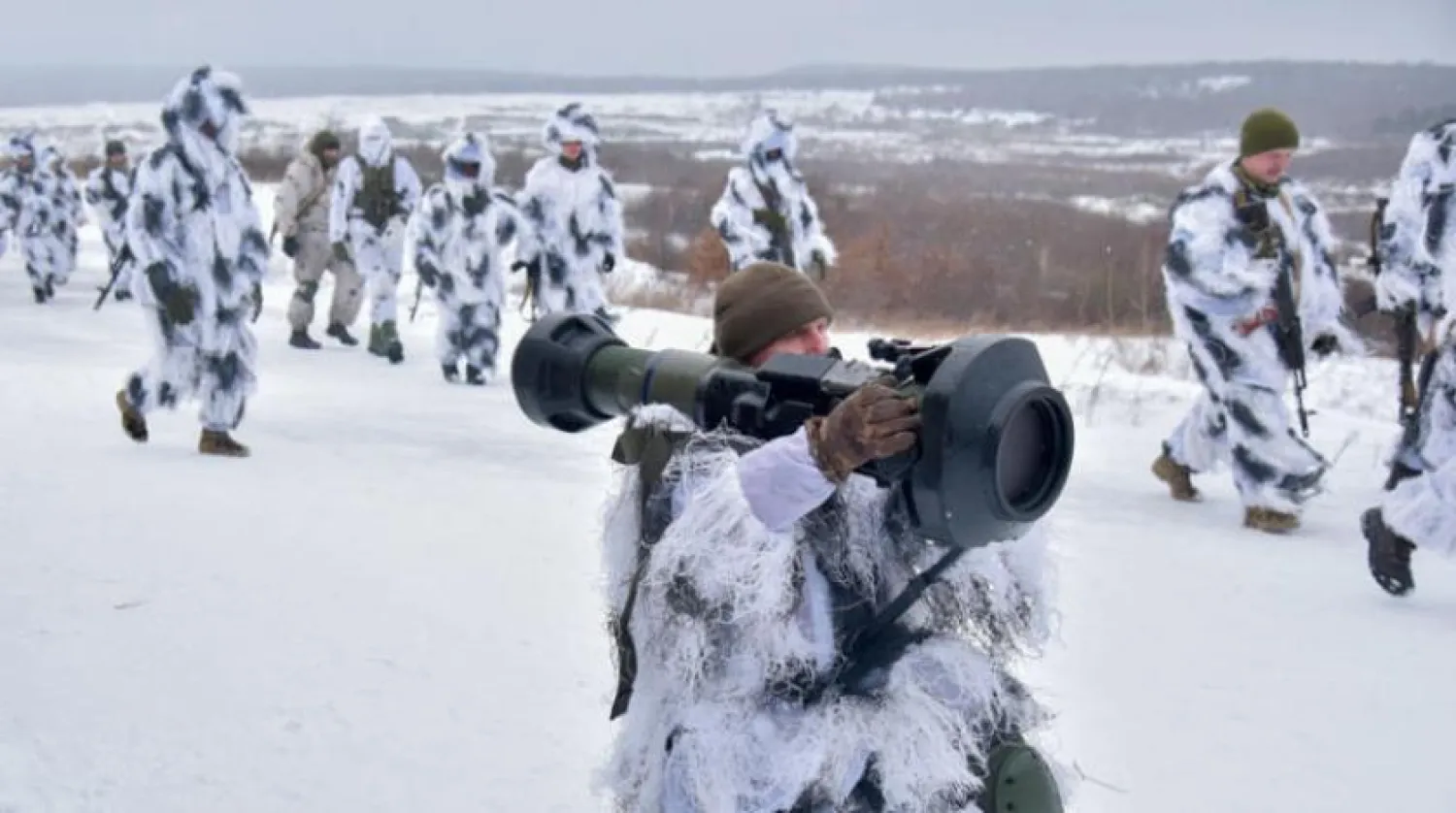
Ukrainian soldiers training with NLAW military materiel during a drill in western Ukraine (EPA)
TT

UK Sends Missiles to Ukraine, Welcomes Refugees

Ukrainian soldiers training with NLAW military materiel during a drill in western Ukraine (EPA)

A British official said he was satisfied with the weapons his country was sending to help the Ukrainian army against the Russian offensive.

The official did not elaborate, but it was evident that he was pleased with the weapons seeing a video footage from Ukraine showing the British missile launchers destroying large numbers of Russian tanks and armored vehicles.

Britain, along with the US, was one of the first countries to provide Ukraine with advanced "lethal" weapons described as "defensive" - weeks before the Russian military operation on February 24.

The first batch of British aid, on January 17, included at least 2,000 Next Generation Light Antitank Weapons (NLAW), in addition to weapons, ammunition, armor, helmets, military boots, food, and communications and positioning equipment.

On March 9, the Minister of Defense, Ben Wallace, revealed that his country intends to supply military aid to the Ukrainian armed forces.

"In response to further acts of aggression by Russia, we have now increased that supply. I can update the House that, as of today, we have delivered 3,615 NLAWs and continue to deliver more," Wallace told the House of Commons.

He indicated that the government would shortly start the delivery of a small consignment of anti-tank Javelin missiles.

"I want to assure the House that everything we do is bound by the decision to supply defensive systems and is calibrated not to escalate to a strategic level."

The government has decided to explore the donation of Starstreak high-velocity, man-portable anti-air missiles.

"We believe that this system will remain within the definition of defensive weapons but will allow the Ukrainian forces to better defend their skies," said the minister.

On Monday, Prime Minister Boris Johnson's spokesman said that the Russian missile strikes on a Ukrainian base near the Polish border are deeply concerning but will not deter Britain from continuing to provide Ukraine with defensive weapons.

The announcement came after Russian missile strikes targeted a major Ukrainian base near the border with Poland that British soldiers used last year to train Ukrainian soldiers to use anti-tank missiles.

A spokesman for the British Foreign Office told Asharq Al-Awsat that the United Kingdom was the leading European country supporting Ukraine's sovereignty.

He recalled that since 2015, British forces had trained more than 22,000 members of the Ukrainian armed forces, and the government approved a £1.7 billion loan to develop Ukraine's maritime capabilities.

He noted that the European Union and many other countries have begun sending defensive weapons to Ukraine.

The spokesman clarified that the UK remains a solid supporter of Ukraine's request for NATO membership per the NATO Bucharest Summit Declaration in 2008.

At the Bucharest Summit, NATO Allies welcomed Ukraine's and Georgia's Euro-Atlantic aspirations for membership and agreed that these countries would become members of NATO.

The spokesman noted that Ukraine has the right to choose its alliances, its future, and Russia, according to its repeated agreements, has no right to dictate that choice on the Ukrainians.

The British support for Ukraine also extends to other non-military areas.

The British government launched the most comprehensive campaign against the wealthy Russians accused of having ties to President Vladimir Putin.

The government froze their assets, estimated at billions of dollars. It also imposed sanctions on a wide range of Russian companies and senior officials, including 386 members of the State Duma who voted to recognize the independence of Lugansk and Donetsk.

Britain also provided financial support to the Ukrainian government to help it deal with the repercussions of the Russian attack.

It launched a campaign to encourage its citizens to host Ukrainian families fleeing their country.

The new scheme called "Homes for Ukraine" will let refugees from the war come to Britain even if they do not have family ties, the government said on Sunday.

Britain will pay people 350 pounds ($456) a month if they can offer refugees a spare room or property for a minimum period of six months.

The government will also support municipalities to provide free education, health care, and assistance to those entitled to residing and working in Britain for three years before applying to settle their situation and stay in this country.

The government says there is no limit for the Ukrainian refugees, but tens of thousands of Ukrainian refugees could come to the UK.

However, Ukraine's neighboring countries currently host at least 2.7 million displaced persons amid expectations that more of them will arrive as the Russian offensive heats up.



Pezeshkian Says Middle East Has No Need for US 'Policeman'

Indian Prime Minister Narendra Modi, right, greets Iranian President Masoud Pezeshkian upon his arrival for the BRICS summit in New Delhi, India, Saturday, Sept. 12, 2026. (Indian Foreign Ministry via AP)
TT

Pezeshkian Says Middle East Has No Need for US 'Policeman'

Indian Prime Minister Narendra Modi, right, greets Iranian President Masoud Pezeshkian upon his arrival for the BRICS summit in New Delhi, India, Saturday, Sept. 12, 2026. (Indian Foreign Ministry via AP)

Iran's President Masoud Pezeshkian said on Saturday that the Middle East does not need the United States to be a "regional policeman,” with the two countries at war and vying for control of the Strait of Hormuz.

"We do not need a regional policeman," he said on the sidelines of a BRICS summit in India during a meeting with Malaysian Prime Minister Anwar Ibrahim.

"The territorial integrity and security of the region can only be guaranteed by its main players and the countries that comprise it," he added, according to the Iranian presidency.

Iran has been at war since February 28, when US-Israeli strikes killed its supreme leader.

Tehran retaliated with attacks across the region and blockaded the Strait of Hormuz, through which one-fifth of the world's oil previously flowed.

Iran and the US have since been vying for control of the strategic waterway.

The strait was free to transit before the war, but Iran now requires vessels to obtain permission and is considering a mechanism to impose service fees.

Ships that do not comply are regularly targeted by Iranian strikes, while the US periodically bombs the Iranian coastline to challenge the country's control of the strait.

More than six months into the Middle East war, the blockade continues to drive up oil prices, which soared past $100 a barrel this week.

"Despite all the injustices suffered by our people, we neither desire war nor its continuation. Peace remains our priority," Pezeshkian added.


Trump Says Iran War Will End after US Midterm Elections

US President Donald Trump meets with Ireland's Prime Minister (Taoiseach) Micheal Martin (not pictured) at Farmleigh House in Dublin, Ireland, September 12, 2026. REUTERS/Kylie Cooper
TT

Trump Says Iran War Will End after US Midterm Elections

US President Donald Trump meets with Ireland's Prime Minister (Taoiseach) Micheal Martin (not pictured) at Farmleigh House in Dublin, Ireland, September 12, 2026. REUTERS/Kylie Cooper

President Donald Trump repeated on Saturday that he believed the war with Iran will end after US midterm elections in November and that oil ⁠prices will tumble once ⁠it does.

"I think very soon. I think it'll be probably ⁠right after the mid-terms. They're trying to hold out as long as they can to complicate the election. But I think people are wise to ⁠it," Trump ⁠told reporters in Dublin.

"When that happens, oil prices will come tumbling down."

Earlier, Iran's President Masoud Pezeshkian said that the Middle East does not need the United States to be a "regional policeman.”

Iran has been at war since February 28, when US-Israeli strikes killed its supreme leader.

Tehran retaliated with attacks across the region and blockaded the Strait of Hormuz, through which one-fifth of the world's oil previously flowed.

Iran and the US have since been vying for control of the strategic waterway.


French Police Suspect Train Derailment Was Sabotage

SNCF workers stand next to a derailed train carriage in Cléon, northwestern France, on September 12, 2026, the morning after the train derailed. (Photo by Guillaume SALIGOT / AFP)
TT

French Police Suspect Train Derailment Was Sabotage

SNCF workers stand next to a derailed train carriage in Cléon, northwestern France, on September 12, 2026, the morning after the train derailed. (Photo by Guillaume SALIGOT / AFP)

Investigators suspect that a train derailment in northwest France which injured 44, one gravely, was the result of sabotage, a police source told AFP on Saturday.

A fragment of rail was found on the track, with the possibility of a malicious act being treated as the main line of inquiry as a result, the source said.

Carrying 186 passengers, the train was running between the Normandy cities of Rouen and Caen when it derailed around 7:45 pm (1745 GMT) Friday.

Authorities activated a mass-casualty response plan, with 130 firefighters, five medical teams and 80 vehicles drafted in.

Rouen prosecutor Sebastien Gallois said 44 people were injured including an 18-year-old woman evacuated "in a critical condition", while tests for drugs and alcohol on the train driver had come back negative.

SNCF Reseau, which controls the French rail network, told AFP that traffic on the line has been suspended and power to the tracks cut to allow emergency services to operate.