


Nations Vet 3,000-page Handbook to Halt Climate Crisis

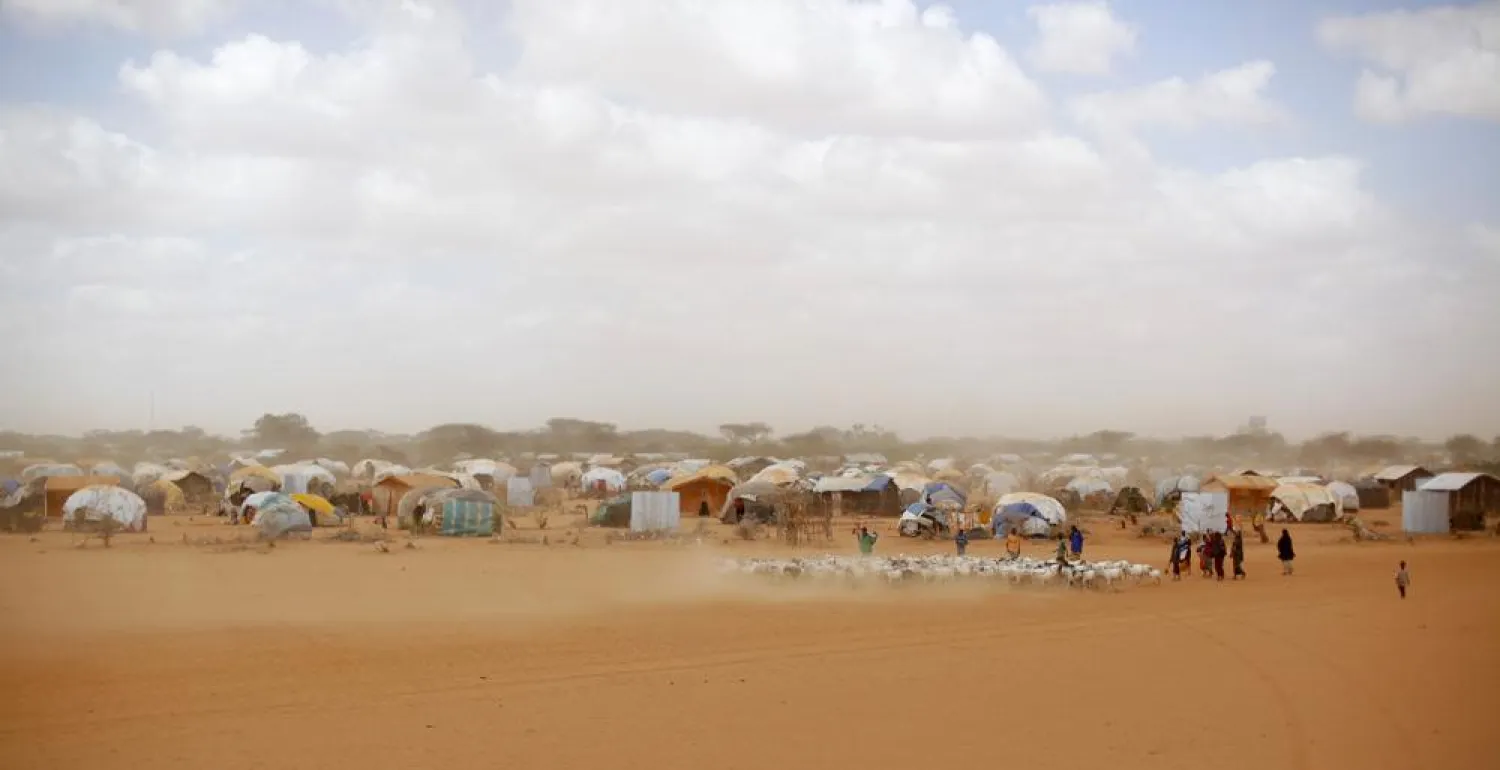
FILE - In this Aug. 7, 2011 file photo, Somali refugees herd their goats at the Ifo refugee camp outside Dadaab, eastern Kenya, 100 kilometers (62 miles) from the Somali border. Climate change could push more than 200 million people to move within their own countries in the next three decades and create migration hotspots unless urgent action is taken. (AP Photo/Jerome Delay, File)
TT

Nations Vet 3,000-page Handbook to Halt Climate Crisis

FILE - In this Aug. 7, 2011 file photo, Somali refugees herd their goats at the Ifo refugee camp outside Dadaab, eastern Kenya, 100 kilometers (62 miles) from the Somali border. Climate change could push more than 200 million people to move within their own countries in the next three decades and create migration hotspots unless urgent action is taken. (AP Photo/Jerome Delay, File)

Nearly 200 nations gather Monday to grapple with a question that will outlive Covid-19 and Russia's invasion of Ukraine: how does a world addicted to fossil fuels prevent carbon pollution from making Earth unliveable?

A partial answer is set for April 4 after closed-door, virtual negotiations approve a nearly 3,000-page report detailing options for drawing down greenhouse gases and extracting them from the air.

"The impacts are costly and mounting, but we still have some time to close the window and get ahead of the worst of them if we act now," said Alden Meyer, a senior analyst at climate and energy think-tank E3G.

"This report will supply the answers as to what we need if we're serious about getting there."

In August 2021, the Intergovernmental Panel on Climate Change (IPCC) laid out the physical science: the pace of global warming and sea level rise, along with shifts in the frequency, duration and intensity of cyclones, heatwaves and droughts.

That was part one in a three-part assessment, the sixth since 1990.

It projected that Earth's surface temperature will rise 1.5 degrees Celsius above preindustrial levels, perhaps within a decade.

A 1.5C cap on global warming -- the aspirational goal of the 2015 Paris climate accord -- has been embraced as a target by most of the world's nations.

It's not hard to see why: barely 1.1C of warming so far has ushered in a crescendo of deadly extreme weather across the globe.

Recently renewed national carbon-cutting commitments, however, still put us on a catastrophic path toward 2.7C of warming by 2100.

- 'Overshooting' 1.5C -
Part two of the IPCC report -- described by UN chief Antonio Guterres as an "atlas of human suffering" -- details past and future climate impacts and the limits of our ability to adapt.

Delaying climate action would severely reduce the chances of a "livable future," it concluded.

Part three is about how to keep planet-warming gases out of the atmosphere, with chapters on the key sectors where rapid and deep change is needed: energy, transport, industry, agriculture, among others.

"We are talking about the large-scale transformation of all the major systems," climate economist and co-author Celine Guivarch told AFP.

The main focus is on weaning the global economy of fossil fuels and moving to low- or zero-carbon sources of energy, from solar and wind to nuclear, hydro and hydrogen.

Helping that transition is the fact that renewable energy is now cheaper than energy generated by fossil fuels in many markets.

The IPCC also details ways to reduce demand for oil, gas and coal, whether by making buildings more energy efficient or encouraging shifts in lifestyle, such as eating less beef and not flying half-way around the world for a week-long holiday.

But humanity has waited so long to take action that switching supply and reducing demand are not enough: we also need to pull CO2 out of the air.

In theory -- because the technology does not yet exist at scale -- carbon dioxide removal will compensate for hard-to-decarbonise sectors such as aviation and shipping, and extract excess CO2 if temperatures "overshoot" the Paris Agreement targets.

- Likely to fail? -
"Delivering on the climate commitments that we've made internationally and nationally is far more challenging than we have been prepared to accept," said Kevin Anderson, a professor of energy and climate change at the University of Manchester.

"Right now, we are very likely to fail. But if we don't try, we are guaranteed to fail," he told AFP.

The IPCC "solutions" report draws from hundreds of models projecting development pathways that keep Earth within the bounds of the Paris temperature goals.

"There are scenarios that show high renewables and low nuclear, and scenarios that show the opposite," said Taryn Fransen, an analyst at the World Resources Institute in Washington DC.

"This report lays out those pathways. Now it's up now to our leaders to take that to heart."

Besides feeding into UN political negotiations, which resume in November in Egypt at COP 27, the IPCC findings will also be important "for the conversation going on in the US and Europe around the need to transition away from Russian oil and gas," said Meyer.

The head of the IPCC delegation from Ukraine made this point in a dramatic statement at a closed plenary in February, only days after Russian troops invaded her country.

"Human-induced climate change and the war on Ukraine have the same roots -- fossil fuels -- and our dependence on them," said Svitlana Krakovska, according to multiple sources.

The Moon and Sun Figure Big in the New Year’s Lineup of Cosmic Wonders

A Boeing 737 Max 8-200 aircraft of Irish budget airline Ryanair flies past the Waxing crescent moon in Frankfurt am Main, western Germany on December 27, 2025. (AFP)
TT

The Moon and Sun Figure Big in the New Year’s Lineup of Cosmic Wonders

A Boeing 737 Max 8-200 aircraft of Irish budget airline Ryanair flies past the Waxing crescent moon in Frankfurt am Main, western Germany on December 27, 2025. (AFP)

The moon and sun share top billing in 2026.

Kicking off the year’s cosmic wonders is the moon, drawing the first astronauts to visit in more than 50 years as well as a caravan of robotic lunar landers including Jeff Bezos’ new supersized Blue Moon. A supermoon looms on Jan. 3 and an astronomical blue moon is on the books for May.

The sun will also generate buzz with a ring-of-fire eclipse at the bottom of the world in February and a total solar eclipse at the top of the world in August. Expect more auroras in unexpected places, though perhaps not as frequently as the past couple years.

And that comet that strayed into our turf from another star? While still visible with powerful backyard telescopes, the recently discovered comet known as 3I/Atlas is fading by the day after swinging past Earth in December. Jupiter is next on its dance card in March. Once the icy outsider departs our solar system a decade from now, it will be back where it belongs in interstellar space.

It’s our third known interstellar visitor. Scientists anticipate more.

“I can’t believe it’s taken this long to find three,” said NASA’s Paul Chodas, who’s been on the lookout since the 1980s. And with ever better technology, “the chance of catching another interstellar visitor will increase.”

Here’s a rundown on what the universe has in store for us in 2026:

Next stop, moon

NASA’s upcoming moonshot commander Reid Wiseman said there’s a good chance he and his crew will be the first to lay eyeballs on large swaths of the lunar far side that were missed by the Apollo astronauts a half-century ago. Their observations could be a boon for geologists, he noted, and other experts picking future landing sites.

Launching early in the year, the three Americans and one Canadian will zip past the moon, do a U-turn behind it, then hustle straight back to Earth to close out their 10-day mission. No stopping for a moonwalk — the boot prints will be left by the next crew in NASA’s Artemis lunar exploration program.

More robotic moon landings are on the books by China as well as US companies. Early in the year, Amazon founder Bezos is looking for his Blue Origin rocket company to launch a prototype of the lunar lander it’s designing for NASA’s astronauts. This Blue Moon demo will stand 26 feet (8 meters), taller than what delivered Apollo’s 12 moonwalkers to the lunar surface. The Blue Moon version for crew will be almost double that height.

Back for another stab at the moon, Astrobotic Technology and Intuitive Machines are also targeting 2026 landings with scientific gear. The only private entity to nail a lunar landing, Firefly Aerospace, will aim for the moon’s far side in 2026.

China is targeting the south polar region in the new year, sending a rover as well as a so-called hopper to jump into permanently shadowed craters in search of ice.

Eclipses

The cosmos pulls out all the stops with a total solar eclipse on Aug. 12 that will begin in the Arctic and cross over Greenland, Iceland and Spain. Totality will last two minutes and 18 seconds as the moon moves directly between Earth and the sun to blot out the latter. By contrast, the total solar eclipse in 2027 will offer a whopping 6 1/2 minutes of totality and pass over more countries.

For 2026, the warm-up act will be a ring-of-fire eclipse in the Antarctic on Feb. 17, with only a few research stations in prime viewing position. South Africa and southernmost Chile and Argentina will have partial viewing. A total lunar eclipse will follow two weeks after February’s ring of fire, with a partial lunar eclipse closing out the action at the end of August.

Parading planets

Six of the solar system’s eight planets will prance across the sky in a must-see lineup around Feb. 28. A nearly full moon is even getting into the act, appearing alongside Jupiter. Uranus and Neptune will require binoculars or telescopes. But Mercury, Venus, Jupiter and Saturn should be visible with the naked eye shortly after sunset, weather permitting, though Mercury and Venus will be low on the horizon.

Mars will be the lone no-show. The good news is that the red planet will join a six-planet parade in August, with Venus the holdout.

Supermoons

Three supermoons will lighten up the night skies in 2026, the stunning result when a full moon inches closer to Earth than usual as it orbits in a not-quite-perfect circle. Appearing bigger and brighter, supermoons are a perennial crowd pleaser requiring no equipment, only your eyes.

The year's first supermoon in January coincides with a meteor shower, but the moonlight likely will obscure the dimmer fireballs. The second supermoon of 2026 won’t occur until Nov. 24, with the third — the year’s final and closest supermoon — occurring the night of Dec. 23 into Dec. 24. This Christmas Eve supermoon will pass within 221,668 miles (356,740 kilometers) of Earth.

Northern and southern lights

The sun is expected to churn out more eruptions in 2026 that could lead to geomagnetic storms here on Earth, giving rise to stunning aurora. Solar action should start to ease, however, with the 11-year solar cycle finally on the downslide.

Space weather forecasters like Rob Steenburgh at the National Oceanic and Atmospheric Administration can’t wait to tap into all the solar wind measurements coming soon from an observatory launched in the fall.

“2026 will be an exciting year for space weather enthusiasts,” he said in an email, with this new spacecraft and others helping scientists “better understand our nearest star and forecast its impacts.”


Row Deepens Over Vanished River Wave in Munich

(FILES) Surfers ride the Eisbach (ice creek) wave during freezing conditions on the Isar River in the English Garden in Munich, southern Germany on January 4, 2017. (Photo by Mark RALSTON / AFP)
TT

Row Deepens Over Vanished River Wave in Munich

(FILES) Surfers ride the Eisbach (ice creek) wave during freezing conditions on the Isar River in the English Garden in Munich, southern Germany on January 4, 2017. (Photo by Mark RALSTON / AFP)

A row over the disappearance of a famous river surfing wave in Munich escalated on Sunday as authorities removed a beam inserted over Christmas to recreate the attraction.

The Eisbach wave on a side branch of the Isar River had been a landmark in the Bavarian city since the 1980s but it vanished in October after annual cleanup work along the riverbed.

Activists had placed a beam in the water early on December 25 to partially recreate the wave, according to German media reports, and hung a banner above the water that read "Merry Christmas".

But a spokesman for the Munich fire service told AFP the "installation was removed" on Sunday at the request of city authorities.

Activists have made several attempts to reinstate the wave in the city's Englischer Garten park since October -- only to see them reversed.

The local surfers' association IGSM on Thursday posted a statement on its website saying it had abandoned its campaign to save the wave, accusing city authorities of dragging their feet.

The Eisbach wave was considered the largest and most consistent river wave in the heart of a major city and had become a tourist attraction in Bavaria's state capital.

Franz Fasel, head of the IGSM, told AFP in July that 3,000 to 5,000 local surfers were using it.

Access to the wave was cut off for several months earlier this year after the death of a 33-year-old Munich woman who became trapped under the surface while surfing at night.


New York Subway Ends its MetroCard Era and Switches Fully to Tap-and-go Fares

Lev Radin, a MetroCard collector, shows his collection of Inaugural Limited Edition MetroCards, Dec. 10, 2025, in New York. (AP Photo/Yuki Iwamura)
TT

New York Subway Ends its MetroCard Era and Switches Fully to Tap-and-go Fares

Lev Radin, a MetroCard collector, shows his collection of Inaugural Limited Edition MetroCards, Dec. 10, 2025, in New York. (AP Photo/Yuki Iwamura)

When the MetroCard replaced the New York City subway token in 1994, the swipeable plastic card infused much-needed modernity into one of the world’s oldest and largest transit systems.

Now, more than three decades later, the gold-hued fare card and its notoriously finicky magnetic strip are following the token into retirement, The Associated Press reported.

The last day to buy or refill a MetroCard is Dec. 31, 2025, as the transit system fully transitions to OMNY, a contactless payment system that allows riders to tap their credit card, phone or other smart device to pay fares, much like they do for other everyday purchases.

Transit officials say more than 90% of subway and bus trips are now paid using the tap-and-go system, introduced in 2019.

Major cities around the world, including London and Singapore, have long used similar contactless systems. In the US, San Francisco launched a pay-go system earlier this year, joining Chicago and others.

MetroCards upended how New Yorkers commute The humble MetroCard may have outlasted its useful life, but in its day it was revolutionary, says Jodi Shapiro, curator at the New York Transit Museum in Brooklyn, which opened an exhibit earlier this month reflecting on the MetroCard’s legacy.

Before MetroCards, bus and subway riders relied on tokens, the brass-colored coins introduced in 1953 that were purchased from station booths. When the subway opened in 1904, paper tickets cost just a nickel, or about $1.82 in today’s dollars.

“There was a resistance to change from tokens to something else because tokens work,” Shapiro said on a recent visit to the museum, housed underground in a decommissioned subway station. “MetroCards introduced a whole other level of thinking for New Yorkers.”

The Metropolitan Transportation Authority launched public campaigns to teach commuters how to swipe the originally blue-colored cards correctly, hoping to avoid the dreaded error message or lost fares. Officials even briefly toyed with the idea of a quirky mascot, the Cardvaark, before coming to their senses.

The cards quickly became collectors items as the transit system rolled out special commemorative editions marking major events, such as the “Subway Series” between baseball’s New York Mets and the New York Yankees in the 2000 World Series. At the time, a fare cost $1.50.

Artists from David Bowie and Olivia Rodrigo to seminal New York hip hop acts, such as the Wu-Tang Clan, the Notorious B.I.G. and LL Cool J, have also graced the plastic card over the years, as have iconic New York shows like Seinfeld and Law & Order.

“For me, the most special cards are cards which present New York City to the world,” said Lev Radin, a collector in the Bronx. “Not only photos of landmarks, skylines, but also about people who live and make New York special.”

Perfecting the correct angle and velocity of the MetroCard swipe also became something of a point of pride separating real New Yorkers from those just visiting.

During her failed 2016 presidential campaign, Hillary Clinton, a former US Senator from New York, took an excruciating five swipes at a Bronx turnstile. In fairness, her chief Democratic opponent at the time, US Sen. Bernie Sanders of Vermont, a native Brooklynite, didn't even appear to realize tokens had been discontinued.

Cost savings and lingering concerns Unlike the MetroCard rollout, OMNY has required little adjustment.

Riders reluctant to use a credit card or smart device can purchase an OMNY card they can reload, similar to a MetroCard. Existing MetroCards will also continue to work into 2026, allowing riders to use remaining balances.

MTA spokespersons declined to comment, pointing instead to their many public statements as the deadline approaches.

The agency has said the changeover saves at least $20 million annually in MetroCard-related costs.

The new system also allows unlimited free rides within a seven-day period because the fare is capped after 12 rides. It'll max out at $35 a week once the fare rises to $3 in January.

Still, new changes come with tradeoffs, with some critics raising concerns about data collection and surveillance.

Near Times Square on a recent morning, Ronald Minor was among the dwindling group of "straphangers" still swiping MetroCards.

The 70-year-old Manhattan resident said he's sad to see them go. He has an OMNY card but found the vending machines to reload it more cumbersome.

“It’s hard for the elders,” Minor said as he caught a train to Brooklyn. “Don’t push us aside and make it like we don’t count. You push these machines away, you push us away.”

John Sacchetti, another MetroCard user at the Port Authority stop, said he likes being able to see his balance as he swipes through a turnstile so he knows how much he’s been spending on rides.

“It’s just like everything else, just something to get used to," he said as he headed uptown. "Once I get used to it, I think it’ll be okay.”