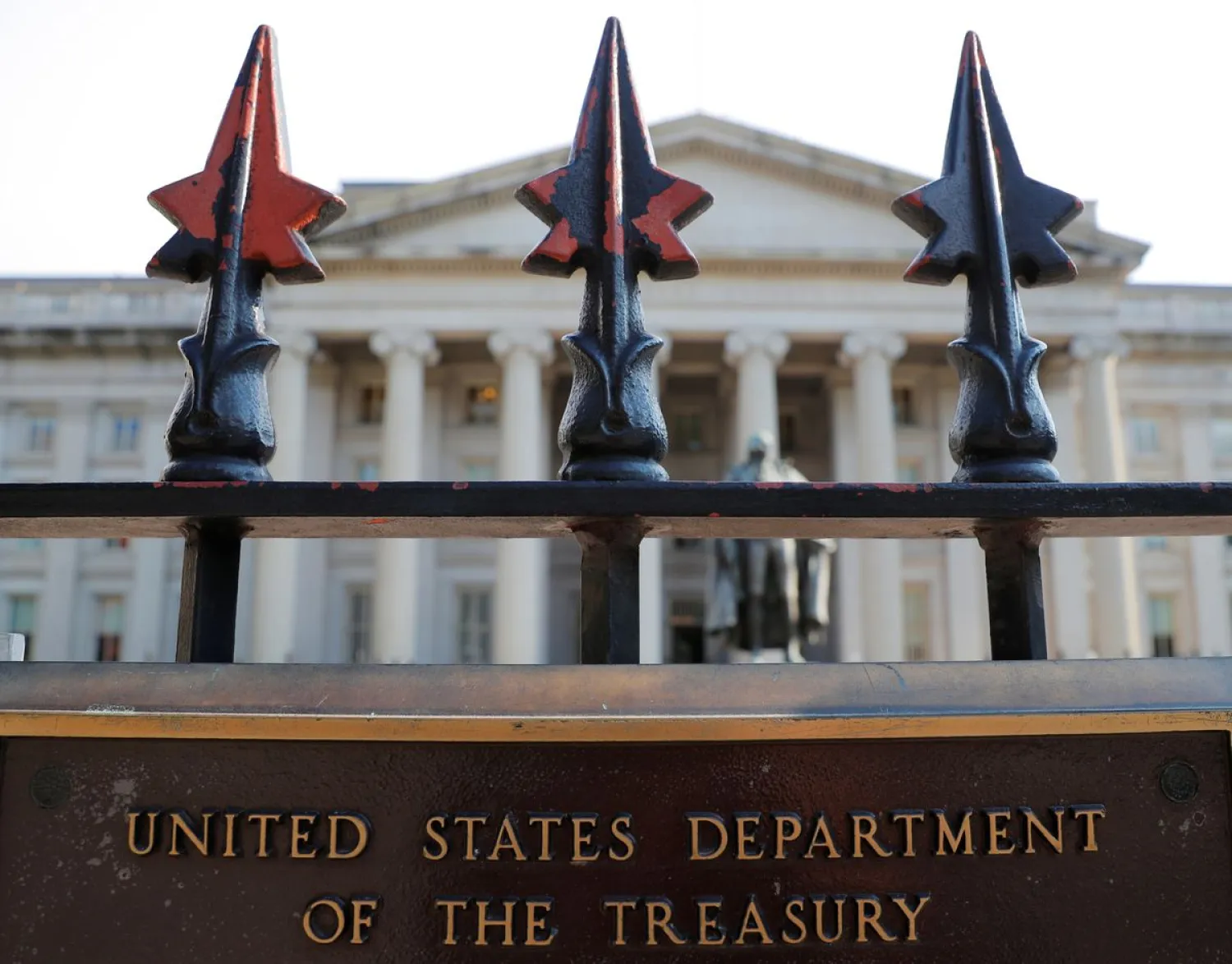
US Issues Fresh Russia-related Sanctions

A sign marks the US Treasury Department in Washington, US, August 6, 2018. REUTERS/Brian Snyder
TT

US Issues Fresh Russia-related Sanctions

A sign marks the US Treasury Department in Washington, US, August 6, 2018. REUTERS/Brian Snyder

The United States on Thursday imposed fresh Russia-related sanctions over its invasion of Ukraine including sanctions against dozens of defense companies, 328 members of the Duma legislative body and the chief executive of Sberbank, the Treasury Department said.

Gold-related transactions involving Russia may be sanctionable by US authorities, the Treasury Department also said in a statement.

The United States will expand its sanctions on Russia in response to the invasion of Ukraine, targeting members of the country’s parliament and the central bank’s gold reserves, the White House announced Thursday.

At the same time, Washington will increase its humanitarian assistance by welcoming 100,000 Ukrainian refugees and providing an additional $1 billion in food, medicine, water and other supplies.

The White House announced the initiatives as US President Joe Biden and world leaders gathered in Brussels for a trio of summits in response to the Russian invasion, seeking new ways to limit the economic and security fallout from the conflict.


Washington Post Publisher Will Lewis Stepping Down Days after Big Layoffs

A person walks outside The Washington Post headquarters in Washington, DC, USA, 04 February 2026. EPA/JIM LO SCALZO
TT

Washington Post Publisher Will Lewis Stepping Down Days after Big Layoffs

A person walks outside The Washington Post headquarters in Washington, DC, USA, 04 February 2026. EPA/JIM LO SCALZO

Washington Post publisher Will Lewis said Saturday that he’s stepping down, ending a troubled tenure three days after the newspaper said that it was laying off one-third of its staff.

Lewis announced his departure in a two-paragraph email to the newspaper's staff, saying that after two years of transformation, “now is the right time for me to step aside.” The Post's chief financial officer, Jeff D'Onofrio, was appointed temporary publisher, The Associated Press reported.

Neither Lewis nor the newspaper's billionaire owner Jeff Bezos participated in the meeting with staff members announcing the layoffs on Wednesday. While anticipated, the cutbacks were deeper than expected, resulting in the shutdown of the Post's renowned sports section, the elimination of its photography staff and sharp reductions in personnel responsible for coverage of metropolitan Washington and overseas.

They came on top of widespread talent defections in recent years at the newspaper, which lost tens of thousands of subscribers following Bezos' order late in the 2024 presidential campaign pulling back from a planned endorsement of Kamala Harris, and a subsequent reorienting of its opinion section in a more conservative direction.

Martin Baron, the Post’s first editor under Bezos, condemned his former boss this week for attempting to curry favor with President Donald Trump and called what has happened at the newspaper “a case study in near-instant, self-inflicted brand destruction.”

The British-born Lewis was a former top executive at The Wall Street Journal before taking over at The Post in January 2024. His tenure has been rocky from the start, marked by layoffs and a failed reorganization plan that led to the departure of former top editor Sally Buzbee.

His initial choice to take over for Buzbee, Robert Winnett, withdrew from the job after ethical questions were raised about both he and Lewis' actions while working in England. They include paying for information that produced major stories, actions that would be considered unethical in American journalism. The current executive editor, Matt Murray, took over shortly thereafter.

Lewis didn't endear himself to Washington Post journalists with blunt talk about their work, at one point saying in a staff meeting that they needed to make changes because not enough people were reading their work.

This week's layoffs have led to some calls for Bezos to either increase his investment in The Post or sell it to someone who will take a more active role. Lewis, in his note, praised Bezos: “The institution could not have had a better owner,” he said.

“During my tenure, difficult decisions have been taken in order to ensure the sustainable future of The Post so it can for many years ahead publish high-quality nonpartisan news to millions of customers each day,” Lewis said.

The Washington Post Guild, the union representing staff members, called Lewis' exit long overdue.

“His legacy will be the attempted destruction of a great American journalism institution,” the Guild said in a statement. “But it’s not too late to save The Post. Jeff Bezos must immediately rescind these layoffs or sell the paper to someone willing to invest in its future.”

Bezos did not mention Lewis in a statement saying D'Onofrio and his team are positioned to lead The Post into “an exciting and thriving next chapter.”

“The Post has an essential journalistic mission and an extraordinary opportunity,” Bezos said. “Each and every day our readers give us a roadmap to success. The data tells us what is valuable and where to focus.”

D'Onofrio, who joined the paper last June after jobs at the digital ad management company Raptive, Google, Zagat and Major League Baseball, said in a note to staff that "we are ending a hard week of change with more change.

“This is a challenging time across all media organizations, and The Post is unfortunately no exception,” he wrote. “I've had the privilege of helping chart the course of disrupters and cultural stalwarts alike. All faced economic headwinds in changing industry landscapes, and we rose to meet those moments. I have no doubt we will do just that, together.”


US Concerned About Expansion of Terrorism in Sahel, West Africa

Members of the Nigeria Armed Forces interact with residents following an attack in Woro, Kwara State, on February 5, 2026. (Photo by Light Oriye Tamunotonye / AFP)
TT

US Concerned About Expansion of Terrorism in Sahel, West Africa

Members of the Nigeria Armed Forces interact with residents following an attack in Woro, Kwara State, on February 5, 2026. (Photo by Light Oriye Tamunotonye / AFP)

The United States is concerned by the “expansion” of al-Qaeda affiliates in the Sahel and West Africa, including Jama'at Nusrat al-Islam wal-Muslimin (JNIM) and ISIS-Sahel’s territorial gains.

US Ambassador to the United Nations Mike Waltz shared the concern in his remarks at this week’s UN Security Council Briefing on Terrorist Threats to International Peace and Security caused by terrorist acts.

Highlighting JNIM and ISIS-Sahel’s territorial gains and use in particular of kidnapping for ransom, Waltz said the threats are increasingly diffuse and complex as they involve foreign fighters converging in multiple conflict zones.

The diplomat cited the latest Analytical Support and Sanctions Monitoring Team report, which showed that terror cells continue to adapt and exploit instability across Africa, the Middle East, and South Asia.

Waltz said ISIS’ growing focus on Africa, and the resilience of its cells in Syria and Iraq, and the persistent threat from ISIS-K in Afghanistan, truly reinforces the need for sustained, coordinated counterterrorism efforts.

Washington is particularly concerned by terrorist groups’ exploitation of new technologies, such as commercial satellite communications, artificial intelligence, drones and cryptocurrencies, he said.

“All of these further complicates the threat landscape and it requires our vigilance, vigilance from Member States and particularly where I think there is room for all of us to improve – is our coordination with the private sector as we face this threat,” Waltz added.

The ambassador called for further disruption of terrorist financing networks, saying the recent successes in Somalia and in West Africa demonstrate that following the money and stopping the money to these various groups can have bold decisive effects.

He said the US commends UN Member States whose counterterrorism operations have constrained ISIS and al-Qaeda, especially in Iraq, Syria, and Somalia.

He also urged all states to strengthen cooperation, including intelligence sharing and joint operations, and to support the effective implementation and evolution of the 1267 sanctions regime.

“Member States should collaborate on screening and information sharing to prevent terrorist movement across borders, in support of UN Security Council Resolution 2396,” Waltz noted.

Last November, the United Kingdom, which currently chairs the UN Security Council, expressed similar concern about the proliferation of terrorist groups in the Sahel and West Africa.

The US has sent a small team of troops to Nigeria, the general in charge of the US command for Africa said on Tuesday, the first acknowledgment of US forces on the ground since Washington struck by air on Christmas Day.

General Dagvin RM Anderson, head of the US military's Africa Command AFRICOM, said the US team was sent after both countries agreed that more needed to be done to combat the terrorist threat in West Africa.

“That has led to increased collaboration between our nations to include a small US team that brings some unique capabilities from the United States,” he told journalists during a press briefing in Dakar on Tuesday.


Kim Expected to Issue Major Policy Goals at NKorea Party Congress

This picture taken on February 1, 2026 and released by North Korea's official Korean Central News Agency (KCNA) via KNS on February 2, 2026 shows North Korean leader Kim Jong Un attending the inauguration ceremony of the Sinuiju Combined Greenhouse Farm in North Pyongan Province, North Korea. (Photo by KCNA VIA KNS / AFP)
TT

Kim Expected to Issue Major Policy Goals at NKorea Party Congress

This picture taken on February 1, 2026 and released by North Korea's official Korean Central News Agency (KCNA) via KNS on February 2, 2026 shows North Korean leader Kim Jong Un attending the inauguration ceremony of the Sinuiju Combined Greenhouse Farm in North Pyongan Province, North Korea. (Photo by KCNA VIA KNS / AFP)

North Korea will convene a major political conference later this month, the country’s state media said Sunday, where leader Kim Jong Un is expected to outline his domestic and foreign policies for the next five years.

The ruling Workers’ Party congress, which Kim previously held in 2016 and 2021, comes after years of accelerated nuclear and missile development and deepening ties with Moscow over the war in Ukraine that have increased his standoffs with the United States and South Korea.

According to The Associated Press, North Korea’s official Korean Central News Agency said the party’s political bureau met under Kim's supervision and decided the congress would be held in late February. State media did not immediately specify a date or release agenda details.

The congress will likely continue for days as a highly choreographed display of Kim’s authoritarian leadership. In recent weeks, Kim has inspected weapons tests and toured military sites and economic projects as state media highlighted his purported achievements, crediting his “immortal leadership” with strengthening the country’s military capabilities and advancing national development.

His recent activities and comments suggest Kim will use the congress to double down on economic development through “self-sustenance” and mass mobilization while announcing plans to further expand the capabilities of his nuclear-armed military, including upgrading conventional weapons systems and integrating them with nuclear forces.

Kim also could highlight his increasingly assertive foreign policy based on closer ties with Moscow and Beijing while hardening an adversarial approach toward rival South Korea as he continues to embrace the idea of a “new Cold War,” experts say.

Kim's willingness to resume diplomacy with the US is unclear. Relations derailed in 2019 after his second summit with US President Donald Trump due to disagreements over sanctions against his nuclear weapons program.

Kim has rejected Trump’s overtures for dialogue since the US president began his second term in January 2025. Kim insists Washington abandon demands for the North to surrender its nuclear weapons as a precondition for future talks.

Entering his 15th year in rule, Kim finds himself in a stronger position than when he opened the previous congress in 2021 during the shock of the COVID-19 pandemic. Navigating what was seen as his toughest stretch in a decade of power, Kim acknowledged his previous economic policies failed and issued a new five-year development plan through 2025.

He called for accelerated development of his nuclear arsenal and issued an extensive wish list of sophisticated assets including solid-fuel intercontinental ballistic missiles, multi-warhead systems, tactical nuclear weapons, spy satellites and nuclear-powered submarines.

Kim has exploited geopolitical turmoil to his advantage. He used Russia's invasion of Ukraine as a window to accelerate weapons testing and align himself with Russian President Vladimir Putin, who has accepted thousands of North Korean troops and large quantities of military equipment for the war.

Kim also has pursued closer ties with China, traditionally the North’s primary ally and economic lifeline. He traveled to Beijing in September for a World War II event and the first summit with Chinese President Xi Jinping in six years.

While Kim’s strict information blockade prevents precise assessments, South Korean analysts say the North's economy appears to have improved over the past five years, possibly due to a gradual recovery in trade with China and an industrial boost from arms exports to Russia.