Iraq Building Syria Wall to Keep out ISIS Fighters
An Iraqi soldier patrols the border with Syria on January 27. Reuters
Iraq is building a concrete wall along part of its border with Syria to stop ISIS group militants from infiltrating, an Iraqi military source said Sunday.
In the "first stage" of construction, a wall around "a dozen kilometers (seven miles) long and 3.5 meters (11 feet) high was built in Nineveh province", in the Sinjar area of northwest Iraq, a senior officer told AFP, requesting anonymity.
Iraq, which shares a more than 600-kilometer long border with Syria, seeks to "put a stop to the infiltration of ISIS members" into its territory, the source added, without specifying how long the wall would eventually run.
Iraq in 2018 said it had begun building a fence along the Syrian border for the same reason.
The Syrian Observatory for Human Rights, a Britain-based war monitor, said the wall's construction was carried out in an area facing the town of Al-Shaddadi, in the south of Syria's Hasakeh province.
In January in the Kurdish-controlled province, ISIS fighters attacked a prison to free fellow militants, sparking days of clashes that left hundreds dead.
Many prisoners are thought to have escaped, with some crossing to neighboring Turkey or Turkish-held territory in Syria's north, the Observatory said.
ISIS overran large swathes of Iraq and Syria in 2014, declaring a "caliphate" before Baghdad proclaimed victory in late 2017 after a grinding campaign.
But a low-level insurgency has persisted, flaring up particularly in rural and mountainous areas between Iraq's autonomous Kurdistan region and northern outskirts of the capital.
Israeli Forces Search Homes, Make Incursions on Fringes of Jabal al-Sheikhhttps://english.aawsat.com/arab-world/5333695-israeli-forces-search-homes-make-incursions-fringes-jabal-al-sheikh
Israeli Forces Search Homes, Make Incursions on Fringes of Jabal al-Sheikh
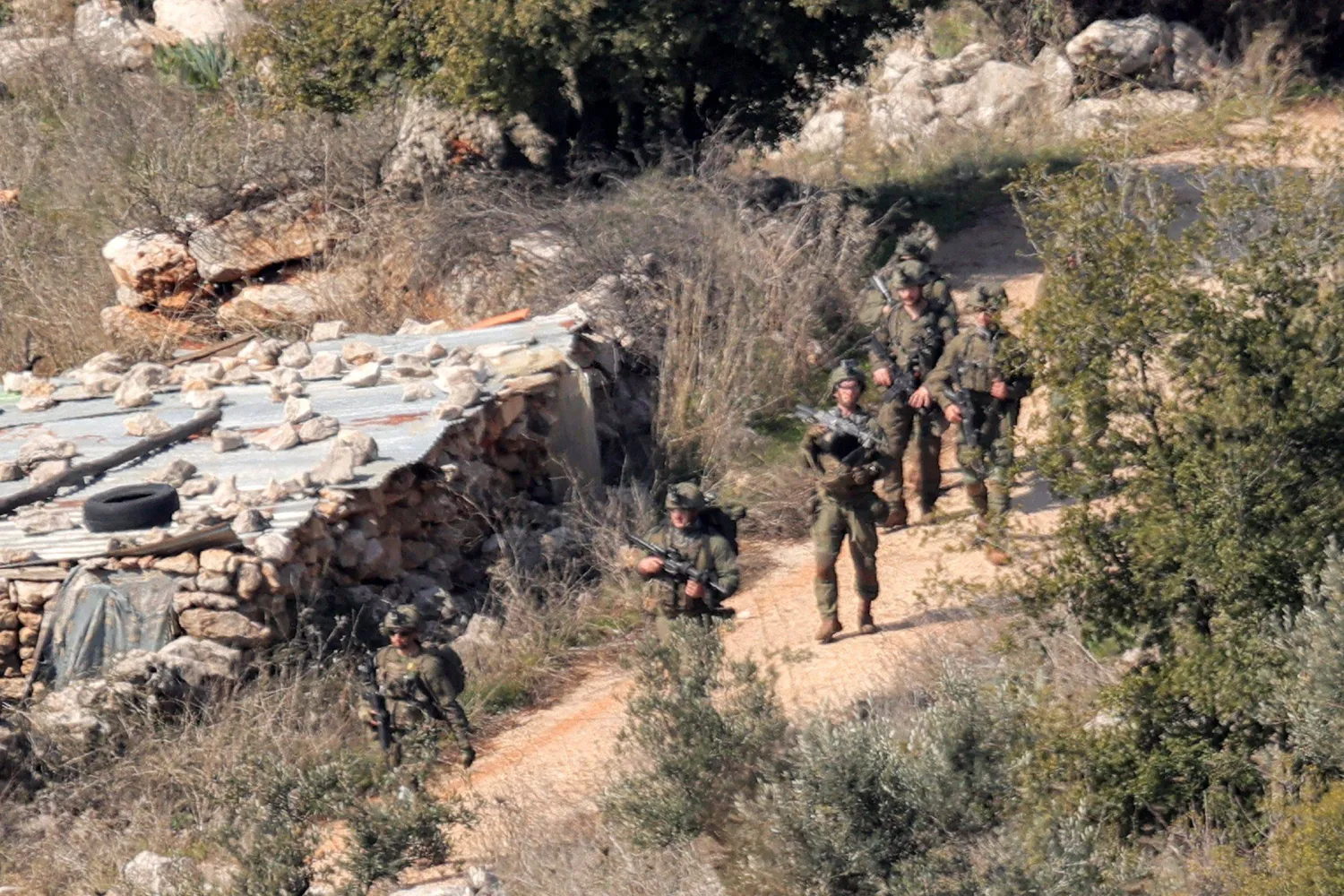
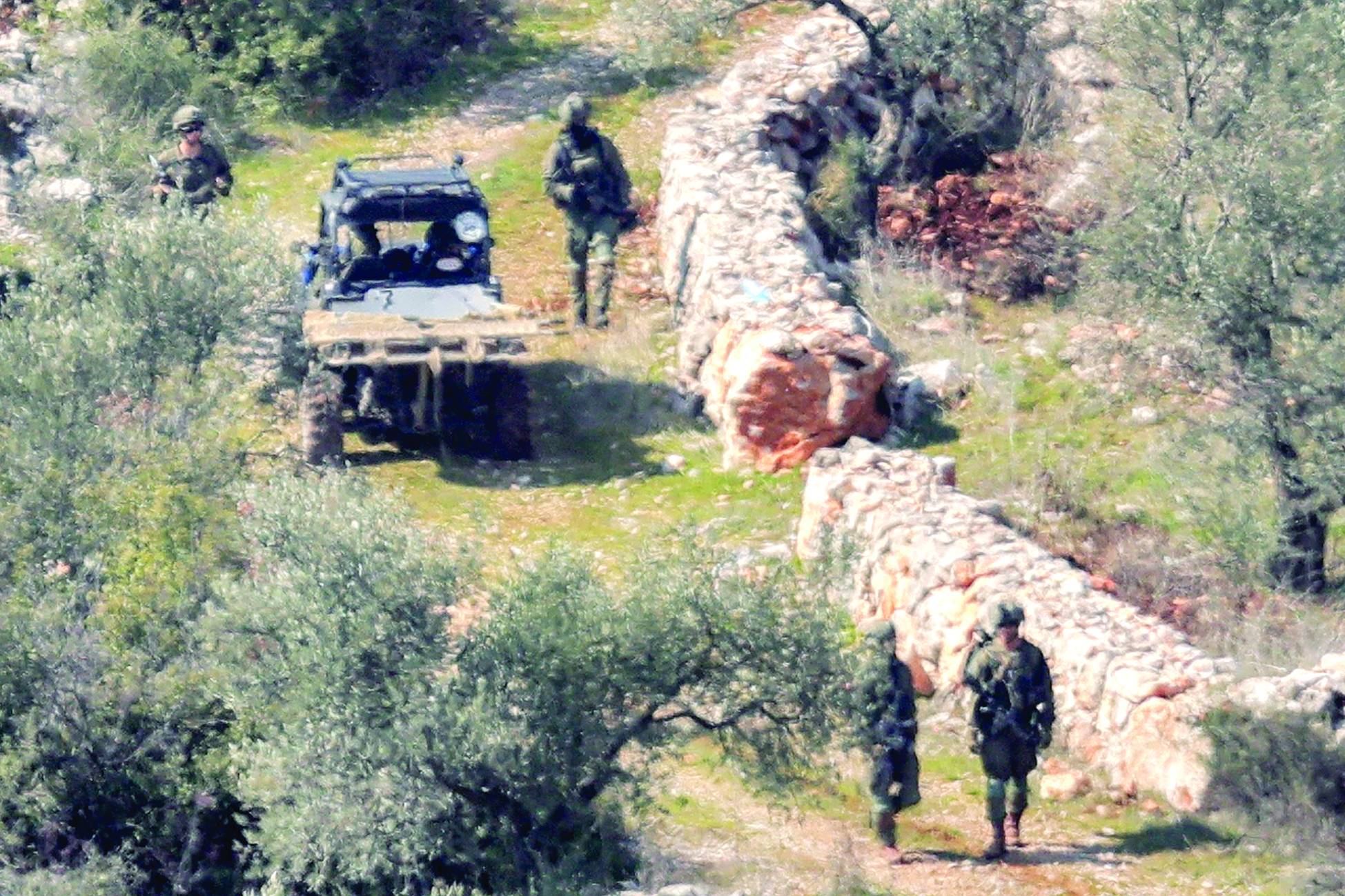
Israeli army forces patrol in the village of Kfar Shouba in southern Lebanon on February 17, 2025. (AFP)
Repeated Israeli incursions into the Arqoub region of southeastern Lebanon, along the border with Israel and Syria, have raised fears that Israel was planning on expanding its control and further restricting the lives of residents.
These developments have prompted locals to issue warnings, the latest of which came in a statement by an Arqoub committee that highlighted "incursions, alterations of terrain, and the clearing of roads" in the towns of Kfar Shouba, Shebaa, Habbariyeh, and Halta, all of which are located on the western slope of Jabal al-Sheikh.
The warning followed repeated Israeli incursions into the area, including the searching of homes in Kfar Shouba last week.
The committee warned against “a recurrence of past events that led to the occupation of the Shebaa Farms and the Kfar Shouba Hills,” pointing to “a historical lack of action or disregard by successive authorities and governments.”
It stressed “the need for swift and urgent intervention through the Arab League, United Nations, and UN Security Council to halt this aggression, these incursions, and the renewed attempts to encroach upon Lebanese territory.”
These operations are taking place within the context of ongoing Israeli movements over several months across southern border villages, specifically within unoccupied areas adjacent to what Israel calls the "Yellow Line."
According to retired General Khalil Gemayel, these actions carry "military, tactical, and security dimensions that extend far beyond searching for Hezbollah weapons or facilities."
"The Israeli incursion into Kfar Shouba and its surrounding villages, alongside the house searches, cannot be viewed simply as a transient military maneuver or a limited security operation," he told Asharq Al-Awsat.
These movements involve "three interconnected dimensions," he said.
Israeli forces conduct a patrol in the village of Kfar Shouba in southern Lebanon on February 17, 2025 (AFP)
The first is "expanding the scope of maneuver and field reconnaissance; entering the village outskirts, advancing between houses, and conducting searches allows Israeli forces to gather direct intelligence on the terrain, corridors, roads, and residents."
He added that these operations also aim to "erase as much of the villages' urban landscape and vegetation cover as possible, under the pretext of preventing Hezbollah from rebuilding its military capabilities in areas close to where Israeli units are stationed."
Gemayel noted that the second dimension involves "imposing a new security reality on the ground," explaining that "Israel is no longer satisfied with stationing itself in elevated positions and fixed military outposts on commanding hills that stretch from the sea to Jabal al-Sheikh to shield northern settlements.”
“Instead, it is seeking to expand its capacity to execute recurring ground operations within a geographical buffer that grants it greater freedom of movement and intervention,” he explained.
He said that "this does not necessarily mean it has decided to advance to occupy additional villages," but rather indicates "its desire to control and monitor the forward border area in accordance with its security interests, by creating a buffer zone held under fire where Israel applies the theory of flexible defense outside its occupied and fixed defensive lines."
The third dimension, it involves "pressuring the population and preventing a return to normalcy by searching homes, blocking farmers from accessing their fields, and restricting movement, thereby maintaining security, economic, and social pressures on dozens of unoccupied villages and complicating the resumption of regular activity."
Gemayel cited "the restrictions that farmers and shepherds in Kfar Shouba and Halta face regarding access to their lands and pastures."
Retired Brigadier General George Nader viewed the "repeated Israeli incursions into southern villages, not as limited military operations or random movements, but rather as a prelude to cementing Israeli military control and widening its operational reach inside Lebanese territory."
"Israel is seeking to encroach upon more land and impose new realities on the ground, either to improve its negotiating leverage following the Israeli elections, or to pave the way for expanding its military operations into areas beyond the Litani River,” he told Asharq Al-Awsat.
Palestinian Authority Says 2,670 Displaced in Israel’s Hebron Operationhttps://english.aawsat.com/arab-world/5333690-palestinian-authority-says-2670-displaced-israel%E2%80%99s-hebron-operation
Israeli forces take Palestinian cars during a military operation in Hebron, in the Israeli-occupied West Bank October 25,2026. (Reuters)
TT
TT
Palestinian Authority Says 2,670 Displaced in Israel’s Hebron Operation
Israeli forces take Palestinian cars during a military operation in Hebron, in the Israeli-occupied West Bank October 25,2026. (Reuters)
The Palestinian Authority said Sunday that nearly 2,700 people had been displaced by an Israeli military operation in the occupied West Bank city of Hebron launched after two soldiers were killed in an attack nearby.
Following Friday's attack, Israeli forces entered the Hebron neighborhood of Ein Deir Baha, where the assailants lived, and ordered residents to pack up and leave after Prime Minister Benjamin Netanyahu pledged a major operation in the occupied territory.
"More than 2,670 Palestinians have been forcibly displaced from their homes in Hebron by Israeli occupation forces, the majority of them women, children, and elderly people, according to data from Hebron Municipality," the Palestinian prime minister's office said on X.
A convoy of Israeli military and police vehicles accompanied by soldiers was seen in Hebron on Sunday, making its way down a street blocked to civilian traffic by parked cars and motorbikes, AFP images showed.
Local shopkeeper Higazi al-Tamimi, who also plays a leadership role in the evacuated neighborhood, accused Israeli soldiers of beating him as he attempted to go to his home.
"I remember one or two people starting to strike my legs, chest and shoulders. One of them even hit me on the head," he said from a hospital bed, with his leg thickly bandaged.
"They then pushed me backwards, and I kept moving until I reached a safe area."
Jordan Arrests Three Suspects in Deadly Church Attackhttps://english.aawsat.com/arab-world/5333672-jordan-arrests-three-suspects-deadly-church-attack
Jordan Arrests Three Suspects in Deadly Church Attack
A Jordanian security officer guards a church (Reuters)
Jordanian security forces have arrested three suspects in connection with an attack on a church that killed nine people, state television reported on Monday.
The attack, in which gunmen opened fire during a funeral at a Greek Orthodox church on Friday in the village of Hamoud in Karak governorate, about 120 km (75 miles) southwest of the capital Amman, also wounded 40 others. The shooting lasted several minutes, witnesses said.
Jordan's Public Security Directorate said security forces located the three suspects early on Monday hiding in an abandoned house in Karak. The suspects refused to surrender and opened fire on security forces, who returned fire and arrested all three after they were wounded, the directorate said in a statement carried on state media.
No security personnel were injured, and a number of firearms and ammunition were found in the suspects' possession after their arrest, reported Reuters.
"Terrorism has no place among us," the directorate said, adding that the suspects had met their "just fate".
The Public Security Directorate did not identify the suspects' affiliation or say whether they belonged to any militant group.
Jordanian authorities have said the attack was carried out by "extremist terrorists", but it was too early to determine whether they had links to known groups inside or outside Jordan. There has been no claim of responsibility.
Interior Minister Mazen al-Faraya said on Monday authorities were reviewing the circumstances that led young people towards extremism and would hold accountable anyone found to have participated in the attack.
King Abdullah has ordered security forces to respond with an "iron fist" to the rare attack on Jordan's Christian minority.
Such violence is highly unusual in Jordan, a relatively stable state in the Middle East, though authorities say they have foiled several extremist militant plots over the years.
لم تشترك بعد
انشئ حساباً خاصاً بك لتحصل على أخبار مخصصة لك ولتتمتع بخاصية حفظ المقالات وتتلقى نشراتنا البريدية المتنوعة