


Aboul Gheit to Asharq Al-Awsat: Iran Uses Arab Crises as Pressure Cards to Confront the West

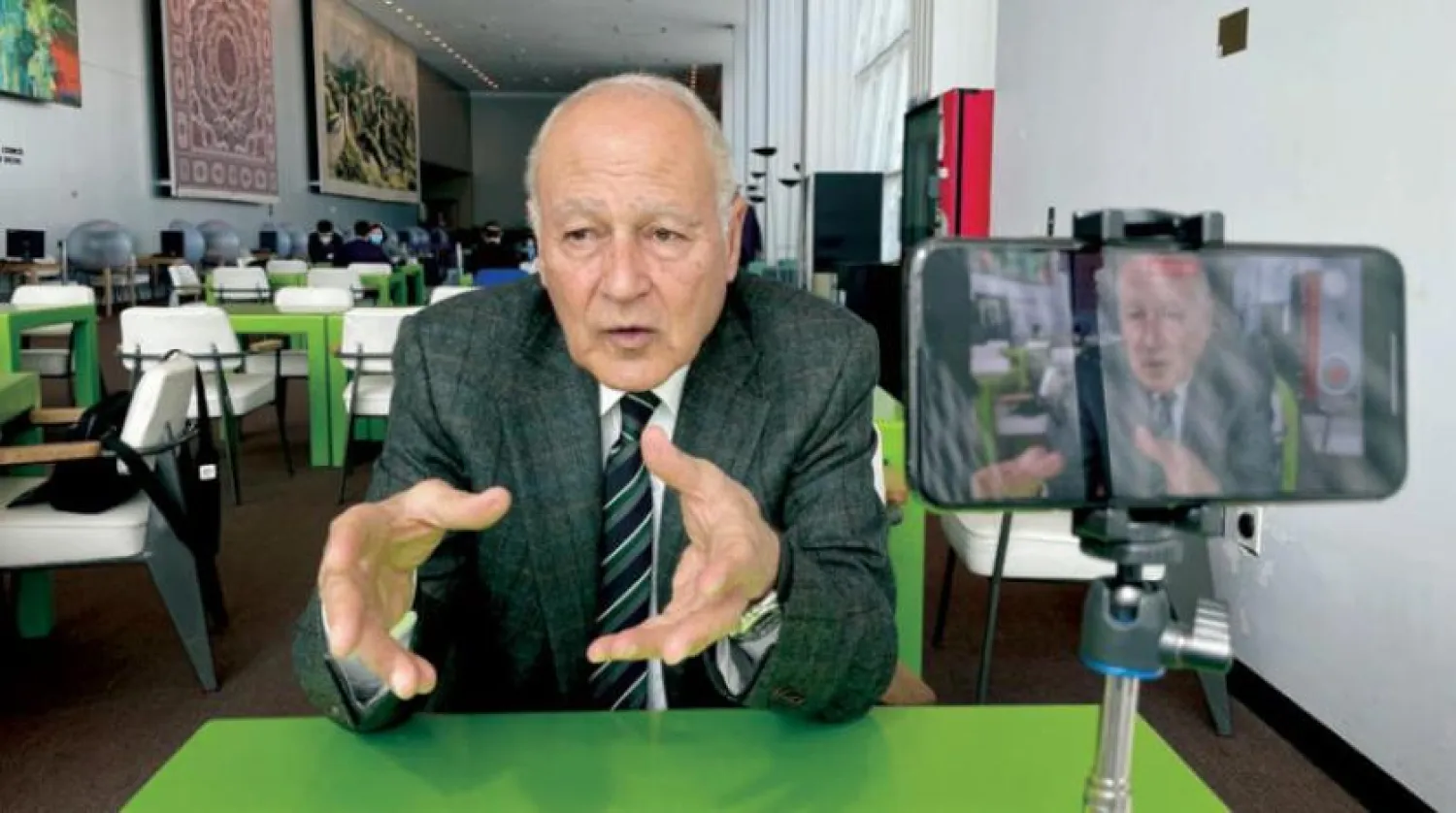
The Secretary-General of the Arab League, Ahmad Aboul Gheit, speaks to Asharq Al-Awsat in New York.
TT

Aboul Gheit to Asharq Al-Awsat: Iran Uses Arab Crises as Pressure Cards to Confront the West

The Secretary-General of the Arab League, Ahmad Aboul Gheit, speaks to Asharq Al-Awsat in New York.

Arab League Secretary General Ahmad Aboul Gheit said that the possible understanding between the United States and Iran in the ongoing nuclear negotiations in Vienna, “does not end” the Iranian nuclear threat, calling on Tehran to stop its “adventures” on Arab land, and to refrain from using Arab files to pressure the Western world and Israel.

“This understanding does not end the Iranian nuclear threat, but only freezes it for several years,” he said. “The Arab world needs assurances from two sides - Iran and Israel - that the threat of nuclear armament must be abandoned. For 40 years, the Arab world has been demanding the declaration of the Middle East as a zone free of nuclear weapons and weapons of mass destruction… This is a key point.”

In an interview with Asharq Al-Awsat during his stay in New York, Aboul Gheit strongly condemned the Houthi militia’s attacks on Saudi oil facilities.

“This is shocking and totally condemned since 2019,” he stated, noting that the Iranian regime was seeking to show the world the importance of lifting sanctions on Iranian oil.

On the Russian-Ukrainian war, Aboul Gheit said that the conflict will have negative repercussions on stability and food security in many Arab countries.

“First, it is a major international crisis that threatens international peace and security. If something goes wrong at any moment, a larger war could erupt. For example, World War I accidentally occurred. The calculations of all parties at the time were not aimed at war… It is a concern over world security,” he underlined.

He added that many Arab countries relied on food imports from Ukraine or Russia. “These two sources supply the Arabs with wheat and crops. They will have supply problems. This may negatively affect stability and food security in the Arab world,” he warned.

The Arab League secretary general stressed that the war would also shift attention from many pressing files in the Arab world.

“This will negatively affect the Arab world, because we are keen to see a settlement in Syria, Yemen and Libya, as well as an improvement in the situation in Lebanon,” he remarked.

Asked about the Houthis’ rejection of a recent GCC invitation to comprehensive talks on the Yemeni crisis, the Arab League secretary general emphasized the Iranian influence.

“It is not in Iran’s interest to settle any of these problems in the current situation, as it has not yet reached an agreement with the 5 + 1. This confirms that these Arab problems are pressure cards that Iran uses in its confrontation with the Western world,” Aboul Gheit said.

He added: “Iran is interfering in Arab problems and in Arab land, and this must stop. Iran is strongly present in Yemen through the Houthis. It is present in Syria in the form of armed militias on Syrian soil. There is a very clear Iranian influence in Lebanon. There are militias in Iraq that are said to have links with the Iranian Revolutionary Guards. This all has to stop.”

Aboul Gheit called on Tehran to interact positively with the Arab world, based on the historical relationship that extends back thousands of years.

“Show good intentions towards the Arab world… Because this region needs economic development, raising the standard of living and modernization. It doesn’t need bombings and armed military confrontations,” he said, addressing Iranian officials.

The Arab League secretary general said he hoped that if an agreement was reached in Vienna, it would encourage Iran to stop interfering in the region.

“Since I was the Egyptian Minister of Foreign Affairs, from 2004, 2005 and 2006, I have seen that Iran is using many Arab problems as pressure cards on the Western world and on Israel. So it has to stop,” he stated.

Moreover, Aboul Gheit said that the possible nuclear agreement would free up billions of dollars, and thus unlock Iran’s capabilities.

“If the money is used for development, building economic capabilities and raising the standard of living, in a way that benefits the Iranian people, we would very much welcome this approach. But the problem is the adventures on Arab land. This is very unfortunate, and Iran must stop. I spoke to the Security Council on this specific subject,” he stated.

Commenting on the current Arab tendency to normalize relations with Syria and the recent visit of President Bashar al-Assad to Abu Dhabi, Aboul Gheit noted that some Arab parties, such as Algeria, Lebanon and Iraq, were showing interest in Syria’s return to the Arab League.

“Other countries talk with the brothers in Damascus, and establish good and reasonable relations. But I did not observe a current tendency to achieve an imminent return of Syria to the Arab League... The next summit will take place in Nigeria on Nov. 1-2, meaning that we have about 8 months ahead,” he remarked.

Aboul Gheit stressed in this regard that any invitation to Syria must be based on an intra-Arab consensus.

“In the end, of course, Syria will return to its seat. It’s normal, because it’s an Arab country, whose membership has been suspended due to a situation,” he said.

But he added: “As Secretary-General of the Arab League, a decision must be issued by the Arab Council of Ministers before the invitation is extended. However, this matter is not even raised in the corridors of the League… I have not seen any effective effort to achieve this goal.”

On Lebanon, the secretary-general of the Arab League urged the country to “save itself” by holding legislative elections, forming a new government, and electing a new president, in conjunction with negotiations with the International Monetary Fund (IMF).

When asked about Hezbollah’s role in the Lebanese crisis, he said: “I do not interfere in the Lebanese internal affairs… [The party] is present in the government. As the Secretary-General of the League – I should not take a position on one of the parties in the government. This should not facilitate reaching the required compromises.”

On Iraq, the senior Arab official stressed that the country “fully assumes its responsibilities towards the Arab League.”

“[Iraq] has been fully interacting for years, and is not constrained by any internal political situation,” he noted.

Aboul Gheit stressed that calm and stability in the Middle East can only be achieved by resolving the Palestinian file.

“Circumventing the Palestinian issue through Arab-Israeli settlements is understandable, in the sense that the Arab countries see their interests fall in this direction. But this does not mean that the Palestinian cause has been forgotten. It should not be forgotten,” he underlined.

Contrary to the administration of former US President Donald Trump, the current administration is expressing interest in talking to the Palestinians, according to Aboul Gheit.

“But the problem is that you are addressing the Palestinians without practical measures, and without real action; Why? Because the Israeli government has a strict and hardline approach… The Israeli prime minister reiterated that he was not ready to start moving or talking about peace or even negotiating with the Palestinians,” he noted.

Commenting on the situation in Sudan, the Arab League secretary general emphasized the need for “internal settlement, dialogue and understanding of the desires of the opposing forces, as well as the need for stability and for the Sudanese army to ensure security and stability.”

“I optimistically note a trend in this direction,” he stated.



Israeli Military Kills Four in Gaza and Expands Control Zone, Locals Say

Palestinians assess damage at the site of an Israeli airstrike in Khan Younis, southern Gaza Strip, on June 7, 2026. (AFP)
TT

Israeli Military Kills Four in Gaza and Expands Control Zone, Locals Say

Palestinians assess damage at the site of an Israeli airstrike in Khan Younis, southern Gaza Strip, on June 7, 2026. (AFP)

Israeli strikes killed four Palestinians, including a child, in the Gaza Strip on Monday, health officials there said, as Israel's military expanded the area under its control, according to residents.

The reports came as mediators in Cairo said they were pressing on with efforts to salvage a fragile US-brokered ceasefire deal that has ended major clashes but left many key points unresolved.

Medics said two people were killed when an Israeli strike hit near a tent encampment in the Mawasi area of Khan Younis in the south of the enclave.

In the Jabalia refugee camp in northern Gaza, medics said two Palestinians, including an eight-year-old boy, were killed and others were wounded in an Israeli ‌airstrike that hit ‌near a group of people digging a well.

The Israeli military did ‌not ⁠immediately comment on ⁠the reports of the attacks or of its forces moving markers to expand the "Yellow Zone" under their control.

Israel and Hamas have repeatedly accused each other of violating the truce. Israeli strikes have killed more than 950 people since the truce, health officials say, while Israel says four soldiers were killed by fighters during the same period.

ISRAEL'S NETANYAHU ORDERED EXPANSION

Israeli troops still control more than 60% of Gaza's territory, where they have ordered residents out and destroyed remaining buildings.

Nearly the entire population of 2 ⁠million people now live in a tiny strip of land along the ‌coast, mainly in makeshift tents or damaged buildings, under ‌Hamas control.

The territory has been bombarded to ruins by Israel's two-year military assault that followed the 2023 Hamas ‌attack on southern Israel.

On Sunday, Prime Minister Benjamin Netanyahu reaffirmed that he had directed Israel's ‌military to expand its hold and take control of 70% of the enclave.

"We are not allowing them to arm themselves or harm us, and we are also eliminating their senior commanders," he said in a speech.

Witnesses in the southern Gaza areas said the Israeli forces have in the past few days expanded the "Yellow ‌Zone", in some areas in eastern Khan Younis and northern Rafah where new markers and concrete blocks have been placed.

They added that new ⁠markers bring forces closer ⁠to areas populated with tents and displacement centers.

In Bani Suhaila town, in eastern Khan Younis, some people say they could see the tanks from their tents.

MEDIATORS PRESS ON WITH TALKS

Three days into a new round of ceasefire talks in Cairo, leaders of Hamas and other Palestinian groups told mediators that Israel must end attacks to allow discussion on the second phase.

They demanded more flow of aid and goods into Gaza, and the retreat of Israeli forces to original October ceasefire lines.

A Hamas official told Reuters on Monday that Israel had so far refused to make commitments to mediators over any of the demands made by Hamas and the factions.

No agreement has been reached to implement a further US-backed plan for Israeli troops to withdraw, Hamas to disarm and Gaza to be rebuilt.

"Israel refuses to end attacks on civilians in Gaza, allow 600 trucks of aid and goods into Gaza as agreed and it continues to occupy more land every day," the official said.


Salam: Israel Has Bombed Lebanon Nearly 3,500 Times During Ceasefire

FILE PHOTO: Lebanese Prime Minister Nawaf Salam speaks during a declaration press event held along with French President Emmanuel Macron (not pictured) following their meeting at the Elysee Presidential Palace in Paris, France, April 21, 2026. Ludovic Marin/Pool via REUTERS/File Photo
TT

Salam: Israel Has Bombed Lebanon Nearly 3,500 Times During Ceasefire

FILE PHOTO: Lebanese Prime Minister Nawaf Salam speaks during a declaration press event held along with French President Emmanuel Macron (not pictured) following their meeting at the Elysee Presidential Palace in Paris, France, April 21, 2026. Ludovic Marin/Pool via REUTERS/File Photo

Israel has carried out nearly 3,500 air strikes on Lebanon and hundreds of controlled explosions since the US announced a ceasefire for the country on April 16, Lebanon's Prime Minister Nawaf Salam said on Monday.

The US-brokered ceasefire came into effect just after midnight on April 17, with Israeli troops still positioned deep inside southern Lebanon.

In comments published by his office ⁠on X after ⁠a cabinet meeting, Salam said that from April 17 to June 7, Israel had carried out 3,491 air strikes, 407 controlled demolitions and six "razing" operations, or demolitions - which have left some entire villages in the southernmost strip of Lebanon entirely flattened.

Workers clean the debris following Israeli airstrikes that hit the previous day, near the archaeological site of the Roman hippodrome in the southern Lebanese city of Tyre on June 8, 2026. (Photo by KAWNAT HAJU / AFP) /

Salam said Lebanon was striving to uphold the ceasefire but that the latest escalation between Iran and Israel had caused additional waves of displacement, straining Lebanon's ability to host fleeing families.

Already, more than 1 million people - a fifth of Lebanon's population - have been displaced by Israel's strikes and evacuation warnings across Lebanon since the war erupted on March 2.

The latest conflict broke out when Hezbollah fired rockets on Israel in support of ⁠its ally ⁠Iran, which was being struck by Israel and the United States.

Hezbollah has continued firing at Israel and has rejected US-mediated talks between Lebanese and Israeli officials aimed at bolstering the ceasefire with a lasting agreement.


Protests in Syria’s Jazira Region Over Deteriorating Living Conditions

Residents protest on the Hol-Hasakah road (Hasakah Observatory)
TT

Protests in Syria’s Jazira Region Over Deteriorating Living Conditions

Residents protest on the Hol-Hasakah road (Hasakah Observatory)

Protesters in the al-Hol area east of Hasakah province blocked the main route used by fuel tankers heading into other parts of Syria, demonstrating against worsening living conditions.

The move came amid calls for demonstrations in Hasakah, Qamishli, al-Shaddadi, al-Yarubiyah, Ras al-Ain, Tell Hamis, and Tell Brak — areas collectively known as Syria’s Jazira region — and opposition to the implementation of integration measures perceived as favoring the Syrian Democratic Forces (SDF) at the expense of other local communities.

Economic hardship has deepened in eastern Syria at a time when residents had hoped for relief following the January 29 agreement between the Syrian government and the SDF, which provides for the integration of the Autonomous Administration’s institutions into the structures of the Syrian state.

Although economic pressures are affecting all parts of Syria, they may be particularly severe in the country’s eastern region, especially in the aftermath of the Euphrates flooding disaster. Researcher Abdul Wahab Assi said that continued economic strain could prompt residents to reassess the government-SDF integration process, which they see as moving too slowly.

In his view, some residents may attribute part of the deterioration in living conditions to the broader instability resulting from the sluggish pace of integration — not because the process itself has directly caused services to decline, but because ongoing administrative and political uncertainty affects essential sectors such as bread supplies, fuel, electricity, employment opportunities, and development, particularly in agriculture.

Speaking to Asharq Al-Awsat, Assi added that the integration process may also have generated genuine concerns among segments of the population about the possible implementation of economic policies, whether related to customs duties, taxes, crop procurement, or agricultural support, that fail to take into account the region’s unique circumstances and already fragile economy. “Any such decision would have a direct impact on people’s livelihoods,” he stated.

Assi further noted that there is little evidence to suggest that all residents of eastern Syria view accelerated integration as an automatic solution to economic and development challenges. Rather, some groups remain wary that integration could lead to policies, which do not reflect the region’s specific needs.

On Sunday, residents of Umm Hujayrah, a town in the al-Hol countryside east of Hasakah, staged a protest during which they blocked several roads and prevented a convoy of fuel tankers from traveling into other parts of the country. Video footage circulated by local media showed the demonstration. According to the Hasakah Media Center, protesters called for improved public services, the delivery of basic necessities, and relief from mounting economic pressures.

Reports from Syria’s Jazira region indicate that a combination of factors has contributed to worsening living conditions, amid a widespread perception among many Arab residents that the integration process is being carried out primarily in the interests of the SDF rather than other communities.

Journalist Khalil Hussein, a native of the Jazira region, said this perception has been reinforced by rising prices resulting from newly imposed customs duties - previously minimal in the area - as well as higher fuel costs.

He argued that SDF-controlled areas have been less affected because oil fields in Hasakah remain under SDF control and much of the oil is directed to predominantly Kurdish areas. Oil leaving Qamishli, for example, is sent to Ain al-Arab (Kobani) rather than to places such as al-Shaddadi, raising questions about the benefits of integration.

Hussein told Asharq Al-Awsat that residents of these areas are no longer primarily concerned with who controls or administers their territories. Instead, their main concern is improving what he described as their harsh living conditions.

Meanwhile, activists in the Jazira region called for demonstrations across predominantly Arab areas in opposition to the integration process.

“What is taking place before our eyes today is not the integration of these militias into state institutions. Rather, it is the government itself being absorbed into their structure and an explicit handover of control over our lives to those who displaced us and killed our sons,” Activist Suhaib al-Yaarubi wrote on social media.

At the same time, residents of the southern countryside of al-Yarubiyah appealed to the Syrian government to intervene and secure drinking water supplies amid severe shortages and the failure of water tankers to reach areas that lack wells and water networks.

Local sources said that water shortages in rural Hasakah worsen during the summer as temperatures rise. Higher fuel prices have also driven up the cost of tanker-delivered drinking water.

Residents of southern and eastern rural Hasakah complain that their areas have been neglected.

According to journalist Khalil Hussein, years of SDF control have brought no significant development projects to these districts, while services such as hospitals, schools, and universities have been set up in cities including Hasakah and Qamishli.

He criticized the SDF’s treatment of predominantly Arab rural areas of Hasakah, saying they have been viewed largely as “a commercial market for the distribution of goods.”