




Russia announced Tuesday it will “fundamentally" scale back military operations near Ukraine’s capital and a northern city, as talks to end the grinding war brought the outlines of a possible deal into view.
Deputy Defense Minister Alexander Fomin said the change on the battlefield was meant to increase trust at the talks after several rounds of negotiations failed to halt what has devolved into a bloody campaign of attrition.
The announcement was met with skepticism from the US. and others.
While Moscow portrayed it as a goodwill gesture, its ground troops have become bogged down and taken heavy losses in their bid to seize Kyiv and other cities. Last week and again on Tuesday, the Kremlin seemed to lower its war aims, saying its “main goal” now is gaining control of the mostly Russian-speaking Donbas region in eastern Ukraine.
US Secretary of State Antony Blinken said he had not seen anything indicating talks were progressing in a “constructive way,” and he suggested Russian indications of a pullback could be an attempt by Moscow to “deceive people and deflect attention.”
“There is what Russia says and there is what Russia does, and we’re focused on the latter,” Blinken said in Morocco. “And what Russia is doing is the continued brutalization of Ukraine.”
He added: “If they somehow believe that an effort to subjugate only the eastern part of Ukraine or the southern part of Ukraine ... can succeed, then once again they are profoundly fooling themselves.”
Western officials say Moscow is reinforcing troops in the Donbas in an attempt to encircle Ukraine’s best-trained and best-equipped forces, which are concentrated in the east.
Even as negotiators from the two sides assembled in Istanbul, Russian President Vladimir Putin's forces hit an oil depot in western Ukraine late Monday and blasted a gaping hole Tuesday morning in a nine-story government administration building in the southern port city of Mykolaiv. At least seven people were killed in that attack, Ukrainian President Volodymyr Zelenskyy said.
“It’s terrible. They waited for people to go to work” before striking the building, said regional governor Vitaliy Kim. “I overslept. I’m lucky.”
Fomin said Moscow has decided to “fundamentally ... cut back military activity in the direction of Kyiv and Chernihiv” to “increase mutual trust and create conditions for further negotiations.” He did not immediately spell out what that would mean in practical terms.
Ukraine’s military said it has noted withdrawals of some forces around Kyiv and Chernihiv. Pentagon spokesman John Kirby told CNN “we haven’t seen anything to corroborate” reports of Russia pulling back significant forces from around Kyiv. “But what we have seen over the last couple of days is they have stopped trying to advance on Kyiv.”
Rob Lee, a military expert at the US-based Foreign Policy Research Institute, tweeted: “This sounds like more of an acknowledgment of the situation around Kyiv where Russia’s advance has been stalled for weeks and Ukrainian forces have had recent successes. Russia doesn’t have the forces to encircle the city.”
The meeting in Istanbul was the first time negotiators from Russia and Ukraine talked face-to-face in two weeks. Earlier talks, held in person in Belarus or by video, made no progress toward ending the more than month-long war that has killed thousands and driven over 10 million Ukrainians from their homes, including almost 4 million who have fled the country.
Ukraine’s delegation set out a detailed framework for a peace deal under which the nation would remain neutral but its security would be guaranteed by a group of third countries, including the US, Britain, France, Turkey, China and Poland, in an arrangement similar to NATO’s “an attack on one is an attack on all” principle.
Ukraine said it would also be willing to hold talks over a 15-year period on the future of the Crimean Peninsula, seized by Russia in 2014.
The Kremlin has demanded among other things that Ukraine drop any hope of joining NATO.
Vladimir Medinskiy, the head of the Russian delegation, said on Russian TV that the Ukrainian proposals are a “step to meet us halfway, a clearly positive fact.” He cautioned that the parties are still far from reaching an agreement, but said: “We know now how to move further toward compromise. We aren’t just marking time in talks.”
Fomin likewise suggested there had been progress, saying “negotiations on preparing an agreement on Ukraine’s neutrality and non-nuclear status, as well as on giving Ukraine security guarantees, are turning to practical matters.”
In other developments:
— In what appeared to be a coordinated action to tackle Russian espionage, the Netherlands, Belgium, the Czech Republic, Ireland and North Macedonia expelled scores of Russian diplomats.
— The head of the UN nuclear watchdog agency arrived in Ukraine to try to ensure the safety of the country’s nuclear facilities. Russian forces have taken control of the decommissioned Chernobyl plant, site in 1986 of the world’s worst nuclear accident, and of the active Zaporizhzhia plant, where a building was damaged in fighting.
— Russia has destroyed more than 60 religious buildings across the country in just over a month of war, with most of the damage concentrated near Kyiv and in the east, Ukraine’s military said.
— In the room at the Istanbul talks was Roman Abramovich, a longtime Putin ally who has been sanctioned by Britain and the European Union. Kremlin spokesman Dmitry Peskov said the Chelsea football team owner has been serving as an unofficial mediator approved by both countries. But mystery about his role has been deepened by news reports that he may have been poisoned during an earlier round of talks.
Over the past several days, Ukrainian forces have mounted counterattacks and reclaimed ground on the outskirts of Kyiv and other areas. They retook Irpin, a key suburb northwest of the capital, Zelenskyy said Monday. But he warned that Russian troops were regrouping to take the area back.
Ukrainian soldiers gathered in a trench for photos with Col. Gen. Oleksandr Syrskyi, who said that Ukraine controls a vast majority of Irpin.
“We defend our motherland because we have very high morale,” said Syrskyi, the top military commander in charge of defense of Kyiv. “And because we want to win.”
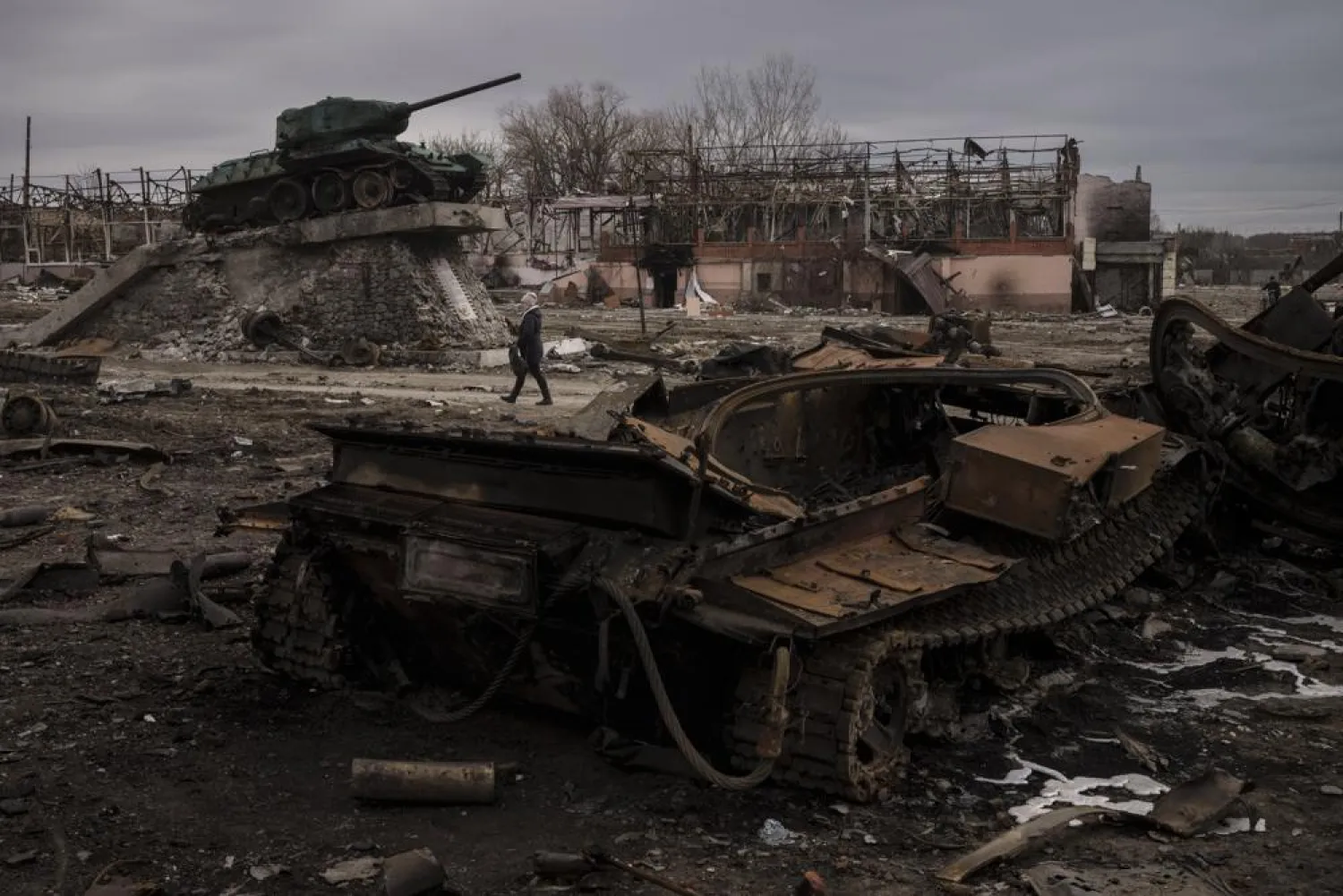
Ukrainian forces also seized back Trostyanets, south of Sumy in the northeast, after weeks of Russian occupation that left a devastated landscape.
Arriving in the town Monday shortly afterward, The Associated Press saw the bodies of two Russian soldiers in the woods, and Russian tanks sat burned and twisted. A red “Z” marked a Russian truck, its windshield fractured, near stacked boxes of ammunition. Ukrainian forces on top of a tank flashed victory signs. Dazed residents lined up amid charred buildings, seeking aid.
Putin’s ground forces have been thwarted not just by stronger-than-expected Ukrainian resistance, but by what Western officials say are Russian tactical missteps, poor morale, shortages of food, fuel and cold weather gear, and other problems.
Reinforcing what the military said last week, Russian Defense Minister Sergei Shoigu said Tuesday that “liberating Donbas” is now Moscow’s chief objective.
While that presents a possible face-saving exit strategy for Putin, it has also raised Ukrainian fears the Kremlin aims to split the country and force it to surrender a swath of its territory.


