


Indian Sari Weavers Toil to Keep Tradition Alive

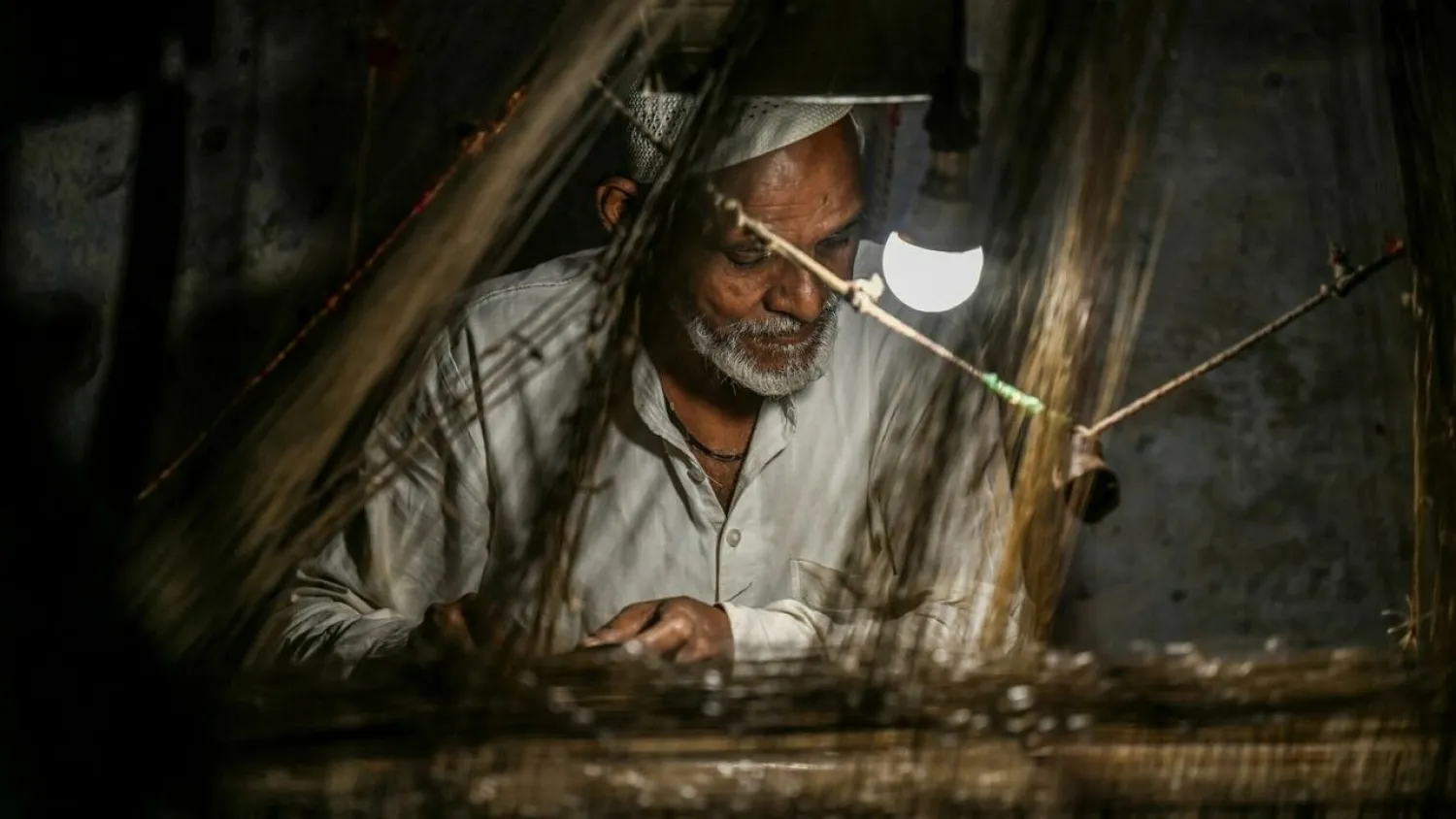
In a dim room near the banks of India's Ganges river, arms glide over a creaking loom as another silken fiber is guided into place with the rhythmic clack of a wooden beam. Money SHARMA AFP
TT

Indian Sari Weavers Toil to Keep Tradition Alive

In a dim room near the banks of India's Ganges river, arms glide over a creaking loom as another silken fiber is guided into place with the rhythmic clack of a wooden beam. Money SHARMA AFP

In a dim room near the banks of India's Ganges river, arms glide over a creaking loom as another silken fiber is guided into place with the rhythmic clack of a wooden beam.

Mohammad Sirajuddin's cramped studio is typical of Varanasi's dwindling community of artisans painstakingly working by hand to produce silk saris, uniquely cherished among their wearers as the epitome of traditional Indian sartorial style, AFP said.

The city he calls home is revered among devout Hindus, who believe that cremation on the banks of its sacred waterway offers the chance to escape the infinite cycle of death and rebirth.

But Sirajuddin's own reflections on mortality are centered on his craft, with competition from more cost-efficient mechanized alternatives and cheap imports from China leaving his livelihood hanging by a thread.

"If you walk around this whole neighborhood, you'll see that this is the only house with a handloom," the 65-year-old tells AFP.

"Even this will be here only as long as I am alive. After that, nobody in this house will continue."

Varanasi's hand-weavers have cultivated a reputation for excellence over centuries, specializing in intricate patterns, floral designs and radiant golden brocades.

The Banarasi saris -- so-called in reference to the city's ancient name -- they produce are widely sought after by Indian brides and are often passed on from one generation to the next as family heirlooms.

The elegant garments fetch handsome prices -- Sirajuddin's current work will go on sale for 30,000 rupees ($390) -- but the cost of inputs and cuts taken by middlemen leave little left for weavers.

"Compared to the hard work that goes into making the sari, the profit is negligible," Sirajuddin says.

His neighbors have all switched to electric looms for their garments, which lack the subtleties of hand-woven textiles and sell for just a third of the price but take a fraction of the time to finish.

- 'Thriving industries got killed' -
The fortunes of India's textile trade -- historically a cottage industry -- have long been subject to sudden and devastating upheavals from abroad.

Its delicate fabrics were prized by the 18th century European elite but British colonization and England's industrial-era factories flooded India with much cheaper textiles, decimating the market for hand-woven garments.

Decades of socialist-inspired central planning after independence bought some reprieve by shielding local handicrafts from the international market.

But economic reforms in the early 1990s opened the country up to cheap goods just as the country's northern neighbor was establishing itself as the globalized world's workshop.

"Chinese yarn and fabric came in everywhere," said author and former politician Jaya Jaitly, who has written a book on Varanasi's woven textiles, adding that sari factories there had for years been emulating the city's unique patterns and detail.

"All of these thriving industries got killed... through Chinese competition, and their ability to produce huge quantities at very low prices."

- 'Tradition to be proud of' -
Jaitly said local weavers needed urgent protection from government to preserve a wealth of artisanal traditions that otherwise risked disappearing.

"We have the largest number of varieties of handloom, techniques, skills... more than anywhere else in the world," she said.

"I think that's truly a tradition to be proud of."

Demand for Banarasi saris, already limited to a select Indian clientele able to justify spending at a premium, has also suffered in the wake of the Covid-19 pandemic.

The virus threat may have receded in India, but job losses and a big dent to the economy have taken their toll.

"The weavers are suffering a lot. They are not getting the right price for their products, payments are also coming late," said local sari merchant Mohammad Shahid, his store empty but for sales assistants stacking silk garments on the shelves.

Shahid was nonetheless hopeful that well-heeled and discerning customers would return.

"Those who know the value of handloom will continue to buy and cherish our saris. The handlooms can dwindle but they will never go away," Shahid, 33, told AFP.


'Large-scale' Avalanche Kills Two Skiers in French Alps

Members of the CRS Alpes Grenoble mountain rescue team prepare to board a Securite Civile helicopter (emergency management) after after an avalanche emergency response rescue mission in an off-piste area of the Ecrins massif, French Alps on January 29, 2026. (Photo by JEFF PACHOUD / AFP)
TT

'Large-scale' Avalanche Kills Two Skiers in French Alps

Members of the CRS Alpes Grenoble mountain rescue team prepare to board a Securite Civile helicopter (emergency management) after after an avalanche emergency response rescue mission in an off-piste area of the Ecrins massif, French Alps on January 29, 2026. (Photo by JEFF PACHOUD / AFP)

An avalanche has killed two off-piste ski tourers in the French Alps, a local prosecutor said on Sunday.

According to local rescue services, the two men died when an avalanche was triggered on Saturday afternoon near the village of Saint-Veran, known as the highest village in the French Alps.

The two victims-- one born in 1997 and the other in 1991 -- were part of a group of four unguided skiers when a "large-scale" avalanche swept down the north side of the Tete de Longet mountain peak, Gap prosecutor Marion Lozac'hmeur told AFP.

The other two skiers were unharmed, Lozac'hmeur added.

An autopsy has been ordered as part of an investigation into the cause of death, according to the prosecutor.

Avalanches have already claimed the lives of more than 20 skiers across the French, Swiss and Austrian Alps so far this season.


Olympic Tourists in Cortina Can Explore the Dolomites with the New ‘Uber Snowmobile’ Service

 The peaks of the Dolomites are seen from the Cortina Sliding Centre during the Milano Cortina 2026 Winter Olympic Games in Cortina d'Ampezzo on February 5, 2026. (AFP)
The peaks of the Dolomites are seen from the Cortina Sliding Centre during the Milano Cortina 2026 Winter Olympic Games in Cortina d'Ampezzo on February 5, 2026. (AFP)
TT

Olympic Tourists in Cortina Can Explore the Dolomites with the New ‘Uber Snowmobile’ Service

 The peaks of the Dolomites are seen from the Cortina Sliding Centre during the Milano Cortina 2026 Winter Olympic Games in Cortina d'Ampezzo on February 5, 2026. (AFP)
The peaks of the Dolomites are seen from the Cortina Sliding Centre during the Milano Cortina 2026 Winter Olympic Games in Cortina d'Ampezzo on February 5, 2026. (AFP)

The peaks of the Dolomites are seen from the Cortina Sliding Centre during the Milano Cortina 2026 Winter Olympic Games in Cortina d'Ampezzo on February 5, 2026. (AFP)

For one month starting on Saturday, Olympic spectators keen for a side trip to a UNESCO World Heritage Site can use Uber to reserve a ride on a snowmobile along the snow-covered road to the base of the Three Peaks of Lavaredo.

The dramatic, jagged limestone pinnacles stand just 23 kilometers (14.3 miles) from the Cortina venues where athletes are competing in the 2026 Winter Olympics and Paralympics.

One of the Olympic torchbearers, Giulia Baffetti, runs snowmobiling tours through Cortina-based winter activities outfit Snowdreamers. The company partnered with Uber, the official ride-hailing sponsor for the Games, to offer free tours on the weekends in February to people in town.

"Uber Snowmobile" tours, which can only be booked through Uber, include a ride in an Uber transfer bus for up to eight people from Cortina to the spot where riders mount their snowmobiles for departure. Tourgoers then follow the instructor, who leads the line of snowmobiles.

The first slots offered went fast, but Uber spokesperson Caspar Nixon said Friday that it planned to add more.

The three peaks are a magical place, Baffetti said, and this is a way for more people to experience it. Hikers and climbers flock there in the warmer months. In the winter, it’s a prime spot for cross-country skiing, snowshoeing and sledding. Snowmobiling is allowed in a limited area in order to protect the environment.

"We want to give an experience to the tourists, so they can feel the mountains in a different way," she said.

The Associated Press took the one-hour tour on Thursday, ahead of the Saturday launch, along with one other person. Helmets are essential, while heated handgrips are a most welcome feature. And that red button? Passengers can push it to stop the snowmobile if it veers off course or they feel unsafe.

The adrenaline-filled ride reaches speeds up to 40 kph (25 mph) when zooming past snow-covered trees, and drivers are instructed to slow when coming upon cross-country skiers and sledders. Deer and wolves are sometimes seen along the 7-kilometer (4.3-mile) route up to the base of the peaks.

Also visible on Thursday was the southernmost of the three Lavaredo peaks, rising sharply out of the fog. While the Dolomites are breathtaking from Cortina — and on Friday, the sun shone and the view was clear from town — they are even more impressive up close.

The route back includes a short loop around Lake Antorno. Before traversing all the ups and downs, the snowmobile instructor leading the tour offers a reminder about that red button.

Saher Deeb, an Israeli tourist, was along for the ride Thursday, one day after his 29th birthday. It was his first time on a snowmobile, and he was all smiles as he climbed off at the end.

"It was perfect," he said.


French Duo Finish Walking from France to Shanghai After 1.5 Years

 Performers throw molten iron to create sparks during a performance on the Bund promenade along the Huangpu river, ahead of the upcoming Lunar New Year of the Horse in Shanghai on February 2, 2026. (AFP)
Performers throw molten iron to create sparks during a performance on the Bund promenade along the Huangpu river, ahead of the upcoming Lunar New Year of the Horse in Shanghai on February 2, 2026. (AFP)
TT

French Duo Finish Walking from France to Shanghai After 1.5 Years

 Performers throw molten iron to create sparks during a performance on the Bund promenade along the Huangpu river, ahead of the upcoming Lunar New Year of the Horse in Shanghai on February 2, 2026. (AFP)
Performers throw molten iron to create sparks during a performance on the Bund promenade along the Huangpu river, ahead of the upcoming Lunar New Year of the Horse in Shanghai on February 2, 2026. (AFP)

Two French adventurers reached the end of an epic walk from France to Shanghai on Saturday, after nearly a year and a half crossing 16 countries almost entirely on foot.

Loic Voisot and Benjamin Humblot embraced as they stood by the river on the Bund promenade, the financial hub's distinctive skyline glittering in the background.

Voisot and Humblot set off from Annecy in September 2024.

"We were thinking about this moment almost every day for more than a year now, so it's a really strong feeling," Humblot said of reaching their destination.

Hanging out after work one day, the two friends realized they both yearned for a "great adventure".

They wanted to visit China -- but without flying, which they believe is too harmful to the environment.

A plan to set out on foot was hatched, and except for a stretch in Russia which was done by bus for safety reasons, 518 days and around 12,850 kilometers (7,980 miles) later they took the last steps to completing it.

Around 50 people gathered at the start point for the last 10km stretch of their odyssey, many local people who have been following them on social media.

Along the way their numbers swelled, as media, French residents of Shanghai and others joined.

"If your dreams are crazy, just take it step by step and sometimes you will not succeed, but sometimes you will," said Voisot.

Asked what he would do first now the walk was over, he joked: "Sleep a lot!"