


Putin Vows War Will Continue as Russian Troops Mount in East

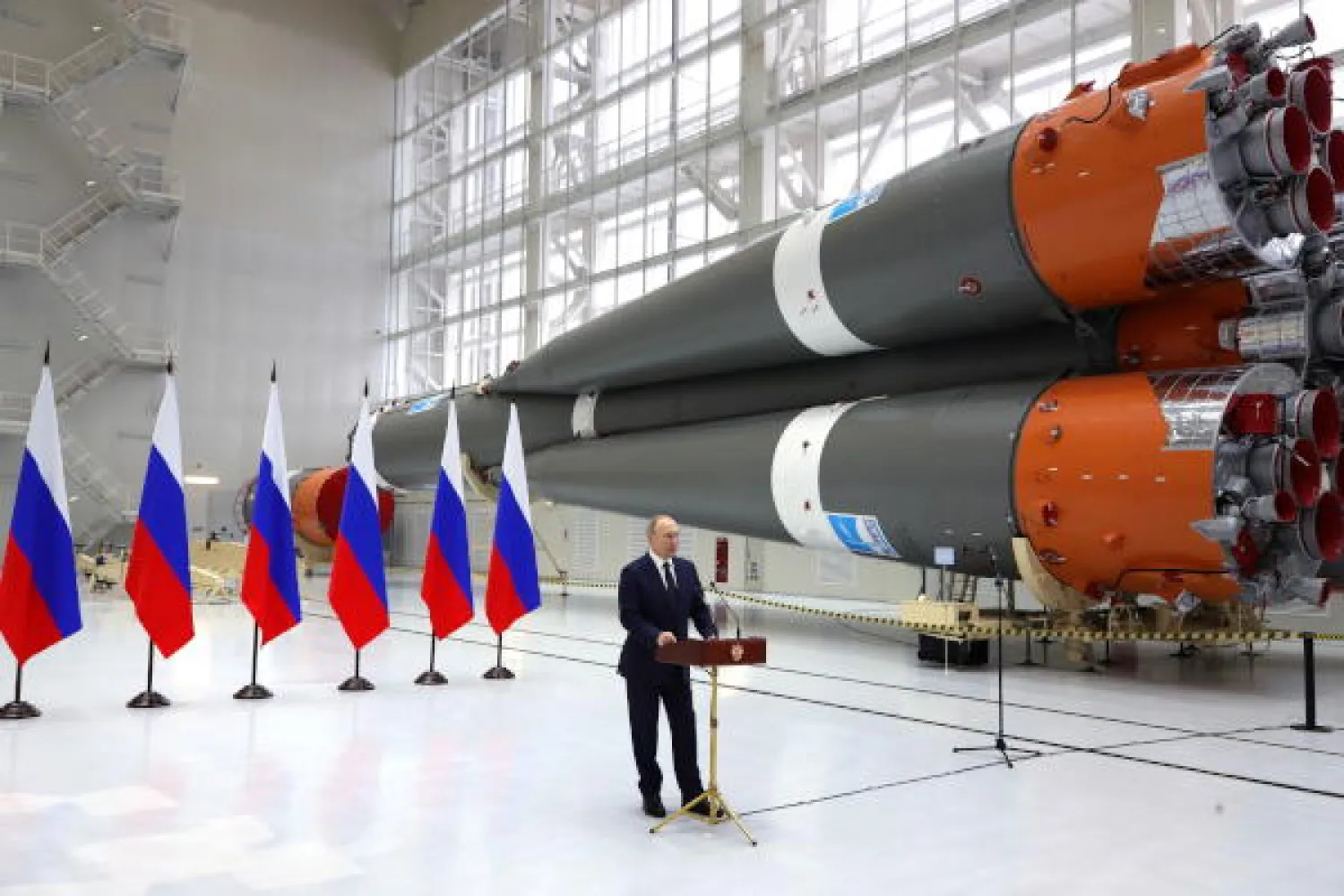
Russian President Vladimir Putin delivers a speech, as he visits the Vostochny cosmodrome outside the city of Tsiolkovsky, some 180 km north of Blagoveschensk, in the far eastern Amur region, Russia, 12 April 2022. EPA/MIKHAIL KLIMENTYEV
TT

Putin Vows War Will Continue as Russian Troops Mount in East

Russian President Vladimir Putin delivers a speech, as he visits the Vostochny cosmodrome outside the city of Tsiolkovsky, some 180 km north of Blagoveschensk, in the far eastern Amur region, Russia, 12 April 2022. EPA/MIKHAIL KLIMENTYEV

Russia vowed to continue its bloody offensive in Ukraine as the war neared its seventh week Wednesday, as President Vladimir Putin insisted the campaign was going as planned despite a major withdrawal and significant losses.

Thwarted in their push toward the capital, Kyiv, Russian troops focused on the eastern region of Donbas, where Ukraine said it was investigating a claim that a poisonous substance had been dropped on its troops. It was not clear what the substance might be, but Western officials warned that any use of chemical weapons by Russia would be a serious escalation of the already devastating war.

Russia invaded on Feb. 24 with the goal, according to Western officials, of taking Kyiv, toppling the government and installing a Moscow-friendly regime. In the six weeks since, the ground advance stalled and Russian forces lost potentially thousands of fighters and were accused of killing civilians and other atrocities.

Putin said Tuesday that Moscow “had no other choice” and that the invasion aimed to protect people in parts of eastern Ukraine and to “ensure Russia’s own security.” He vowed it would “continue until its full completion and the fulfillment of the tasks that have been set.”

Meanwhile Wednesday, Ukrainian President Volodymyr Zelenskyy was expected to receive the presidents of Poland, Lithuania, Latvia and Estonia — his staunch European allies.

“We are visiting Ukraine to show strong support for the Ukrainian people, will meet dear friend President Zelenskyy,“ Estonian President Alar Karis tweeted.

For now, Putin’s forces are gearing up for a major offensive in the Donbas, where Russian-allied separatists and Ukrainian forces have been fighting since 2014, and where Russia has recognized the separatists’ claims of independence. Military strategists say Moscow believes local support, logistics and the terrain in the region favor its larger, better-armed military, potentially allowing Russia to finally turn the tide in its favor.

In Mariupol, a strategic port city in the Donbas, a Ukrainian regiment defending a steel mill alleged that a drone dropped a poisonous substance on the city. The assertion by the Azov Regiment, a far-right group now part of the Ukrainian military, could not be independently verified. The regiment indicated there were no serious injuries.

Zelenskyy said that while experts try to determine what the substance might be, “The world must react now.”

The claims came after a Russia-allied separatist official appeared to urge the use of chemical weapons, telling Russian state TV on Monday that separatist forces should seize the plant by first blocking all the exits. “And then we’ll use chemical troops to smoke them out of there,” the official, Eduard Basurin, said. He denied Tuesday that separatist forces had used chemical weapons in Mariupol.

Ukrainian Deputy Defense Minister Hanna Maliar said officials were investigating, and it was possible phosphorus munitions — which cause horrendous burns but are not classed as chemical weapons — had been used in Mariupol, which has been pummeled by weeks of Russian assaults.

Western leaders warned that if chemical weapons are found to have been used, it would amount to a grievous breach of international law.

President Joe Biden for the first time referred to Russia’s invasion as a “genocide” and said “Putin is just trying to wipe out the idea of even being a Ukrainian.”

The Pentagon said it could not confirm the drone report but reiterated US concerns about Russia using chemical agents. Britain, meanwhile, has warned that Russia may resort to phosphorus bombs, which are banned in civilian areas under international law, in Mariupol.

Most armies use phosphorus munitions to illuminate targets or to produce smoke screens. Deliberately firing them into an enclosed space to expose people to fumes could breach the Chemical Weapons Convention, said Marc-Michael Blum, a former laboratory head at the Netherlands-based Organization for the Prohibition of Chemical Weapons.

“Once you start using the properties of white phosphorus, toxic properties, specifically and deliberately, then it becomes banned,” he said.

In Washington, a senior US defense official said the Biden administration was preparing another package of military aid for Ukraine to be announced in the coming days, possibly totaling $750 million.
The official spoke on condition of anonymity to discuss plans not yet publicly announced. Delivery is due to be completed this week of $800 million in military assistance approved by Biden a month ago.

In the face of stiff resistance by Ukrainian forces bolstered by Western weapons, Russian forces have increasingly relied on bombarding cities, flattening many urban areas and killing thousands. The war has driven more than 10 million Ukrainians from their homes — including nearly two-thirds of the country’s children.

Ukraine's Deputy Prime Minister Iryna Vereshchuk said humanitarian corridors used to get people out of cities under Russian attack will not operate on Wednesday because of poor security.

She said that in the southeast Zaporizhzhia region, Russian troops blocked evacuation buses, and in the Luhansk region, they were violating the cease-fire.

"The occupiers not only disregard the norms of international humanitarian law, but also cannot properly control their people on the ground. All this creates such a level of danger on the routes that we are forced to refrain from opening humanitarian corridors today.”

Moscow’s retreat from cities and towns around Kyiv led to the discovery of large numbers of apparently massacred civilians, prompting widespread condemnation and accusations of war crimes.
Zelenskyy said evidence of “inhuman cruelty” toward women and children in Bucha and other suburbs of Kyiv continued to surface, including alleged rapes.

“Not all serial rapists reach the cruelty of Russian soldiers,” Zelenskyy said.

More than 720 people were killed in Kyiv suburbs that had been occupied by Russian troops and over 200 were considered missing, the Interior Ministry said early Wednesday.
In Bucha alone, Mayor Anatoliy Fedoruk said 403 bodies had been found and the toll could rise as minesweepers comb the area.

In the Chernihiv region, villagers said more than 300 people had been trapped for almost a month by the occupying Russian troops in the basement of a school and only allowed outside to go to the toilet or cook on open fires.

Valentyna Saroyan told The Associated Press she saw at least five people die in Yahidne, 140 kilometers (86 miles) north of Kyiv. In one of the rooms, the residents wrote the names of those who perished during the ordeal — the list counted 18 people.

Villagers say they don’t know the cause of the deaths. Russian soldiers allowed them to remove the bodies from time to time in order to bury them in a mass grave at the local cemetery.

Julia Surypak said the Russians only allowed some people to make a short trip home if they sang the Russian anthem. Another resident, Svitlana Baguta, said a Russian soldier made her drink from a flask pointing a gun at her face.

Ukraine’s prosecutor-general’s office said Tuesday it was also looking into events in the Brovary district, which lies to the northeast. It said the bodies of six civilians were found with gunshot wounds in a basement in the village of Shevchenkove and Russian forces were believed to be responsible.

Prosecutors are also investigating allegations that Russian forces fired on a convoy of civilians trying to leave by car from the village of Peremoha in the Brovary district, killing four people including a 13-year-old boy. In another attack near Bucha, five people were killed including two children when a car was fired upon, prosecutors said.

Putin falsely claimed Tuesday that Ukraine’s accusation that hundreds of civilians were killed by Russian troops in the town of Bucha were “fake.”

Associated Press journalists saw dozens of bodies in and around the town, some of whom had their hands bound and appeared to have been shot at close range.



Netanyahu Skeptical of an Iran Breakthrough

Israel's Prime Minister Benjamin Netanyahu leaves after a meeting with US President Donald Trump at the White House February 11, 2026, in Washington, DC. (Photo by Brendan Smialowski / AFP)
TT

Netanyahu Skeptical of an Iran Breakthrough

Israel's Prime Minister Benjamin Netanyahu leaves after a meeting with US President Donald Trump at the White House February 11, 2026, in Washington, DC. (Photo by Brendan Smialowski / AFP)

Israeli Prime Minister Benjamin Netanyahu said he was skeptical that US nuclear talks with Iran will lead to a breakthrough but described his meeting with US President Donald Trump at the White House as “excellent.”

Speaking to reporters Thursday in Washington before boarding a plane to return to Israel, Netanyahu said Trump’s terms and Iran’s “understanding that they made a mistake the last time when they did not reach an agreement, may lead them to agree to conditions that will enable a good agreement to be reached.”

While he said he did “not hide my general skepticism” about any deal, he stressed that any agreement must include concessions about Iran’s ballistic missiles program and support for militant proxies.

He added that the conversation Wednesday with Trump, which lasted more than two hours, included a number of other subjects, including Gaza and regional developments but focused on the negotiations with Iran.


German Court Rejects Palestinian's Claim over Weapons Exports

A view shows the front of the Reichstag building, the seat of the German parliament, the Bundestag, in Berlin, Germany March 5, 2025. REUTERS/Annegret Hilse/File Photo
TT

German Court Rejects Palestinian's Claim over Weapons Exports

A view shows the front of the Reichstag building, the seat of the German parliament, the Bundestag, in Berlin, Germany March 5, 2025. REUTERS/Annegret Hilse/File Photo

Germany's highest court on Thursday threw out a case brought by a Palestinian civilian from Gaza seeking to sue the German government over its weapons exports to Israel.

The complainant, supported by the European Center for Constitutional and Human Rights (ECCHR), had been seeking to challenge export licences for German parts used in Israeli tanks deployed in Gaza.

After his case was rejected by lower courts in 2024 and 2025, he had appealed to the Federal Constitutional Court.

But the court in Karlsruhe dismissed the case, stating that "the complainant has not sufficiently substantiated that the specialized courts misjudged or arbitrarily denied a possible duty to protect him", AFP reported.

While Germany is obliged to protect human rights and respect international humanitarian law, this does not mean the state is necessarily obliged to take specific action on behalf of individuals, the court said.

"It is fundamentally the responsibility of the state authorities themselves to decide how they fulfil their general duty of protection," it added.

The ECCHR called the decision "a setback for civilian access to justice".

"The court acknowledges the duty to protect but only in the abstract and refuses to ensure its practical enforcement," said Alexander Schwarz, co-director of the NGO's International Crimes and Legal Accountability program.

"For people whose lives are endangered by the consequences of German arms exports, access to justice remains effectively closed," he said.

The ECCHR had been hoping for a successful appeal after the Constitutional Court ruled last year that Germany had "a general duty to protect fundamental human rights and the core norms of international humanitarian law, even in cases involving foreign countries".

In that case, two Yemenis had been seeking to sue Berlin over the role of the US Ramstein airbase in a 2012 drone attack.

The complainant was one of five Palestinians who initially brought their case against the German government in 2024.


2 Israelis Charged with Using Classified Military Information to Place Bets

The Israeli Iron Dome air defense system intercepts missiles during an Iranian attack on Tel Aviv, Israel, June 18, 2025. (AP Photo/Leo Correa, File)
TT

2 Israelis Charged with Using Classified Military Information to Place Bets

The Israeli Iron Dome air defense system intercepts missiles during an Iranian attack on Tel Aviv, Israel, June 18, 2025. (AP Photo/Leo Correa, File)

Two Israelis have been charged with using classified military information to place bets on how future events will unfold, Israeli authorities said Thursday, accusing the individuals of “serious security offenses.”

A joint statement by the Israeli Ministry of Defense, domestic security service Shin Bet and police said that a civilian and a reservist are suspected of placing bets on the US-based prediction market Polymarket on future military operations based on information that the reservist had access to, The AP news reported.

Israel’s Attorney General’s Office decided to prosecute the two individuals following a joint investigation by police, military intelligence and other security agencies that resulted in several arrests. The two face charges including bribery and obstruction of justice.

Authorities offered no details on the identity of the two individuals or the reservist's rank or position in the Israeli military but warned that such actions posed a “real security risk” for the military and the Israeli state.

Israel’s public broadcaster Kan had reported earlier that the bets were placed in June ahead of Israel’s war with Iran and that the winnings were roughly $150,000.

Israel's military and security services “view the acts attributed to the defendants very seriously and will act resolutely to thwart and bring to justice any person involved in the activity of using classified information illegally,” the statement said.

The accused will remain in custody until the end of legal proceedings against them, the Prosecutor's Office said.

Prediction markets are comprised of typically yes-or-no questions called event contracts, with the prices connected to what traders are willing to pay, which theoretically indicates the perceived probability of an event occurring.

Their use has skyrocketed in recent years, but despite some eye-catching windfalls, traders still lose money everyday. In the US, the trades are categorized differently than traditional forms of gambling, raising questions about transparency and risk.