

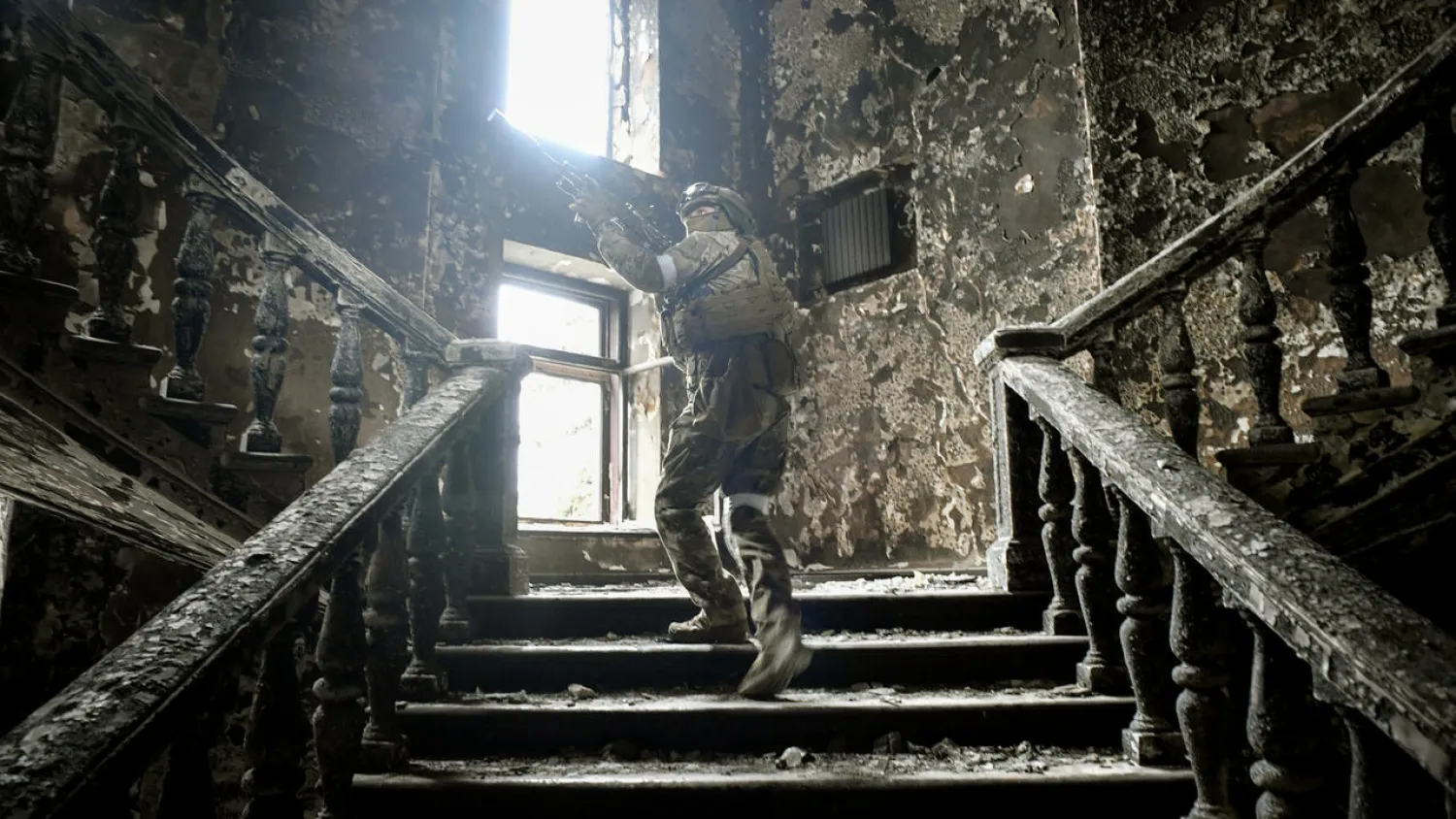

In Mariupol, Destroyed Buildings and Fresh Graves

Russian soldiers patrol in the bombed Mariupol theatre during a media tour organized by Russia. Alexander NEMENOV AFP
TT

In Mariupol, Destroyed Buildings and Fresh Graves

Russian soldiers patrol in the bombed Mariupol theatre during a media tour organized by Russia. Alexander NEMENOV AFP

Galina Vasilyeva looks around at the ruins of the devastated Ukrainian city of Mariupol that she once helped to build.

Pointing towards a charred nine-storey building, the retired construction worker with bright red hair says: "There are burnt corpses in there."

"All these buildings were built by my generation. And now they have bombed everything," says 78-year-old Vasilyeva, as she queues for humanitarian aid distributed by pro-Russia separatists.

The strategic port city was encircled by Russian troops early on in what Moscow calls its "special military operation" in Ukraine. Conquering the city would connect Russia-controlled Crimea to the territories of Moscow-backed separatists in the eastern Donbas region, AFP reported.

Over a month later, Ukraine's forces continue resisting from inside the city's giant metallurgical and heavy machinery plants, but are struggling to hold the city with a population of around 500,000 people.

While the official death toll is unknown, thousands of civilians are believed to have died in the besieged city while others have survived with hardly any food or water and no electricity.

- Fear and horror -
"There are a lot of dead people and unfortunately, we can't remove them all," Yury Bukharev, a soldier in the separatist army, tells reporters taking part in a media trip organized by the Russian army, blaming ongoing fighting.

Bukharev stands inside the remains of Mariupol's drama theatre, partially destroyed and burnt in an attack on March 16 as hundreds sheltered in its basement.

It is not known how many people remain buried in the rubble.

"When we start removing the rubble, the number of victims will become clearer," Bukharev says.

Authorities in Kyiv say Russia deliberately bombed the theatre, while Moscow accuses a Ukrainian nationalist battalion of blowing up the theatre themselves in order to blame it on Russia.

They also say Ukrainian forces used high-rise apartment blocks as firing positions.

Now that the fighting has subsided, Mariupol's residents have started coming outside in search of food, water and an escape route from the city.

"I know that we experienced horror and we don't know what will happen next. We live like we're on top of a volcano," says 59-year-old Tatyana, a municipal employee, who is also waiting for humanitarian aid, carrying a broom she is using to help clear up the city.

"There's fear, fear! What else is there to say? A lot of people are suffering," adds Tatyana, who didn't give her last name.

She says that people have died in her apartment building: "We bury them right there in the courtyards."

AFP journalists saw numerous such hastily dug graves on a city boulevard.

-- 'Under fire' --
With only a backpack between them, Konstantin Mavrodi and his mother Taisiya say they have left their home in the hope of finding a bus leaving for Volnovakha, a town further north under Russian control, where his grandmother lives.

"To get here today, we had to run under fire, under bullets," Mavrodi says.

They said they came under gunfire while walking through streets close to the Azovstal industrial zone where the Ukrainian army is still resisting, from inside tunnels dug during the Soviet era.

The 28-year-old, who taught computer science to children, says that everyone in the city has been living without electricity or the internet since March 3, making it impossible to let family members know they are alive.

His future remains unclear, as he is neither ready to turn his back on his homeland Ukraine nor Russia, where he and his mother have relatives.

"Now we are simply people who want to live. Which country we want to live in -- we will decide later," he says.

Back in the queue for a truck carrying humanitarian aid, Svetlana Yasakova says she does not plan to leave.

"I am homeless, my apartment is totally destroyed. I moved in three months ago, a new apartment, newly renovated," the 43-year-old accountant in orange glasses says, smiling despite everything.

"I live in the present moment. Today I am here, and tomorrow will be tomorrow. I love my city, even in this state. It is beautiful even like this," Svetlana adds.

"I'm for peace, love and calm. And as they say, may God help all people and take charge of the situation."



UK PM's Top Aide Quits over Mandelson-Epstein Scandal

FILE PHOTO: British Prime Minister Keir Starmer talks with Britain's ambassador to the United States Peter Mandelson during a welcome reception at the ambassador's residence on February 26, 2025, in Washington, DC, US. Carl Court/Pool via REUTERS/File Photo
TT

UK PM's Top Aide Quits over Mandelson-Epstein Scandal

FILE PHOTO: British Prime Minister Keir Starmer talks with Britain's ambassador to the United States Peter Mandelson during a welcome reception at the ambassador's residence on February 26, 2025, in Washington, DC, US. Carl Court/Pool via REUTERS/File Photo

British Prime Minister Keir Starmer's chief of staff, Morgan McSweeney, quit on Sunday, saying he took responsibility for advising Starmer to name Peter Mandelson as ambassador to the US despite his known links to Jeffrey Epstein.

After new files revealed the depth of the Labour veteran's relationship with the late sex offender, Starmer is facing what is widely seen as the gravest crisis of his 18 months in power over his decision to send Mandelson to Washington in 2024, Reuters reported.

The loss of McSweeney, 48, a strategist who was instrumental in Starmer's rise to power, is the latest in a series of setbacks, less than two years after the Labour Party won one of the largest parliamentary majorities in modern British history.

With polls showing Starmer is hugely unpopular with voters after a series of embarrassing U-turns, some in his own party are openly questioning his judgment and his future, and it remains to be seen whether McSweeney's exit will be enough to silence critics.

The files released in the US on January 30 sparked a police investigation for misconduct in office over indications that Mandelson leaked market-sensitive information to Epstein when he was a government minister during the global financial crisis in 2009 and 2010.

In a statement, McSweeney said: "The decision to ⁠appoint Peter Mandelson was wrong. He has damaged our party, our country and trust in politics itself.
"When asked, I advised the Prime Minister to make that appointment and I take full responsibility for that advice."

The leader of the opposition Conservative Party, Kemi Badenoch, said the resignation was overdue and that "Keir Starmer has to take responsibility for his own terrible decisions".

Nigel Farage, head of the populist Reform UK party, which is leading in the polls, said he believed Starmer's time would soon be up.

Starmer has spent the last week defending McSweeney, a strategy that could prompt further questions about his own judgment. In a statement on Sunday, Starmer said it had been "an honor" working with him.

Many Labour members of parliament had blamed McSweeney for the appointment of Mandelson and the damage caused by the publication of the exchanges between Epstein ⁠and Mandelson. Others have said Starmer must go.

One Labour lawmaker, speaking on condition of anonymity, said McSweeney's resignation had come too late: "It buys the PM time, but it's still the end of days."

Starmer sacked Mandelson as ambassador in September over his links to Epstein.

The government agreed last week to release virtually all previously private communications between members of his government from the time when Mandelson was being appointed.

That release could come as early as this week, creating a new headache for Starmer just as he hopes to move on. If previously secret messages about how London planned to approach its relationship with Donald Trump are made public, it could damage Starmer's relationship with the US President.

McSweeney had held the role of chief of staff since October 2024, when he was handed the job following the resignation of Sue Gray after a row over pay and donations.

Starmer on Sunday appointed his deputy chiefs of staff, Jill Cuthbertson and Vidhya Alakeson, to serve as joint acting chiefs of staff.


Iran Sentences Nobel Laureate Narges Mohammadi to 7 More Years in Prison

(FILES) A handout photo provided by the Narges Mohammadi Foundation on October 2, 2023 shows an undated, unlocated photo of Iranian rights campaigner Narges Mohammadi. (Photo by Handout / NARGES MOHAMMADI FOUNDATION / AFP)
TT

Iran Sentences Nobel Laureate Narges Mohammadi to 7 More Years in Prison

(FILES) A handout photo provided by the Narges Mohammadi Foundation on October 2, 2023 shows an undated, unlocated photo of Iranian rights campaigner Narges Mohammadi. (Photo by Handout / NARGES MOHAMMADI FOUNDATION / AFP)

Iran sentenced Nobel Peace Prize laureate Narges Mohammadi to over seven more years in prison after she began a hunger strike, supporters said Sunday.

Mohammadi’s supporters cited her lawyer, who spoke to Mohammadi.

The lawyer, Mostafa Nili, confirmed the sentence on X, saying it had been handed down Saturday by a Revolutionary Court in the city of Mashhad. Such courts typically issue verdicts with little or no opportunity for defendants to contest their charges.

“She has been sentenced to six years in prison for ‘gathering and collusion’ and one and a half years for propaganda and two-year travel ban,” he wrote, according to The Associated Press.

She received another two years of internal exile to the city of Khosf, some 740 kilometers (460 miles) southeast of Tehran, the capital, the lawyer added.

Supporters say Mohammadi has been on a hunger strike since Feb. 2. She had been arrested in December at a ceremony honoring Khosrow Alikordi, a 46-year-old Iranian lawyer and human rights advocate who had been based in Mashhad. Footage from the demonstration showed her shouting, demanding justice for Alikordi and others.

Supporters had warned for months before her December arrest that Mohammadi, 53, was at risk of being put back into prison after she received a furlough in December 2024 over medical concerns.

While that was to be only three weeks, Mohammadi’s time out of prison lengthened, possibly as activists and Western powers pushed Iran to keep her free. She remained out even during the 12-day war in June between Iran and Israel.

Mohammadi still kept up her activism with public protests and international media appearances, including even demonstrating at one point in front of Tehran’s notorious Evin prison, where she had been held.

Mohammadi had been serving 13 years and nine months on charges of collusion against state security and propaganda against Iran’s government.

She also had backed the nationwide protests sparked by the 2022 death of Mahsa Amini, which have seen women openly defy the government by not wearing the hijab.

Mohammadi suffered multiple heart attacks while imprisoned before undergoing emergency surgery in 2022, her supporters say. Her lawyer in late 2024 revealed doctors had found a bone lesion that they feared could be cancerous that later was removed.

“Considering her illnesses, it is expected that she will be temporarily released on bail so that she can receive treatment,” Nili wrote.

However, Iranian officials have been signaling a harder line against all dissent since the recent demonstrations. Speaking on Sunday, Iranian judiciary chief Gholamhossein Mohseni-Ejei made comments suggesting harsh prison sentences awaited many.

“Look at some individuals who once were with the revolution and accompanied the revolution," he said. "Today, what they are saying, what they are writing, what statements they issue, they are unfortunate, they are forlorn (and) they will face damage.”


Nigeria's President to Make a Sate Visit to the UK in March

Nigeria’s President Bola Tinubu gives a joint statement with Brazil’s President Luiz Inacio Lula da Silva, at the Planalto presidential palace, in Brasilia, Brazil, Aug. 25, 2025. (AP Photo/Eraldo Peres, File)
TT

Nigeria's President to Make a Sate Visit to the UK in March

Nigeria’s President Bola Tinubu gives a joint statement with Brazil’s President Luiz Inacio Lula da Silva, at the Planalto presidential palace, in Brasilia, Brazil, Aug. 25, 2025. (AP Photo/Eraldo Peres, File)

Nigeria’s president is set to make a state visit to the UK in March, the first such trip by a Nigerian leader in almost four decades, Britain’s Buckingham Palace said Sunday.

Officials said President Bola Tinubu and first lady Oluremi Tinubu will travel to the UK on March 18 and 19, The AP news reported.

King Charles III and Queen Camilla will host them at Windsor Castle. Full details of the visit are expected at a later date.

Charles visited Nigeria, a Commonwealth country, four times from 1990 to 2018 before he became king. He previously received Tinubu at Buckingham Palace in September 2024.m

Previous state visits by a Nigerian leader took place in 1973, 1981 and 1989.

A state visit usually starts with an official reception hosted by the king and includes a carriage procession and a state banquet.

Last year Charles hosted state visits for world leaders including US President Donald Trump, French President Emmanuel Macron and German President Frank-Walter Steinmeier.