'Thai Messi' Chanathip Making Own Name in Japan

Thailand's Chanathip Songkrasin idolized Argentina legend Diego Maradona growing up. Roslan RAHMAN AFP
TT

'Thai Messi' Chanathip Making Own Name in Japan

Thailand's Chanathip Songkrasin idolized Argentina legend Diego Maradona growing up. Roslan RAHMAN AFP

He is known as the "Thai Messi" and grew up idolizing Diego Maradona -- now Chanathip Songkrasin is making his own name after joining one of Asia's top clubs.

The 159-centimeter (five foot two) attacking midfielder is a hero in Thailand, where he captains the national team and advertises everything from credit cards to energy drinks, AFP said.

Now the 28-year-old is breaking new ground after a January move to Japanese champions Kawasaki Frontale, which have won the J-League four times in the last five years.

Chanathip, also known as "Jay" in his home country, is keen to show football-mad Thai fans that he can live up to their expectations.

"Football is a sport that's popular all over the world and it's very popular in Thailand too," he told AFP.

"The fans gave me the nickname 'Messi' and that's a big honor, but Messi is a world-famous player, the best in the world.

"I can't be like Messi, but I'm happy to be called that."

Chanathip was born in central Thailand and first learned football from his father, a huge fan of Argentine legend Maradona.

His father showed him videos of the midfield great and encouraged his son to copy his bamboozling tricks and dynamic dribbles.

Chanathip made his Thai league debut in 2012 and had a trial with German side Hamburg, before earning himself a move to Japanese team Consadole Sapporo in 2017.

He spent four and a half years with the northern outfit, scoring 15 goals in 123 games, before joining Frontale this year for a reported J-League record transfer fee thought to be just under $4 million.

Now he is pulling the midfield strings for Japan's leading club and has helped Frontale top the J-League table 10 games into the new season.

"I've been able to get some games under my belt since I joined Frontale and to be honest I've had some good moments and some bad moments," he said.

"I'm still getting used to my teammates and my link-up play with them could be better. I have to keep adapting and show what I can do."

- 'Professional mentality' -
Chanathip says he struggled when he first moved to the J-League but his "imagination and vision have developed" after almost five years in Japan.

He thinks the J-League is a higher level than many European leagues and would like to see more Thai players follow in his footsteps by moving overseas.

"It sounds disrespectful to say that you can't compare the Thai league and the J-League, but you really can't," he said.

"Lots of players in the J-League have a professional mentality and it's been like that for a long time. It's very difficult to compare the two."

Chanathip says he is not "technically or physically ready" to play in Europe, but he has plenty of ambitions to fulfil in Asian club football.

Frontale have dominated the J-League for the past five years but they have yet to win the AFC Champions League.

They will try to put that right when this season's group stage gets under way on Friday, with the Japanese side drawn against South Korea's Ulsan Hyundai, China's Guangzhou and Malaysia's Johor Darul Ta'zim.

Chanathip believes Frontale, which have never gone past the quarter-finals, are good enough to finally claim the Asian title.

"When you look at the kind of football we're playing, winning the trophy is the target and I think we're capable of doing it," he said.

Chanathip will switch focus to his national team this summer when Thailand play their qualifying matches in June for next summer's Asian Cup.

The "War Elephants" will face Uzbekistan, Maldives and Sri Lanka in a round-robin tournament and are desperate not to miss out after failing to reach the final round of qualifiers for the 2022 World Cup.

Chanathip is confident his team will make it to the Asian Cup finals in China next year.

"As a player if you don't think you can get through then it's all over," he said.

"I think we can do it."


Organizer Says Sorry for Logistical Headaches at Asian Games

Gold medalists Wang Zongyuan and Zheng Jiuyuan of China, center, flanked by silver medalists Senri Ikuma and Haruki Suyama of Japan, left, and bronze medalist Rui Jie Yong and Nurgayyum Mohamad of Malaysia pose on the podium after the men's synchronized 3m springboard final at the Asian Games in Tokyo, Japan, Saturday, Sept. 26, 2026. (AP Photo/Hiro Komae)
TT

Organizer Says Sorry for Logistical Headaches at Asian Games

Gold medalists Wang Zongyuan and Zheng Jiuyuan of China, center, flanked by silver medalists Senri Ikuma and Haruki Suyama of Japan, left, and bronze medalist Rui Jie Yong and Nurgayyum Mohamad of Malaysia pose on the podium after the men's synchronized 3m springboard final at the Asian Games in Tokyo, Japan, Saturday, Sept. 26, 2026. (AP Photo/Hiro Komae)

The chief organizer of the Asian Games apologized on Saturday for the logistical headaches plaguing the event, saying a late influx of athletes and officials had made it difficult to extend smooth service.

The number of participants at the continental showpiece ballooned to 17,000 following a flurry of late entries — around 2,000 more than the Aichi-Nagoya 2026 Asian Games Organizing Committee had initially projected.

The unexpected surge strained accommodation and transport networks, prompting complaints from athletes and team officials over cramped rooms, small beds and travel delays.

"There have been mistakes in accommodation and transport, for various reasons," AINAGOC Secretary General Satoshi Murate told a press conference, according to Reuters.

"Whatever the cause, AINAGOC is responsible for providing ⁠the service, and ⁠I frankly apologize for the mistakes.

"Our staff work every day to identify the causes of each mistake and make sure they don't happen again. I think you can see that accommodation and transport have improved greatly compared with the early days."

Murate added that maintaining consistent service standards had proved challenging following the "significant" increase in delegation sizes.

"Our top priority is making sure the ⁠athletes can compete at their best. We are fully committed to making the necessary improvements to ensure that they can do so," he said.

"We are already working on a number of improvements, and in the second half of the Games, we want to make sure those efforts produce results and that we can manage things more smoothly and effectively."

Mongolian women's basketball coach Javier Garcia Alvarez criticized the transport system after a training session had to be scrapped when the team bus failed to arrive.

"I played in many FIBA Asia basketball cups and even Asian Games in Incheon some ⁠years ago. I ⁠never had this kind of issue that the bus is not coming for practice," he told Reuters.

"It was kind of disappointing because we were planning some practice, some shooting for the girls and the mind was prepared for that, and then at the end we had to cancel."

Filipino squash player Yvonne Alyssa Dalida had to endure a lengthy wait before checking into her room aboard a chartered cruise ship, though she found a silver lining in the unconventional setup.

"I think Japan or AINAGOC could have prepared better for this event, but I find it cool as well because it's very unique.

"I've never been on a cruise, so I think that's also the upside of them using this."


Prozorova Says Physio 'Pressure' Led to Withdrawal from Singapore Open Semi-final

Russia's Tatiana Prozorova serves against Philippines' Alexandra Eala during the WTA Singapore Open Tennis round of 16 in Singapore on September 24, 2026. (Photo by Roslan RAHMAN / AFP)
TT

Prozorova Says Physio 'Pressure' Led to Withdrawal from Singapore Open Semi-final

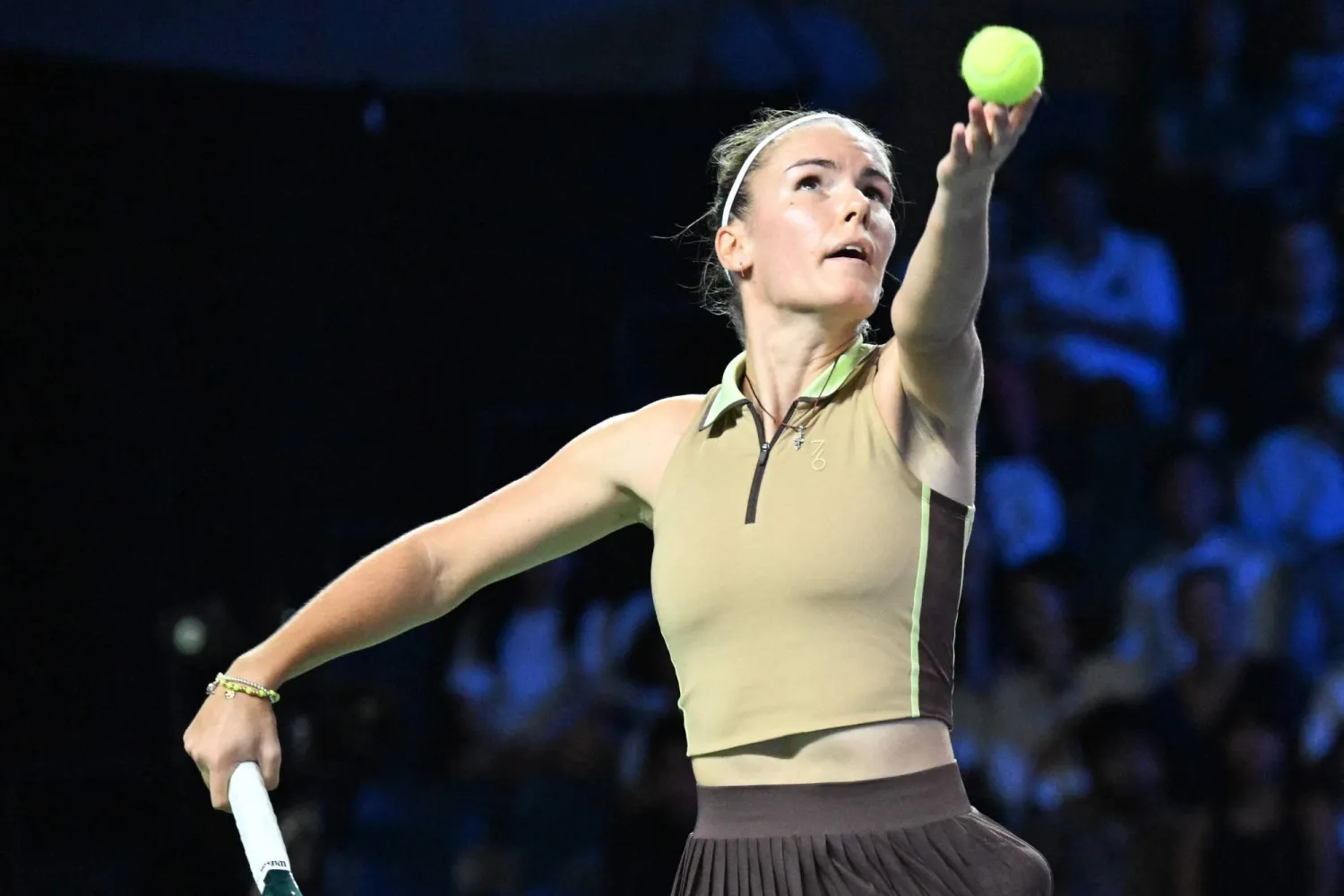
Russia's Tatiana Prozorova serves against Philippines' Alexandra Eala during the WTA Singapore Open Tennis round of 16 in Singapore on September 24, 2026. (Photo by Roslan RAHMAN / AFP)

Russia's Tatiana Prozorova said her withdrawal from the Singapore Open semi-finals followed "pressure" from a WTA physiotherapist who diagnosed her with concussion after being struck by a ball.

The 22-year-old withdrew from the singles event this weekend due to injury, tournament organizers said, sending Australia's Talia Gibson to the final by walkover.

That announcement followed Prozorova and partner Sofya Lansere's retirement from their doubles quarter-final match on Friday after Prozorova ⁠was hit in ⁠the face by a ball.

"The physio called to the court insisted on taking me off-court to run a specific test," Prozorova wrote.

"Unfortunately I didn't know I could refuse. The test wasn't easy. Given that I'd ⁠spent over three hours on court each of the last three days, I was fatigued, and I struggled with some of the exercises like standing on one leg with my eyes closed.

"My team and I had a long discussion with the organizers... The physio pressured everyone present and even claimed I wasn't capable of taking responsibility for my ⁠own ⁠life."

She said tournament organizers had supported her desire to continue playing but the final decision rested with the WTA.

Prozorova said the outcome could jeopardize her participation at next week's China Open.

Her run to the semi-finals in Singapore was a career best. It involved a quarter-final win over China's Wang Xinyu after back-to-back three-set victories over Alexandra Eala and Sofia Costoulas.


Saudi Sports Facilities Advance Under Vision 2030 to Host Global Championships

 Kingdom's 2034 FIFA World Cup plans include 15 stadiums distributed across five major cities - SPA
Kingdom's 2034 FIFA World Cup plans include 15 stadiums distributed across five major cities - SPA
TT

Saudi Sports Facilities Advance Under Vision 2030 to Host Global Championships

 Kingdom's 2034 FIFA World Cup plans include 15 stadiums distributed across five major cities - SPA
Kingdom's 2034 FIFA World Cup plans include 15 stadiums distributed across five major cities - SPA

Driven by the objectives of Saudi Vision 2030, the Kingdom continues to upgrade its sports infrastructure to the highest international standards, establishing itself as a global hub for premier tournaments backed by an expanding network of world-class venues.

In recent years, Saudi Arabia has hosted major global and continental competitions across its premier facilities. Leading the way is King Abdullah Sports City in Jeddah, with a capacity exceeding 62,000 spectators and an established record of hosting regional and international championships, supported by the recently redeveloped Prince Abdullah Al Faisal Sports City, SPA reported.

In Riyadh, comprehensive modernization is underway at King Fahd Sports City to elevate its facilities to premier global standards ahead of future international events. Concurrently, construction is advancing on multiple state-of-the-art venues, led by the 47,000-seat Aramco Stadium in Al-Khobar, scheduled for completion next month, which will host matches during the 2027 AFC Asian Cup.

Future pipeline projects feature the Jeddah Central Stadium, designed to reflect local architectural heritage, and the multi-purpose Prince Mohammed bin Salman Stadium in Qiddiya, alongside numerous venues being developed across the Kingdom.

Anchoring these developments, the Kingdom's 2034 FIFA World Cup plans include 15 stadiums distributed across five major cities, comprising 11 newly built venues and four extensively upgraded sports cities. This large-scale infrastructure program underscores Saudi Arabia's rising prominence on the international sporting map and its sustained readiness to deliver global tournaments.