

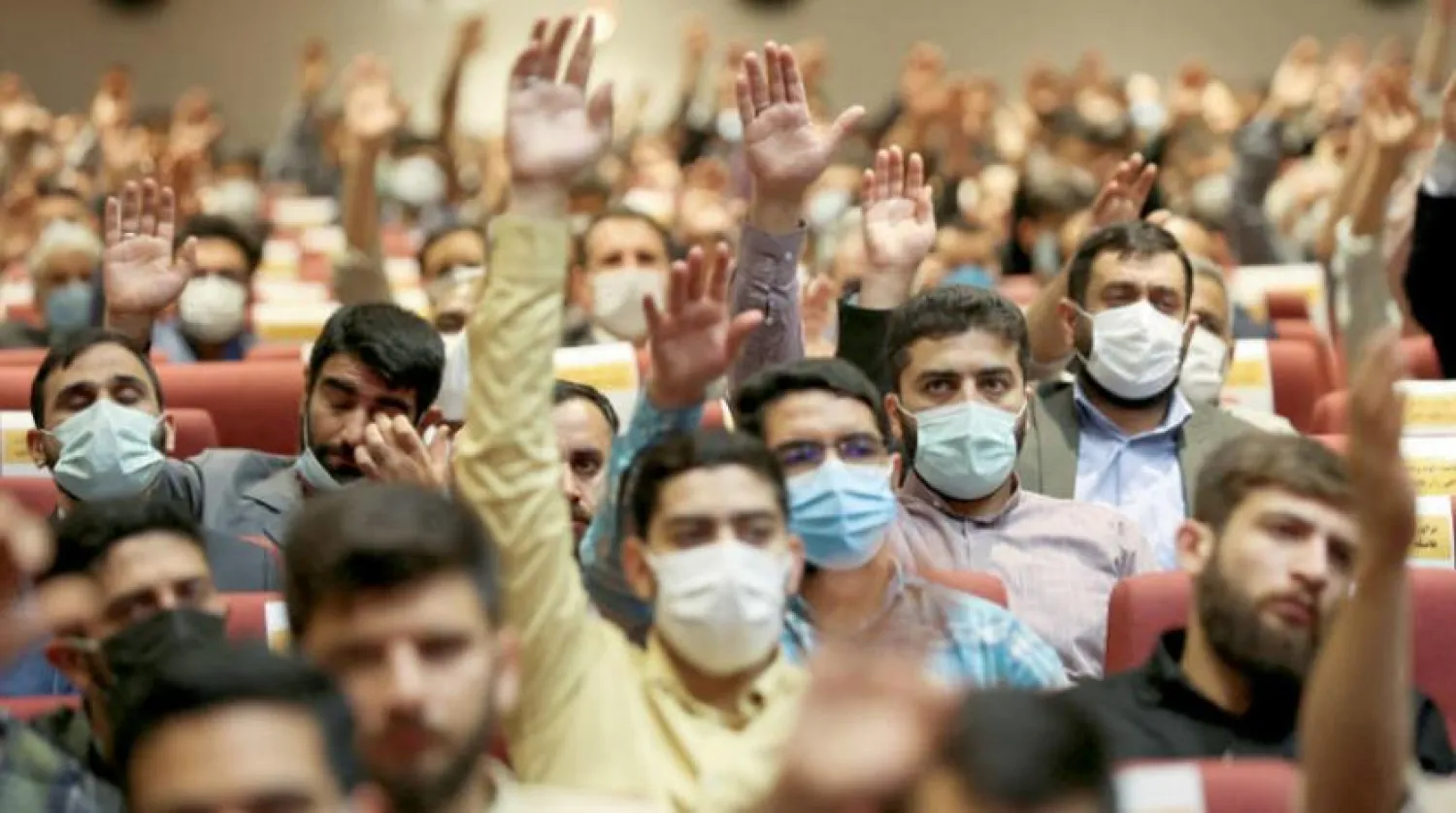

Iranian Lawmaker: Nuclear Talks Have Not Yet Reached an Agreement on Surveillance Footage

Hardline supporters of Iran’s elite Revolutionary Guard during a rally in Tehran (Reuters)
TT

Iranian Lawmaker: Nuclear Talks Have Not Yet Reached an Agreement on Surveillance Footage

Hardline supporters of Iran’s elite Revolutionary Guard during a rally in Tehran (Reuters)

An Iranian parliament spokesperson affirmed on Friday that Tehran will not hand over to the International Atomic Energy Agency (IAEA) any footage from its nuclear facilities. They noted that the Vienna talks have not yet reached an agreement on how international inspectors will access surveillance data.

Iran is starting to operate a new workshop at Natanz that will make parts for uranium-enriching centrifuges with machines moved there from its now-closed Karaj facility, the UN nuclear watchdog said in a confidential report on Thursday seen by Reuters.

“On 12 April 2022, the IAEA completed the installation of the surveillance cameras at this location and then removed the seals from the machines,” the IAEA said in the report to member states without describing where at Natanz that location was.

“On 13 April 2022, Iran informed the IAEA that the machines would start operating at the new workshop the same day,” it added, without saying whether it had verified that the machines had started operating.

In an interview with the “DidbanIran” news website, Mahmoud Abbaszadeh Meshkini, the spokesman for Parliament’s National Security and Foreign Policy Committee, said that all installed cameras are “within the framework of IAEA laws.”

However, he insisted that the cameras be separated into two groups.

According to Meshkini, there are cameras belonging to the IAEA (according to NPT laws), and other cameras set to monitor sensitive Iranian activities as stipulated by the nuclear deal.

For Tehran, IAEA inspectors accessing surveillance footage is contingent on arriving at deal in Vienna, a matter that stumbled last month due to a Russian obstacle before Iran demanding that its elite Revolutionary Guards be removed from the list of terrorist organizations.

Before moving the Karaj parts to Natanz, Iran had also told the IAEA it was moving the Karaj workshop’s activities to another site at Isfahan, and the IAEA has set up cameras there, according to Reuters.

If Isfahan went into operation, that would be a big increase in Iran’s capacity to produce advanced centrifuge parts.

Meshkini’s statements could be an indication that negotiations did not address the technical issues related to the IAEA's verification of Iranian activities.

Washington and Tehran have been trading blame over the failure to reach an agreement at the Vienna talks.

Last week, the Iranian Foreign Ministry expressed its doubts about the US’ “will” to reach an understanding.

“We really don’t know if we’ll get a deal or not, because the United States hasn’t shown the necessary will to reach an agreement,” Iranian Foreign Ministry spokesman Saeed Khatibzadeh told reporters.

Two days later, Iran’s supreme leader urged Iranian officials to not tie the country’s affairs to the fate of the negotiations of the nuclear deal.

“Do not wait for an outcome from the nuclear negotiations when planning … do not let your work be disrupted by the negotiations,” state media quoted Supreme Leader Ali Khamenei as saying in a meeting with a group of high-ranking officials.

Meanwhile, the Iranian foreign minister said Wednesday that a preliminary agreement has been reached on releasing the Iranian assets currently frozen in a foreign bank due to US sanctions, the official news agency IRNA reported.

Hossein Amir Abdollahian added that a foreign delegation had negotiated on Tuesday with officials from the Central Bank of Iran and the Foreign Ministry to make the arrangements.

An initial agreement has been achieved on the timing and method of releasing the assets, the Iranian foreign minister noted.

For its part, the US said any reports about the release of Iranian funds frozen by third countries are false.

In a press briefing on Thursday, State Department Spokesperson Ned Price said US partners have not released any blocked funds to Iran, nor has the US authorized or approved any such funds to Iran.

Price denied “any breakthrough” in two parallel tracks that are underway with Iran – one in Vienna for mutual return to full implementation of the JCPOA, and one on the release of all four US citizens who are unjustly held in Iran, cautioning everyone about such reports.



Iran's Supreme Leader Urges Iranians to Show 'Resolve' against Foreign Pressure

Iran's supreme leader Ali Khamenei on (File Photo/Supreme Leader's website).
TT

Iran's Supreme Leader Urges Iranians to Show 'Resolve' against Foreign Pressure

Iran's supreme leader Ali Khamenei on (File Photo/Supreme Leader's website).

Iran's supreme leader Ali Khamenei on Monday called on his compatriots to show "resolve" ahead of the anniversary of the 1979 Islamic revolution this week.

Since the revolution, "foreign powers have always sought to restore the previous situation", Ali Khamenei said, referring to the period when Iran was under the rule of shah Reza Pahlavi and dependent on the United States, AFP reported.

"National power is less about missiles and aircraft and more about the will and steadfastness of the people," the leader said, adding: "Show it again and frustrate the enemy."


UK PM's Communications Director Quits

British Prime Minister Keir Starmer delivers a speech at Horntye Park Sports Complex in St Leonards, Britain, February 05, 2026. Peter Nicholls/Pool via REUTERS
TT

UK PM's Communications Director Quits

British Prime Minister Keir Starmer delivers a speech at Horntye Park Sports Complex in St Leonards, Britain, February 05, 2026. Peter Nicholls/Pool via REUTERS

British Prime Minister Keir Starmer's director of communications Tim Allan resigned on Monday, a day after Starmer's top aide Morgan McSweeney quit over his role in backing Peter Mandelson over his known links to Jeffrey Epstein.

The loss of two senior aides ⁠in quick succession comes as Starmer tries to draw a line under the crisis in his government resulting from his appointment of Mandelson as ambassador to the ⁠US.

"I have decided to stand down to allow a new No10 team to be built. I wish the PM and his team every success," Allan said in a statement on Monday.

Allan served as an adviser to Tony Blair from ⁠1992 to 1998 and went on to found and lead one of the country’s foremost public affairs consultancies in 2001. In September 2025, he was appointed executive director of communications at Downing Street.


Road Accident in Nigeria Kills at Least 30 People

FILE PHOTO: A police vehicle of Operation Fushin Kada (Anger of Crocodile) is parked on Yakowa Road, as schools across northern Nigeria reopen nearly two months after closing due to security concerns, following the mass abductions of school children, in Kaduna, Nigeria, January 12, 2026. REUTERS/Nuhu Gwamna/File Photo
TT

Road Accident in Nigeria Kills at Least 30 People

FILE PHOTO: A police vehicle of Operation Fushin Kada (Anger of Crocodile) is parked on Yakowa Road, as schools across northern Nigeria reopen nearly two months after closing due to security concerns, following the mass abductions of school children, in Kaduna, Nigeria, January 12, 2026. REUTERS/Nuhu Gwamna/File Photo

At least 30 people have been killed and an unspecified number of people injured in a road accident in northwest Nigeria, authorities said.

The accident occurred Sunday in Kwanar Barde in the Gezawa area of Kano state and was caused by “reckless driving” by the driver of a truck-trailer, Gov. Abba Yusuf said in a statement. He did not specify what other vehicles were involved.

Yusuf described the accident as “heartbreaking and a great loss” to the affected families and the state. He did not provide more details of the accident, said The Associated Press.

Africa’s most populous country recorded 5,421 deaths in 9,570 road accidents in 2024, according to data by the country’s Federal Road Safety Corps.

Experts say a combination of factors including a network of bad roads, lax enforcement of traffic laws and indiscipline by some drivers produce the grim statistics.

In December, boxing heavyweight champion Anthony Joshua was in a deadly car crash that injured him and killed Sina Ghami and Latif “Latz” Ayodele, two of his friends, in southwest Nigeria.

Adeniyi Mobolaji Kayode, Joshua’s driver, was charged with dangerous and reckless driving and his trial is scheduled to begin later this month.

Africa has the highest road fatality rate in the world despite having only about 3% of the world’s vehicles, mainly due to weak enforcement of road laws, poor infrastructure and widespread use of unsafe transport.