


China Economy Grows 4.8% in 1st Quarter as Virus Bites

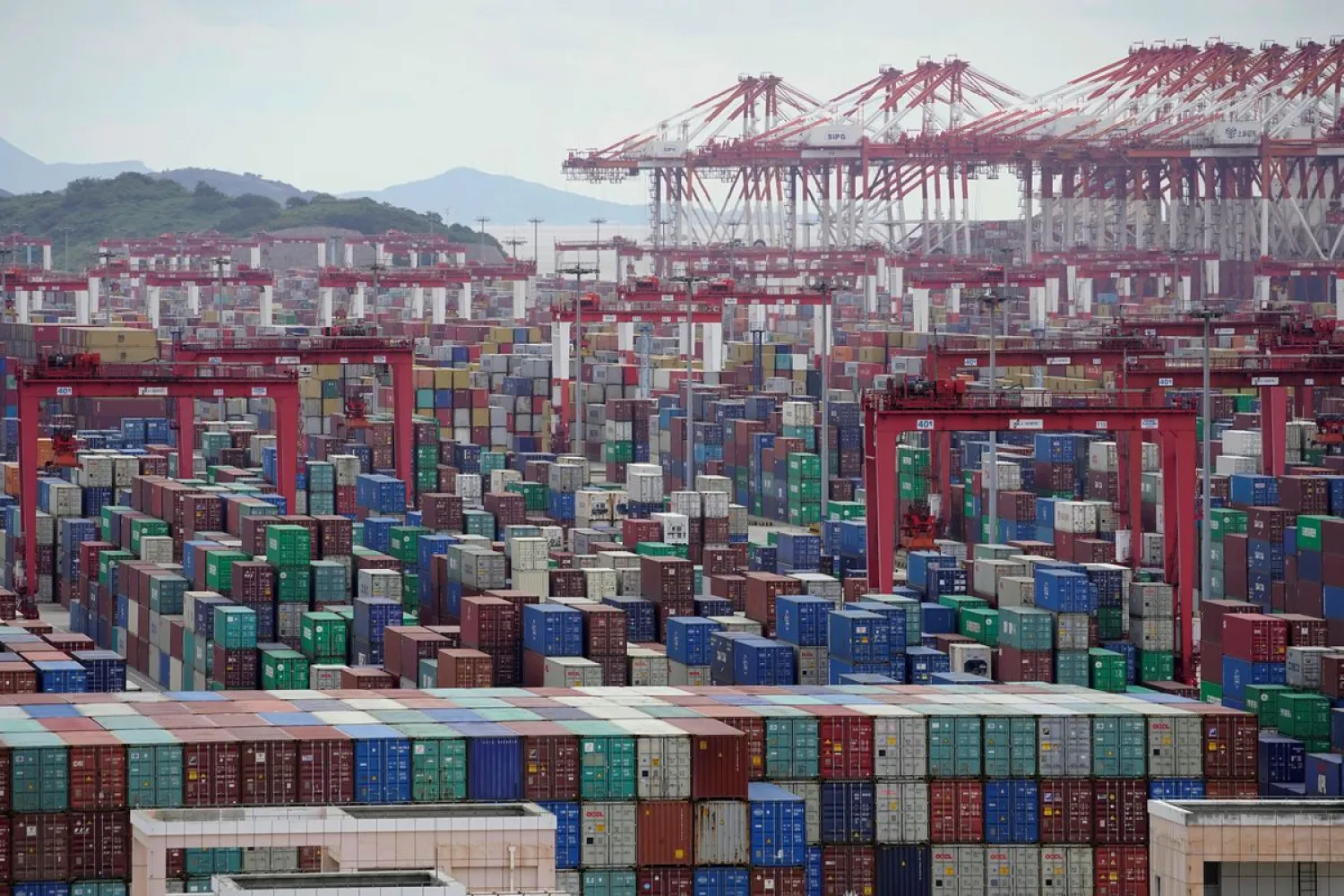
Containers are seen at the Yangshan Deep-Water Port in Shanghai, China October 19, 2020. REUTERS/Aly Song
TT

China Economy Grows 4.8% in 1st Quarter as Virus Bites

Containers are seen at the Yangshan Deep-Water Port in Shanghai, China October 19, 2020. REUTERS/Aly Song

China's economy grew 4.8 percent in the first quarter, the National Bureau of Statistics said Monday, warning of "significant challenges" ahead as a resurgence of the coronavirus threatens Beijing's ambitious annual target.

The world's second-biggest economy was already losing steam in the latter half of last year with a property slump and regulatory crackdowns.

But Beijing's unrelenting zero-Covid approach to outbreaks in multiple cities this year has clogged supply chains and locked down tens of millions of people -- including in the economic dynamos of Shanghai and Shenzhen as well as the northeastern grain basket of Jilin.

China's gross domestic product growth was 4.8 percent on-year in the first quarter, said the NBS on Monday, a figure that beat analysts' expectations and up on 4.0 percent in the final months of 2021.

But the data does not entirely take in the gnawing impact of the lockdown in Shanghai, which has left millions stuck at home for several weeks.

Virus restrictions hitting key cities in March also gouged at retail sales, driving up the unemployment rate, AFP reported.

It ups the ante on officials to meet the country's full-year growth target of around 5.5 percent, in a pivotal political period for President Xi Jinping who is eyeing another term in power at the Party Congress to be held later this year.

"With the domestic and international environment becoming increasingly complicated and uncertain, economic development is facing significant difficulties and challenges," said NBS spokesman Fu Linghui on Monday.

While China saw an uptick in manufacturing growth earlier this year -- with a shot in the arm from spending during the Lunar New Year holiday -- curbs on movement struck several parts of the country during March, disrupting businesses and keeping consumers at home.

Industrial production growth eased to 5.0 percent in March, NBS data showed, down from the January-February period.

Meanwhile, retail sales sank 3.5 percent and the urban unemployment rate ticked up to 5.8 percent last month.

"March activity data suggests that China's economy slowed, especially in household consumption," Tommy Wu, lead China economist at Oxford Economics, said in a note.

China's central government is trying to balance "minimizing disruption against controlling the latest wave of Covid infections", he added, but warned of a drag on economic activity into May, if not longer.

Last week, carmakers including XPeng and Volkswagen warned of severe disruptions to supply chains and possibly even a halt on production completely if the lockdown on Shanghai's 25 million inhabitants persisted.

Major cities struck by Covid outbreaks include southern tech powerhouse Shenzhen, which went into full lockdown for almost a week in March, although it has since been reopened.

On Monday, Shanghai reported its first Covid deaths since the start of its lockdown -- all elderly patients -- on top of over 22,000 new positive cases.



Türkiye Says to Maintain Tight Monetary Policy, Fiscal Discipline

FILE PHOTO: People shop at a green market in Istanbul, Türkiye, October 22, 2025. REUTERS/Dilara Senkaya/File Photo
TT

Türkiye Says to Maintain Tight Monetary Policy, Fiscal Discipline

FILE PHOTO: People shop at a green market in Istanbul, Türkiye, October 22, 2025. REUTERS/Dilara Senkaya/File Photo

Türkiye will maintain its tight monetary policy and keep fiscal discipline in order to further lower inflation, Vice President Cevdet Yilmaz said on Saturday.

Turkish consumer price inflation leapt to a higher-than-expected 4.84% month-on-month in January, official data showed on Tuesday, driven in part by new year price adjustments and a jump in food and non-alcoholic drinks prices. Annual inflation dipped to 30.65%.

Speaking at an event in the southeastern province of Siirt, Yilmaz said ⁠the 45-point fall in inflation since May 2024 was not enough, adding the government was on a path to further lower consumer prices.

"We will maintain our tight monetary policy, we will keep our disciplined fiscal policies, we are determined to do this. But ⁠these are not enough either. On the other hand, we have to contribute to our battle with inflation through our supply-side policies," he added, according to Reuters.

Last month, Türkiye's central bank lowered its key interest rate by a less-than-expected 100 basis points to 37%, citing firming inflation, pricing behavior and expectations that threaten the disinflation process.

After a brief policy reversal early last year due to political turmoil, the bank's ⁠rate-cutting cycle resumed in July with a 300-basis-point cut, followed by more subsequent cuts.

The bank has eased by 1,300 points since 2024, when it held rates at 50% for most of the year to wrestle down inflation expectations.

Last month, the head of the Turkish Exporters Assembly told reporters late that Türkiye's extended period of tight economic policies had hurt manufacturers, with high interest rates and costs posing risks to the country's official $282 billion export target.


India, Malaysia Renew Pledges to Boost Trade and Collaboration

Malaysia's Prime Minister Anwar Ibrahim shakes hands with India's Prime Minister Narendra Modi in Putrajaya on February 8, 2026. (Photo by Hasnoor Hussain / POOL / AFP)
TT

India, Malaysia Renew Pledges to Boost Trade and Collaboration

Malaysia's Prime Minister Anwar Ibrahim shakes hands with India's Prime Minister Narendra Modi in Putrajaya on February 8, 2026. (Photo by Hasnoor Hussain / POOL / AFP)

India's Prime Minister Narendra Modi and his Malaysian counterpart Anwar Ibrahim renewed pledges on Sunday to bolster trade and explore potential collaborations in semiconductors, defense and other fields.

Modi is on a two-day visit to the Southeast Asian nation, his first since the two countries elevated ties to ⁠a comprehensive strategic partnership in August 2024.

Anwar said the partnership included deep collaborations in multiple fields, including trade and investments, food security, defense, healthcare and tourism.

"It's really comprehensive, and we believe ⁠that we can advance this and execute in a speedy manner with the commitment of our both governments," he told a press conference after hosting Modi at his official residence in the administrative capital Putrajaya.

Following their meeting, Anwar and Modi also witnessed the exchange of 11 cooperation agreements, including ⁠on semiconductors, disaster management and peacekeeping, Reuters reported.

Anwar said India and Malaysia would continue efforts to promote the use of local-currency settlement for cross-border activities and expressed hope that bilateral trade would surpass last year's $18.6 billion.

Malaysia will also support India's efforts to open a consulate in Malaysia's Sabah state on Borneo island, Anwar said.


Saudi Arabia, Syria Sign Joint Airline and Telecoms Deals

Officials pose after signing a framework agreement for developmental cooperation and the launch of 45 development initiatives between the Syrian Development Fund and Saudi Arabia's Development Committee at the People's Palace in Damascus, Syria, Saturday, Feb. 7, 2026. (AP)
TT

Saudi Arabia, Syria Sign Joint Airline and Telecoms Deals

Officials pose after signing a framework agreement for developmental cooperation and the launch of 45 development initiatives between the Syrian Development Fund and Saudi Arabia's Development Committee at the People's Palace in Damascus, Syria, Saturday, Feb. 7, 2026. (AP)

Syria and Saudi Arabia signed deals Saturday that include a joint airline and a $1-billion project to develop telecommunications, officials said, as Syria seeks to rebuild after years of war.

The new authorities in Damascus have worked to attract investment and have signed major agreements with several companies and governments.

Syrian Investment Authority chief Talal al-Hilali announced a series of deals including "a low-cost Syrian-Saudi airline aimed at strengthening regional and international air links".

The agreement also includes the development of a new international airport in the northern city of Aleppo, and redeveloping the existing facility.

Hilali also announced an agreement for a project called SilkLink to develop Syria's "telecommunications infrastructure and digital connectivity".

Syrian Telecommunications Minister Abdulsalam Haykal told the signing ceremony that the project would be implemented "with an investment of around $1 billion".

For decades, Syria was unable to secure significant investments because of Assad-era sanctions.

But the United States fully removed its remaining sanctions on Damascus late last year, paving the way for the full return of investments.

Syria and Saudi Arabia also inked an agreement on water desalination and development cooperation on Saturday.

At the ceremony, Saudi Investment Minister Khalid Al-Falih announced the launch of an investment fund for "major projects in Syria with the participation of the (Saudi) private sector".

The deals are part of "building a strategic partnership" between the two countries, he said.

Syria's Hilali said the agreements targeted "vital sectors that impact people's lives and form essential pillars for rebuilding the Syrian economy".

Syria has begun the mammoth task of trying to rebuild its shattered infrastructure and economy.

In July last year, Riyadh signed investment and partnership deals with Damascus valued at $6.4 billion to help rebuild the country's infrastructure, telecommunications and other major sectors.

A month later, Syria signed agreements worth more than $14 billion, including investments in Damascus airport and other transport and real estate projects.

This week, Syria signed a preliminary deal with US energy giant Chevron and Qatari firm Power International to explore for oil and gas offshore.