

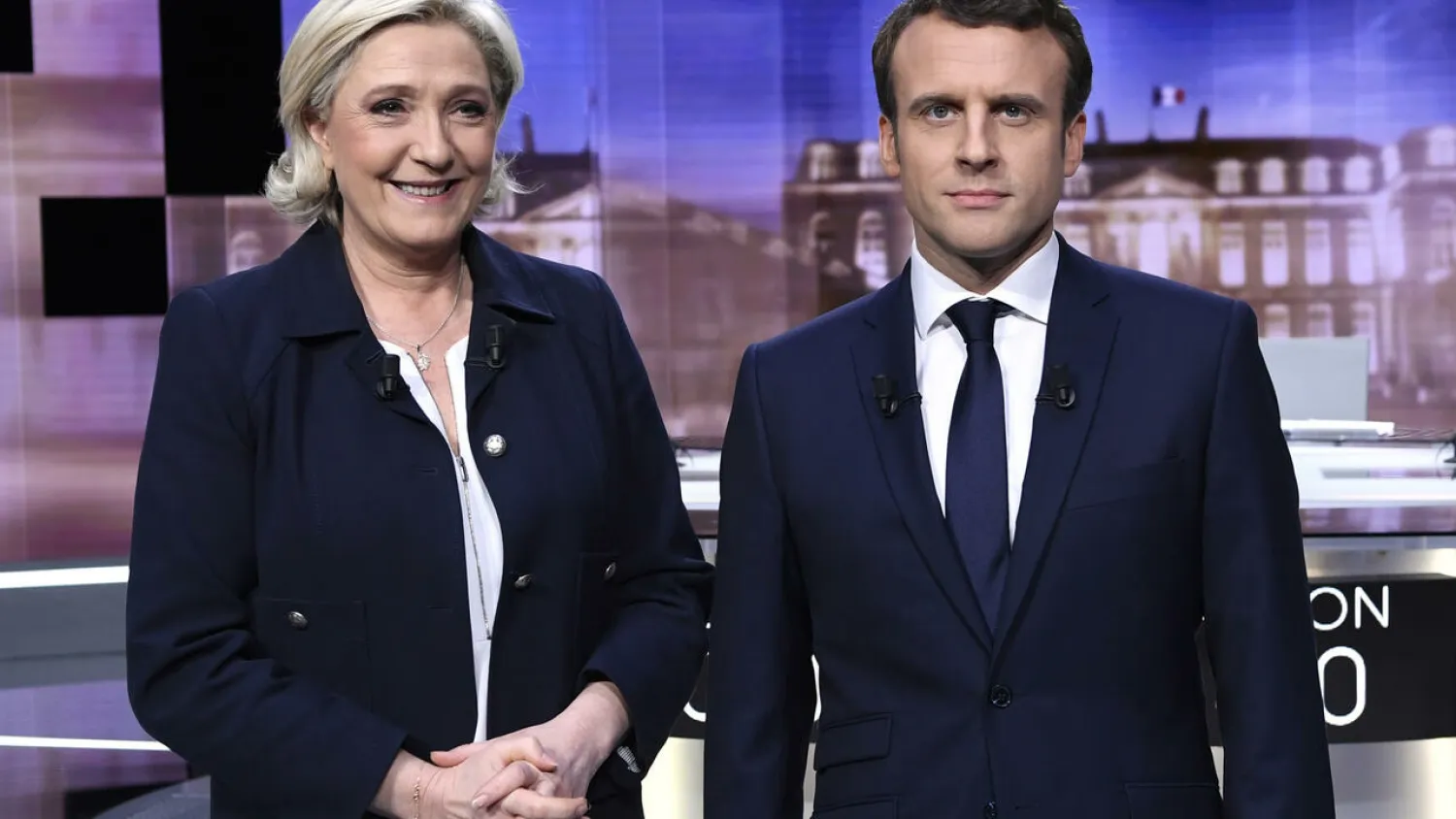

Le Pen, Macron to Face off in Crunch TV Election Duel

The run-off debate is traditionally a pivotal moment in French presidential elections. Eric Feferberg POOL/AFP/File
TT

Le Pen, Macron to Face off in Crunch TV Election Duel

The run-off debate is traditionally a pivotal moment in French presidential elections. Eric Feferberg POOL/AFP/File

French leader Emmanuel Macron and the far-right's Marine Le Pen go head-to-head in a crunch TV debate on Wednesday, seeking to sway undecided voters with four days left until the presidential election's decisive second round.

Macron holds a solid poll lead, but his political allies have warned against any complacency in the prime-time duel -- their only direct clash -- which will be watched by millions, AFP said.

Some polls are predicting a lead of around 10 points for Macron over Le Pen in the run-off, a repeat of the 2017 election. But undecided voters and abstentions could yet swing the figures.

Le Pen has cleared her diary to concentrate on preparing for the debate, hoping to avoid any repeat of the fiasco five years ago, when her ill-prepared performance contributed to her defeat at the hands of the centrist Macron.

This year's vote will mark the closest the far right has come to taking the Elysee presidential palace. Marine Le Pen's father Jean-Marie was crushed by Jacques Chirac in the 2002 run-off election, and she was easily defeated by Macron in 2017.

The live televised debate -- scheduled from 1900 GMT -- has been a political tradition in France since 1974, when Socialist Francois Mitterrand took on centrist Valery Giscard d'Estaing.

But it did not take place in 2002, when Chirac said debate was impossible with "intolerance and hatred" after Jean-Marie Le Pen stunned France by making the run-off.

- 'Kick in the backside' -
The stakes are high in this election, and Europe is watching.

Macron is expected to continue to champion the EU if he wins another five years in office. Le Pen has vowed to reform it under a far-right presidency.

Opinion polls currently put Macron at 53 to 56 percent in the run-off against 44 to 47 percent for Le Pen -- a much tighter finish than five years ago, when Macron carried the vote with 66 percent.

For Le Pen, the debate represents a final chance to win back ground in the polls and convince France she has moderated her anti-immigration party into a mainstream force.

Macron will likely seek to portray her as a dangerous extremist who cannot be trusted on foreign policy -- especially after Russia's invasion of Ukraine, given her past comments in support of President Vladimir Putin.

Both candidates are particularly keen to woo the electorate of hard-left candidate Jean-Luc Melenchon, who finished a strong third in the first round.

Le Pen was reportedly spending Tuesday with her closest aides to rehearse the debate, having admitted previously that her performance against Macron in 2017 was not up to scratch.

"For me, failure is sometimes a kick in the backside," she told TF1 television.

Le Monde newspaper said Le Pen would seek to present herself as a credible French leader and portray the election as an anti-Macron "referendum".

She has "spent five years trying to bury that disastrous (2017) televised duel, by sprucing up her image, party and ideological tenets," the paper said.

- 'Either could win' -
Macron has insisted the election is not yet in the bag, reminding voters of the political upsets of 2016 when Britons voted to leave the EU and Americans put Donald Trump in the White House.

Key allies have made clear nothing should be taken for granted, telling voters tempted to stay at home that they must cast their ballots.

"The game isn't over yet and we certainly can't draw conclusions... that this election, this match, is already decided," Prime Minister Jean Castex told France Inter radio.

"We have to convince the French that Emmanuel Macron's programs are the best for France and for them," he said. He added that if Macron won, his government would resign to give the ruling party new impetus ahead of legislative elections in June.

Castex's predecessor as prime minister, Edouard Philippe, mayor of the northern city of Le Havre and a heavyweight center-right backer of Macron, said nothing could be taken for granted due to the numerous "unknowns" hanging over the election -- abstentions above all.

He told Le Figaro newspaper on Monday that the so-called Republican front -- which in past elections had seen French voters of all political stripes line up against the far right -- "was no longer a natural reflex".

"Right now, either candidate could win," added another ally, Francois Bayrou, the leader of the pro-Macron Modem party.



Top Trump Iran Negotiator Says Visits US Aircraft Carrier in Middle East

US Special Envoy Steve Witkoff delivers a press conference upon the signing of the declaration on deploying post-ceasefire force in Ukraine, during the so-called "Coalition of the Willing" summit, at the Elysee Palace in Paris, France, January 6, 2026. (Reuters)
TT

Top Trump Iran Negotiator Says Visits US Aircraft Carrier in Middle East

US Special Envoy Steve Witkoff delivers a press conference upon the signing of the declaration on deploying post-ceasefire force in Ukraine, during the so-called "Coalition of the Willing" summit, at the Elysee Palace in Paris, France, January 6, 2026. (Reuters)

US President Donald Trump's lead Iran negotiator Steve Witkoff on Saturday said he visited the USS Abraham Lincoln aircraft carrier currently in the Arabian Sea, with Washington and Tehran due to hold further talks soon.

"Today, Adm. Brad Cooper, Commander of US Naval Forces Central Command, Jared Kushner, and I met with the brave sailors and Marines aboard the USS Abraham Lincoln, her strike group, and Carrier Air Wing 9 who are keeping us safe and upholding President Trump's message of peace through strength," said Witkoff in a social media post.

Iranian Foreign Minister Abbas Araghchi said on Saturday he hoped talks with the United States would resume soon, while reiterating Tehran's red lines and warning against any American attack.


Israel’s Netanyahu Expected to Meet Trump in US on Wednesday and Discuss Iran

Israeli Prime Minister Benjamin Netanyahu delivers a speech during a special session to mark the 77th anniversary of the Knesset's establishment and the 60th anniversary of the dedication of the current building at the Knesset, the Israeli parliament, in Jerusalem, 02 February 2026. (EPA)
TT

Israel’s Netanyahu Expected to Meet Trump in US on Wednesday and Discuss Iran

Israeli Prime Minister Benjamin Netanyahu delivers a speech during a special session to mark the 77th anniversary of the Knesset's establishment and the 60th anniversary of the dedication of the current building at the Knesset, the Israeli parliament, in Jerusalem, 02 February 2026. (EPA)

Israeli Prime Minister Benjamin Netanyahu is expected to meet US President Donald Trump on Wednesday in Washington, where they will discuss negotiations with Iran, Netanyahu's office said on Saturday.

Iranian and US officials held indirect nuclear ‌talks in the ‌Omani capital ‌Muscat ⁠on Friday. ‌Both sides said more talks were expected to be held again soon.

A regional diplomat briefed by Tehran on the talks told Reuters Iran insisted ⁠on its "right to enrich uranium" ‌during the negotiations with ‍the US, ‍and that Tehran's missile capabilities ‍were not raised in the discussions.

Iranian officials have ruled out putting Iran's missiles - one of the largest such arsenals in the region - up ⁠for discussion, and have said Tehran wants recognition of its right to enrich uranium.

"The Prime Minister believes that any negotiations must include limiting ballistic missiles and halting support for the Iranian axis," Netanyahu's office said in a ‌statement.


Italy FM Rules Out Joining Trump’s ‘Board of Peace’

Italy's Minister for Foreign Affairs Antonio Tajani speaks to the press during the EPP Leaders’ meeting, in Zagreb, Croatia, 30 January 2026. (EPA)
TT

Italy FM Rules Out Joining Trump’s ‘Board of Peace’

Italy's Minister for Foreign Affairs Antonio Tajani speaks to the press during the EPP Leaders’ meeting, in Zagreb, Croatia, 30 January 2026. (EPA)

Italy will not take part in US President Donald Trump's "Board of Peace", Italian Foreign Minister Antonio Tajani said Saturday, citing "insurmountable" constitutional issues.

Trump launched his "Board of Peace" at the World Economic Forum in Davos in January and some 19 countries have signed its founding charter.

But Italy's constitution bars the country from joining an organization led by a single foreign leader.

Prime Minister Giorgia Meloni, a Trump ally, last month noted "constitutional problems" with joining, but suggested Trump could perhaps reopen the framework "to meet the needs not only of Italy, but also of other European countries".

Tajani appeared Saturday to rule that out.

"We cannot participate in the Board of Peace because there is a constitutional limit," he told the ANSA news agency.

"This is insurmountable from a legal standpoint," he said, the day after meeting US Secretary of State Marco Rubio and US Vice President JD Vance at the Olympics in Milan.

Although originally meant to oversee Gaza's rebuilding, the board's charter does not limit its role to the Palestinian territory and appears to want to rival the United Nations.