

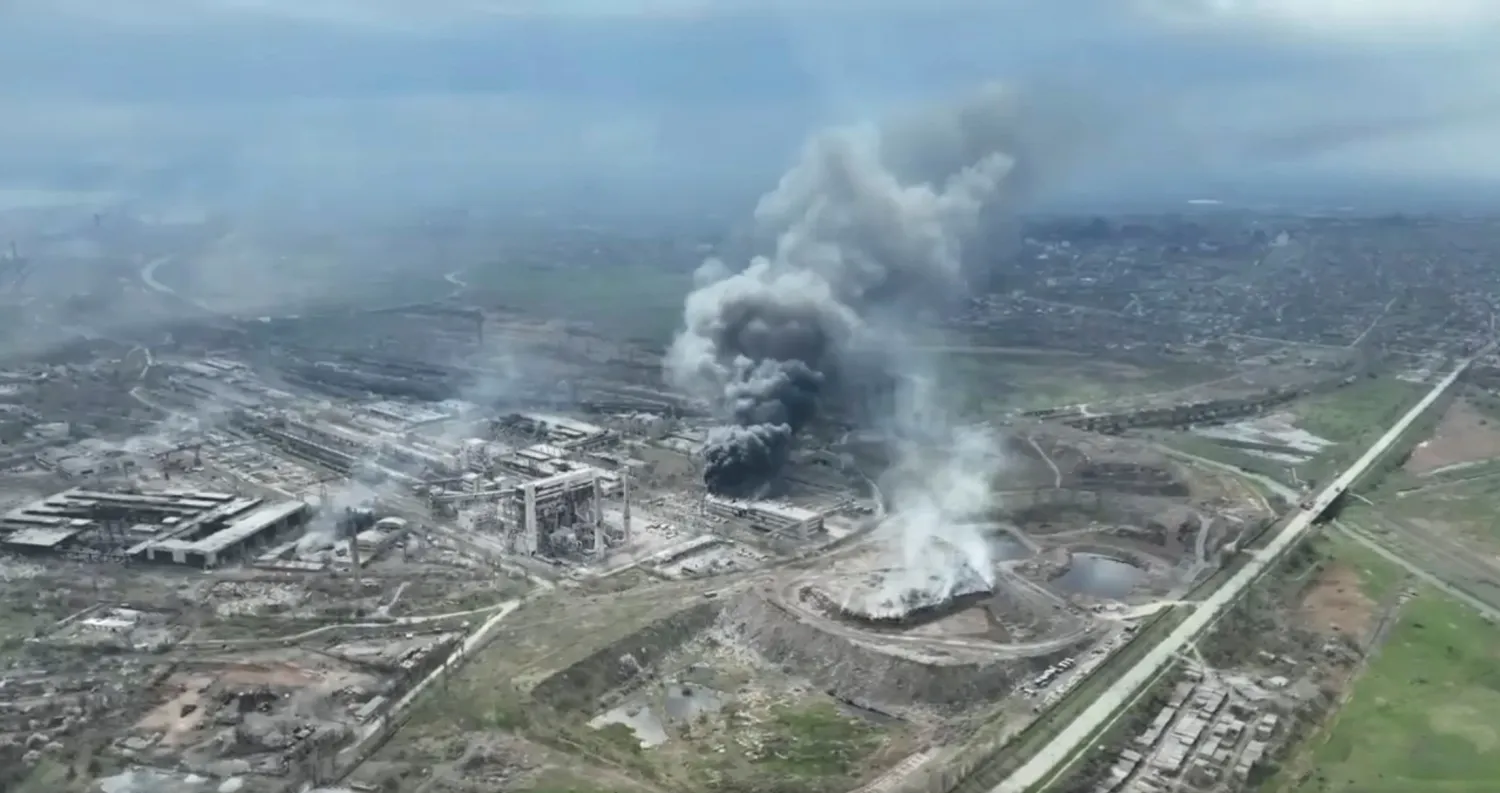

Ukraine: Russians Try to Storm Mariupol Plant, Strike Odesa

Smoke rises above Azovstal steelworks, in Mariupol, Ukraine, in this still image obtained from a recent drone video posted on social media. MARIUPOL CITY COUNCIL/via REUTERS
TT

Ukraine: Russians Try to Storm Mariupol Plant, Strike Odesa

Smoke rises above Azovstal steelworks, in Mariupol, Ukraine, in this still image obtained from a recent drone video posted on social media. MARIUPOL CITY COUNCIL/via REUTERS

Russian forces in Ukraine tried to storm a steel plant housing soldiers and civilians in the southern city of Mariupol on Saturday while attempting to crush the last corner of resistance in a place of deep symbolic and strategic value to Moscow, Ukrainian officials said.

The reported assault on the eve of Orthodox Easter came after the Kremlin claimed its military had seized all of the shattered city except for the Azovstal plant, and as Russian forces pounded other cities and towns in southern and eastern Ukraine.

A 3-month-old baby was among six people killed when Russia fired cruise missiles at the Black Sea port city of Odesa, officials said.

The fate of the Ukrainians in the sprawling seaside steel mill wasn’t immediately clear; earlier Saturday, a Ukrainian military unit released a video reportedly taken two days earlier in which women and children holed up underground, some for as long as two months, said they longed to see the sun.

"We want to see peaceful skies, we want to breathe in fresh air," one woman in the video said. "You have simply no idea what it means for us to simply eat, drink some sweetened tea. For us, it is already happiness."

As the battle for the port ground on, Russia claimed it had taken control of several villages elsewhere in the eastern Donbas region and destroyed 11 military Ukrainian military targets overnight, including three artillery warehouses. Russian attacks also struck populated areas of Ukraine.

Associated Press journalists also observed shelling in residential areas of Kharkiv, Ukraine's second-largest city; regional governor reported Oleh Sinehubov said three people were killed. In the Luhansk area of the Donbas, Gov. Serhiy Haidai said six people died during the shelling of a village, Gorskoi.

In Sloviansk, a town in northern Donbas. The AP witnessed two soldiers arriving at the town's hospital, one of them mortally wounded. Nearby, a small group of people gathered outside a church, where a priest blessed them with water on Holy Saturday.

While British officials said the Russians hadn’t gained significant new ground, Ukrainian officials announced a nationwide curfew ahead of Easter Sunday, a sign of the war’s disruption and threat to the entire country.

Mariupol, a part of the industrial region in eastern Ukraine known as the Donbas, has been a key Russian objective since the Feb. 24 invasion began and has taken on outsize importance in the war. Completing its capture would give Russia its biggest victory yet, after a nearly two-month siege reduced much of the city to a smoking ruin.

Occupying Mariupol would deprive the Ukrainians of a vital port, free up Russian troops to fight elsewhere and allow Russia to create a land corridor with the Crimean Peninsula, which Moscow seized from Ukraine in 2014. Russia-backed separatists control parts of the Donbas.

An advisor to Ukraine's presidential office, Oleksiy Arestovich, said during a Saturday briefing that Russian forces had resumed air strikes on the Azovstal plant and were trying to storm it. A direct attempt to take the plant would represent a reversal from an order Russian President Vladimir Putin gave two days earlier.

Russian Defense Minister Sergei Shoigu reported to Putin on Thursday that the whole of Mariupol, with the exception of Azovstal, had been "liberated" by the Russians. At the time, Putin ordered him not to send Russian troops into the plant but instead to block off the facility, an apparent attempt to starve out the Ukrainians and force them to surrender.

Ukrainian officials have estimated that about 2,000 of their troops are inside the plant along with the civilians sheltering in the facility’s underground tunnels. Arestovic said the Ukrainian forces were trying to counter the new attacks.

Earlier Saturday, the Azov Regiment of Ukraine’s National Guard, which has members holed up in the plant, released the footage of around two dozen women and children. The contents could not be independently verified.

If authentic, it would be the first video testimony of what life has been like for civilians still trapped in Mariupol's underground bunkers. The video showed soldiers giving sweets to children who respond with fist-bumps.

One young girl says she and her relatives "haven’t seen neither the sky, nor the sun” since they left home on Feb. 27.

The regiment’s deputy commander, Sviatoslav Palamar, told The AP the video was shot Thursday. The Azov Regiment has its roots in the Azov Battalion, which was formed in 2014 by far-right activists at the start of the separatist conflict in eastern Ukraine and elicited criticism for some of its tactics.

More than 100,000 people - down from a prewar population of about 430,000 - are believed trapped in Mariupol with little food, water or heat, according to Ukrainian authorities, who estimate that over 20,000 civilians have been killed in the city during the Russian blockade.

Satellite images released this week showed what appeared to be a second mass grave near Mariupol, and local officials accused Russia of burying thousands of civilians to conceal the slaughter taking place there.

The Kremlin hasn’t responded to the satellite images.

Ukrainian officials had said they would try again Saturday to evacuate women, children and older adults from Mariupol. Deputy Prime Minister Iryna Vereshchuk said on Telegram that the effort was to get underway at midday.

Like previous plans to get civilians out of the city, this one failed. Petro Andryushchenko, an adviser to the Mariupol’s mayor, said Russian forces did not allow Ukrainian-organized buses to take residents to Zaporizhzhia, a city 227 kilometers (141 miles) to the northwest.

"At 11 o’clock, at least 200 Mariupol residents gathered near the Port City shopping center, waiting for evacuation," Andryushchenko posted on the Telegram messaging app. "The Russian military drove up to the Mariupol residents and ordered them to disperse, because now there will be shelling."

At the same time, he said, Russian buses assembled about 200 meters away. Residents who got on board were told that they were being taken to separatist-occupied territory and not allowed to disembark, Andryushchenko said. His account could not be independently verified.

During the attack on Odesa, the Russians fired at least six missiles, Anton Gerashchenko, an advisor to Ukraine’s interior minister. Defense forces repelled some of the rockets, but at least one landed and exploded, he said.

"Residents of the city heard explosions in different areas," Gerashchenko wrote in a Telegram post. "Residential buildings were hit. It is already known about one victim. He burned in his car in a courtyard of one of the buildings."

The Ukraine presidential chief of staff, Andriy Yermak, later reported that the 3-month-old baby was among the five people killed in the missile attack.



UK PM's Communications Director Quits

British Prime Minister Keir Starmer delivers a speech at Horntye Park Sports Complex in St Leonards, Britain, February 05, 2026. Peter Nicholls/Pool via REUTERS
TT

UK PM's Communications Director Quits

British Prime Minister Keir Starmer delivers a speech at Horntye Park Sports Complex in St Leonards, Britain, February 05, 2026. Peter Nicholls/Pool via REUTERS

British Prime Minister Keir Starmer's director of communications Tim Allan resigned on Monday, a day after Starmer's top aide Morgan McSweeney quit over his role in backing Peter Mandelson over his known links to Jeffrey Epstein.

The loss of two senior aides ⁠in quick succession comes as Starmer tries to draw a line under the crisis in his government resulting from his appointment of Mandelson as ambassador to the ⁠US.

"I have decided to stand down to allow a new No10 team to be built. I wish the PM and his team every success," Allan said in a statement on Monday.

Allan served as an adviser to Tony Blair from ⁠1992 to 1998 and went on to found and lead one of the country’s foremost public affairs consultancies in 2001. In September 2025, he was appointed executive director of communications at Downing Street.


Road Accident in Nigeria Kills at Least 30 People

FILE PHOTO: A police vehicle of Operation Fushin Kada (Anger of Crocodile) is parked on Yakowa Road, as schools across northern Nigeria reopen nearly two months after closing due to security concerns, following the mass abductions of school children, in Kaduna, Nigeria, January 12, 2026. REUTERS/Nuhu Gwamna/File Photo
TT

Road Accident in Nigeria Kills at Least 30 People

FILE PHOTO: A police vehicle of Operation Fushin Kada (Anger of Crocodile) is parked on Yakowa Road, as schools across northern Nigeria reopen nearly two months after closing due to security concerns, following the mass abductions of school children, in Kaduna, Nigeria, January 12, 2026. REUTERS/Nuhu Gwamna/File Photo

At least 30 people have been killed and an unspecified number of people injured in a road accident in northwest Nigeria, authorities said.

The accident occurred Sunday in Kwanar Barde in the Gezawa area of Kano state and was caused by “reckless driving” by the driver of a truck-trailer, Gov. Abba Yusuf said in a statement. He did not specify what other vehicles were involved.

Yusuf described the accident as “heartbreaking and a great loss” to the affected families and the state. He did not provide more details of the accident, said The Associated Press.

Africa’s most populous country recorded 5,421 deaths in 9,570 road accidents in 2024, according to data by the country’s Federal Road Safety Corps.

Experts say a combination of factors including a network of bad roads, lax enforcement of traffic laws and indiscipline by some drivers produce the grim statistics.

In December, boxing heavyweight champion Anthony Joshua was in a deadly car crash that injured him and killed Sina Ghami and Latif “Latz” Ayodele, two of his friends, in southwest Nigeria.

Adeniyi Mobolaji Kayode, Joshua’s driver, was charged with dangerous and reckless driving and his trial is scheduled to begin later this month.

Africa has the highest road fatality rate in the world despite having only about 3% of the world’s vehicles, mainly due to weak enforcement of road laws, poor infrastructure and widespread use of unsafe transport. 


US Vice President Vance Heads to Armenia, Azerbaijan to Push Peace, Trade

US Vice President JD Vance speaks during the Critical Minerals Ministerial at the State Department in Washington, DC, US, February 4, 2026. (Reuters)
TT

US Vice President Vance Heads to Armenia, Azerbaijan to Push Peace, Trade

US Vice President JD Vance speaks during the Critical Minerals Ministerial at the State Department in Washington, DC, US, February 4, 2026. (Reuters)

US Vice President JD Vance will visit Armenia and Azerbaijan this week to push a Washington-brokered peace agreement that could transform energy and trade routes in the strategic South Caucasus region.

His two-day trip to Armenia, which begins later on Monday, comes just six months after the Armenian and Azerbaijani leaders signed an agreement at the White House seen as the first step towards peace after nearly 40 years of war.

Vance, the first US vice president to visit Armenia, is seeking to advance the Trump Route for International Peace and Prosperity (TRIPP), a proposed 43-kilometre (27-mile) corridor that would run across southern Armenia and give Azerbaijan a direct route to its exclave ‌of Nakhchivan ‌and in turn to Türkiye, Baku's close ally.

"Vance's visit should ‌serve ⁠to reaffirm the ‌US's commitment to seeing the Trump Route through," said Joshua Kucera, a senior South Caucasus analyst at Crisis Group.

"In a region like the Caucasus, even a small amount of attention from the US can make a significant impact."

The Armenian government said on Monday that Vance would hold talks with Prime Minister Nikol Pashinyan and that both men would then make statements, without elaborating.

Vance will then visit Azerbaijan on Wednesday and Thursday, the White House has said.

Under the agreement signed last year, ⁠a private US firm, the TRIPP Development Company, has been granted exclusive rights to develop the proposed corridor, with Yerevan ‌retaining full sovereignty over its borders, customs, taxation and security.

The ‍route would better connect Asia to Europe ‍while - crucially for Washington - bypassing Russia and Iran at a time when Western countries are ‍keen on diversifying energy and trade routes away from Russia due to its war in Ukraine.

Russia has traditionally viewed the South Caucasus as part of its sphere of influence but has seen its clout there diminish as it is distracted by the war in Ukraine.

Securing US access to supplies of critical minerals is also likely to be a key focus of Vance's visit.

TRIPP could prove a key transit corridor for the vast mineral wealth of ⁠Central Asia - including uranium, copper, gold and rare earths - to Western markets.

CLOSED BORDERS, BITTER RIVALS

In Soviet times the South Caucasus was criss-crossed by railways and oil pipelines until a series of wars beginning in the 1980s disrupted energy routes and shuttered the border between Armenia and Türkiye, Azerbaijan's key regional ally.

Armenia and Azerbaijan were locked in bitter conflict for nearly four decades, primarily over the mountainous region of Nagorno-Karabakh, an internationally recognized part of Azerbaijan that broke away from Baku's control as the Soviet Union fell apart in 1991.

Azerbaijan and Armenia fought two wars over Karabakh before Baku finally took it back in 2023. Karabakh's entire ethnic Armenian population of around 100,000 people fled to Armenia. The two neighbors have made progress in recent months on normalizing relations, including restarting ‌some energy shipments.

But major hurdles remain to full and lasting peace, including a demand by Azerbaijan that Armenia change its constitution to remove what Baku says contains implicit claims on Azerbaijani territory.