


EU Defies Gas 'Blackmail' as Russia Pushes Deeper into Ukraine

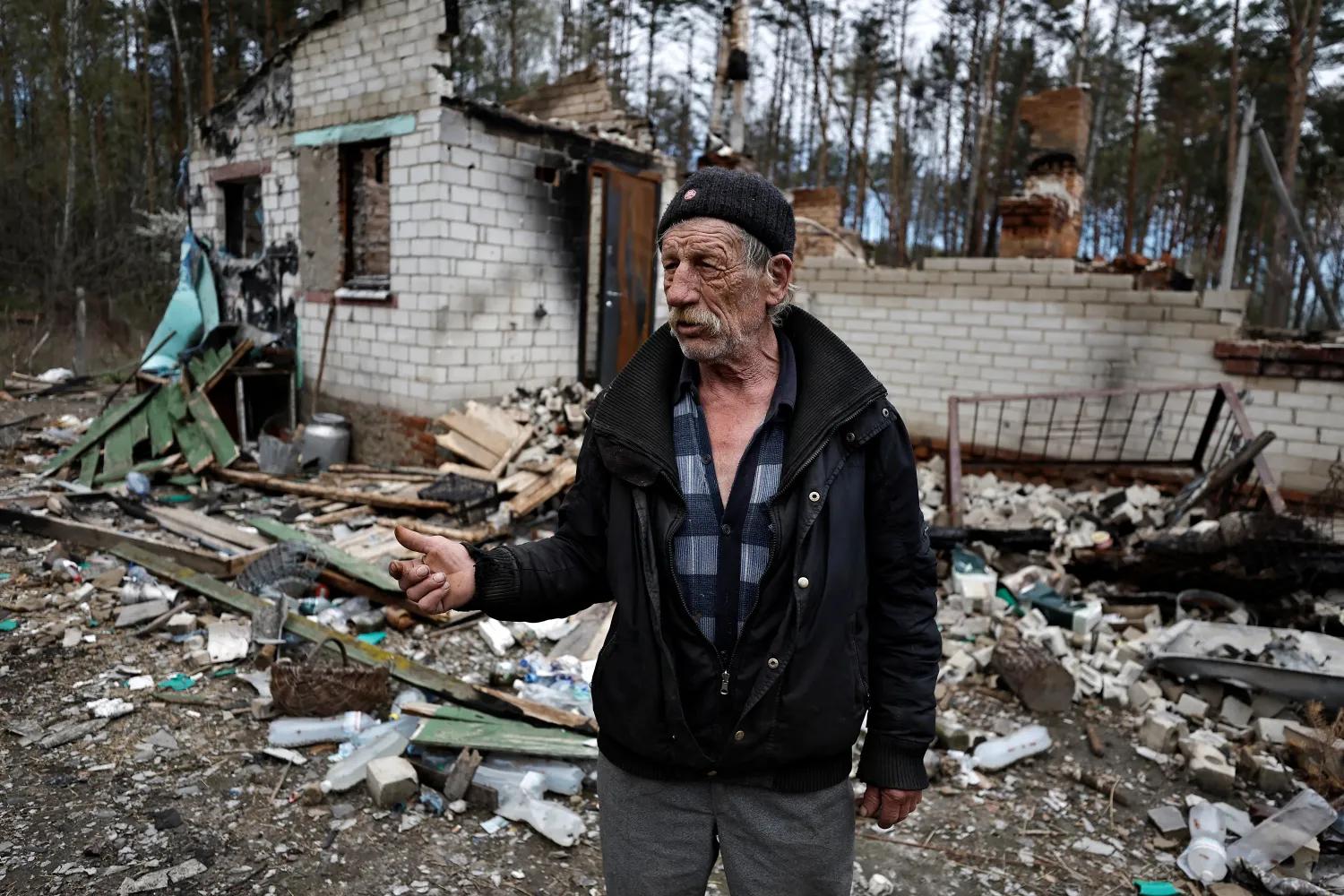
Anatolii Matukha, 70, stands outside his house, which he says was destroyed by shelling, in Yahidne, in Ukraine's Chernihiv region, on April 27, 2022. PHOTO: REUTERS
TT

EU Defies Gas 'Blackmail' as Russia Pushes Deeper into Ukraine

Anatolii Matukha, 70, stands outside his house, which he says was destroyed by shelling, in Yahidne, in Ukraine's Chernihiv region, on April 27, 2022. PHOTO: REUTERS

The European Union has warned Russia it will not bend to "blackmail" over its support for Kyiv after the Kremlin cut off gas supplies to Bulgaria and Poland.

The warning on Wednesday came ahead of UN chief Antonio Guterres arriving in Kyiv to meet Ukrainian leader Volodymyr Zelensky following talks with Russian President Vladimir Putin in Moscow, AFP said.

Putin issued his own warning the same day, saying that if Western forces intervene in Ukraine, they will face a "lightning-fast" military response.

"We have all the tools for this, that no one else can boast of having," the Russian leader told lawmakers, implicitly referring to Moscow's ballistic missiles and nuclear arsenal.

"We won't boast about it: we'll use them, if needed. And I want everyone to know that," he said. "We have already taken all the decisions on this."

The dire threats came as Moscow claimed to have carried out a missile strike in southern Ukraine to destroy a "large batch" of Western-supplied weapons.

As the war, which has already claimed thousands of lives, entered its third month, Kyiv conceded that Russian forces had made gains in the east.

Russia's military offensive saw it capture a string of villages in the Donbas region, now the focus of its invasion.

And in its economic standoff with the West, Moscow cut off gas supplies to Bulgaria and Poland, two EU and NATO members backing Ukraine in the conflict.

However, Ursula von der Leyen, the president of the European Commission, said Poland and Bulgaria are now receiving gas from their EU neighbors.

- 'Blackmail' -
She described the announcement by Russia's state energy giant Gazprom as "another provocation from the Kremlin".

"It comes as no surprise that the Kremlin uses fossil fuels to try to blackmail us... Our response will be immediate, united and coordinated.

"Both Poland and Bulgaria are now receiving gas from their EU neighbors," she said. "The era of Russian fossil fuels in Europe will come to an end."

EU officials said energy ministers from across the bloc will meet in an extraordinary session on Monday to discuss the situation.

European powers have imposed massive sanctions on Russia since Putin's decision to invade his neighbor, while shipping weapons to Ukraine's defenders.

But they have moved slowly on hitting Moscow's vast exports, with many EU members -- notably industrial giant Germany -- reliant on Russian energy to keep their lights on.

Putin has attempted to turn up the pressure by insisting that Russia will only accept payments for gas in rubles -- hoping to force his foes to prop up his currency.

Gazprom announced the halt of gas to both Poland and highly dependent Bulgaria, saying it had not received payment in rubles from the two EU members.

But von der Leyen said that "about 97 percent" of all EU contracts explicitly stipulate payments in euros or dollars -- and warned importing firms off paying in rubles.

"This would be a breach of the sanctions," she told reporters.

The European Commission, meanwhile, sought to lend Kyiv economic support by proposing a suspension of import duties on Ukrainian goods, though the idea still needs to be approved in a vote by the bloc's 27 members.

President Zelensky welcomed the plan, saying Russia was "trying to provoke a global price crisis" and stir "chaos" in the world's food market.

An IMF report issued Wednesday said the war had "significantly" impacted the Middle East and North Africa, with the crisis dealing a heavy blow to low-income countries dealing with surging inflation driven by rising food and fuel costs.

- 'Destruction and painful casualties' -
The first phase of Russia's invasion failed to reach Kyiv or overthrow Zelensky's government after encountering stiff Ukrainian resistance reinforced with Western weapons.

The campaign has since refocused on seizing the east and south of the country while increasing the use of long-range missiles against west and central Ukraine.

Ukraine's Defense Minister Oleksiy Reznikov predicted "extremely difficult weeks" for the country amid "destruction and painful casualties" during the offensive.

In Kharkiv, whose northern and eastern districts are less than five kilometers from the front, at least three people died and 15 were injured in shelling, Governor Oleg Synegoubov said Wednesday.

Defenders of the besieged Azovstal factory in the strategic port city of Mariupol described massive bombardments, with Sergey Volyna of the 36th Marine Brigade pleading for extraction for the 600 wounded soldiers and hundreds of civilians he said remain trapped there.

Russia's defense ministry, meanwhile, said its forces had destroyed a "large batch" of weapons and ammunition supplied by the United States and European countries.

Russia hit hangars at an aluminum plant near the Ukrainian city of Zaporizhzhia with "high-precision long-range sea-based Kalibr missiles", the ministry said.

Local authorities denied that weapons had been stored at the factory, which they said had not been operational for six years.

Tensions are also rising in Transnistria, a breakaway region of Moldova that borders southwestern Ukraine.

Pro-Russian separatists in the area claimed shots were fired across the border towards a village housing a Russian arms depot after drones flew over from Ukraine.

- 'Dangerous deterioration' -
The unrecognized region has reported a series of explosions in recent days that it called "terrorist attacks", leading Kyiv to accuse Moscow of seeking to expand the war further into Europe.

Moldovan Foreign Minister Nicu Popescu called the events a "dangerous deterioration of the situation".

Popescu said the Transnistrian authorities announced they would prevent men of fighting age from leaving the region.

Russia's targeting of Western-supplied arms came as the United States and Europe started to heed Zelensky's call for heavier firepower.

Western allies remain wary of being drawn into war with Russia but have stepped up military support as Ukraine has maintained its fierce resistance.

In a Wednesday evening speech from London, UK Foreign Secretary Liz Truss made a fresh call for an increase in arms deliveries to Ukraine, including heavy weapons, tanks and planes.

The UN tourism body added to Russia's isolation on the international scene earlier in the day, as most of its 159 members voted to suspend it from the agency.

US President Joe Biden, meanwhile, is set to deliver remarks Thursday on "support for Ukrainians defending their country and their freedom against Russia's brutal war," the White House said.

- Pledges of justice -
Several countries and organizations, including the United Nations, on Wednesday pledged to bring the perpetrators of any war crimes committed during the invasion of Ukraine to justice.

Lebanese-British barrister Amal Clooney told an informal meeting of the UN Security Council she feared "politicians calling for justice but not delivering it."

"My fear is that you will get busy and distracted and that each day there'll be a little bit less coverage of the war and people will become a little bit more numb to it," Clooney said.

UN Secretary-General Guterres' Thursday trip to Kyiv is expected to include visits to the suburbs of Bucha, Irpin and Borodianka, sites of alleged war crimes attributed to Russian soldiers.



Italy Arrests Nine Over Alleged Hamas Funding through Charities

President of the Palestinian Association in Italy, Mohammad Hannoun, carries a Palestinian flag during a nationwide strike, called by the USB union, in solidarity with Gaza and against the government and its plan to increase military spending, in Rome, Italy, November 29, 2025. Italian Interior Minister Matteo Piantedosi said Mohammad Hannoun is among nine people arrested on December 27 on suspicion of financing Hamas through charities based in Italy, in an operation coordinated by anti-mafia and anti-terrorism units. in Italy. REUTERS/Remo Casilli
TT

Italy Arrests Nine Over Alleged Hamas Funding through Charities

President of the Palestinian Association in Italy, Mohammad Hannoun, carries a Palestinian flag during a nationwide strike, called by the USB union, in solidarity with Gaza and against the government and its plan to increase military spending, in Rome, Italy, November 29, 2025. Italian Interior Minister Matteo Piantedosi said Mohammad Hannoun is among nine people arrested on December 27 on suspicion of financing Hamas through charities based in Italy, in an operation coordinated by anti-mafia and anti-terrorism units. in Italy. REUTERS/Remo Casilli

Italian prosecutors said on Saturday they had arrested nine people on suspicion of ​financing Hamas through charities based in Italy, in an operation coordinated by anti-mafia and anti-terrorism units.

The suspects are accused of "belonging to and having financed" the Palestinian group, which the European Union designates as a terrorist organization, prosecutors in the northern Italian city of Genoa said in a statement, Reuters reported.

Those arrested allegedly diverted to Hamas-linked ‌entities around 7 million ‌euros ($8.2 million) raised over the ‌last ⁠two years ​for ‌ostensibly humanitarian purposes, prosecutors said. Police seized assets worth more than 8 million euros.

In another statement on Sunday, police said officers had seized 1.08 million euros in cash found in the offices of a pro-Palestinian charity and in the private homes of suspects, as well as pro-Hamas material.

The ⁠Italian investigation began after suspicious financial transactions were flagged and expanded ‌through cooperation with Dutch authorities and other ‍EU countries, coordinated through the ‍EU judicial agency Eurojust.

Prime Minister Giorgia Meloni thanked ‍the authorities for "a particularly complex and important operation" which had uncovered financing for Hamas through "so-called charity organizations."


470-kilo WWII Bomb Removed in Belgrade

This handout photograph taken on December 28, 2025 and released by Serbia's Ministry of Interior shows a 470-kg World War II aerial bomb, dropped on Nazi-occupied Belgrade in 1944, found in a construction site in the Serbian capital before being removed by Serbian bomb disposal experts. (Photo by Handout / SERBIAN MINISTRY OF INTERIOR AFFAIRS / AFP)
TT

470-kilo WWII Bomb Removed in Belgrade

This handout photograph taken on December 28, 2025 and released by Serbia's Ministry of Interior shows a 470-kg World War II aerial bomb, dropped on Nazi-occupied Belgrade in 1944, found in a construction site in the Serbian capital before being removed by Serbian bomb disposal experts. (Photo by Handout / SERBIAN MINISTRY OF INTERIOR AFFAIRS / AFP)

A 470-kilogram (1,000-pound) World War II aerial bomb was safely removed on Sunday from a construction site in a central district of Serbia’s capital, Belgrade, police said.

The US-made AN-M44 bomb was used during Allied air raids on German positions during the liberation of Belgrade from Nazi occupation in 1944.

Ahead of the bomb’s removal, the site, which is near a residential area and a shopping mall, underwent detailed reconnaissance "to ensure safe conditions," AFP quoted police as saying.

Residents were also told to remove vehicles and leave their homes if possible.
The bomb was transported to an army arms training ground 180 km (110 miles) from Belgrade, where it will be destroyed in the coming days.

Several unexploded bombs dating back to past wars have been discovered in Serbia in recent years, all of which were safely removed without detonating.

In September 2024, a century-old artillery shell weighing nearly 300 kilograms (660 pounds) was cleared from a construction site near the Serbian parliament in Belgrade.

Earlier that year, in April, a large bomb from the 1999 NATO bombing campaign was found in Nis, southern Serbia.

In 2021, a 242-kilogram (530-pound) World War II bomb was also removed from a construction site in a Belgrade suburb.


Has Iran Built an Espionage Network in Israel?

People walk in the rain during stormy weather in the port of Tel Aviv, Israel, 27 December 2025.  EPA/ABIR SULTAN
People walk in the rain during stormy weather in the port of Tel Aviv, Israel, 27 December 2025. EPA/ABIR SULTAN
TT

Has Iran Built an Espionage Network in Israel?

People walk in the rain during stormy weather in the port of Tel Aviv, Israel, 27 December 2025.  EPA/ABIR SULTAN
People walk in the rain during stormy weather in the port of Tel Aviv, Israel, 27 December 2025. EPA/ABIR SULTAN

For the past year, Israel has arrested dozens of Israeli citizens on suspicion of spying for Iran, Yedioth Ahronoth has reported on.

The Hebrew newspaper revealed on Saturday that some of the recruits were asked to photograph sensitive facilities and to collect information including documentation of Israeli army bases, strategic sites and homes linked to senior Israeli officials.

The newspaper said that since September 2024, Israeli authorities have uncovered 35 serious Iranian espionage cases. In some, individuals acted alone; in others, they were part of organized cells, with a mission to sow chaos, burn vehicles and carry out failed assassination plots.

It said the youngest of their recruits is a 13-year-old boy from Tel Aviv. Others had served in the reserves and regular forces.

They leaked sensitive information, including documentation of sensitive military bases, strategic sites and homes linked to senior Israeli officials.

The recruits included Mordechai “Moti” Maman, 72, of Ashkelon. He entered Iran twice and discussed with the agents the possibility of carrying out terror attacks in Israel.

The Iranian handlers discussed with him the option of assassinating senior figures such as Prime Minister Benjamin Netanyahu, then-Defense Minister Yoav Gallant and then-Shin Bet chief Ronen Bar.

After Maman told them the level of security surrounding senior officials made such attacks impractical, the sides discussed alternative terror and espionage activities, including possible attacks on former Prime Minister Naftali Bennett or mayors. Maman was arrested in September 2024.

In October 2024, four cells were arrested, including a couple who had been in contact with Iranian agents since 2021 and groups of five to eight people on suspicion of conducting espionage for Iran.

One of the cases involved seven Israelis who immigrated from Azerbaijan, including a father and son, suspected of maintaining ties for two years with operatives from Iran.

As part of that relationship, the suspects photographed military bases that later became targets in Iran’s ballistic missile attack last year. Some of the group were caught surveilling a senior Israeli official and his son, allegedly as part of an assassination plan.

Authorities also uncovered another case in which seven people aged 19 to 23 from the Jerusalem neighborhood of Beit Safafa were arrested on suspicion of conducting espionage for Iran for several months. Their main assignment was to assassinate an Israeli nuclear scientist and a mayor.

In early 2025, another espionage case was uncovered, and an indictment was filed against an Israeli from Petah Tikva, on charges including contact with a foreign agent and passing information to the enemy.

According to the indictment, the recruit photographed the neighborhood of National Unity party leader Benny Gantz and a power station in Tel Aviv.

His handler contacted him via Telegram and offered payment through a digital wallet in exchange for carrying out security-related tasks. These included documenting security facilities, spraying political graffiti, arson attacks on vehicles and other acts.

During 2025, more than nine indictments have been filed against cells and individuals accused of spying for Iran, most of them Jews the newspaper said.
Investigations revealed that most of the spies had carried out various missions in exchange for payment.

The majority of the recruits had not travelled to Iran to complete their recruitment, but communicated with Iranians through social networks or during their presence in other countries.