

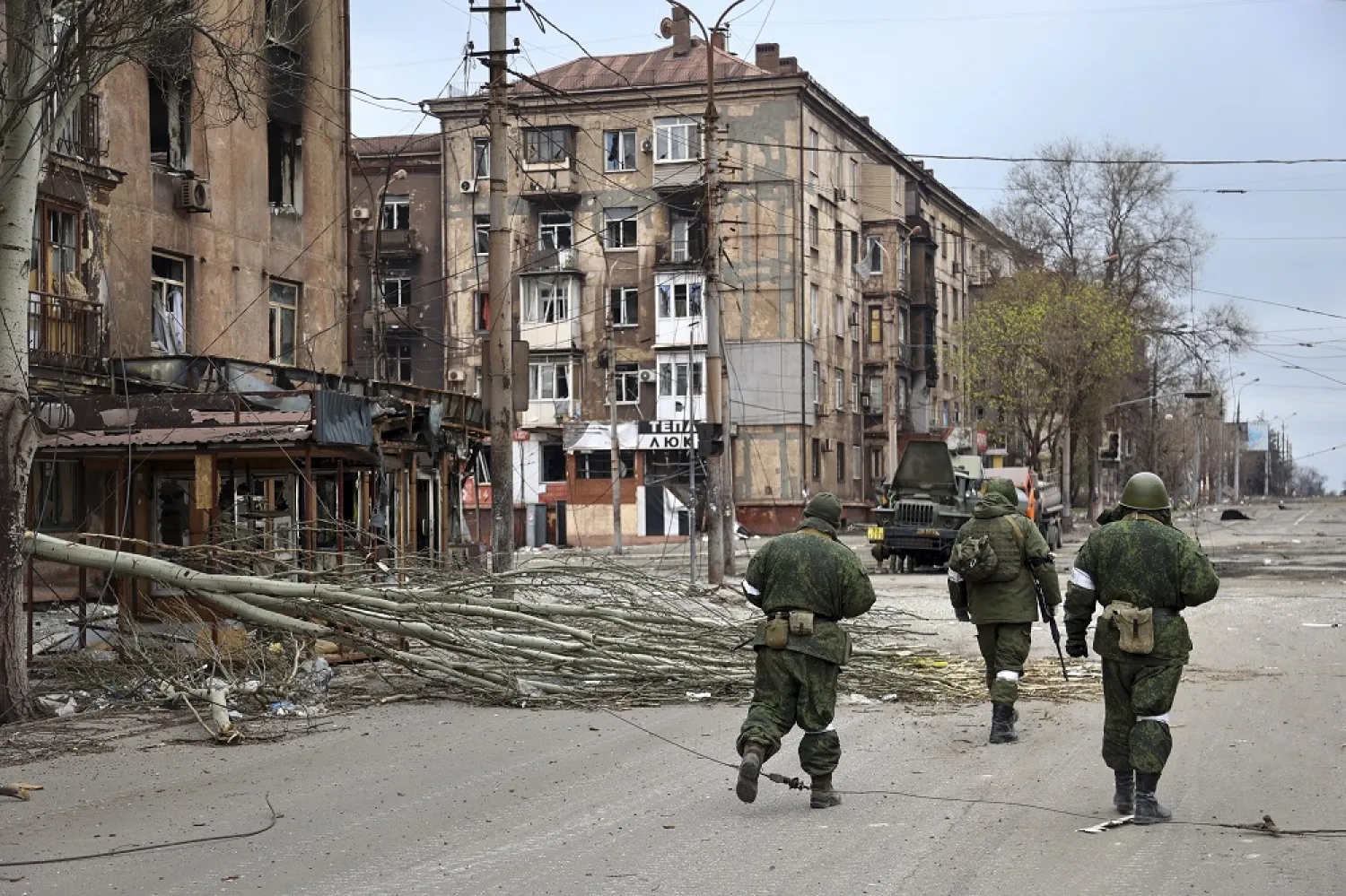

East Ukraine under Heavy Fire in Advance of Russian Holiday

Servicemen of the militia from the Donetsk People's Republic walk past damaged apartment buildings near the Illich Iron & Steel Works Metallurgical Plant, the second-largest metallurgical enterprise in Ukraine, in an area controlled by Russian-backed separatist forces in Mariupol, Ukraine, Saturday, April 16, 2022. (AP)
TT

East Ukraine under Heavy Fire in Advance of Russian Holiday

Servicemen of the militia from the Donetsk People's Republic walk past damaged apartment buildings near the Illich Iron & Steel Works Metallurgical Plant, the second-largest metallurgical enterprise in Ukraine, in an area controlled by Russian-backed separatist forces in Mariupol, Ukraine, Saturday, April 16, 2022. (AP)

Moscow's offensive in eastern Ukraine gathered momentum as several areas came under heavy shelling Thursday, amid suspicions Russian President Vladimir Putin wants to score a major battlefield success in time for Victory Day, one of Russia's proudest holidays, on May 9.

Ukrainian authorities reported intense Russian fire in the Donbas - the eastern industrial heartland that the Kremlin is bent on capturing - and near Kharkiv, a northeastern city outside the Donbas that is seen as key to the offensive.

In the ruined southern port city of Mariupol, Ukrainian fighters holed up in the steel plant that represents the last pocket of resistance said concentrated bombing overnight killed and wounded more people. And authorities warned that a lack of safe drinking water inside the city could lead to outbreaks of deadly diseases.

The fresh attacks came as the United Nations chief met in Kyiv with Ukrainian President Volodymyr Zelenskyy and surveyed the destruction in small towns outside the capital that saw some of the worst horrors of the first onslaught of the war.

UN Secretary-General António Guterres condemned the atrocities committed in towns like Bucha, where evidence of mass killings of civilians was found after Russia retreated in the face of unexpectedly stiff resistance. He called such towns "the epicenter of unbearable heartbreak and pain."

"Wherever there is a war, the highest price is paid by civilians," Guterres lamented, reiterating the importance of investigating alleged war crimes.

Separately, Ukraine’s prosecutor accused 10 Russian soldiers, including a general, of being "involved in the torture of peaceful people" in Bucha. Prosecutor General Iryna Venediktova did not say her office had filed criminal charges, and she appealed to the public to help assemble evidence. Russia denies it targets civilians.

"During the occupation of Bucha, they took unarmed civilians hostage, killed them with hunger and thirst, kept them on their knees with hands tied and eyes taped, mocked and beat them," Venediktova said.

Getting a full picture of the unfolding battle in the east has been difficult because airstrikes and artillery barrages have made it extremely dangerous for reporters to move around. Several journalists have been killed in the war, now in its third month.

Also, both Ukraine and the Moscow-backed rebels fighting in the east have introduced tight restrictions on reporting from the combat zone.

Western officials say the Kremlin's apparent goal is to take the Donbas by encircling and crushing Ukrainian forces from the north, south and east.

But so far, Russia's troops and their allied separatist forces appear to have made only minor gains, taking several small towns as they try to advance in relatively small groups against staunch Ukrainian resistance.

Russian military units were mauled in the abortive bid to storm Kyiv and had to regroup and refit. Some analysts say the delay in launching a full-fledged offensive may reflect Putin’s decision to wait until his forces are ready for a decisive battle - rather than rushing in and risking another failure that could shake his rule amid worsening economic conditions at home because of Western sanctions.

Many observers expect Putin will try to claim a big victory in the east by Victory Day, which marks the defeat of Nazi Germany during World War II.

Putin, like many of his predecessors, often uses patriotic Russian holidays and anniversaries to make announcements. In March, he appeared at a Moscow stadium at a rally marking the eighth anniversary of Russia’s annexation of the Crimean Peninsula, and used the event to build support for the war.

The discovery of the mass killings around Kyiv helped to galvanize support for Ukraine in the West. Bulgarian Prime Minister Kiril Petkov vowed his country would join others in providing military assistance as he toured another scene of atrocities outside Kyiv, in Borodyanka.

"We cannot be indifferent. We cannot say that this is a Ukrainian problem. We cannot say some people are dying but we are not interested in that," he said. "This is not just the battle for Ukraine, but it is a matter for civilization to choose which side to take."

Bulgaria, under a new liberal government that took office last fall, has severed many of its old ties to Moscow and supported punitive measures against the Kremlin.

The visit by the Bulgarian leader came a day after Russia cut off the supply of natural gas to his country and fellow NATO member Poland, in what was seen as a bid to punish and divide the West.

As Russia presses its offensive, civilians again bear the brunt.

"It’s not just scary. It’s when your stomach contracts from pain," said Kharkiv resident Tatiana Pirogova. "When they shoot during the day, it’s still OK, but when the evening comes, I can’t describe how scary it is."

Ukraine's military said that Russian troops were subjecting several places in the Donbas to "intense fire" and that over the past 24 hours, Ukrainian forces had repelled six attacks in the region.

Four civilians were killed in heavy shelling of residential areas in the Luhansk region of the Donbas, according to the regional governor.

Columns of smoke could be seen rising at different points across the Donetsk region of the Donbas, and artillery and sirens were heard on and off.

Satellite photos analyzed by The Associated Press also showed evidence of intense Russian fire on Mariupol in recent days.

A video posted online by Ukraine's Azov Regiment inside the steel plant showed people combing through the rubble to remove the dead and help the wounded. The regiment said the Russians hit an improvised underground hospital and its surgery room, killing an unspecified number of people. The video couldn’t be independently verified.

Hundreds of thousands of Mariupol's residents have fled. Authorities said the estimated 100,000 who remain run the risk of diseases like cholera and dysentery.

"Deadly epidemics may break out in the city due to the lack of centralized water supply and sewers," the council said on the messaging app Telegram. It reported bodies decomposing under the rubble and a "catastrophic" shortage of drinking water and food.

Russia, meanwhile, said a city under its control in the south came under fire. In what may have been a Ukrainian counterattack, a series of explosions boomed near the television tower late Wednesday in Kherson, which has been occupied by Russian forces since early in the war. The blasts at least temporarily knocked Russian channels off the air.

Loud bangs were reported in Russia’s Belgorod region bordering Ukraine, but there was no immediate explanation. In recent days, fuel and ammunition sites on Russian soil have been hit with explosions and fires, and suspicion has fallen on Ukraine.

Ukraine has urged its allies to send even more military equipment to fend off the Russians. US President Joe Biden plans to Congress for an additional $33 billion to help Ukraine.



Somalia’s Al-Shabaab Vows to Fight Any Israeli Use of Somaliland

Residents wave Somaliland flags as they gather to celebrate Israel's announcement recognizing Somaliland's statehood in downtown Hargeisa, on December 26, 2025. (AFP)
TT

Somalia’s Al-Shabaab Vows to Fight Any Israeli Use of Somaliland

Residents wave Somaliland flags as they gather to celebrate Israel's announcement recognizing Somaliland's statehood in downtown Hargeisa, on December 26, 2025. (AFP)

Somalia's Al-Qaeda-linked militant group Al-Shabaab vowed Saturday to fight any attempt by Israel "to claim or use parts of Somaliland" following its recognition of the breakaway territory.

"We will not accept it, and we will fight against it," Al-Shabaab said in a statement.

Its spokesman Ali Dheere said in the statement that Israel's recognition of Somaliland as a sovereign state showed it "has decided to expand into parts of the Somali territories" to support "the apostate administration in the northwest regions".

Israel said Friday it was officially recognizing Somaliland, a first for the self-proclaimed republic that in 1991 declared it had unilaterally seceded from Somalia.

Mogadishu immediately denounced a "deliberate attack" on its sovereignty, while Egypt, Türkiye, the six-nation Gulf Cooperation Council and the Saudi-based Organization of Islamic Cooperation all condemned Israel's move.

Regional analysts believe that a rapprochement with Somaliland could allow Israel to secure better access to the Red Sea.

In addition, press reports a few months ago said Somaliland was among a handful of African territories willing to host Palestinians expelled by Israel, but neither the Somaliland authorities nor the Israeli government has ever commented on those reports.

"It is humiliation of the highest level today, to see some Somali people celebrating a recognition by the Israeli Prime Minister (Benjamin) Netanyahu" when "Israel is the biggest enemy of the Islamic society".

The territory of Somaliland is roughly a third the size of France and corresponds more or less to the former British Somaliland protectorate.

It has its own money, army and police and enjoys relative stability compared to its neighbors.

But, until now, Somaliland had not been publicly recognized by any country, which has kept it politically and economically isolated despite its location on one of the world's busiest trade routes connecting the Indian Ocean to the Suez Canal.

Somalia has been battling Al-Shabaab for nearly 20 years and while security has significantly improved in Mogadishu, the war still rages 60 kilometers from the capital.


China Welcomes Cambodia-Thailand Ceasefire, Plans Talks

A handout photo made available by the Defense Ministry of Thailand shows Cambodian Defense Minister Tea Seiha (L) and Thai Defense Minister Natthaphon Narkphanit exchanging ceasefire agreement documents during a General Border Committee Meeting in Ban Pak Kard, Chanthaburi Province, Thailand, 27 December 2025. (EPA/Defense Ministry of Thailand/Handout)
TT

China Welcomes Cambodia-Thailand Ceasefire, Plans Talks

A handout photo made available by the Defense Ministry of Thailand shows Cambodian Defense Minister Tea Seiha (L) and Thai Defense Minister Natthaphon Narkphanit exchanging ceasefire agreement documents during a General Border Committee Meeting in Ban Pak Kard, Chanthaburi Province, Thailand, 27 December 2025. (EPA/Defense Ministry of Thailand/Handout)

China on Saturday welcomed a joint ceasefire statement signed by Cambodia and Thailand and said its foreign minister would meet his counterparts from both countries in China, according to a notice posted on the foreign ministry's website late in the day.

Cambodia and Thailand agreed ‌on Saturday to ‌a second ceasefire ‌in ⁠recent months, ‌ending weeks of intense border clashes described as the worst fighting in years between the two Southeast Asian neighbors.

China's foreign ministry said the agreement showed that dialogue and consultation ⁠were practical and effective ways to resolve ‌complex disputes.

Foreign Minister Wang ‍Yi will meet ‍Cambodian counterpart Prak Sokhonn and ‍Thailand's Sihasak Phuangketkeow in southwestern Yunnan province on December 28–29, the ministry said, adding that military representatives from all three countries would also attend.

China said it was willing to continue ⁠providing a platform and facilitating more substantive and detailed communication between Cambodia and Thailand.

"China will play a constructive role in its own way to help Cambodia and Thailand consolidate the ceasefire, resume exchanges, rebuild political mutual trust, achieve a turnaround in relations and maintain regional ‌peace," the ministry said.


Netanyahu to Meet Trump in US on Monday for Talks on Iran, Gaza, Hezbollah, Syria

 Israeli Prime Minister Benjamin Netanyahu speaks during a joint press conference with Greek Prime Minister Kyriakos Mitsotakis and Cypriot President Nikos Christodoulides (not pictured) after a trilateral meeting in Jerusalem on December 22, 2025. (AFP)
Israeli Prime Minister Benjamin Netanyahu speaks during a joint press conference with Greek Prime Minister Kyriakos Mitsotakis and Cypriot President Nikos Christodoulides (not pictured) after a trilateral meeting in Jerusalem on December 22, 2025. (AFP)
TT

Netanyahu to Meet Trump in US on Monday for Talks on Iran, Gaza, Hezbollah, Syria

 Israeli Prime Minister Benjamin Netanyahu speaks during a joint press conference with Greek Prime Minister Kyriakos Mitsotakis and Cypriot President Nikos Christodoulides (not pictured) after a trilateral meeting in Jerusalem on December 22, 2025. (AFP)
Israeli Prime Minister Benjamin Netanyahu speaks during a joint press conference with Greek Prime Minister Kyriakos Mitsotakis and Cypriot President Nikos Christodoulides (not pictured) after a trilateral meeting in Jerusalem on December 22, 2025. (AFP)

Israeli Prime Minister Benjamin Netanyahu is due to meet US President Donald Trump in Florida on Monday, an Israeli official told AFP, in what is seen as a crucial visit for the next steps of the fragile Gaza truce plan.

It will be Netanyahu's fifth visit to see key ally Trump in the United States this year.

His trip comes as the Trump administration and regional mediators push to proceed to the second stage of the ceasefire between Israel and Hamas in the Gaza Strip.

An Israeli official on Saturday said Netanyahu would leave for the US on December 28 and meet with Trump a day later in Florida, without providing a specific location.

Trump told reporters in mid-December that Netanyahu would probably visit him in Florida during the Christmas holidays.

"He would like to see me. We haven't set it up formally, but he'd like to see me," Trump said before leaving for his Mar-a-Lago resort.

Israel's Yedioth Ahronoth newspaper reported on Wednesday that a wide range of regional issues was expected to be discussed, including Iran, talks on an Israel-Syria security agreement, the ceasefire with Hezbollah in Lebanon and the next stages of the Gaza deal.

- 'Going nowhere' -

Concerning Gaza, the timing of the meeting is "very significant", said Gershon Baskin, the co-head of peacebuilding commission the Alliance for Two States, who has taken part in back-channel negotiations with Hamas.

"Phase one is basically over, there's one remaining Israeli deceased hostage which they (Hamas) are having difficulty finding," he told AFP.

"Phase two has to begin, it's even late and I think the Americans realize that it's late because Hamas has had too much time to re-establish its presence and this is certainly not a situation that the Americans want to leave in place," he added.

Progress in moving to the second phase of October's Gaza ceasefire agreement, which was brokered by Washington and its regional allies, has so far been slow.

Both sides allege frequent ceasefire violations and mediators fear that Israel and Hamas alike are stalling.

Under the next stages, Israel is supposed to withdraw from its positions in Gaza, an interim authority is to govern the Palestinian territory instead of Hamas, and an international stabilization force (ISF) is to be deployed.

It also includes a provision for Palestinian movement Hamas to lay down its weapons -- a major sticking point.

On Friday, US news outlet Axios reported that the meeting between Trump and Netanyahu was key to advancing to the next steps of the deal.

Citing White House officials, Axios said that the Trump administration wanted to announce the Palestinian technocratic government for Gaza and the ISF as soon as possible.

It reported that senior Trump officials were growing exasperated "as Netanyahu has taken steps to undermine the fragile ceasefire and stall the peace process".

"There are more and more signs that the American administration is getting frustrated with Netanyahu," said Yossi Mekelberg, a Middle East expert at London-based think-tank Chatham House.

"The question is what it's going to do about it," he added, "because phase two is right now going nowhere."

- Iran tops agenda -

While the Trump administration is keen for progress on Gaza, analysts said the prospect of Iran rebuilding its nuclear program and ballistic missile capabilities was likely to top the agenda for Netanyahu.

"All the news that we've heard in the Israeli media over the last two weeks about Iran building up its missiles and being a threat to Israel is all part of a planned strategy of deflecting attention from Gaza to the issue that Netanyahu loves to talk about which is Iran," said Baskin.

In June, Israel launched strikes on Iranian military and nuclear sites as well as residential areas.

Iran responded with drone and missile strikes on Israel, and later on in the 12-day war, the United States joined Israel in targeting Iranian nuclear facilities.

Mekelberg shared the view that Netanyahu could be attempting to shift attention from Gaza onto Iran.

With Israel entering an election year, Mekelberg said with regards to the Trump meeting, Netanyahu would be "taking a defensive approach, to minimize what can be difficult for him coming back home".

"Everything is connected to staying in power," he said of the long-time Israeli premier.