

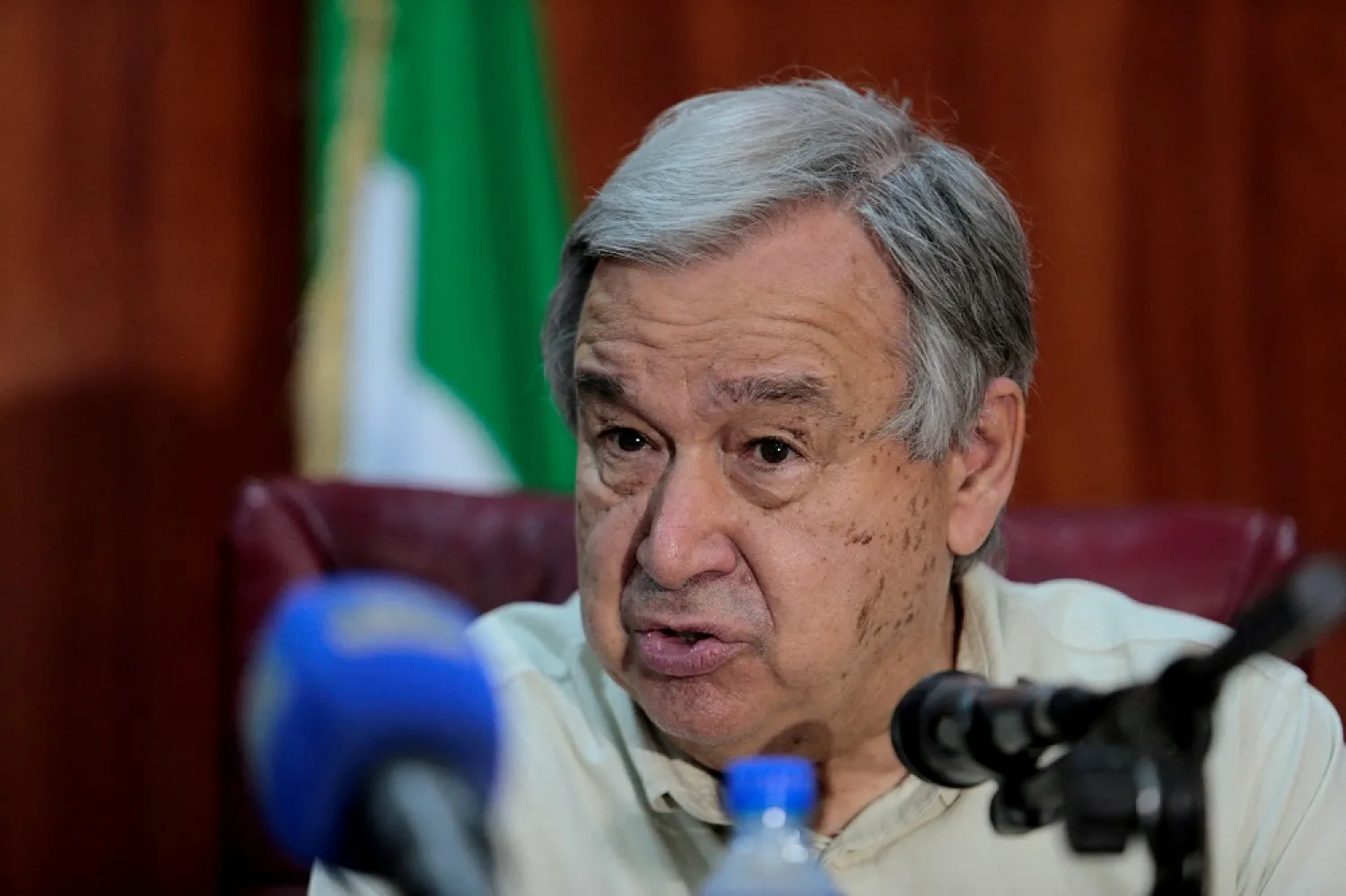

UN Chief Urges Free, Transparent Elections in Lebanon on May 15

United Nations Secretary-General, Antonio Guterres speaks during a courtesy visit to Borno State Governor Babagana Zulum in Maiduguri, Nigeria, May 3, 2022. (Reuters)
TT

UN Chief Urges Free, Transparent Elections in Lebanon on May 15

United Nations Secretary-General, Antonio Guterres speaks during a courtesy visit to Borno State Governor Babagana Zulum in Maiduguri, Nigeria, May 3, 2022. (Reuters)

The UN chief called for Lebanon’s parliamentary elections on May 15 to be "free, fair transparent and inclusive" in a report circulated Wednesday and urged the quick formation of a government afterward that gives priority to implementing reforms addressing the country’s multiple crises.

Secretary-General Antonio Guterres said in the report to the UN Security Council that political polarization in the country has deepened and the Lebanese people "are struggling daily to meet basic essential needs." He pointed to frequent protests across the country sparked by "public frustration with the political situation and the economic and financial crisis."

The May 15 elections for parliament are the first since Lebanon’s economic meltdown began in late 2019. The government’s factions have done virtually nothing to address the collapse, leaving Lebanese to fend for themselves as they plunge into poverty, without electricity, medicine, garbage collection or any other semblance of normal life.

The elections are also the first since the August 4, 2020, catastrophic explosion at Beirut port that killed more than 215 people and wrecked large parts of the city. The destruction sparked widespread outrage at the traditional parties’ endemic corruption and mismanagement.

Guterres, who visited Lebanon last December, said no one has yet been held accountable for the explosion and the Lebanese people are demanding "truth and justice." He reiterated his call for "a swift, impartial, thorough and transparent investigation" and stressed that "the independence of the judiciary must be respected."

In the May 15 election, a total of 103 lists with 1,044 candidates are vying for the 128-seat legislature, which is equally divided between Christians and Muslims.

Self-declared opposition groups remain divided along ideological lines on virtually every issue, including over how to revive the economy, and as a result, there are an average of at least three different opposition lists in each of the 15 electoral districts, a 20% increase from the 2018 elections.

Guterres noted that proposals submitted in the past two years for a women’s quota were still pending in parliament, and he urged that the new government be quickly formed "with full participation of women and young people."

The secretary-general's semi-annual report on implementation of a 2004 Security Council resolution reiterated that its key demands -- that the Lebanese government establish its sovereignty throughout the country and that all Lebanese militias disarm and disband -- have not been fulfilled.

Guterres said Hezbollah’s maintenance "of sizeable and sophisticated military capabilities outside the control of the government of Lebanon remains a matter of grave concern." He noted Hezbollah leader Hassan Nasrallah’s February announcement that it now has the ability to transform thousands of its missiles "into precision missiles" and has been manufacturing drones "for a long time."

The secretary-general urged the Lebanese state to "increase its efforts to achieve a monopoly over the possession of weapons and the use of force throughout its territory."

"I continue to urge the government and the armed forces of Lebanon to take all measures necessary to prohibit Hezbollah and other armed groups from acquiring weapons and building paramilitary capacity outside the authority of the state," the UN chief said, stressing that this violates Security Council resolutions.

Guterres said Hezbollah’s continued involvement in the war in neighboring Syria also risks entangling Lebanon in regional conflicts and undermining its stability.

He called on countries in the region with close ties to Hezbollah to encourage its disarmament and transformation into "a solely civilian political party." Both Syria and Iran have close ties to Hezbollah.



Will STC Keep its Gains in Yemen or Prepare for a Major Confrontation?

A supporter of the Southern Transitional Council (STC) stands in the back of a pickup truck in the Khor Maksar district of the second city of Aden on August 29, 2019. (AFP file)
TT

Will STC Keep its Gains in Yemen or Prepare for a Major Confrontation?

A supporter of the Southern Transitional Council (STC) stands in the back of a pickup truck in the Khor Maksar district of the second city of Aden on August 29, 2019. (AFP file)

Yemen's eastern provinces of Hadhramaut and Al-Mahra are passing through a critical phase amid the unprecedented unilateral military escalation carried out by the Southern Transitional Council (STC) that has been met with widespread regional and international condemnation.

Observers have said the STC cannot be allowed to impose a new status quo through the use of force no matter its justifications or claims.

They said the situation is not a passing development that can be ignored by the Saudi-led Arab coalition to restore legitimacy in Yemen and its supporters. Rather, this is a multifaceted political and security test where southern interests, the war against the Houthis and regional peace collide.

At the moment, the STC is opting to maneuver under pressure instead of leading the challenge head-on. In its recent statements, the council has resorted to political claims to justify its actions on the ground, speaking of "coordination" and "understanding concerns", reflecting a growing realization that its room to maneuver is shrinking and that it must take the right decision.

Saudi Arabia has made clear warnings over the situation, starting with a political warning, followed by an airstrike on Hadhramaut. The stern response means that a firm decision has been taken to prevent Hadhramaut and Al-Mahra from being dragged into an internal conflict or becoming an arena where agendas are imposed by force.

The STC is aware that ignoring the warnings puts it in a direct confrontation with a regional heavyweight - Saudi Arabia. The council does not have the political or military means to come out on top, so it has been advised to seriously deal with the warnings and avoid resorting to stalling tactics if it is considering taking the option of minimal losses to the gains it has amassed over the years.

Failing to heed the warning will mean it will have to come to heel through force, which will end in its major defeat.

The observers said the STC has landed itself in an unprecedented crisis. The council has justified its unilateral military actions as aimed at "protecting the southern cause" and that it was meeting the demands of the people. It also claimed that it sought to block Houthi smuggling routes and fight terrorist groups.

Despite everything, it is not too late for the STC to salvage the situation, as stated by Saudi Defense Minister Prince Khalid bin Salman on Saturday. The STC can still end the crisis while taking minimal losses by immediately withdrawing its forces from Hadhramaut and Al-Mahra.

Should it stand its ground, the STC does not have the means to consolidate its presence in the two provinces, especially amid wide popular opposition, notably in Hadhramaut. Moreover, the STC lacks regional cover and international support that is a main condition for creating any security changes in critical areas.

So, it would seem that the best and easiest scenario would be for the STC to withdraw its forces, under such pretexts of "redeployment" or "security arrangements", to minimize its political losses, said the observers.

Should it ignore the warnings and choose to continue to escalate the situation, then the STC will lose its partnership with the legitimate Yemeni authorities, transforming into an obstacle in efforts to restore stability in the country. International sanctions may even be imposed on its leaders.

On the military level, the Arab coalition was clear in stating that it will not allow a new status quo to be imposed by force in eastern Yemen. Any escalation may be met with direct deterrence, meaning casualties on the ground that the STC cannot justify.

On the ground, the STC does not enjoy the support of the people in Hadhramaut and Al-Mahra and the continued escalation will deepen opposition to it in the south. The southern cause will transform from an issue that enjoys consensus to one that causes division.


Syrian Army Enters Latakia, Tartus after Attacks by Regime Remnants

Syrian Security forces stand atop a military vehicle in the city of Latakia, Syria, 28 December 2025. (EPA)
TT

Syrian Army Enters Latakia, Tartus after Attacks by Regime Remnants

Syrian Security forces stand atop a military vehicle in the city of Latakia, Syria, 28 December 2025. (EPA)

The Syrian Defense Ministry announced on Sunday the deployment of military forces in the coastal cities of Latakia and Tartus in wake of an armed attack against security forces and civilians during recent protests.

Syrian television said the deployment was happening after "outlawed groups" carried out attacks against security forces and the people.

The military will work on preserving security and restoring calm in cooperation with the internal security forces, it added.

Earlier, local media reported that three people were killed and 48 wounded when gunmen affiliated with the ousted regime opened fire at civilians and security forces during protests in Latakia and Tartus.

State television said a member of the security forces was killed and others were injured while they were protecting protests in Latakia.

Head of the security forces in the Latakia province Abdulaziz al-Ahmed said the attack was carried out by terrorist members of the former regime.

The protests in Latakia were called for by Ghazal Ghazal.

Al-Ahmed added that masked gunmen were spotted at the protests and they were identified as members of Coastal Shield Brigade and Al-Jawad Brigade terrorist groups, reported the official SANA news agency.

The groups were responsible for bombings on the M1 highway and extrajudicial killings, it added.

A member of the groups was arrested in the Jableh countryside during a security operation, announced the Interior Ministry. Three other members were killed, while explosives and various weapons and ammunition were seized during the operation.

The Al-Jawad Brigade is affiliated with Suheil al-Hassan, a notorious former Syrian military officer.

In a statement, the Interior Ministry said the group was involved in assassinations, bombings and attacks against the Interior Ministry forces and the army.

It was planning attacks on New Year celebrations, it revealed. The detainee also revealed the locations of weapons caches used by the group.


Hezbollah Chief Accuses Lebanese Authorities of Working ‘in the Interest of What Israel Wants’

Hezbollah leader Naim Qassem
TT

Hezbollah Chief Accuses Lebanese Authorities of Working ‘in the Interest of What Israel Wants’

Hezbollah leader Naim Qassem

Hezbollah leader Naim Qassem on Sunday said moves to disarm the group in Lebanon are an "Israeli-American plan,” accusing Israel of failing to abide by a ceasefire agreement sealed last year.

Under heavy US pressure and fears of expanded Israeli strikes, the Lebanese military is expected to complete Hezbollah's disarmament south of the Litani River -- located about 30 kilometers from the border with Israel -- by the end of the year.

It will then tackle disarming the Iran-backed movement in the rest of the country.

"Disarmament is an Israeli-American plan," Qassem said.

"To demand exclusive arms control while Israel is committing aggression and America is imposing its will on Lebanon, stripping it of its power, means that you are not working in Lebanon's interest, but rather in the interest of what Israel wants."

Despite a November 2024 ceasefire that was supposed to end more than a year of hostilities between Israel and Hezbollah, Israel has kept up strikes on Lebanon and has maintained troops in five areas it deems strategic.

According to the agreement, Hezbollah was required to pull its forces north of the Litani River and have its military infrastructure in the vacated area dismantled.

Israel has questioned the Lebanese military's effectiveness and has accused Hezbollah of rearming, while the group itself has rejected calls to surrender its weapons.

"The deployment of the Lebanese army south of the Litani River was required only if Israel had adhered to its commitments... to halting the aggression, withdrawing, releasing prisoners, and having reconstruction commence," Qassem said in a televised address.

"With the Israeli enemy not implementing any of the steps of the agreement... Lebanon is no longer required to take any action on any level before the Israelis commit to what they are obligated to do."

Lebanese army chief Rodolphe Haykal told a military meeting on Tuesday "the army is in the process of finishing the first phase of its plan.”

He said the army is carefully planning "for the subsequent phases" of disarmament.