


WHO: Nearly 15 Million Deaths Associated with COVID-19

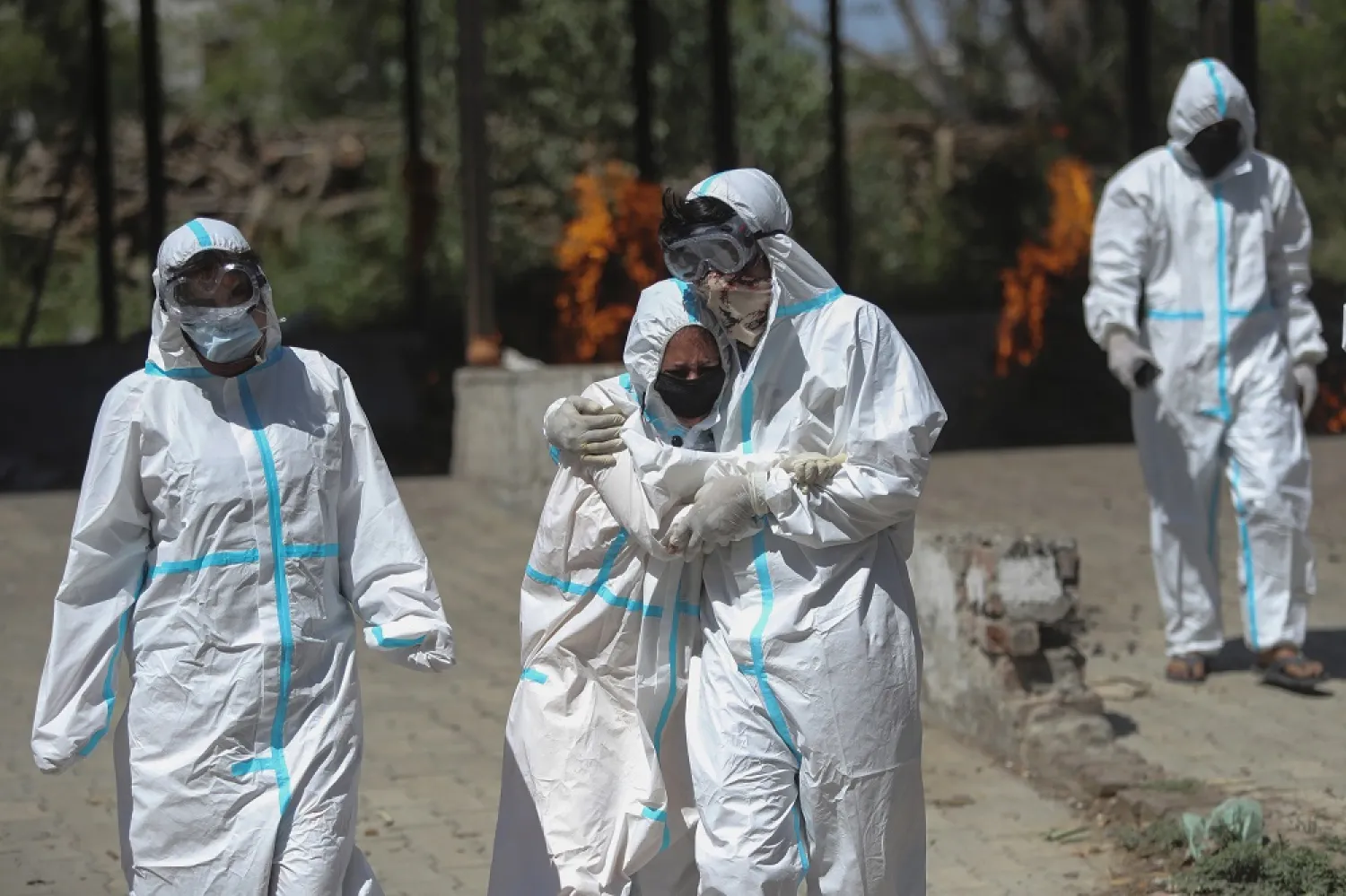
A relative of a person who died of COVID-19 is consoled by another during cremation in Jammu, India, Sunday, April 25, 2021. (AP)
TT

WHO: Nearly 15 Million Deaths Associated with COVID-19

A relative of a person who died of COVID-19 is consoled by another during cremation in Jammu, India, Sunday, April 25, 2021. (AP)

The World Health Organization estimates that nearly 15 million people were killed either by coronavirus or by its impact on overwhelmed health systems during the first two years of the pandemic, more than double the current official death toll of over 6 million.

Most of the deaths occurred in Southeast Asia, Europe and the Americas, according to a WHO report issued Thursday.

The UN health agency’s director-general, Tedros Adhanom Ghebreyesus, described the calculated figure as "sobering," saying it should prompt countries to invest more in their capacities to quell future health emergencies.

WHO tasked scientists with determining the actual number of COVID-19 deaths between January 2020 and the end of last year. They estimated that between 13.3 million and 16.6 million people died either due to the coronavirus directly or because of factors somehow attributed to the pandemic’s impact on health systems, such as cancer patients who were unable to seek treatment when hospitals were full of COVID patients.

Based on that range, the scientists came up with an approximated total of 14.9 million.

The estimate was based on country-reported data and statistical modeling, but only about half of countries provided information. WHO said it wasn't yet able to break down the data to distinguish between direct deaths from COVID-19 and those related to effects of the pandemic, but the agency plans a future project examining death certificates.

"This may seem like just a bean-counting exercise, but having these WHO numbers is so critical to understanding how we should combat future pandemics and continue to respond to this one," said Dr. Albert Ko, an infectious diseases specialist at the Yale School of Public Health who was not linked to the WHO research.

For example, Ko said, South Korea’s decision to invest heavily in public health after it suffered a severe outbreak of MERS allowed it to escape COVID-19 with a per-capita death rate around a 20th of the one in the United States.

Accurately counting COVID-19 deaths has been problematic throughout the pandemic, as reports of confirmed cases represent only a fraction of the devastation wrought by the virus, largely because of limited testing. Government figures reported to WHO and a separate tally kept by Johns Hopkins University show more than 6.2 million reported virus deaths to date.

Scientists at the Institute of Health Metrics and Evaluation at the University of Washington calculated for a recent study published in the journal Lancet that there more than 18 million COVID deaths from January 2020 to December 2021.

A team led by Canadian researchers estimated there were more than 3 million uncounted coronavirus deaths in India alone. WHO's new analysis estimated that missed deaths in India ranged between 3.3 million to 6.5 million.

In a statement following the release of WHO's data, India disputed the UN agency's methodology. India's Health and Family Welfare Ministry called the analysis and data collection methods "questionable" and complained that the new death estimates were released "without adequately addressing India's concerns."

Samira Asma, a senior WHO director, acknowledged that "numbers are sometimes controversial" and that all estimates are only an approximation of the virus' catastrophic effects.

"It has become very obvious during the entire course of the pandemic, there have been data that is missing," Asma told reporters during a press briefing on Thursday. "Basically, all of us were caught unprepared."

Ko said the new figures from WHO might also explain some lingering mysteries about the pandemic, like why Africa appears to have been one of the least affected by the virus, despite its low vaccination rates.

"Were the mortality rates so low because we couldn’t count the deaths, or was there some other factor to explain that?" he asked, citing the far higher mortality rates in the US and Europe.

Dr. Bharat Pankhania, a public health specialist at Britain’s University of Exeter, said the world may never get close to measuring the true toll of COVID-19, particularly in poor countries.

"When you have a massive outbreak where people are dying in the streets because of a lack of oxygen, bodies were abandoned or people had to be cremated quickly because of cultural beliefs, we end up never knowing just how many people died," he explained.

Pankhania said that while the estimated COVID-19 death toll still pales in comparison to the 1918 Spanish flu pandemic, which experts estimate caused up to 100 million deaths, the fact that so many people died despite the advances of modern medicine, including vaccines, is shameful.

He also warned that the cost of COVID-19 could be far more damaging in the long term, given the increasing burden of caring for people with long COVID.

"With the Spanish flu, there was the flu and then there were some (lung) illnesses people suffered, but that was it," he said. "There was not an enduring immunological condition that we’re seeing right now with COVID."

"We do not know the extent to which people with long COVID will have their lives cut short and if they will have repeated infections that will cause them even more problems," Pankhania said.



Top Trump Iran Negotiator Says Visits US Aircraft Carrier in Middle East

US Special Envoy Steve Witkoff delivers a press conference upon the signing of the declaration on deploying post-ceasefire force in Ukraine, during the so-called "Coalition of the Willing" summit, at the Elysee Palace in Paris, France, January 6, 2026. (Reuters)
TT

Top Trump Iran Negotiator Says Visits US Aircraft Carrier in Middle East

US Special Envoy Steve Witkoff delivers a press conference upon the signing of the declaration on deploying post-ceasefire force in Ukraine, during the so-called "Coalition of the Willing" summit, at the Elysee Palace in Paris, France, January 6, 2026. (Reuters)

US President Donald Trump's lead Iran negotiator Steve Witkoff on Saturday said he visited the USS Abraham Lincoln aircraft carrier currently in the Arabian Sea, with Washington and Tehran due to hold further talks soon.

"Today, Adm. Brad Cooper, Commander of US Naval Forces Central Command, Jared Kushner, and I met with the brave sailors and Marines aboard the USS Abraham Lincoln, her strike group, and Carrier Air Wing 9 who are keeping us safe and upholding President Trump's message of peace through strength," said Witkoff in a social media post.

Iranian Foreign Minister Abbas Araghchi said on Saturday he hoped talks with the United States would resume soon, while reiterating Tehran's red lines and warning against any American attack.


Israel’s Netanyahu Expected to Meet Trump in US on Wednesday and Discuss Iran

Israeli Prime Minister Benjamin Netanyahu delivers a speech during a special session to mark the 77th anniversary of the Knesset's establishment and the 60th anniversary of the dedication of the current building at the Knesset, the Israeli parliament, in Jerusalem, 02 February 2026. (EPA)
TT

Israel’s Netanyahu Expected to Meet Trump in US on Wednesday and Discuss Iran

Israeli Prime Minister Benjamin Netanyahu delivers a speech during a special session to mark the 77th anniversary of the Knesset's establishment and the 60th anniversary of the dedication of the current building at the Knesset, the Israeli parliament, in Jerusalem, 02 February 2026. (EPA)

Israeli Prime Minister Benjamin Netanyahu is expected to meet US President Donald Trump on Wednesday in Washington, where they will discuss negotiations with Iran, Netanyahu's office said on Saturday.

Iranian and US officials held indirect nuclear ‌talks in the ‌Omani capital ‌Muscat ⁠on Friday. ‌Both sides said more talks were expected to be held again soon.

A regional diplomat briefed by Tehran on the talks told Reuters Iran insisted ⁠on its "right to enrich uranium" ‌during the negotiations with ‍the US, ‍and that Tehran's missile capabilities ‍were not raised in the discussions.

Iranian officials have ruled out putting Iran's missiles - one of the largest such arsenals in the region - up ⁠for discussion, and have said Tehran wants recognition of its right to enrich uranium.

"The Prime Minister believes that any negotiations must include limiting ballistic missiles and halting support for the Iranian axis," Netanyahu's office said in a ‌statement.


Italy FM Rules Out Joining Trump’s ‘Board of Peace’

Italy's Minister for Foreign Affairs Antonio Tajani speaks to the press during the EPP Leaders’ meeting, in Zagreb, Croatia, 30 January 2026. (EPA)
TT

Italy FM Rules Out Joining Trump’s ‘Board of Peace’

Italy's Minister for Foreign Affairs Antonio Tajani speaks to the press during the EPP Leaders’ meeting, in Zagreb, Croatia, 30 January 2026. (EPA)

Italy will not take part in US President Donald Trump's "Board of Peace", Italian Foreign Minister Antonio Tajani said Saturday, citing "insurmountable" constitutional issues.

Trump launched his "Board of Peace" at the World Economic Forum in Davos in January and some 19 countries have signed its founding charter.

But Italy's constitution bars the country from joining an organization led by a single foreign leader.

Prime Minister Giorgia Meloni, a Trump ally, last month noted "constitutional problems" with joining, but suggested Trump could perhaps reopen the framework "to meet the needs not only of Italy, but also of other European countries".

Tajani appeared Saturday to rule that out.

"We cannot participate in the Board of Peace because there is a constitutional limit," he told the ANSA news agency.

"This is insurmountable from a legal standpoint," he said, the day after meeting US Secretary of State Marco Rubio and US Vice President JD Vance at the Olympics in Milan.

Although originally meant to oversee Gaza's rebuilding, the board's charter does not limit its role to the Palestinian territory and appears to want to rival the United Nations.