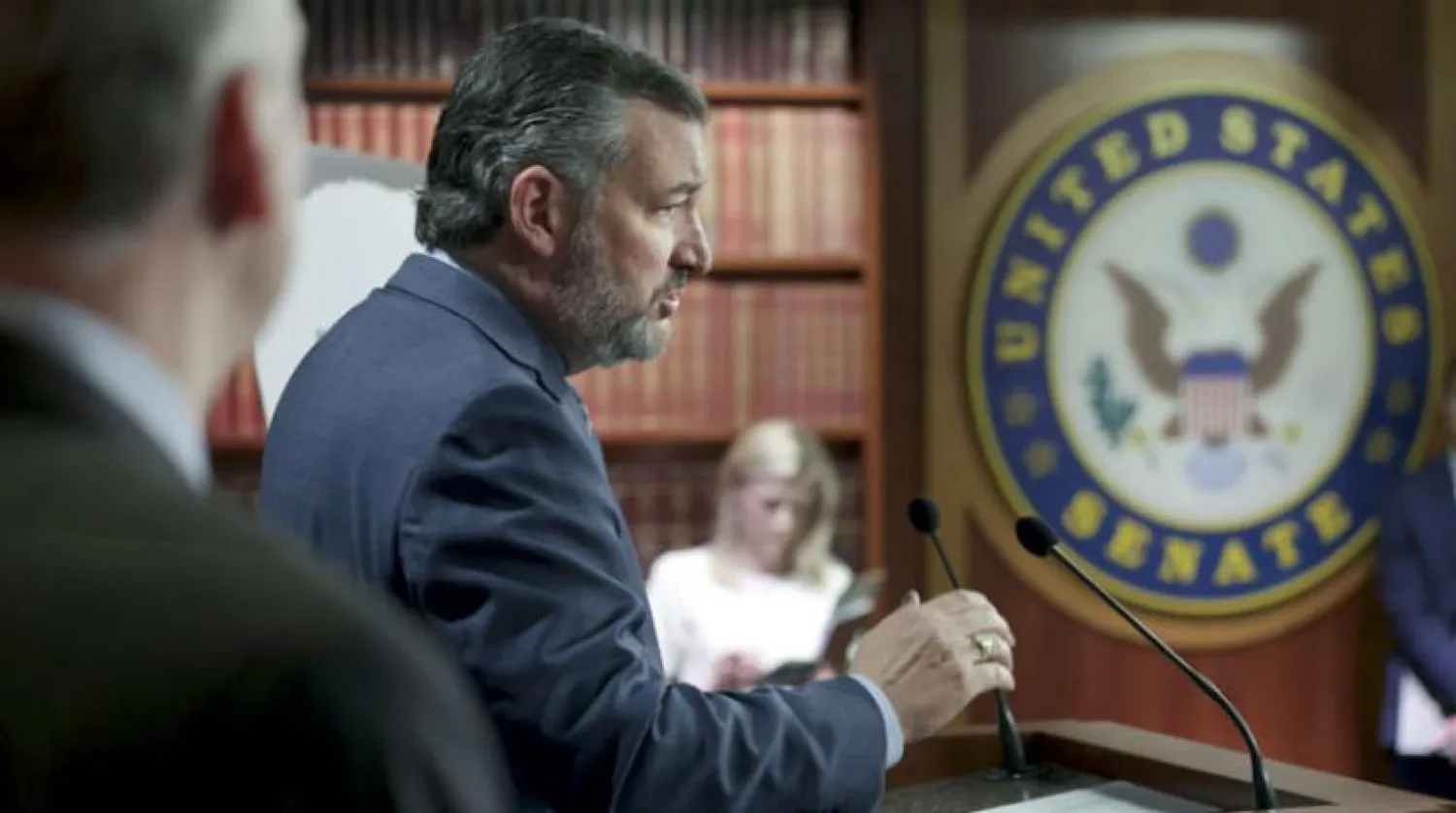
Congress Fires Its Warning Shot on Iran Nuclear Deal

Senator Ted Cruz during a press conference at the Capitol Hill (AFP)
TT

Congress Fires Its Warning Shot on Iran Nuclear Deal

Senator Ted Cruz during a press conference at the Capitol Hill (AFP)

The US Congress fired a warning shot at the US administration's efforts to return to the nuclear agreement with Iran.

A total of 16 Democrats voted with almost all Republicans to approve Sen. James Lankford's motion, easily clearing the 60-vote threshold to reach 62 senators voting that the US should not lift sanctions on Iran's Revolutionary Guard Corps (IRGC).

Lankford said the Senate sent a clear message "tonight that we do not want the United States to make a nuclear deal with Iran that ignores their past behavior and present intentions."

While Lankford's proposal is non-binding, the vote alters the administration, especially since votes came from the US president's party, reflecting growing opposition to its efforts to revive the 2015 nuclear agreement.

The group of "yes" votes included Majority Leader Chuck Schumer, who opposed the 2015 nuclear deal, clearly indicating their dissatisfaction with the progress of the negotiations.

The lawmakers' statements show that they have had it with the administration's insistence on moving forward with the agreement without addressing Iran's destabilizing activities in the region and the White House's willingness to delist the IRGC.

Some Democrats, who had previously refrained from publicly criticizing Biden, are warning him against taking such a step.

Lankford urged his colleagues to vote with the bill, saying that this proposal deals with Iran's terrorist activities and requests to remove the IRGC from terrorist lists during negotiations with the Biden administration.

"The IRGC was attacking our troops in Iraq and facilitating their death," he indicated.

Senator Chris Coons, a top Biden ally, supported the motion to encourage the administration's negotiations to "push for the strongest possible deal that addresses Iran's nuclear weapons program and many other malign activities."

The senators approved another proposal made by Senator Ted Cruz, stressing the need to maintain terrorism-related sanctions on the Central Bank of Iran and the Revolutionary Guards.

The proposal, which 86 members supported, considers maintaining these sanctions necessary to limit cooperation between Iran and China and necessitates submitting a report to the Congress detailing the nature of the collaboration in the fields of energy, infrastructure, economy, finance, and the diplomatic, military, and banking sectors.

"The Biden administration is negotiating to lift terrorism sanctions on the Revolutionary Guards and the Central Bank of Iran," Cruz said while putting the bill to a vote, adding that the "IRGC is responsible for murdering over 600 servicemen and women. The IRGC is actively trying to murder the former Secretary of State and the former security advisor."

Then he concluded, addressing the senators: "If you support terrorism sanctions on the IRGC, you should vote yes, and if you want to lift those sanctions, you should vote no."

Despite the growing opposition in Congress to the administration's efforts to return to the nuclear agreement, lawmakers know that the White House will not seek congressional approval of the deal if it occurs, as did the administration of former President Barack Obama.

However, the administration's position remains oscillating between the possibility of an agreement and other options without specifying them.

State Department spokesman Ned Price said the United States is now preparing equally for both a scenario where there is a mutual return to compliance with Iran on a nuclear deal and one in which there is not an agreement.

"Because a mutual return to compliance with the JCPOA is very much an uncertain proposition, we are now preparing equally for either scenario," Price said in a briefing.

A senior Israeli official told the Axios website that Israel and the US are discussing ways to put more pressure on Iran in a scenario where there is no return to the 2015 nuclear deal soon.

He indicated that Israeli national security adviser Eyal Hulata, his US counterpart Jake Sullivan and other senior officials met at the White House last week. The talks primarily focused on Iran, including preparation for a possible reality in which there is no return to the nuclear deal.

The two national security advisers discussed how to do this without pushing Iran to escalate its nuclear program and enrich uranium to 90 percent purity, the level needed to produce a nuclear bomb.


Le Pen Says France Will No Longer Aid Ukraine ‘Financially’ if Elected

Marine Le Pen (C), the far-right National Rally (RN) party's candidate for the 2027 French presidential election, visits the "Made in France" fair at the Porte de Versailles exhibition center in Paris, France, 13 November 2026. (EPA)
TT

Le Pen Says France Will No Longer Aid Ukraine ‘Financially’ if Elected

Marine Le Pen (C), the far-right National Rally (RN) party's candidate for the 2027 French presidential election, visits the "Made in France" fair at the Porte de Versailles exhibition center in Paris, France, 13 November 2026. (EPA)

Marine Le Pen on Monday said that France would provide no further financial aid to Ukraine if she is elected president next year, after a meeting with Kyiv's ambassador in Paris.

"The state of France's public finances would no longer allow the country to provide financial assistance to Ukraine in the coming months," Le Pen said in a statement, while insisting France would honor existing commitments, including toward a 90-billion-euro ($100-billion) European Union loan.

Le Pen is currently ahead in polls in the race to succeed President Emmanuel Macron next year, as the war sparked by Russia's 2022 full-scale invasion of Ukraine grinds towards its fifth anniversary.

She has faced criticism over past links to Russia, which included a 2017 meeting in the Kremlin with President Vladimir Putin and her party taking a loan from a Russian bank that it paid off in full in 2023.

But she has opposed the invasion and, at her talks in Paris with Ukrainian ambassador Vadym Omelchenko, Le Pen made clear her "unwavering support for Ukraine since the beginning of the conflict".

The statement said the talks -- the first such between Le Pen and the Ukrainian ambassador -- were "cordial".

While financial aid would be cut, Le Pen told the ambassador that "France would continue to support Ukraine through donations of equipment, humanitarian aid and much more active diplomacy".

The statement said there was a "frank discussion" on the future of the conflict, with Le Pen stressing that "the pursuit of peace -- though a difficult goal to achieve -- must remain a priority for all".

She also asked the ambassador to tell President Volodymyr Zelensky she is ready to meet in "either Paris or Brussels". However, there was no mention of the candidate making the journey to Kyiv after Zelensky invited her to visit the Ukrainian capital.

Le Pen's opponents have expressed alarm that by emphasizing the importance of ending the war swiftly, she could force Ukraine to capitulate on unfavorable terms.

"If Russia imposes its will on a European nation through brutality, all of Europe is weakened," Macron wrote on Facebook at the weekend.

Taking aim at Le Pen, he said: "Let us be clear: those who seek to limit the resources available to Ukraine are, in effect, pushing for an unjust peace -- one that would leave Ukraine permanently vulnerable, and, by extension, leave Europe vulnerable as well."


Trump Says He Might Meet with North Korea’s Kim Jong Un in China

US President Donald Trump and North Korean leader Kim Jong Un shake hands before their one-on-one chat during the second US-North Korea summit at the Metropole Hotel in Hanoi, Vietnam February 27, 2019. (Reuters)
TT

Trump Says He Might Meet with North Korea’s Kim Jong Un in China

US President Donald Trump and North Korean leader Kim Jong Un shake hands before their one-on-one chat during the second US-North Korea summit at the Metropole Hotel in Hanoi, Vietnam February 27, 2019. (Reuters)

US President Donald Trump said on Monday he might meet with North Korean leader Kim Jong Un in China this week, an announcement that could dramatically reshape his upcoming trip through East Asia if it occurs.

The president, who met the North Korean leader several times during his 2017-2021 term, including once in the Korean Demilitarized Zone, has previously expressed ‌interest in ‌another meeting during his current term. Senior ‌US ⁠officials, however, have previously ⁠said he has no immediate plans to do so.

Moreover, Trump has repeatedly previewed meetings with Kim that never took place, including during a trip to Asia last year. North Korea, whose mission to the United Nations did not immediately respond to a ⁠request for comment, has publicly indicated it ‌has no intention of ‌meeting with the US president at this time.

Trump told reporters ‌while departing the White House en route to ‌the Philippines and China that any meeting would occur in China, and that the North Korean leader's presence was ultimately up to Chinese President Xi Jinping.

"(Xi) was here a ‌month ago, and we're also going to meet with (Russian) President Putin, and we ⁠may ⁠meet with Kim Jong Un also," Trump said.

"So that'll be good. We have a chance to accomplish a lot."

Trump has indicated he will meet with Putin and Xi during his trip, but US officials and analysts have played down the possibility of a meaningful agreement emerging from any trilateral sit-down.

Among the possible topics of conversation, Trump and others have said, are Russia's invasion of Ukraine, counterproliferation and the war in Iran.


Third US Aircraft Carrier Arrives in Middle East

This US Navy handout photograph released by US Naval Forces Central Command on November 4, 2026, shows the Nimitz-class aircraft carrier USS Theodore Roosevelt (CVN 71) sails alongside Royal Australian Navy Supply-class replenishment oiler HMAS Stalwart (A304). (AFP / NAVCENT Public Affairs / US Navy)
TT

Third US Aircraft Carrier Arrives in Middle East

This US Navy handout photograph released by US Naval Forces Central Command on November 4, 2026, shows the Nimitz-class aircraft carrier USS Theodore Roosevelt (CVN 71) sails alongside Royal Australian Navy Supply-class replenishment oiler HMAS Stalwart (A304). (AFP / NAVCENT Public Affairs / US Navy)

The USS Theodore Roosevelt aircraft carrier arrived in the Middle East on Sunday, media reports said, bringing the number of American carrier strike groups in the region to three.

The deployment, which was reported by the National News and Axios journalist Barak Ravid, comes as fighting reignites in the region, with Iran claiming a drone attack on Bahrain on Sunday, ending a lull in strikes in the war.

Iran also fired drones at Bahrain on Friday -- the first strikes since September against countries in the energy-rich Gulf, which has been targeted several times in the conflict that erupted in February.

US President Donald Trump plans to discuss the war at a trilateral meeting with his Chinese and Russian counterparts Xi Jinping and Vladimir Putin this week, an official said Friday.

Months of diplomacy have failed to resolve the war, which began with US-Israeli strikes that killed Iran's supreme leader Ali Khamenei.