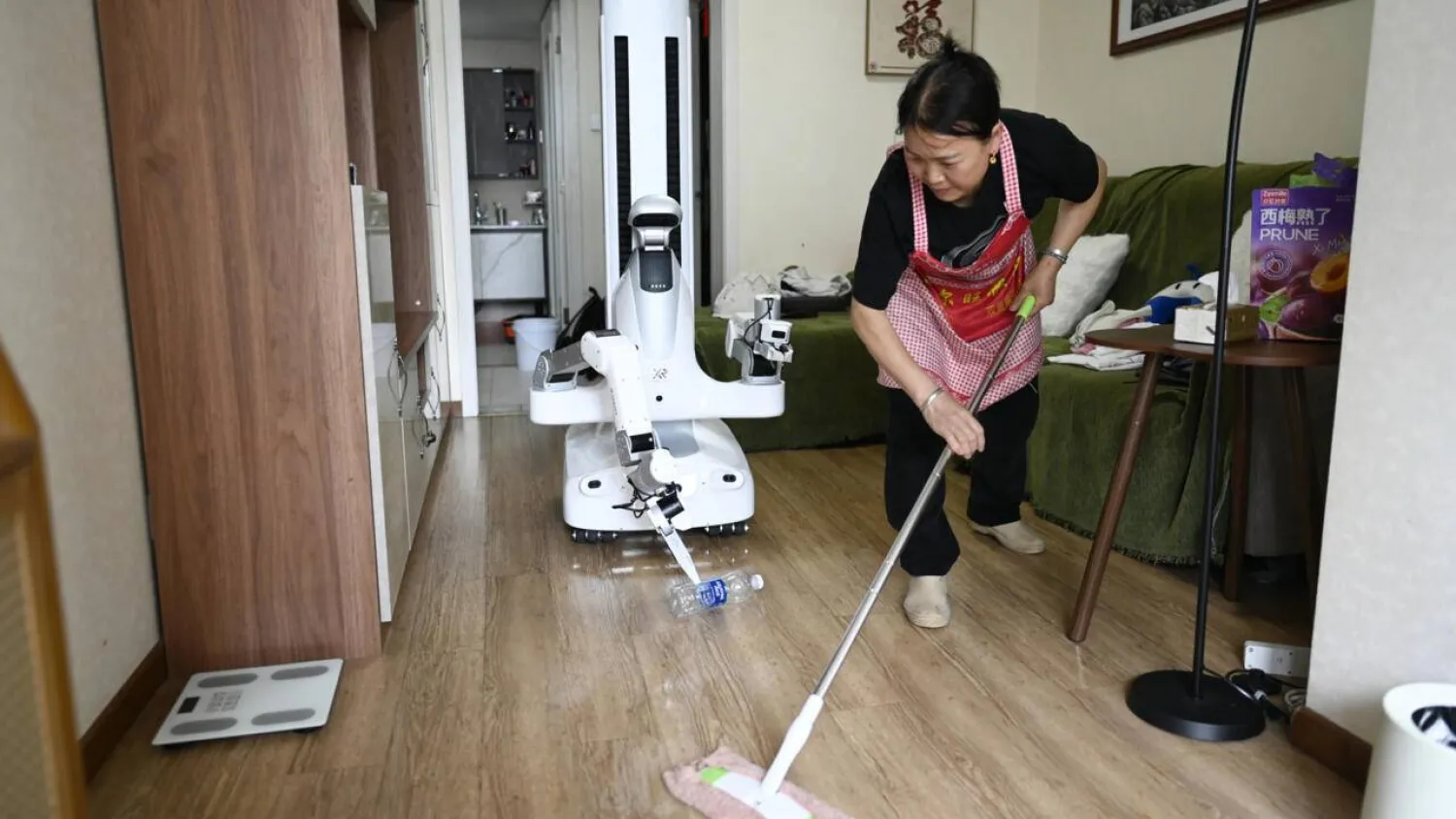
Beijing cleaner Lin Meiqiong found her work a little easier the day she was paired with an unlikely new colleague -- a tall, wheeled robot with AI-powered tidying skills.
The 56-year-old and her white-and-silver partner, fitted with cameras and two mechanical claws, are part of a new human-robot cleaning service offered by Chinese household help platform 58.com.
It's a baby step towards a future espoused by tech evangelists in which robots increasingly take over manual labor from humans -- though at the moment, such services are largely a data-gathering exercise for companies and a novelty for curious customers.
"It's definitely different," Lin told AFP in between cleaning the kitchen and wiping down windows.
"I used to have to do everything myself," she said. "It's reduced the workload a bit."
The cleaning service, a collaboration between 58.com and Chinese robotics company X Square, costs 149 yuan ($22) for three hours and is available in Beijing and tech hub Shenzhen.
Helped into the apartment by an X Square engineer, the AI-operated Quanta X1 Pro robot uses its cameras to identify areas it could spruce up.
As Lin scrubbed the floor on her knees, it picked up rubbish and folded clothes strewn across a sofa.
Grasping a pair of dark grey trousers, it raised its upper body to stretch the fabric taut, before laying it flat and arranging it into neat halves.
The process took several minutes and resembled a child learning to fold clothes for the first time.
Future iterations of the robot will respond to voice commands and even be able to chat, said the engineer, Hu Bowen.
- 'Better than a lab' -
Around 200 households have booked the service since it was rolled out in March.
Tan Pei, who works in advertising and booked the robot to clean her Beijing flat, said she had chosen the service because she was interested to "see what it could do".
"Even though it's not that perfect, there are still parts of it that surprised me," such as folding a pair of trousers "quite well", she said.
China's robots have wowed audiences with fluid dancing and set-piece martial arts displays onstage, but their application and performance in real-life settings remains limited.
For companies like X Square, the logic of launching an imperfect service lies in data collection for so-called embodied artificial intelligence.
Unlike large language models trained on vast quantities of internet content, robots lack comparable real-world datasets.
"We don't have a robot internet yet," Christoforos Mavrogiannis from the University of Michigan told AFP.
"It is much more informative to put the robot out there and study what happens than staying forever in the lab."
X Square engineer Hu said he sends his robots to work in a "completely unfamiliar environment".
"That is very challenging, but this unfamiliar data is also very helpful for the robot's growth."
As investment into embodied AI booms, similar trials in China include robots directing traffic in cities like Hangzhou or working on factory floors.
On the domestic help front, firm GigaAI also plans to deploy 100 humanoid robots into households in central Wuhan this autumn for free home-service trials.
Investors have poured more than 57.7 billion yuan ($8.5 billion) into China's embodied AI industry so far this year, already soaring past the total for last year as a whole, according to business database ITjuzi.
- 'Very elementary stage' -
But a myriad of hurdles stand in the way of widespread deployment.
As the Quanta X1 Pro's clothes folding demonstrated, robots still can't match human dexterity.
"Even though many companies are working on building better hands and building autonomy for hands, we don't have that yet," the University of Michigan's Mavrogiannis said.
There are multiple regulatory issues even once the physical capability is there.
Privacy will become a big issue, as robots would have access to huge amounts of personal data.
"We don't know where that data is going, where it's located... who is looking at that information," said Valeria Alessandra Macalupu Chira from Queensland University of Technology.
The safety of clients and their homes is another unresolved issue.
"I think we are still at a very elementary stage," said Yang Jianfei from Singapore's Nanyang Technological University.
Robots currently require supervision by humans who can activate emergency stop functions, he noted, and there are not yet recognized industry-wide safety standards.
Experts agree broad adoption seems a long way off.
Asked whether she thought robots would revolutionize her industry, cleaner Lin did not seem too concerned.
"Compared with people, it's obviously still not quite there," she said. "After all, it's a robot."