


Russia Shells Ukraine's Odessa as US Pledges Fresh Arms for Kyiv

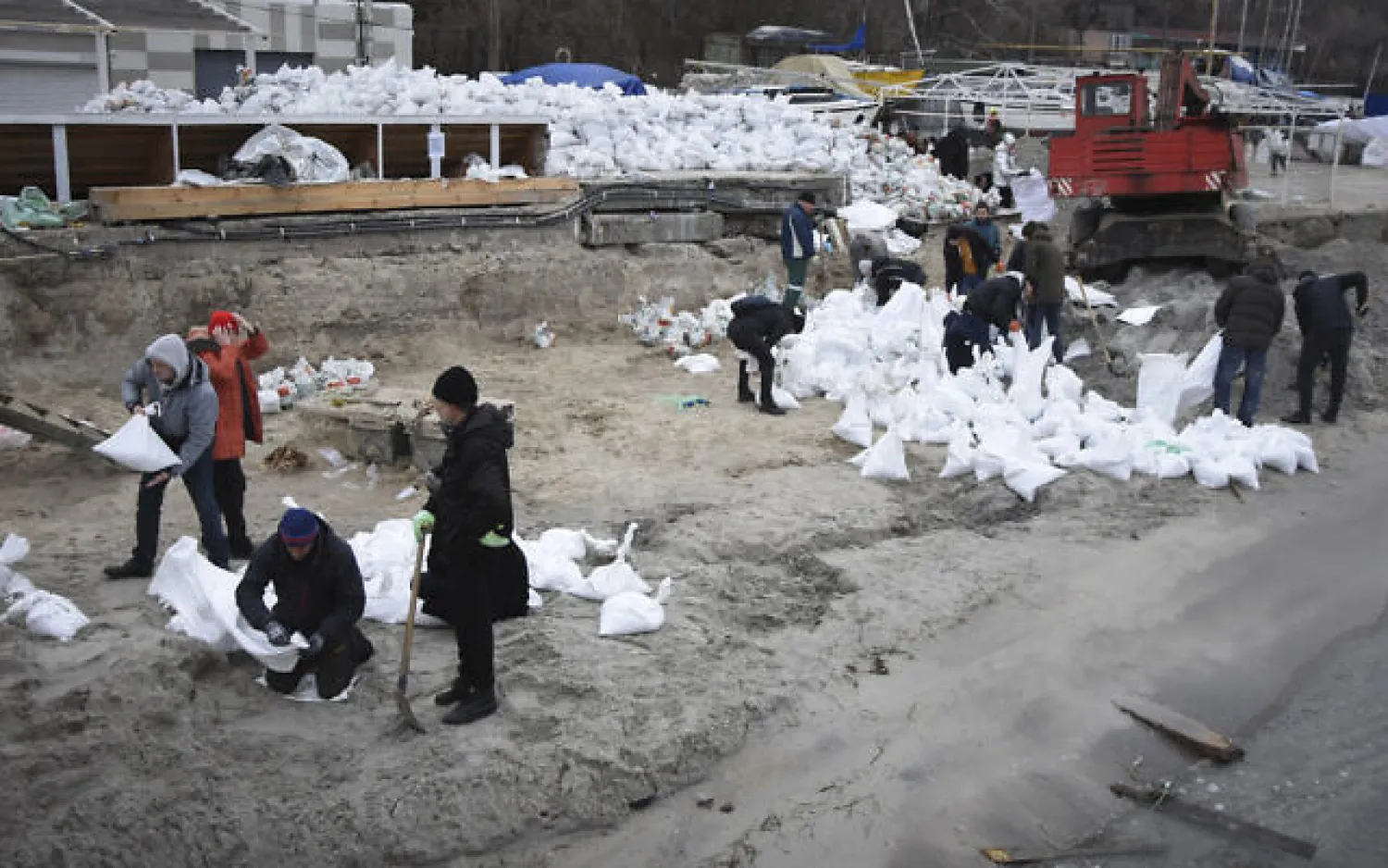
Volunteers fill sandbags to build barricades in Odesa, Ukraine, March 5, 2022. (AP Photo/Max Pshybyshevsky)
TT

Russia Shells Ukraine's Odessa as US Pledges Fresh Arms for Kyiv

Volunteers fill sandbags to build barricades in Odesa, Ukraine, March 5, 2022. (AP Photo/Max Pshybyshevsky)

Russian forces intensified their fight in Ukraine's east and fired missiles over the port city of Odessa, as President Joe Biden signed a law speeding up arms deliveries to Kyiv.

The southern city was hit by a series of missiles Monday, destroying buildings, setting ablaze a shopping center and killing one person, its city council said, just hours after a visit by European Council President Charles Michel, said AFP.

As Russia stepped up its fight to seize Ukraine's east, US President Joe Biden resurrected a World War II measure to aid Kyiv, opening the spigots on artillery, anti-aircraft missiles, anti-tank weapons and other powerful Western materiel.

The United States has sent some $4 billion in military aid to Ukraine already but "caving to aggression is even more costly," Biden said as he signed the act, passed with unusual bipartisan support.

Missiles earlier rumbled through Moscow's Red Square as Russia's President Vladimir Putin sought to channel national pride on the anniversary of the defeat of Nazi Germany into support for a war that has killed thousands and sent millions into exile.

On the ground in Ukraine, the governor of Lugansk reported "very serious battles" in the frontline areas of Bilogorivka and Rubizhne.

An AFP team reported seeing columns of trucks filled with soldiers and heavy equipment move down the main road leading away from the city of Severodonetsk -- one of its last eastern strongholds against Russia -- suggesting Ukraine was pulling back from some parts of the front.

In the devastated southern port of Mariupol, pro-Russian separatists feted Victory Day, with leader Denis Pushilin and residents carried a giant black and orange ribbon of Saint George -- a symbol of WWII celebrations in Russia -- through a city that has seen some of the heaviest fighting since the invasion on February 24.

Full control of Mariupol would allow Moscow to create a land bridge between the Crimean peninsula, which it annexed in 2014, and eastern regions run by pro-Russian separatists.

Some have speculated that Putin was seeking to achieve that goal in time for Victory Day, but a small contingent of depleted Ukrainian forces continued their defense of a final bastion at the Azovstal steelworks.

- 'I bow to Putin' -
In his speech in Moscow, the Russian leader blamed the West and Ukraine for the two-and-a-half-month conflict, telling the parade that his country faced an "absolutely unacceptable threat" and warning against the "horror of a global war".

"You are fighting for the Motherland, for its future, so that no one forgets the lessons of the Second World War," he said.

The celebration in Red Square also featured some 11,000 troops and more than 130 military vehicles, although a planned military flypast was cancelled.

"Putin conducts politics so well, well done to him. He makes sure that our boys don't die, that there is as little blood as possible. I bow down to him," added Taisiya Chepurina, 81, whose husband fought in the Battle of Stalingrad in 1943.

But Ukrainians and Western powers accused Putin of exploiting the anniversary, with protesters in Warsaw tossing blood-red paint on the Russian ambassador, chanting "fascists!" and hoisting a Ukrainian flag, as he visited a cemetery.

Ukrainian leader Volodymyr Zelensky also invoked the ghosts of World War II, chiding Russia for claiming sole credit for winning.

"We will not allow anyone to annex this victory. We will not allow it to be appropriated," he said in a video speech shortly before Putin spoke.

In Kyiv the commemoration day was largely shunned as life slowly returned to normal, weeks after fierce fighting raged in its suburbs.

- Camps in the east? -
Still facing the brunt of the fighting are Ukraine's civilians, with the country reeling from a Russian attack on a school over the weekend that killed 60 people.

And the Pentagon said Monday it has seen indications that those caught up in Russia's invasion are being forcibly removed from their homeland.

"I can't speak to how many camps or what they look like," Pentagon spokesman John Kirby told reporters when asked about statements from Kyiv that some 1.2 million Ukrainians were being sent across the border and placed in camps.

"But we do have indications that Ukrainians are being taken against their will into Russia," Kirby said. He called these actions "unconscionable" and "not the behaviour of a responsible power."

The deportation of Ukrainians from their own nation -- often to isolated or economically depressed regions of Russia, according to Kyiv -- is another indication that Putin "simply won't accept and respect Ukrainian sovereignty," he added.

-Progress towards embargo -
In another step forward in building pressure on Russia, EU chief Ursula von der Leyen said she made "progress" on a proposed Russian oil embargo during talks with Hungarian Prime Minister Viktor Orban.

The populist Orban is one of Putin's closest friends in Europe and had held up the bloc's attempt to phase out Russian oil -- one of the most painful measures yet taken by the West -- as he pointed to economic consequences in landlocked Hungary.

But France's President Emmanuel Macron poured cold water on Ukraine's oft-repeated desire for fast-track European Union membership, saying it would take "decades".

Macron, however, suggested building a broader political bloc that could also include Britain.

One ray of hope has come from prisoner swaps.

Ukrainian soldier Glib Stryzhko, 25, was gravely wounded and captured in Mariupol in April but finally released after a secret phone call to his mother.

"After we were loaded onto the bus waiting for us, the driver said: 'Guys, you can breathe. You are home now,'" Stryzhko told AFP from his hospital bed in Zaporizhzhia.




US Vice President Vance Heads to Armenia, Azerbaijan to Push Peace, Trade

US Vice President JD Vance speaks during the Critical Minerals Ministerial at the State Department in Washington, DC, US, February 4, 2026. (Reuters)
TT

US Vice President Vance Heads to Armenia, Azerbaijan to Push Peace, Trade

US Vice President JD Vance speaks during the Critical Minerals Ministerial at the State Department in Washington, DC, US, February 4, 2026. (Reuters)

US Vice President JD Vance will visit Armenia and Azerbaijan this week to push a Washington-brokered peace agreement that could transform energy and trade routes in the strategic South Caucasus region.

His two-day trip to Armenia, which begins later on Monday, comes just six months after the Armenian and Azerbaijani leaders signed an agreement at the White House seen as the first step towards peace after nearly 40 years of war.

Vance, the first US vice president to visit Armenia, is seeking to advance the Trump Route for International Peace and Prosperity (TRIPP), a proposed 43-kilometre (27-mile) corridor that would run across southern Armenia and give Azerbaijan a direct route to its exclave ‌of Nakhchivan ‌and in turn to Türkiye, Baku's close ally.

"Vance's visit should ‌serve ⁠to reaffirm the ‌US's commitment to seeing the Trump Route through," said Joshua Kucera, a senior South Caucasus analyst at Crisis Group.

"In a region like the Caucasus, even a small amount of attention from the US can make a significant impact."

The Armenian government said on Monday that Vance would hold talks with Prime Minister Nikol Pashinyan and that both men would then make statements, without elaborating.

Vance will then visit Azerbaijan on Wednesday and Thursday, the White House has said.

Under the agreement signed last year, ⁠a private US firm, the TRIPP Development Company, has been granted exclusive rights to develop the proposed corridor, with Yerevan ‌retaining full sovereignty over its borders, customs, taxation and security.

The ‍route would better connect Asia to Europe ‍while - crucially for Washington - bypassing Russia and Iran at a time when Western countries are ‍keen on diversifying energy and trade routes away from Russia due to its war in Ukraine.

Russia has traditionally viewed the South Caucasus as part of its sphere of influence but has seen its clout there diminish as it is distracted by the war in Ukraine.

Securing US access to supplies of critical minerals is also likely to be a key focus of Vance's visit.

TRIPP could prove a key transit corridor for the vast mineral wealth of ⁠Central Asia - including uranium, copper, gold and rare earths - to Western markets.

CLOSED BORDERS, BITTER RIVALS

In Soviet times the South Caucasus was criss-crossed by railways and oil pipelines until a series of wars beginning in the 1980s disrupted energy routes and shuttered the border between Armenia and Türkiye, Azerbaijan's key regional ally.

Armenia and Azerbaijan were locked in bitter conflict for nearly four decades, primarily over the mountainous region of Nagorno-Karabakh, an internationally recognized part of Azerbaijan that broke away from Baku's control as the Soviet Union fell apart in 1991.

Azerbaijan and Armenia fought two wars over Karabakh before Baku finally took it back in 2023. Karabakh's entire ethnic Armenian population of around 100,000 people fled to Armenia. The two neighbors have made progress in recent months on normalizing relations, including restarting ‌some energy shipments.

But major hurdles remain to full and lasting peace, including a demand by Azerbaijan that Armenia change its constitution to remove what Baku says contains implicit claims on Azerbaijani territory.


Adviser to Iran's Supreme Leader to Visit Oman on Tuesday

FILED - 06 February 2009, Bavaria, Munich: Ali Larijani, then chairman of the Iranian parliament, speaks at the 45th Munich Security Conference in Munich. Photo: Andreas Gebert/dpa
TT

Adviser to Iran's Supreme Leader to Visit Oman on Tuesday

FILED - 06 February 2009, Bavaria, Munich: Ali Larijani, then chairman of the Iranian parliament, speaks at the 45th Munich Security Conference in Munich. Photo: Andreas Gebert/dpa

Ali Larijani, an adviser to Iran's Supreme Leader Ali Khamenei, will visit Oman accompanied by a delegation on Tuesday, the ‌semi-official Tasnim news ‌agency reported ‌on ⁠Monday.

American and ‌Iranian diplomats held indirect talks in Oman last week, aimed at reviving diplomacy amid a US ⁠naval buildup near Iran and ‌Tehran's vows ‍of a ‍harsh response if ‍attacked.

"During this trip, (Larijani) will meet with high-ranking officials of the Sultanate of Oman and discuss the latest regional ⁠and international developments and bilateral cooperation at various levels," Tasnim said.

The date and venue of the next round of talks are yet to be announced.


Russia’s Lavrov Sees No ‘Bright Future’ for Economic Ties with US

06 February 2026, Russia, Moscow: Russian Foreign Minister Sergei Lavrov gives a press conference following a meeting with Organization for Security and Cooperation in Europe (OSCE) Chairperson-in-Office Ignazio Cassis, head of Switzerland's Federal Department of Foreign Affairs, Federal Councilor of the Swiss Confederation, and OSCE Secretary General Feridun Sinirlioglu at the Russian Foreign Ministry's Reception House. (Sofya Sandurskaya/TASS via ZUMA Press/dpa)
TT

Russia’s Lavrov Sees No ‘Bright Future’ for Economic Ties with US

06 February 2026, Russia, Moscow: Russian Foreign Minister Sergei Lavrov gives a press conference following a meeting with Organization for Security and Cooperation in Europe (OSCE) Chairperson-in-Office Ignazio Cassis, head of Switzerland's Federal Department of Foreign Affairs, Federal Councilor of the Swiss Confederation, and OSCE Secretary General Feridun Sinirlioglu at the Russian Foreign Ministry's Reception House. (Sofya Sandurskaya/TASS via ZUMA Press/dpa)

Russia remains open for cooperation with the United States but is not hopeful about economic ties despite Washington's ongoing efforts to end the Ukraine war, Russian Foreign Minister Sergei Lavrov said in an interview published on Monday.

Speaking to Russia-based media outlet TV BRICS, ‌Lavrov cited what ‌he called the ‌United ⁠States' declared ‌aim of "economic dominance".

"We also don't see any bright future in the economic sphere," Lavrov said.

Russian officials, including envoy Kirill Dmitriev, have previously spoken of the prospects for a major restoration ⁠of economic relations with the United States as ‌part of any eventual Ukraine ‍peace settlement.

But although ‍President Donald Trump has also ‍spoken of reviving economic cooperation with Moscow and has hosted his Russian counterpart Vladimir Putin on US soil since returning to the White House, he has imposed further onerous sanctions on Russia's vital ⁠energy sector.

Lavrov also cited Trump's hostility to the BRICS bloc, which includes Russia, China, India, Brazil and other major developing economies.

"The Americans themselves create artificial obstacles along this path (towards BRICS integration)," he said.

"We are simply forced to seek additional, protected ways to develop our financial, economic, logistical and ‌other projects with the BRICS countries."