

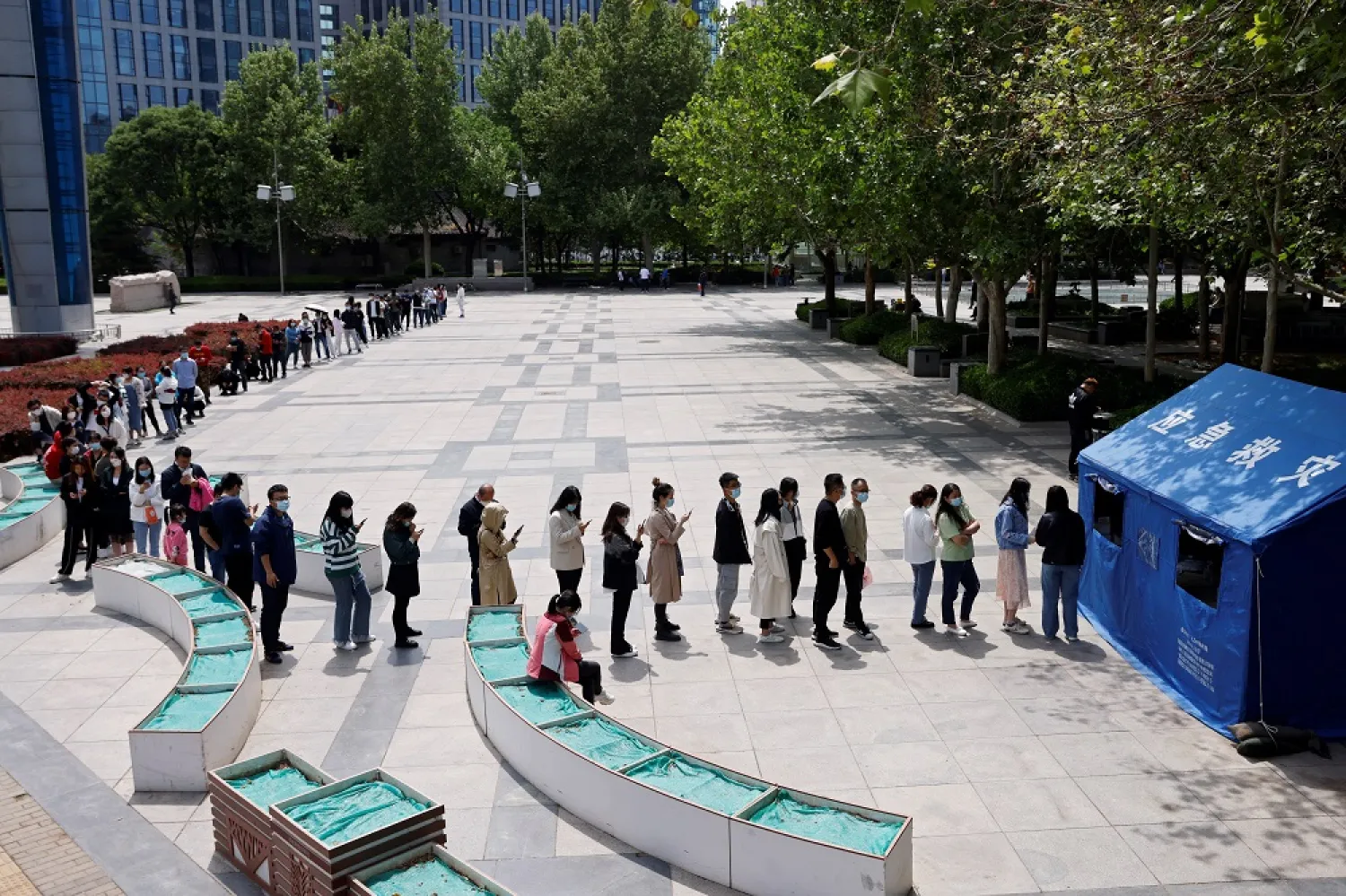

Pandemic Gets Tougher to Track as COVID Testing Plunges

People line up at a makeshift nucleic acid testing site to get tested for the coronavirus disease (COVID-19) in Haidian district of Beijing, China May 9, 2022. (Reuters)
TT

Pandemic Gets Tougher to Track as COVID Testing Plunges

People line up at a makeshift nucleic acid testing site to get tested for the coronavirus disease (COVID-19) in Haidian district of Beijing, China May 9, 2022. (Reuters)

Testing for COVID-19 has plummeted across the globe, making it much tougher for scientists to track the course of the pandemic and spot new, worrisome viral mutants as they emerge and spread.

Experts say testing has dropped by 70 to 90% worldwide from the first to the second quarter of this year - the opposite of what they say should be happening with new omicron variants on the rise in places such as the United States and South Africa.

"We’re not testing anywhere near where we might need to," said Dr. Krishna Udayakumar, who directs the Duke Global Health Innovation Center at Duke University. "We need the ability to ramp up testing as we’re seeing the emergence of new waves or surges to track what’s happening" and respond.

Reported daily cases in the US, for example, are averaging 73,633, up more than 40% over the past two weeks, according to data compiled by Johns Hopkins University. But that is a vast undercount because of the testing downturn and the fact tests are being taken at home and not reported to health departments. An influential modeling group at the University of Washington in Seattle estimates that only 13% of cases are being reported to health authorities in the US - which would mean more than a half million new infections every day.

The drop in testing is global but the overall rates are especially inadequate in the developing world, Udayakumar said. The number of tests per 1,000 people in high income countries is around 96 times higher than it is in low income countries, according to the Geneva-based public health nonprofit FIND.

What’s driving the drop? Experts point to COVID fatigue, a lull in cases after the first omicron wave and a sense among some residents of low-income countries that there’s no reason to test because they lack access to antiviral medications.

At a recent press briefing by the World Health Organization, FIND CEO Dr. Bill Rodriguez called testing "the first casualty of a global decision to let down our guard" and said "we’re becoming blind to what is happening with the virus."

Testing, genomic sequencing and delving into case spikes can lead to the discovery of new variants. New York state health officials found the super contagious BA.2.12.1 variant after investigating higher-than-average case rates in the central part of the state.

Going forward, "we’re just not going to see the new variants emerge the way we saw previous variants emerge," Rodriquez told The Associated Press.

Testing increases as infections rise and people develop symptoms - and it falls along with lulls in new cases. Testing is rising again in the US along with the recent surge.

But experts are concerned about the size of the drop after the first omicron surge, the low overall levels of testing globally, and the inability to track cases reliably. While home tests are convenient, only tests sent to labs can be used to detect variants. If fewer tests are being done, and fewer of those tests are processed in labs, fewer positive samples are available for sequencing.

Also, home test results are largely invisible to tracking systems.

Mara Aspinall, managing director of an Arizona-based consulting company that tracks COVID-19 testing trends, said there’s at least four times more home testing than PCR testing, and "we are getting essentially zero data from the testing that’s happening at home."

That’s because there’s no uniform mechanism for people to report results to understaffed local health departments. The CDC strongly encourages people to tell their doctors, who in most places must report COVID-19 diagnoses to public health authorities.

Generally, though, results from home tests fall under the radar.

Reva Seville, a 36-year-old Los Angeles parent, tested herself at home this week after she began feeling symptoms such as a scratchy throat, coughing and congestion. After the results came back positive, she tested twice more just to be sure. But her symptoms were mild, so she didn't plan to go to the doctor or report her results to anyone.

Beth Barton of Washington, Missouri, who works in construction, said she’s taken about 10 home tests, either before visiting her parents or when she’s had symptoms she thought might be COVID-19. All came back negative. She shared the results with the people around her but didn’t know how to report them.

"There should be a whole system for that," said Barton, 42. "We as a society don’t know how to gauge where we’re at."

Aspinall said one potential solution would be to use technology like scanning a QR code to report home test results confidentiality.

Another way to keep better track of the pandemic, experts said, is to bolster other types of surveillance, such as wastewater monitoring and collecting hospitalization data. But those have their own drawbacks. Wastewater surveillance remains a patchwork that doesn’t cover all areas, and hospitalization trends lag behind cases.

Udayakumar said scientists across the world must use all the tracking methods at their disposal to keep up with the virus, and will need to do so for months or even years.

At the same time, he said, steps must be taken to boost testing in lower-income countries. Demand for tests would rise if access to antivirals were improved in these places, he said. And one of the best ways to increase testing is to integrate it into existing health services, said Wadzanayi Muchenje, who leads health and strategic partnerships in Africa for The Rockefeller Foundation.

Georges Benjamin, executive director of the American Public Health Association, said there will come a point when the world stops widespread testing for COVID-19 - but that day isn’t here yet.

With the pandemic lingering and virus still unpredictable, "it’s not acceptable for us to only be concerned about individual health,” he said. "We have to worry about the population."



Russia Releases Video Footage to Challenge Kyiv Over Alleged Attack

A Russian service member stands next to the remains of a drone, which, according to the Russian Defense Ministry, was downed during the repelling of an alleged Ukrainian attack on the Russian presidential residence in the Novgorod Region, in an unknown location in Russia, in this still image from a video released December 31, 2025. (Russian Defense Ministry/Handout via Reuters)
TT

Russia Releases Video Footage to Challenge Kyiv Over Alleged Attack

A Russian service member stands next to the remains of a drone, which, according to the Russian Defense Ministry, was downed during the repelling of an alleged Ukrainian attack on the Russian presidential residence in the Novgorod Region, in an unknown location in Russia, in this still image from a video released December 31, 2025. (Russian Defense Ministry/Handout via Reuters)

Russia's defense ministry released video footage on Wednesday of what it said was a downed drone at a briefing intended to show Ukraine tried this week to attack a presidential residence and challenge Kyiv's denials that such an attack took place. 

Kyiv says Moscow has produced no evidence to support its allegations and that Russia invented the alleged attack to block progress at talks on ‌ending the war ‌in Ukraine. Officials in several ‌Western ⁠countries have ‌cast doubt on Russia's version of events and questioned whether there was any attack. 

Video footage released by Russia's defense ministry showed a senior officer, Major-General Alexander Romanenkov, setting out details of how Moscow says it believes Ukraine attacked one of President Vladimir Putin's residences in ⁠the Novgorod region. 

Romanenkov said 91 drones had been launched from Ukraine's Sumy ‌and Chernihiv regions in a "thoroughly ‍planned" attack that he said ‍was thwarted by Russian air defenses, caused ‍no damage and injured no one. 

The video released by the ministry included footage of a Russian serviceman standing next to fragments of a device which he said was a downed Ukrainian Chaklun-V drone carrying a 6-kg explosive device which had not detonated. 

The ministry did ⁠not explain how it knew what the device's target was. 

Speaking to Reuters, Ukrainian Foreign Ministry spokesperson Heorhii Tykhyi said the footage was "laughable" and that Kyiv was "absolutely confident that no such attack took place". 

Reuters could not confirm the location and the date of the footage showing fragments of a destroyed device. The model of the destroyed device could not be immediately verified. 

Other footage featured a man, identified as Igor Bolshakov from a ‌village in the Novgorod region, saying he had heard air defense rockets in action. 


China Slams Countries That Criticized Taiwan Drills as 'Irresponsible'

A screen broadcasting news about military drills conducted by China around Taiwan is seen on a street in Beijing, China, 30 December 2025. (EPA)
TT

China Slams Countries That Criticized Taiwan Drills as 'Irresponsible'

A screen broadcasting news about military drills conducted by China around Taiwan is seen on a street in Beijing, China, 30 December 2025. (EPA)

Beijing slammed on Wednesday countries including Japan and Australia for their "irresponsible" criticism of China's military drills in waters around Taiwan.

China launched missiles and deployed dozens of fighter jets, navy ships and coastguard vessels around the island on Monday and Tuesday in live-fire drills.

There has been a chorus of international criticism of China's drills, including from Japan, Australia and European countries.

Japan said Wednesday that China's exercises "increase tensions" across the Taiwan Strait, while Australia's foreign ministry condemned the "destabilizing" military drills.

The European Union on Tuesday said the military activity "endangers international peace and stability".

Beijing on Wednesday hit back at the remarks.

"These countries and institutions are turning a blind eye to the separatist forces in Taiwan attempting to achieve independence through military means," foreign ministry spokesman Lin Jian told reporters at a news briefing.

"Yet, they are making irresponsible criticisms of China's necessary and just actions to defend its national sovereignty and territorial integrity, distorting facts and confusing right and wrong, which is utterly hypocritical."

Lin said Beijing appreciated countries such as Russia, Pakistan and Venezuela expressing their support for China.

"We want to reiterate China's unwavering resolve for safeguarding national sovereignty, security and territorial integrity," he added.

"Any egregious provocative act that crosses the line on the Taiwan issue will be met with a firm counter from China."


Iran Appoints New Central Bank Governor After Record Currency Fall and Mass Protests

A person walks past a sign at a currency exchange, as the value of the Iranian rial drops, in Tehran, Iran, December 30, 2025. Majid Asgaripour/WANA (West Asia News Agency) via Reuters
TT

Iran Appoints New Central Bank Governor After Record Currency Fall and Mass Protests

A person walks past a sign at a currency exchange, as the value of the Iranian rial drops, in Tehran, Iran, December 30, 2025. Majid Asgaripour/WANA (West Asia News Agency) via Reuters

Iran on Wednesday appointed a new governor to the central bank after the former one resigned following a record currency fall against the US dollar that sparked large protests.

The plummeting of the rial, Iran's currency, sparked the largest protests in the country in three years, with rallies that began Sunday and continued until Tuesday.

A report by the official IRNA news agency said President Masoud Pezeshkian’s Cabinet appointed Abdolnasser Hemmati, a former economics minister, as new governor of the Central Bank of Iran. He replaces Mohammad Reza Farzin, who resigned on Monday.

Experts say a 40% inflation rate led to public discontent. The US dollar traded at 1.38 million rials on Wednesday, compared to 430,000 when Farzin took office in 2022.

Many traders and shopkeepers closed their businesses and took to the streets of Tehran and other cities to protest.

The new governor's agenda will included a focus on controlling inflation and strengthening the currency, as well as addressing the mismanagement of banks, the government’s spokeswoman Fatemeh Mohajerani wrote on X.

Hemmati, 68, previously served as minister of economic and financial affairs under Pezeshkian.

In March parliament dismissed Hemmati for alleged mismanagement and accusations his policies hurt the strength of Iran’s rial against hard currencies.

A combination of the currency's rapid depreciation and inflationary pressure has pushed up the prices of food and other daily necessities, adding to strain on household budgets already under pressure due to Western sanctions on Iran over its nuclear program.

Inflation is expected to worsen with a gasoline price change introduced in recent weeks.

Iran’s currency was trading at 32,000 rials to the dollar at the time of the 2015 nuclear accord that lifted international sanctions in exchange for tight controls on Iran’s nuclear program. That deal unraveled after President Donald Trump unilaterally withdrew the United States from it in 2018, during his first term.