Lebanon Holds First Parliament Election since Financial Collapse, Blast

A woman votes during parliamentary elections in Beirut, Lebanon, 15 May 2022. (EPA)
TT

Lebanon Holds First Parliament Election since Financial Collapse, Blast

A woman votes during parliamentary elections in Beirut, Lebanon, 15 May 2022. (EPA)

Lebanese voted on Sunday in the first parliamentary election since the country's economic collapse, with many saying they hoped to deal a blow to ruling politicians they blame for the crisis even if the odds of major change appear slim.

The election is seen as a test of whether the Iran-backed Hezbollah party and its allies can keep their assembly majority amid soaring poverty and anger at parties in power.

Since Lebanon last voted in 2018 it has suffered an economic meltdown that the World Bank says was orchestrated by the ruling class, and a massive explosion at Beirut's port in 2020.

But while analysts believe public anger could help reform-minded candidates win some seats, expectations are low for a big shift in the balance of power, with the sectarian political system skewed in favor of established parties.

"Lebanon deserves better," said Nabil Chaya, 57, voting with his father in Beirut.

"It's not my right, it's my duty - and I think it makes a difference. There's been an awakening by the people. Too little too late? Maybe, but people feel change is necessary."

The meltdown has marked Lebanon's most destabilizing crisis since the 1975-90 civil war, sinking the currency by more than 90%, plunging three-quarters of the population into poverty, and freezing savers out of bank deposits.

In a symptom of the collapse, polling stations across the country suffered power cuts on Sunday.

In southern Lebanon, a political stronghold for the Shiite Hezbollah, Rana Gharib said she had lost her money in the financial collapse, but was still voting for the group.

"We vote for an ideology, not for money," said Gharib, a woman in her thirties who was casting her vote in the village of Yater, crediting Hezbollah for driving Israeli forces from southern Lebanon in 2000.

Fistfights and other disputes disrupted voting in several districts, according to the state-run news agency, with security forces intervening so it could resume. Interior Minister Bassam Mawlawi said incidents remained "at an acceptable level."

Tensions were particularly high between Hezbollah and the Lebanese Forces.

The LF is vehemently opposed to Hezbollah's arsenal of weapons and tried to run Shiite candidates in Hezbollah-dominated areas, although most withdrew before Sunday.

The LF said Hezbollah supporters had attacked their delegates at several polling stations, leaving at least four wounded in the southern district of Jezzine.

A Hezbollah official said the group had no presence in Jezzine and a statement by the party later blamed the LF for starting clashes in other districts.

The last vote in 2018 saw Hezbollah and its allies - including President Michel Aoun's Free Patriotic Movement (FPM), a Christian party - win 71 out of parliament's 128 seats.

Those results pulled Lebanon deeper into the orbit of Iran, distancing it from the Arab world.

Hezbollah has said it expects few changes from the make-up of the current parliament, although its opponents, including the LF, hope to scoop up seats from the FPM.

Adding a note of uncertainty, a boycott by Sunni leader Saad al-Hariri has left a vacuum that both Hezbollah allies and opponents are seeking to fill.

In Hariri's main stronghold in Beirut, residents skipped voting and instead took time out to relax, some going swimming.

Polls closed at 7:00 p.m. (1600 GMT), with voting continuing inside some centers. Unofficial results are due in overnight.

Two hours ahead of polls closing, the interior ministry announced a 32% voter turnout.

By comparison, the expatriate vote which took place last week saw a turnout over 60%. Analysts are already expecting the outcome to face a slew of objections, especially in districts where newcomers are taking on established parties.

"Where competition is fierce and where the electoral threshold is something opposition parties can overcome, we're going to see a lot of disputes," said elections expert Amal Hamdan.

The next parliament must nominate a prime minister to form a cabinet - a process that can take months. Any delay would hold up reforms that are needed to address the crisis and unlock support from the International Monetary Fund and donor states.

Prime Minister Najib Mikati, who clinched a draft IMF deal in April, conditional on reforms, has said he would be ready to return as premier if he was sure of a quick cabinet formation.


UN Experts Urge Israel to Protect West Bank Olive Farmers

Palestinian volunteers douse an olive tree set on fire by Israeli settlers, near the village of Turmus Ayya, north of Ramallah, in the Israeli-occupied West Bank on October 16, 2026.  Ahmad Gharabli, AFP
Palestinian volunteers douse an olive tree set on fire by Israeli settlers, near the village of Turmus Ayya, north of Ramallah, in the Israeli-occupied West Bank on October 16, 2026. Ahmad Gharabli, AFP
TT

UN Experts Urge Israel to Protect West Bank Olive Farmers

Palestinian volunteers douse an olive tree set on fire by Israeli settlers, near the village of Turmus Ayya, north of Ramallah, in the Israeli-occupied West Bank on October 16, 2026.  Ahmad Gharabli, AFP
Palestinian volunteers douse an olive tree set on fire by Israeli settlers, near the village of Turmus Ayya, north of Ramallah, in the Israeli-occupied West Bank on October 16, 2026. Ahmad Gharabli, AFP

UN rights experts on Monday called on Israel to protect Palestinian farmers in the West Bank as settler attacks worsen with the annual olive harvest.

"Palestinian farmers must be protected and able to access their land safely. Yet, year after year, the violence, destruction and restrictions intensify," the experts said in a statement.

"The olive harvest should be a time when farmers can enjoy, in safety and dignity, the food and livelihoods their nature and land provide, not another season of fear, loss, violence and destruction."

The experts urged Israel to ensure that its forces protect Palestinian farmers from settler attacks and refrain from interference with their access to land. They also urged the international community to "exercise maximum pressure to protect Palestinian civilians", reported AFP.

Israel has occupied the West Bank since 1967. About 500,000 Israelis live in the West Bank, alongside three million Palestinians.

Violence is surging in the territory ahead of Israel's bitterly fought October 27 elections. The vote coincides with Palestinians' annual olive harvest which has been repeatedly disrupted by Israeli settlers as Prime Minister Benjamin Netanyahu seeks to shore up his pro-settlement right-wing base.

According to the UN humanitarian agency OCHA, 178 settler attacks related to the 2025 olive harvest were recorded in the West Bank, affecting 88 Palestinian communities.

More than 6,000 trees and saplings were "vandalised", it said -- nearly double the number in 2024 and the highest figure in six years.

"The olive harvest is an essential source of food, income and livelihood for thousands of Palestinian families," the UN experts said.

"Olive trees take years to mature and can sustain families for generations. Their destruction deprives families of far more than a single harvest: it undermines local food systems, cultural practices and ways of life, as well as the right to food and the food sovereignty of Palestinian communities."

The seven signatories to the statement include Sofia Monsalve Suarez, special rapporteur on the right to food; and Francesca Albanese, special rapporteur on human rights in the occupied Palestinian territories.

The special rapporteurs are independent experts mandated by the Human Rights Council. They do not speak for the United Nations itself.


UK Urges Firms Not to Take Part in E1 Settlement Tender or Risk Sanctions

Israeli settlers (foreground) harvesting olives confront a Palestinian family outside the settlement of Alei Zahav, near the Palestinian town of Kafr al-Dik in the Israeli-occupied West Bank, on October 13, 2026. (AFP)
TT

UK Urges Firms Not to Take Part in E1 Settlement Tender or Risk Sanctions

Israeli settlers (foreground) harvesting olives confront a Palestinian family outside the settlement of Alei Zahav, near the Palestinian town of Kafr al-Dik in the Israeli-occupied West Bank, on October 13, 2026. (AFP)

British foreign minister Ed Miliband on Monday urged companies and individuals not to proceed with bids for the E1 West Bank settlement project on Monday, warning those involved in the ‌construction of ‌illegal settlements could face ‌sanctions.

"We ⁠urge businesses and ⁠individuals not to proceed with bids for E1 construction tenders," Miliband said in a statement. "They should be ⁠aware of legal ‌and ‌reputational consequences, including the risk ‌of involving themselves in ‌serious breaches of international law."

The E1 project would bisect the Israeli-occupied West Bank and ‌cut it off from East Jerusalem, fragmenting ⁠the ⁠land Palestinians hope will form the heart of a state.

Many Western states and campaign groups have opposed the project over concerns that it could undermine a future peace deal with the Palestinians.


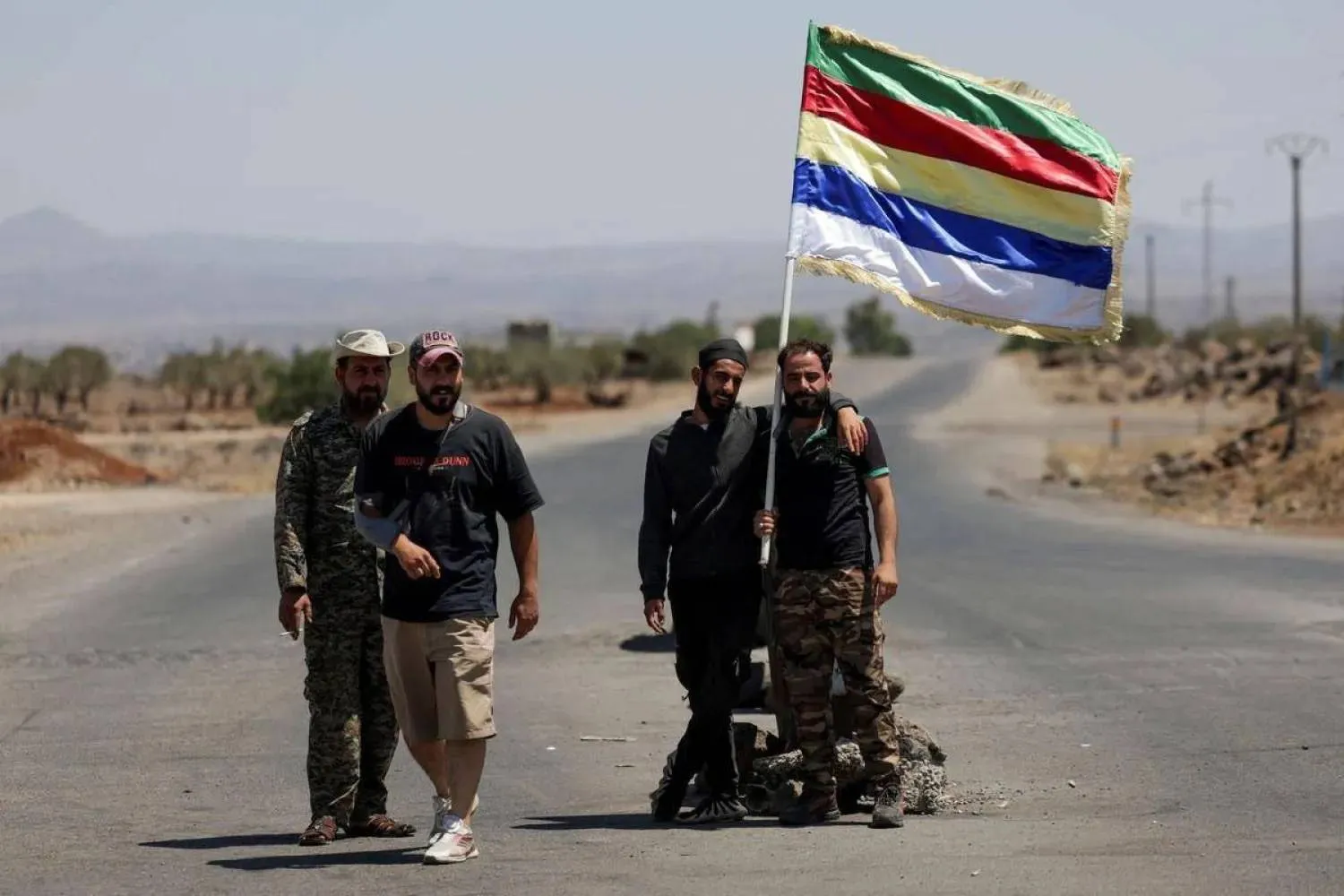
Syrian State Media: Armed Groups Ban UN Delegation from Entering Sweida

Members of the National Guard affiliated with Sheikh Hikmat al-Hijri in Sweida (File photo: Sweida 24). 
TT

Syrian State Media: Armed Groups Ban UN Delegation from Entering Sweida

Members of the National Guard affiliated with Sheikh Hikmat al-Hijri in Sweida (File photo: Sweida 24). 

Groups described by Syrian state media as operating outside the law prevented a joint UN humanitarian delegation from entering the southern Syrian city of Sweida on Sunday, citing a lack of coordination with them, according to Syria’s Al-Ikhbariya television channel.

The delegation included representatives of the UN Office for the Coordination of Humanitarian Affairs (OCHA) and international organizations. Its visit had been coordinated with the Sweida branch of the Syrian Arab Red Crescent, whose team was expected to accompany the delegation on field visits to Sweida city, Shahba and the village of Ara.

Al-Ikhbariya reported that the groups stopped the delegation at the Umm al-Zeitoun checkpoint for two to three hours before informing its members that entry was prohibited.

The delegation had earlier passed through the Al-Matouna checkpoint, operated by the Sweida Security Directorate.

The broadcaster also recalled that groups affiliated with Druze spiritual leader Sheikh Hikmat al-Hijri had blocked commercial trucks carrying essential goods and fuel from entering Sweida province on September 10.

According to Al-Ikhbariya’s correspondent at the time, the restrictions on commercial convoys coincided with the groups preventing approximately 12,000 students from reaching examination centers to sit special make-up exams for students in Sweida.