

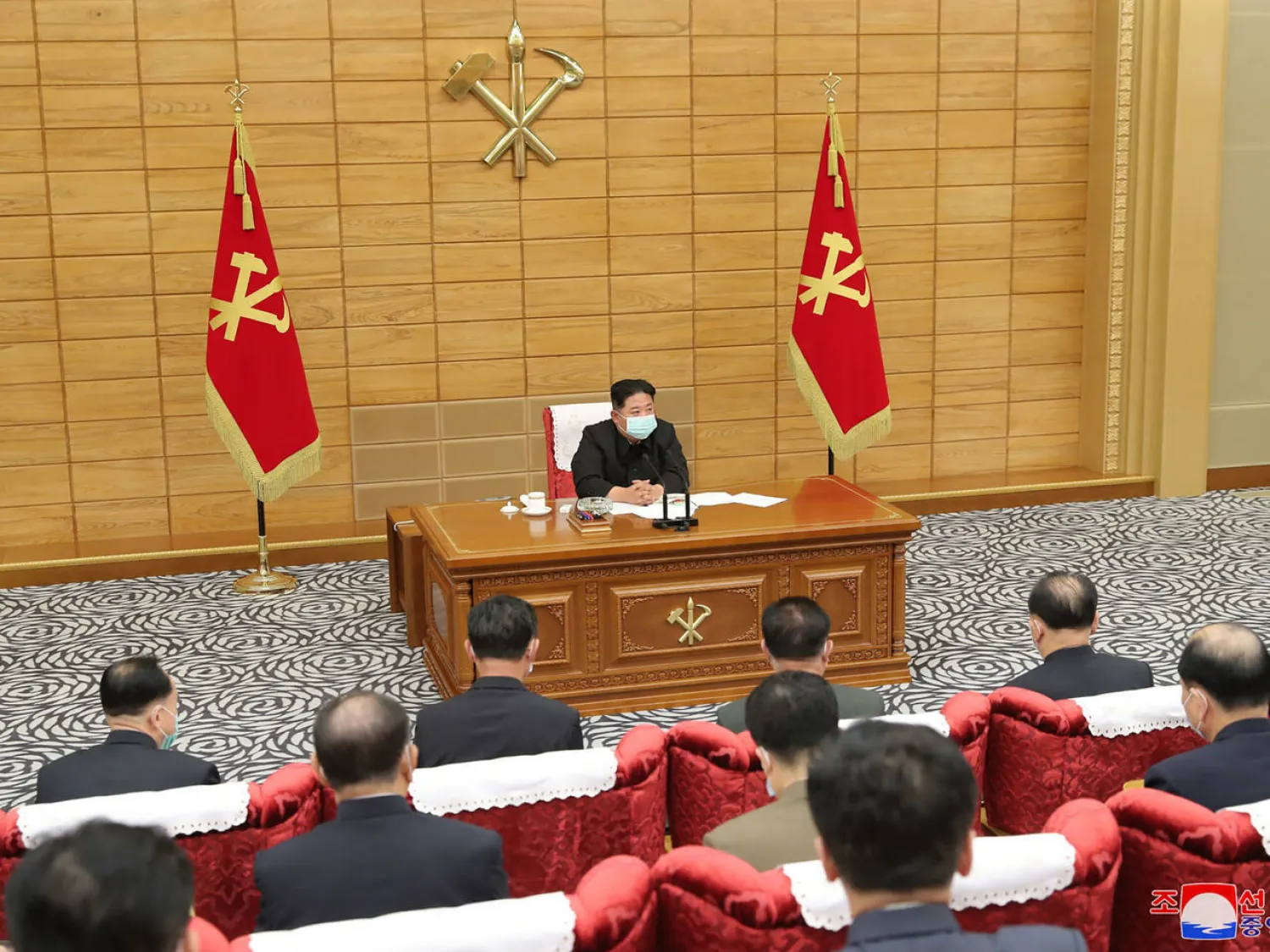

N Korea Reports 15 More 'Fever' Deaths amid Covid Outbreak

North Korea confirmed that the highly-contagious Omicron variant had been detected in the capital Pyongyang STR KCNA VIA KNS/AFP
TT

N Korea Reports 15 More 'Fever' Deaths amid Covid Outbreak

North Korea confirmed that the highly-contagious Omicron variant had been detected in the capital Pyongyang STR KCNA VIA KNS/AFP

North Korea on Sunday reported 15 additional deaths from "fever", days after officially confirming its first-ever Covid-19 cases and ordering nationwide lockdowns.

The outbreak, which leader Kim Jong Un has said is causing "great upheaval", leaves a country with one of the world's worst healthcare systems on the edge of potential disaster.

North Korea has no Covid vaccines, antiviral treatment drugs or mass-testing capacity, AFP said.

While it has maintained a rigid coronavirus blockade since the pandemic's start, experts have said that massive Omicron outbreaks in neighboring countries meant it was only a matter of time before Covid snuck in.

Despite activating a "maximum emergency quarantine system" to slow the disease's spread through its unvaccinated population, Pyongyang is now reporting large numbers of new cases daily.

Official state media KCNA on Sunday said 42 people had died since the outbreak's beginning, with 820,620 cases and at least 324,550 receiving medical treatment.

The news agency reported that "all provinces, cities and counties of the country have been totally locked down and working units, production units and residential units closed from each other."

North Korea first revealed the highly contagious Omicron variant had been detected in the capital on Thursday, with Kim ordering nationwide lockdowns after an emergency meeting of the country's Politburo.

"The spread of malignant disease comes to be a great upheaval in our country," Kim said Saturday.

-- Learning from China --
Sunday's KCNA report did not specify whether the new cases and deaths tested positive for Covid-19, but experts say the country will struggle to screen and diagnose on this scale.

North Korea's healthcare system ranked 193 out of 195 countries in a 2021 Johns Hopkins University survey.

Kim has said the country will "actively learn" from China's pandemic management strategy, according to KCNA.

China, the world's only major economy still maintaining a zero-Covid policy, is battling multiple Omicron outbreaks -- with lockdowns in some major cities, including financial hub Shanghai, sparking increasing public frustration.

North Korea has previously turned down offers of Covid vaccines from China and the World Health Organization's Covax scheme, but both Beijing and Seoul have issued fresh offers of aid and vaccines since the outbreak was announced.

Despite the public health crisis, new satellite imagery indicates North Korea has resumed construction at a long-dormant nuclear reactor.

The United States and South Korea have warned that Kim is preparing to conduct another nuclear test -- the regime's seventh -- and that it could come any day.

Analysts have warned Kim could speed up nuclear testing plans to distract North Korea's population from the disastrous coronavirus outbreak.



Top US, Israeli Generals Meet at Pentagon Amid Soaring Iran Tensions

In this handout photo released by the US Navy on January 31, 2026, an F/A-18F Super Hornet attached to Strike Fighter Squadron (VFA) 41 prepares to launch from the flight deck of the Nimitz-class aircraft carrier USS Abraham Lincoln (CVN-72) as it conducts routine flight operations in the Arabian Sea on January 28, 2026. (AFP / US Navy / Mass Communication Specialist Seaman Zoe Simpson)
TT

Top US, Israeli Generals Meet at Pentagon Amid Soaring Iran Tensions

In this handout photo released by the US Navy on January 31, 2026, an F/A-18F Super Hornet attached to Strike Fighter Squadron (VFA) 41 prepares to launch from the flight deck of the Nimitz-class aircraft carrier USS Abraham Lincoln (CVN-72) as it conducts routine flight operations in the Arabian Sea on January 28, 2026. (AFP / US Navy / Mass Communication Specialist Seaman Zoe Simpson)

The top US and Israeli generals held talks at the Pentagon on Friday amid soaring tensions with Iran, two US officials told Reuters on Sunday, speaking on condition of ‌anonymity.

The officials ‌did not ‌offer ⁠details about ‌the closed-door discussions between US General Dan Caine, the chairman of the Joint Chiefs of Staff, and Eyal ⁠Zamir, the Israeli armed ‌forces chief of staff. ‍The meeting ‍has not been ‍previously reported.

The United States has ramped up its naval presence and hiked its air defenses in the Middle East ⁠after President Donald Trump repeatedly threatened Iran, trying to pressure it to the negotiating table.

Iran's leadership warned on Sunday of a regional conflict if the US were to ‌attack it.


Russia’s Medvedev Says Trump Is an Effective Leader Who Seeks Peace

 Deputy Chairman of the Russian Security Council Dmitry Medvedev attends an interview with Reuters, TASS and WarGonzo in the Moscow region, Russia January 29, 2026. (Dmitry Medvedev's Secretariat/Handout via Reuters)
Deputy Chairman of the Russian Security Council Dmitry Medvedev attends an interview with Reuters, TASS and WarGonzo in the Moscow region, Russia January 29, 2026. (Dmitry Medvedev's Secretariat/Handout via Reuters)
TT

Russia’s Medvedev Says Trump Is an Effective Leader Who Seeks Peace

 Deputy Chairman of the Russian Security Council Dmitry Medvedev attends an interview with Reuters, TASS and WarGonzo in the Moscow region, Russia January 29, 2026. (Dmitry Medvedev's Secretariat/Handout via Reuters)
Deputy Chairman of the Russian Security Council Dmitry Medvedev attends an interview with Reuters, TASS and WarGonzo in the Moscow region, Russia January 29, 2026. (Dmitry Medvedev's Secretariat/Handout via Reuters)

Dmitry Medvedev, deputy chairman of Russia's Security Council, said that US President Donald Trump was an effective leader who was genuinely seeking peace, but that Moscow ‌had seen ‌no ‌trace ⁠of nuclear ‌submarines Trump said he moved to Russian shores last year.

Speaking to Reuters, TASS and the WarGonzo ⁠Russian war blogger in an ‌interview, Medvedev praised ‍Trump's ‍courage in resisting the ‍US establishment and said that the US president's sometimes "brash" style was "effective".

Referring to Trump's August remarks that he had ⁠repositioned two nuclear submarines to appropriate regions in response to Medvedev's warning that throwing ultimatums at Russia was a step towards war, Medvedev said: "We still haven't found ‌them."


Iran’s Supreme Leader Warns Any US Attack Would Spark ‘Regional War’

People walk in front of a mural depicting the late Iranian revolutionary founder Khomeini, right, members of the Basij paramilitary force and Supreme Leader Ali Khamenei along Enqelab-e-Eslami Street in Tehran, Iran, Sunday, Jan. 25, 2026. (AP Photo/Vahid Salemi)
TT

Iran’s Supreme Leader Warns Any US Attack Would Spark ‘Regional War’

People walk in front of a mural depicting the late Iranian revolutionary founder Khomeini, right, members of the Basij paramilitary force and Supreme Leader Ali Khamenei along Enqelab-e-Eslami Street in Tehran, Iran, Sunday, Jan. 25, 2026. (AP Photo/Vahid Salemi)

Iran's supreme leader warned Sunday that any attack by the United States would spark a "regional war" in the Middle East, further escalating tensions as President Donald Trump has threatened to militarily strike the country over its crackdown on recent nationwide protests. 

The comments from the 86-year-old Ali Khamenei are the most-direct threat he’s made so far as the aircraft carrier USS Abraham Lincoln and associated American warships are in the Arabian Sea, sent by Trump there after Tehran's bloody crackdown on nationwide protests. 

It remains unclear whether Trump will use force. He's repeatedly said Iran wants to negotiate and has brought up Tehran's nuclear program as another issue he wants to see resolved. 

But Khamenei also referred to the nationwide protests as "a coup," hardening the government's position as tens of thousands of people reportedly have been detained since the start of the demonstrations. Sedition charges in Iran can carry the death penalty, which again renews concerns about Tehran carrying out mass executions for those arrested — a red line for Trump. 

Iran had also planned a live-fire military drill for Sunday and Monday in the strategic Strait of Hormuz, the narrow mouth of the Gulf through which a fifth of all oil traded passes. The US military's Central Command had warned against threatening American warships or aircraft during the drill or disrupting commercial traffic. 

Khamenei warns US  

Khamenei spoke to a crowd at his compound in Tehran as Iran marked the start of a dayslong commemoration of the country's 1979 revolution. He, at one point, described the US as being interested in its oil, natural gas and other mineral resources, saying that they wanted to "seize this country, just as they controlled it before." 

"The Americans must be aware that if they wage a war this time, it will be a regional war," he said. 

The supreme leader added that: "We are not the instigators, we are not going to be unfair to anyone, we don’t plan to attack any country. But if anyone shows greed and wants to attack or harass, the Iranian nation will deal a heavy blow to them." 

Khamenei also hardened his position on the demonstrations after earlier acknowledging some people had legitimate economic grievances that sparked their protests. The demonstrations began Dec. 28, initially over the collapse of Iran's rial currency. It soon grew into a direct challenge to Khamenei's rule. 

"The recent sedition was similar to a coup. Of course, the coup was suppressed," he said. "Their goal was to destroy sensitive and effective centers involved in running the country, and for this reason they attacked the police, government centers, (Revolutionary Guard) facilities, banks and mosques — and burned copies of the Quran. They targeted centers that run the country." 

The US-based Human Rights Activists New Agency, which relies on a network inside Iran to verify its information, reports that over 49,500 people have been detained in the crackdown. It says the violence killed at least 6,713 people, the vast majority of them demonstrators. The Associated Press has been unable to independently assess the death toll and arrest figures, given authorities have cut Iran's internet off from the rest of the world. 

As of Jan. 21, Iran’s government put the death toll at a far lower 3,117, saying 2,427 were civilians and security forces, labeling the rest "terrorists." In the past, Iran’s theocracy has undercounted or not reported fatalities from unrest. 

That death toll exceeds that of any other round of protest or unrest in Iran in decades and recalls the chaos surrounding the 1979 revolution. 

Parliament speaker says EU militaries considered terrorist groups 

The speaker of Iran's parliament, meanwhile, said that Tehran now considers all European Union militaries to be terrorist groups, lashing out after the bloc declared the country's paramilitary Revolutionary Guard a terror group over taking part in the bloody crackdown. 

Mohammad Bagher Qalibaf, a former Guard commander, announced the terror designation, which will likely be mostly symbolic. Iran has used a 2019 law to reciprocally declare other nations' militaries terror groups following the United States declaration of the Guard a terror group that year. 

Qalibaf made the announcement as he and others in parliament wore Guard uniforms in support of the force. The Guard, which also controls Iran's ballistic missile arsenal and has vast economic interests in Iran, answers only to Khamenei. 

"By seeking to strike at the (Guard), which itself has been the greatest barrier to the spread of terrorism to Europe, Europeans have in fact shot themselves in the foot and, once again, through blind obedience to the Americans, decided against the interests of their own people," Qalibaf said. 

Lawmakers at the session later chanted: "Death to America!" and "Death to Israel!" at the session. 

Trump says Iran is ‘seriously talking' to US  

Trump has laid out two red lines for military action: the killing of peaceful protesters or the possible mass execution of those detained in a major crackdown over the demonstrations. He's increasingly begun discussing Iran's nuclear program as well, which the US negotiated over with Tehran in multiple sessions before Israel launched a 12-day war with Iran back in June. 

The US bombed three Iranian nuclear sites during the war. Activity at two of the sites suggests Iran may be trying to obscure the view of satellites as it tries to salvage what remains there. 

Trump on Saturday night declined to say whether he’d made a decision on what he wanted to do regarding Iran. 

Speaking to reporters as he flew to Florida, Trump sidestepped a question about whether Tehran would be emboldened if the US backed away from launching strikes on Iran, saying, "Some people think that. Some people don’t." 

Trump said Iran should negotiate a "satisfactory" deal to prevent the country from getting any nuclear weapons, but said, "I don’t know that they will. But they are talking to us. Seriously talking to us."