Tunisia’s Balance of Trade Deficit Widens in Four Monthshttps://english.aawsat.com/home/article/3648371/tunisia%E2%80%99s-balance-trade-deficit-widens-four-months
Tunisia’s Balance of Trade Deficit Widens in Four Months
Tunisian imports of energy increased by about 90% in four months. (Reuters)
Tunisia’s balance of trade deficit widened by 50% to 6.6 billion dinars ($2.2 billion) in the first four months of this year compared to 4.4 billion dinars in the same period last year, the state Institute of Statistics said.
The deficit has been one of the main problems facing Tunisia as it grapples with an economic crisis.
Imports rose by 30%, while exports climbed by 24.6% only, affecting the foreign trade coverage ratio, which fell by 3.4 points compared to the same period in 2021.
Government officials blamed the growing deficit on the huge rise in Tunisian imports of energy, which increased by about 90%, around four billion dinars, in four months.
This increase was sparked by the rise in global fuel prices, which resulted in the unprecedented rise in the value of energy imports.
This in turn led to an increase in the energy balance deficit despite the significant rise in the value of exports.
Official figures said the energy trade balance deficit in the country reached 2.3 billion dinars in late April, more than a third of the total trade balance deficit.
The volume of imported raw materials and semi-finished materials increased the trade deficit as it alone contributes to 40% of the total deficit.
Several economic experts, however, spoke of signs of an economic recovery.
The high internal demand for raw materials and semi-finished materials may help in the recovery.
Abdulaziz bin Salman: Riyadh is the Capital of Energy Securityhttps://english.aawsat.com/business/5328379-abdulaziz-bin-salman-riyadh-capital-energy-security
Saudi Energy Minister Prince Abdulaziz bin Salman speaks at the opening of the ministerial meeting of the International Energy Forum (IEF) in Riyadh (Turki Al-Agili)
Abdulaziz bin Salman: Riyadh is the Capital of Energy Security
Saudi Energy Minister Prince Abdulaziz bin Salman speaks at the opening of the ministerial meeting of the International Energy Forum (IEF) in Riyadh (Turki Al-Agili)
Saudi Energy Minister Prince Abdulaziz bin Salman stressed on Sunday that Riyadh represents the capital of energy security, noting that this status reflects the Kingdom's efforts, as well as those of the men and women working in the energy sector, to ensure reliable energy supplies and fulfill Saudi Arabia’s commitments to the world.
Achieving energy security requires cooperation among all countries, he said.
Speaking at the opening of the ministerial meeting of the International Energy Forum (IEF) in Riyadh, at the start of Riyadh Energy Week, the minister expressed hope that the gathering would help direct attention toward the most important issues that energy stakeholders should focus on.
He noted that the current period makes dialogue on energy security more important than ever and that in-person meetings enable participants to exchange assessments directly, discuss concerns, and build the understanding necessary for practical cooperation among nations.
He emphasized that Saudi Arabia will continue implementing its plans, meeting its domestic needs, and honoring its commitments to the world regardless of circumstances, stressing the Kingdom’s resilience and ability to continue advancing toward its objectives.
Prince Abdulaziz said that Saudi Arabia’s commitment to energy security is one of its defining characteristics and expressed hope that the event would help more participants understand the depth of that commitment.
“I am proud to say that this country, and the city of Riyadh, is the capital of energy security,” he said, attributing this standing to the efforts of the women and men working in the energy sector and to the work they undertake to ensure the continuity of supplies and the fulfillment of the Kingdom’s obligations.
He pointed to the significant amount of work Saudi Arabia has accomplished over the past eight months, stressing that the Kingdom continues to reassure its partners that it will meet its commitments to the world and will not fail to do so.
Abdulaziz bin Salman also noted that Saudi Arabia has demonstrated its ability to support the reliability of energy supplies under challenging circumstances through investment, preparedness, and decisive action.
He cited the East-West Pipeline as a clear example, explaining that it connects production centers in the Eastern Province with export facilities in Yanbu on the Red Sea, providing an alternative route for oil to reach international markets.
He further spoke about ongoing work on additional pipeline routes, expressing hope that the Kingdom’s commitments in this area would become clearer soon, ensuring the continuation of its efforts and strengthening its role in global energy markets.
International Energy Forum: Security of Supply Requires Ensuring Energy Access for Consumershttps://english.aawsat.com/business/5328368-international-energy-forum-security-supply-requires-ensuring-energy-access
International Energy Forum (IEF) Secretary General Jassim Alshirawi speaks with Asharq Al-Awsat on the sidelines of the 17th Ministerial Meeting of the International Energy Forum (IEF) in Riyadh. Asharq Al-Awsat
International Energy Forum: Security of Supply Requires Ensuring Energy Access for Consumers
International Energy Forum (IEF) Secretary General Jassim Alshirawi speaks with Asharq Al-Awsat on the sidelines of the 17th Ministerial Meeting of the International Energy Forum (IEF) in Riyadh. Asharq Al-Awsat
International Energy Forum (IEF) Secretary General Jassim Alshirawi stressed on Sunday that supply security remains a top priority amid growing global energy demand, driven by population growth, industrial expansion, and the increasing needs of data centers and artificial intelligence applications.
He emphasized that the challenge goes beyond producing energy and includes ensuring that it is delivered reliably to consumers.
In remarks to Asharq Al-Awsat on the sidelines of the 17th Ministerial Meeting of the International Energy Forum in Riyadh, Alshirawi praised Saudi Arabia for hosting Riyadh Energy Week, which opened with the forum's ministerial meeting.
He noted that these gatherings provide an opportunity to strengthen dialogue between energy-producing and energy-consuming nations and to explore ways of safeguarding energy security amid the ongoing transformations in the energy sector.
He explained that the forum comprises around 70 countries representing the majority of the world's energy producers and consumers. It also includes an industry advisory board that enables companies to participate in the dialogue between governments, helping to bridge perspectives among stakeholders and address challenges related to energy availability.
Alshirawi added that population growth, industrial needs, and the new demand generated by the expanding use of artificial intelligence are increasing the importance of ensuring adequate energy supplies and the infrastructure needed to transport them to consumers.
He stressed that energy security is not only about a country's ability to produce energy, but also about ensuring that supplies reach their destinations in order to meet the needs of economies and industries.
Aramco Namaat: 5 Years of Industrial Localization and Economic Diversification in Saudi Arabiahttps://english.aawsat.com/business/5328359-aramco-namaat-5-years-industrial-localization-and-economic-diversification-saudi
Aramco Namaat: 5 Years of Industrial Localization and Economic Diversification in Saudi Arabia
Two workers carry out tasks at one of Saudi Aramco's facilities. (Aramco)
Saudi Aramco is expanding its investments in industries and services linked to its core business through the Aramco Namaat program, which has attracted nearly SAR 216 billion ($58 billion) in investments and helped establish 58 new companies since its launch in 2021, according to information obtained by Asharq Al-Awsat.
The program reflects the company's strategy of building local and international industrial partnerships aimed at localizing manufacturing and advanced technologies, strengthening supply chains, and contributing approximately SAR 103 billion ($27.4 billion) to the Kingdom’s gross domestic product.
Aramco Namaat is an industrial investment and strategic partnership program launched by the Saudi energy giant to attract local and international companies to invest in the Kingdom, develop domestic industries, create jobs for Saudis, and support economic diversification in line with Saudi Vision 2030.
Over the past five years, the program has reinforced Aramco’s role in excellence, innovation, and strategic planning, moving from one success to another by leveraging the company’s unique technical, commercial, and execution capabilities.
These five years have marked a turning point by transforming promising business ideas into tangible investment opportunities, turning what was once a vision into successful industrial projects that support a prosperous and sustainable future.
By the Numbers
According to information obtained by Asharq Al-Awsat, Aramco Namaat has become the meeting point between ambition and execution. The program has contributed to the launch of 58 active companies and attracted nearly SAR 216 billion ($58 billion) in investments.
Its impact extends beyond investment figures, contributing around SAR 103 billion ($27.4 billion) to Saudi Arabia’s GDP. This highlights the program’s central role in strengthening the domestic economy, localizing key industrial capabilities, and creating employment opportunities for Saudi men and women.
An Integrated Ecosystem
Aramco Namaat serves as a key tool for Saudi Aramco in building industrial investment partnerships. The program’s strategy focuses on creating value through three main pillars:
• Operational resilience for Saudi Aramco
• Technological resilience
• Development of new diversified industries
At the same time, it actively contributes to achieving the ambitions of Vision 2030.
The program seeks to empower national companies and generate value throughout Aramco’s ecosystem across four main areas: manufacturing, industrial services, digitalization and sustainability.
The program has strengthened public-private partnerships and fostered close collaboration with global and local partners, creating large-scale investment opportunities, establishing leading companies, and attracting foreign direct investment, all of which have enhanced the resilience and sustainability of supply chains.
Many of these investments are also supported by Saudi incentive programs that encourage companies to increase local investment. These initiatives have opened new opportunities for industrial-investment partners to participate in and benefit from the company’s long-term growth prospects.
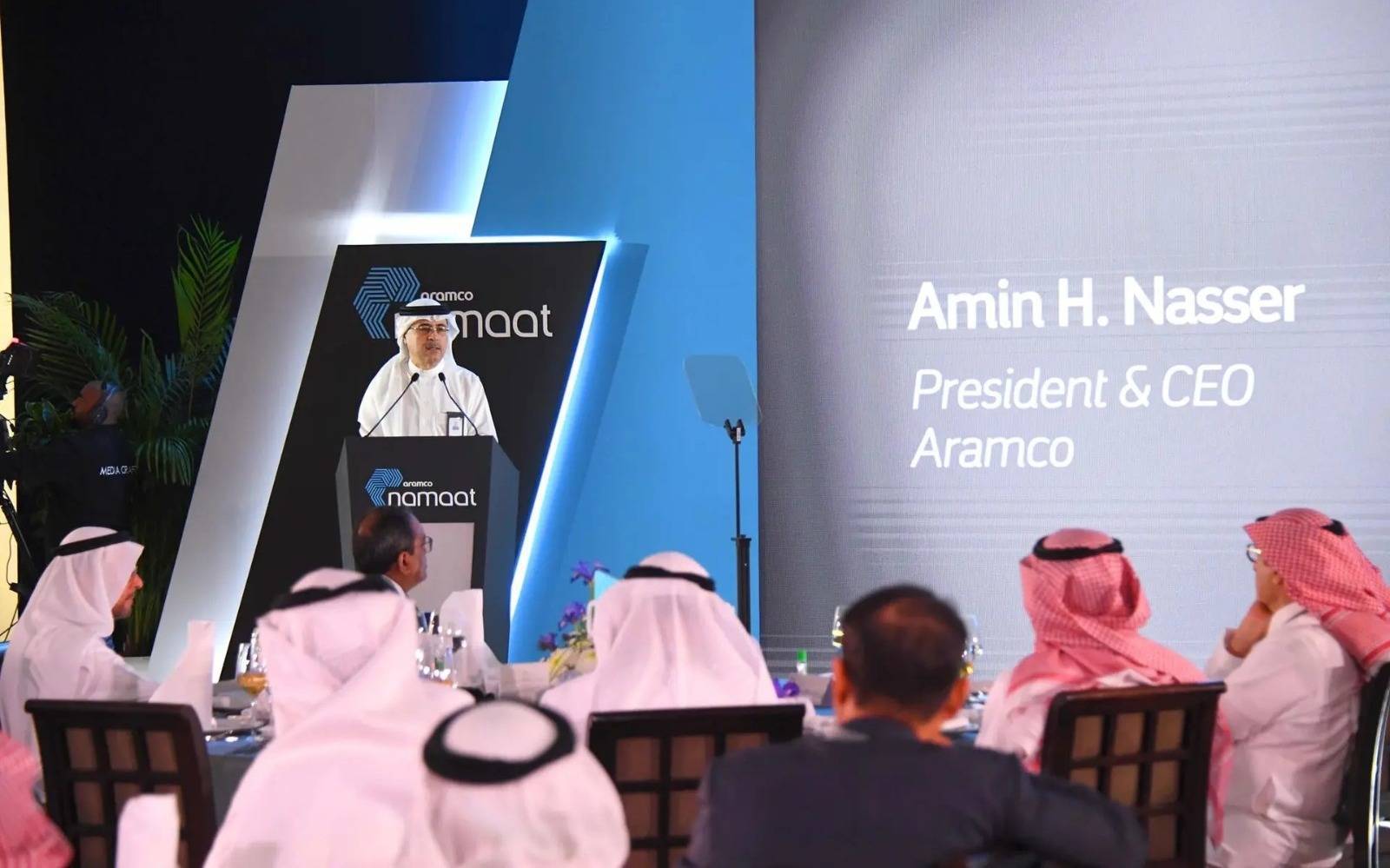
President and CEO of Saudi Aramco Amin Nasser speaks with partners in the Namaat program. (SPA)
Industrial Services
Since its launch, Aramco Namaat has achieved major milestones across its four focus areas and has helped shape the future of industrial localization and economic diversification in the Kingdom.
In manufacturing, the program has supported local production of high-voltage subsea power cables, thick-wall pressure vessels and corrosion-resistant steel pipes.
These initiatives have enabled the localization of strategic and critical manufacturing capabilities.
The program is also working to establish an advanced global hub in Saudi Arabia specializing in modern metal reclamation technologies and production of advanced refining catalysts.
This strategic initiative positions the Kingdom as a leading regional center for sustainable resource recovery, high-value industrial production, and clean-energy solutions, driving economic growth and supporting Saudi Arabia’s commitment to a more sustainable and environmentally responsible economy.
Within industrial services, Aramco Namaat has supported the localization of a metal casting and forming facility, helping strengthen domestic manufacturing of critical products and enhancing the resilience of industrial supply chains.
The program has also contributed to the development of Saudi engineering, procurement, and construction (EPC) companies, increasing their ability to deliver reliable and competitive projects both within and outside the Kingdom.
Digitalization and Sustainability
Aramco Namaat has continued its contribution to national development through key digitalization initiatives.
Among the most notable are the localization of advanced digital technologies, including the establishment of a national information technology services company that provides integrated solutions in software development, consulting, and technical support to meet the technological needs of various sectors.
The program has also supported Unified Telecom, and more than seven companies located in the Digital Hub at King Salman Energy Park (SPARK).
The program has also made significant contributions to sustainability, including a project to localize the production of specialized glass.
Through the GulfGuard joint venture, it supported Guardian Glass in expanding specialized glass manufacturing within the Kingdom.
The project focuses on high-performance architectural glass, helping meet growing regional demand for energy-efficient buildings. The collaboration included the addition of new float-glass production lines and glass-processing facilities in Jubail Industrial City, strengthening the local supply chain with advanced products and delivering significant gains in technology localization.
The Road Ahead
Building on these achievements, Aramco Namaat is moving into its next phase with a focus on developing strategic industrial opportunities that strengthen Saudi Aramco’s ecosystem while accelerating the Kingdom’s industrial transformation.
Its priorities include driving innovation, supporting local industry, diversifying the economy, encouraging ambitious ideas and entrepreneurship, building resilient supply chains and localizing critical and advanced technologies.
The program continues to attract global partners to help establish new industrial capabilities while expanding advanced digital and manufacturing capacities and accelerating the adoption of industrial and digital solutions across emerging sectors.
In this way, Aramco Namaat is becoming part of a broader success story that reflects the Kingdom’s achievements in energy, industry, and innovation, both regionally and globally.
لم تشترك بعد
انشئ حساباً خاصاً بك لتحصل على أخبار مخصصة لك ولتتمتع بخاصية حفظ المقالات وتتلقى نشراتنا البريدية المتنوعة