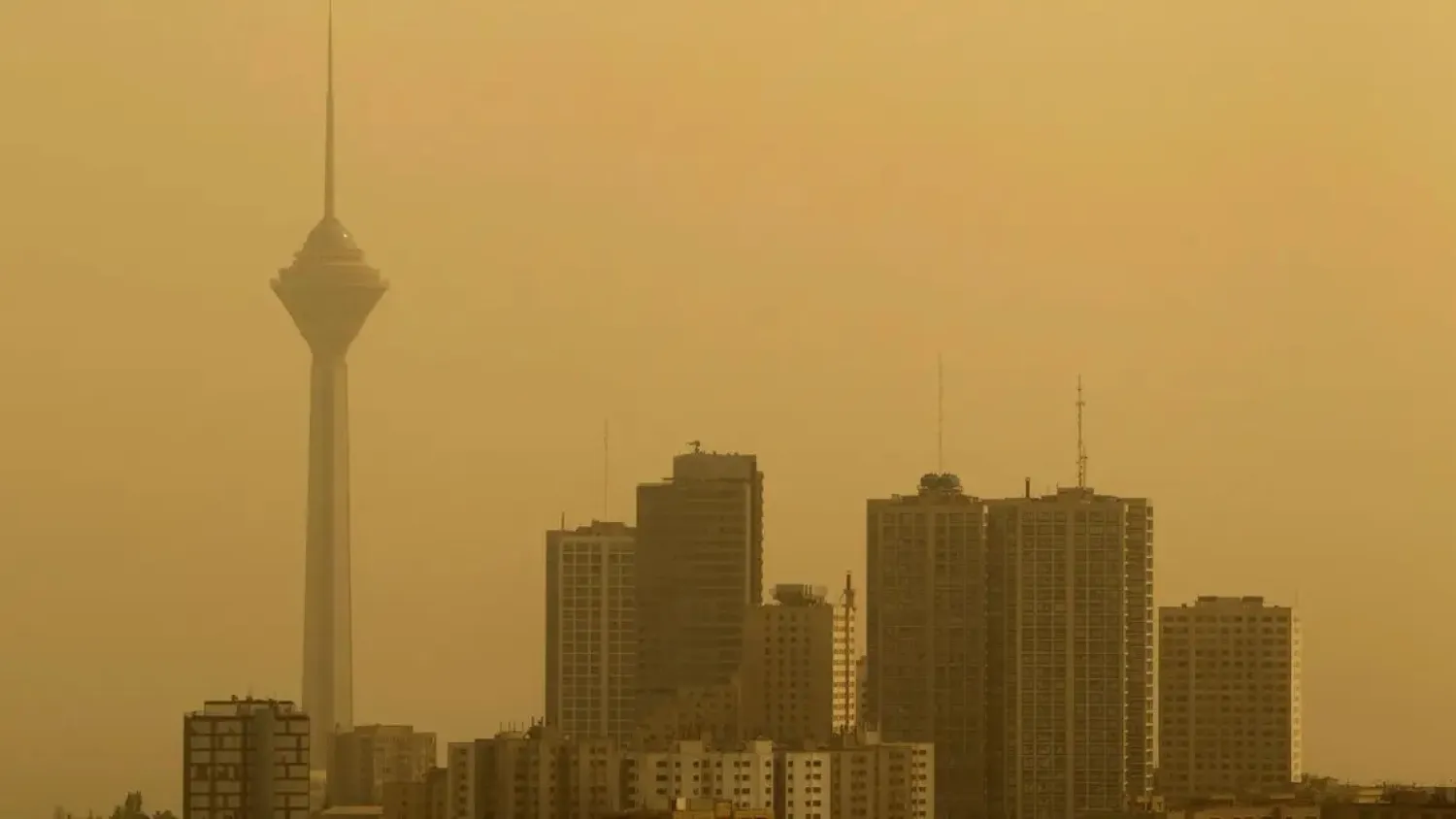
Schools, Offices Close in Tehran as Sandstorm Hits Iran

A view shows Tehran's Milad telecommunication tower during a sandstorm in Tehran. (Reuters)
TT

Schools, Offices Close in Tehran as Sandstorm Hits Iran

A view shows Tehran's Milad telecommunication tower during a sandstorm in Tehran. (Reuters)

Schools and government offices closed in the Iranian capital on Tuesday and elsewhere in the country after yet another sandstorm blanketed Tehran, state TV reported.

The report said the air quality was very poor and that the pollution from the dust was high. It was the third severe sandstorm in Iran since mid-April.

Last week, authorities also shuttered schools in Tehran and other provinces because of a similar sandstorm but Tuesday marks the first time government offices closed in Tehran due to a sandstorm.

Tehran is among the most polluted cities in the world. The country’s west, along the border with Iraq, has seen frequent closures of schools and offices due to sandstorms. On Monday, airports in western Iran saw dozens of flights canceled or delayed.

In neighboring Iraq, sandstorms - at least eight since April - have landed thousands in hospitals with severe respiratory problems and killed at least one person. In Syria, at least three people died along the border with Iraq because of the storm.

Experts blame poor government policies, desertification and low water levels as well as climate change for the frequency and intensity of recent sandstorms.


Iran Releases on Bail Senior Reformists Arrested After Protests

An Iranian man speaks on his mobile phone as he walks past a huge national flag hanging above shops, in Tehran on February 6, 2026. (AFP)
TT

Iran Releases on Bail Senior Reformists Arrested After Protests

An Iranian man speaks on his mobile phone as he walks past a huge national flag hanging above shops, in Tehran on February 6, 2026. (AFP)

Iranian authorities released the leader of the country's reformist coalition on bail Friday, days after she was arrested following anti-government protests, local media reported.

Azar Mansouri, head of the Reformist Front, "was released from prison a few minutes ago after posting bail," her lawyer Hojjat Kermani told the ISNA news agency.

Mansouri, 60, an adviser to reformist former president Mohammad Khatami, was arrested on Sunday alongside two other senior reformist figures, Javad Emam and Ebrahim Asgharzadeh.

Late Thursday, Kermani told ISNA that Emam and Asgharzadeh were also released after posting bail.

Asgharzadeh is a former member of parliament and Emam is the spokesman of the Reformist Front, the main coalition of the reformist camp.

They were accused of "undermining national unity" and "coordinating with enemy propaganda," the Fars news agency reported at the time of their arrests.

Reformists traditionally call for more social freedoms and the establishment of a civil society and backed current President Masoud Pezeshkian during his 2024 campaign.

The arrests come weeks after protests erupted across the country, in which thousands of people died and many more were arrested.

In 2009, Emam was one of the campaign managers for Mir Hossein Mousavi, a leading figure in the Iranian opposition and former prime minister, who has been under house arrest since 2011.


Return of Millions of Afghans from Pakistan and Iran Pushes Afghanistan to the Brink, UN Warns

Afghan families receive food rations for the coming holy month of Ramadan in Jalalabad, Nangarhar province, Afghanistan, 09 February 2026. (EPA)
TT

Return of Millions of Afghans from Pakistan and Iran Pushes Afghanistan to the Brink, UN Warns

Afghan families receive food rations for the coming holy month of Ramadan in Jalalabad, Nangarhar province, Afghanistan, 09 February 2026. (EPA)

The return of millions of Afghans from neighboring Pakistan and Iran is pushing Afghanistan to the brink, the UN refugee agency said on Friday, describing an unprecedented scale of returns.

A total of 5.4 million people have returned to Afghanistan since October 2023, mostly from the two neighboring countries, UNHCR’s Afghanistan representative Arafat Jamal said, speaking to a UN briefing in Geneva via video link from Kabul, the Afghan capital.

“This is massive, and the speed and scale of these returns has pushed Afghanistan nearly to the brink,” Jamal said.

Pakistan launched a sweeping crackdown in Oct. 2023 to expel migrants without documents, urging those in the country to leave of their own accord to avoid arrest and forcible deportation and forcibly expelling others. Iran also began a crackdown on migrants at around the same time.

Since then, millions have streamed across the border into Afghanistan, including people who were born in Pakistan decades ago and had built lives and created businesses there.

Last year alone, 2.9 million people returned to Afghanistan, Jamal said, noting it was “the largest number of returns that we have witnessed to any single country.”

Afghanistan’s Taliban rulers have criticized the mass expulsions.

Afghanistan was already struggling with a dire humanitarian situation and a poor human rights record, particularly relating to women and girls, and the massive influx of people amounting to 12% of the population has put the country under severe strain, Jamal said.

Already in just the month and a half since the start of this year, about 150,000 people had returned to Afghanistan, he added.

Afghan authorities provide care packages for those returning that include some food aid, cash, a telephone SIM card and transportation to parts of the country where they might have family. But the returns have strained resources in a country that was already struggling to cope with a weak economy and the effects of a severe drought and two devastating earthquakes.

In November, the UN development program said nine out of 10 families in areas of Afghanistan with high rates of return were resorting to what are known as negative coping mechanisms — either skipping meals, falling into debt or selling their belongings to survive.

“We are deeply concerned about the sustainability of these returns,” Jamal said, noting that while 5% of those who return say they will leave Afghanistan again, more than 10% say they know of someone who has already left.

“These decisions, I would underscore, to undertake dangerous journeys, are not driven by a lack of a desire to remain in the country, on the contrary, but the reality that many are unable to rebuild their viable and dignified lives,” he said.


Iran's Ex-crown Prince Calls for Fresh Anti-government Actions

The Iranian flag waves in front of the International Atomic Energy Agency (IAEA) headquarters, before the beginning of a board of governors meeting, in Vienna, Austria, March 1, 2021. REUTERS/Lisi Niesner
TT

Iran's Ex-crown Prince Calls for Fresh Anti-government Actions

The Iranian flag waves in front of the International Atomic Energy Agency (IAEA) headquarters, before the beginning of a board of governors meeting, in Vienna, Austria, March 1, 2021. REUTERS/Lisi Niesner

The exiled son of Iran's last shah has called for anti-government actions in his homeland to coincide with protests in Germany and other countries, as the key opposition figure was due to speak at the Munich security conference.

US-based Reza Pahlavi, who has not returned to his country since before the 1979 Islamic revolution that ousted the monarchy, called for protests on Saturday in Munich, Toronto and Los Angeles to demand international action on Iran, AFP reported.

In an X post on Thursday, Pahlavi urged Iranians inside the country to join in by chanting slogans from their homes and rooftops, after street protests that peaked in January were violently suppressed by authorities in a crackdown that rights groups say left thousands dead.

Pahlavi said that Iranians abroad would demonstrate on Saturday "to mobilize broader international support" for what he described as "Iran's Lion and Sun Revolution", a reference to the insignia on the imperial flag.

"In this spirit, I invite you, on the evenings of February 14 and 15 at 8:00 pm, to raise your voices and chant from your homes and rooftops. Shout your demands. Show your unity. With an unbreakable will, we will prevail over this occupying regime," he added.

Pahlavi is due to address the Munich Security Conference at 1745 GMT on Friday, a rare chance for him to speak at an international event.

Videos verified by AFP showed people in Iran this week chanting anti-government slogans as the clerical leadership celebrated the anniversary of the Islamic revolution, despite the ongoing crackdown.

According to US-based Human Rights Activists News Agency, 7,005 people, mostly protesters, were killed in the crackdown, though rights groups warn the toll is likely far higher.

Pahlavi had encouraged Iranians to join the wave of protests, which caused US President Donald Trump to threaten military action in their support -- a move Pahlavi has urged.

Iranian authorities have blamed the violence on "rioters" instigated by their sworn enemies the United States and Israel, which waged a 12-day war against Iran in June.

Many protest chants had called for the monarchy's return, and Pahlavi, 65, has said he is ready to lead a democratic transition in the country.

The Iranian opposition remains divided and Pahlavi has faced criticism for his support for Israel, making a highly publicised visit in 2023 that fractured an attempt to unify opposition camps. He has also never distanced himself from his father's autocratic rule.