

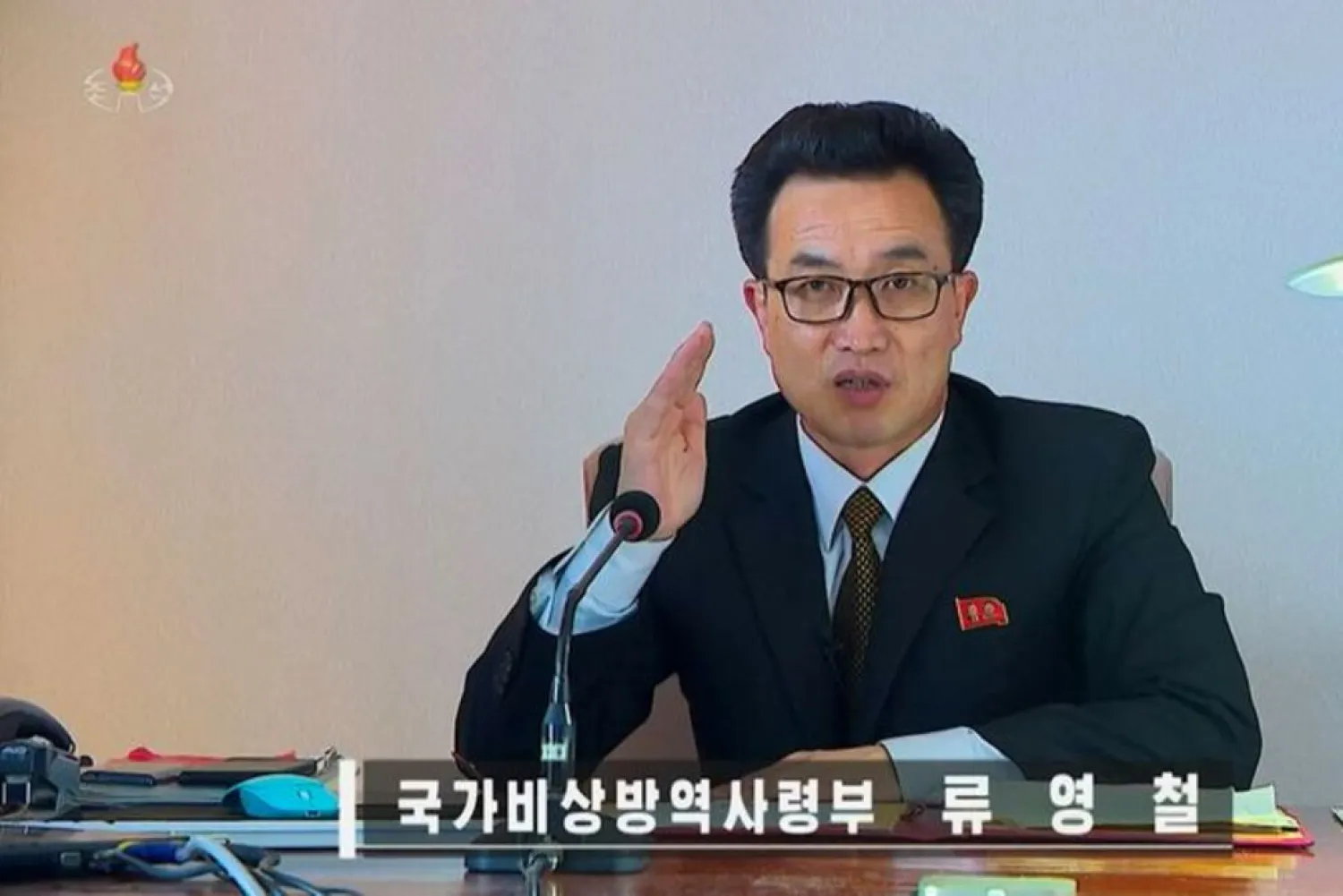

North Korea’s Dr. Fauci? Health Official Emerges as Face of COVID Campaign

Ryu Yong Chol, an official at North Korea's state emergency epidemic prevention headquarters, speaks during a daily coronavirus program on state-run television KRT, in this still image obtained from KRT footage released on May 20, 2022. (KRT via Reuters)
TT

North Korea’s Dr. Fauci? Health Official Emerges as Face of COVID Campaign

Ryu Yong Chol, an official at North Korea's state emergency epidemic prevention headquarters, speaks during a daily coronavirus program on state-run television KRT, in this still image obtained from KRT footage released on May 20, 2022. (KRT via Reuters)

At 9:30 a.m. every day this week, a soft-spoken official has appeared on North Korean television to report the number of people with fever and new deaths, and to explain measures to stop North Korea's first confirmed COVID-19 outbreak.

The little-known official, Ryu Yong Chol, has become the public face of the isolated country's battle against the epidemic, the equivalent of US COVID-19 czar Dr Anthony Fauci or the director of South Korea's disease prevention agency, Jeong Eun-kyeong.

For more than two years, with its borders sealed, North Korea did not report a single case of COVID, which skeptics abroad suggested was more a reflection of its traditional state secrecy than a real absence of the coronavirus.

Since confirming its first outbreak and declaring a state of emergency last week, North Korea has changed tack. Appearing to take a page from playbooks of many other countries, it is releasing detailed data about the spread of the virus and advice on how to avoid it.

Ryu works for the state emergency epidemic prevention headquarters, KCNA has reported, which appears to be newly set up to tackle COVID.

Like its South Korean equivalent, the North Korean agency holds daily briefings, chaired by Ryu, though without questions from reporters.

Ryu, dressed in a suit and with horn-rimmed glasses, comes across as sensible and to-the-point, uncommon qualities on North Korea's tightly controlled television better known for the histrionics of its announcers and fawning military commanders.

"We should strengthen efforts to control and isolate every and each infected person without exception so as to thoroughly eliminate any spaces where the infectious disease can spread," Ryu said on Friday, urging "guarding against loopholes".

North Korea has reported 2,241,610 people with fever and 65 deaths among its 25 million people. It lacks testing capacity and has not specified how many of those people have been confirmed to have contracted COVID.

Taming the outbreak

Little is known about Ryu, including his medical qualifications.

In a July 2017 state media report, a director-general at the health ministry with the same name accused South Korea of "plotting a biochemical terror attack" against North Korean leader Kim Jong Un. South Korea denied the accusation.

An official at South Korea's unification ministry, which handles North Korean affairs, said Ryu previously held that position, though it was not clear whether he was the person cited in the report.

The new North Korean media strategy of apparent openness on COVID was in line with a push by Kim to build a "normal state" by improving transparency and acknowledging defects, said Yang Moo-jin, a professor at the University of North Korean Studies in Seoul.

"He can also encourage people to report symptoms and join efforts to tame the outbreak, in which public participation is key," Yang said.

"There's some propaganda value, as the figures are relatively lower than those reported elsewhere," Yang said.

Another unification ministry official said North Korea might have taken lessons from other countries and is releasing facts and figures as part of an effort to "mobilize every means available", given the urgency of the outbreak.

But Yang pointed out what seem to be significantly low fatalities than elsewhere, saying the death toll might have be under-reported to head off political trouble.

"Publishing death tolls could require political considerations as a surge in deaths will likely stoke people's fear and sour public sentiment," he said.



Türkiye and Armenia Agree to Simplify Visa Procedures to Normalize Ties

Türkiye’s President Recep Tayyip Erdogan, right, and Armenia's Prime Minister Nikol Pashinyan shake hands before a meeting at Prague Castle in Prague, Czech Republic, Thursday, Oct. 6, 2022. (Turkish Presidency via AP, File)
TT

Türkiye and Armenia Agree to Simplify Visa Procedures to Normalize Ties

Türkiye’s President Recep Tayyip Erdogan, right, and Armenia's Prime Minister Nikol Pashinyan shake hands before a meeting at Prague Castle in Prague, Czech Republic, Thursday, Oct. 6, 2022. (Turkish Presidency via AP, File)

Türkiye and Armenia have agreed to simplify visa procedures as part of efforts to normalize ties, Türkiye’s Foreign Ministry announced Monday, making it easier for their citizens to travel between the two countries.

Relations between Türkiye and Armenia have long been strained by historic grievances and Türkiye’s alliance with Azerbaijan. The two neighboring countries have no formal diplomatic ties and their joint border has remained closed since the 1990s.

The two countries, however, agreed to work toward normalization in 2021, appointing special envoys to explore steps toward reconciliation and reopening the frontier. Those talks have progressed in parallel with efforts to ease tensions between Armenia and Azerbaijan.

Türkiye supported Azerbaijan during its 2020 conflict with Armenia for control of the Karabakh region, known internationally as Nagorno-Karabakh, a territorial dispute that had lasted nearly four decades.

The Turkish Foreign Ministry said in a statement posted on social platform X that Ankara and Yerevan agreed that holders of diplomatic, special and service passports from both countries would be able to obtain electronic visas free of charge as of Jan. 1.

“On this occasion, Türkiye and Armenia reaffirm once again their commitment to continue the normalization process between the two countries with the goal of achieving full normalization without any preconditions,” the ministry said.

Türkiye and Armenia also have a more than century-old dispute over the deaths of an estimated 1.5 million Armenians in massacres, deportations and forced marches that began in 1915 in Ottoman Türkiye. Historians widely view the event as genocide.

Türkiye denies the deaths constituted genocide, saying the toll has been inflated and those killed were victims of civil war and unrest. It has lobbied to prevent countries from officially recognizing the massacres as genocide.


Russia Says Ukraine Tried to Attack Putin's Residence so Moscow's Negotiating Stance under Review

Russian President Vladimir Putin chairs a meeting on the "special military operation" amid the ongoing Russia-Ukraine conflict in Moscow, Russia, December 29, 2025. Sputnik/Mikhail Metzel/Pool via REUTERS
TT

Russia Says Ukraine Tried to Attack Putin's Residence so Moscow's Negotiating Stance under Review

Russian President Vladimir Putin chairs a meeting on the "special military operation" amid the ongoing Russia-Ukraine conflict in Moscow, Russia, December 29, 2025. Sputnik/Mikhail Metzel/Pool via REUTERS

Russian Foreign Minister Sergei Lavrov said on Monday that Ukraine had tried to attack President Vladimir Putin's residence ‌in the Novgorod ‌region and so ‌Moscow's ⁠negotiating ​position ‌would be reviewed.

Lavrov said that on Dec. 28-29, Ukraine had attacked the Russian president's state residence in the Novgorod region with 91 long-range drones which were all ⁠destroyed by Russian air defenses.

"Such reckless actions will ‌not go unanswered," ‍Lavrov said, adding ‍that the attack amounted to "state ‍terrorism."

He said that targets had already been selected for retaliatory strikes by Russia's armed forces, Reuters reported.

Lavrov noted that the ​attack took place during negotiations about a possible Ukrainian peace ⁠deal and that while Russia would not leave the negotiations, Moscow's position will be reviewed.

Ukrainian President Volodymyr Zelenskiy said the accusation was a lie, adding that Moscow was preparing the ground to strike government buildings in Kyiv.

It was not immediately clear if Putin ‌was in the residence at the time.


Paris Metro Stabbing Suspect is French, Says Ministry

The attacks happened on a central line of Paris's metro, seen here in a file picture © JULIEN DE ROSA / AFP/File
TT

Paris Metro Stabbing Suspect is French, Says Ministry

The attacks happened on a central line of Paris's metro, seen here in a file picture © JULIEN DE ROSA / AFP/File

The suspect in the stabbing of three women in the Paris metro last week is French, the interior ministry said Monday, after previously saying he was an undocumented Malian ordered to leave the country.

A source with knowledge of the case, requesting anonymity because not allowed to speak to the press, said he had held a French passport since 2018, AFP reported.

The 25-year-old man was arrested on suspicion of having stabbed and injured three women along the Paris metro's Line 3 on Friday, then admitted to a psychiatric hospital the next day.

"The investigation uncovered a French passport belonging to the suspect," the ministry said, adding that he had not once mentioned his French nationality during previous run-ins with police.

The ministry said on Friday the man was a Malian citizen imprisoned in January last year for aggravated theft and sexual assault, and required to leave France after being released in July.

The man had been placed in an administrative detention centre, but failure to obtain a consular travel document required for his deportation meant he was released after 90 days as required by law, it said.

Interior Minister Laurent Nunez last week called for "maximum vigilance" during the festive season in France.