


Russia Says Mariupol Battle at End as Ukrainian Defenders Surrender

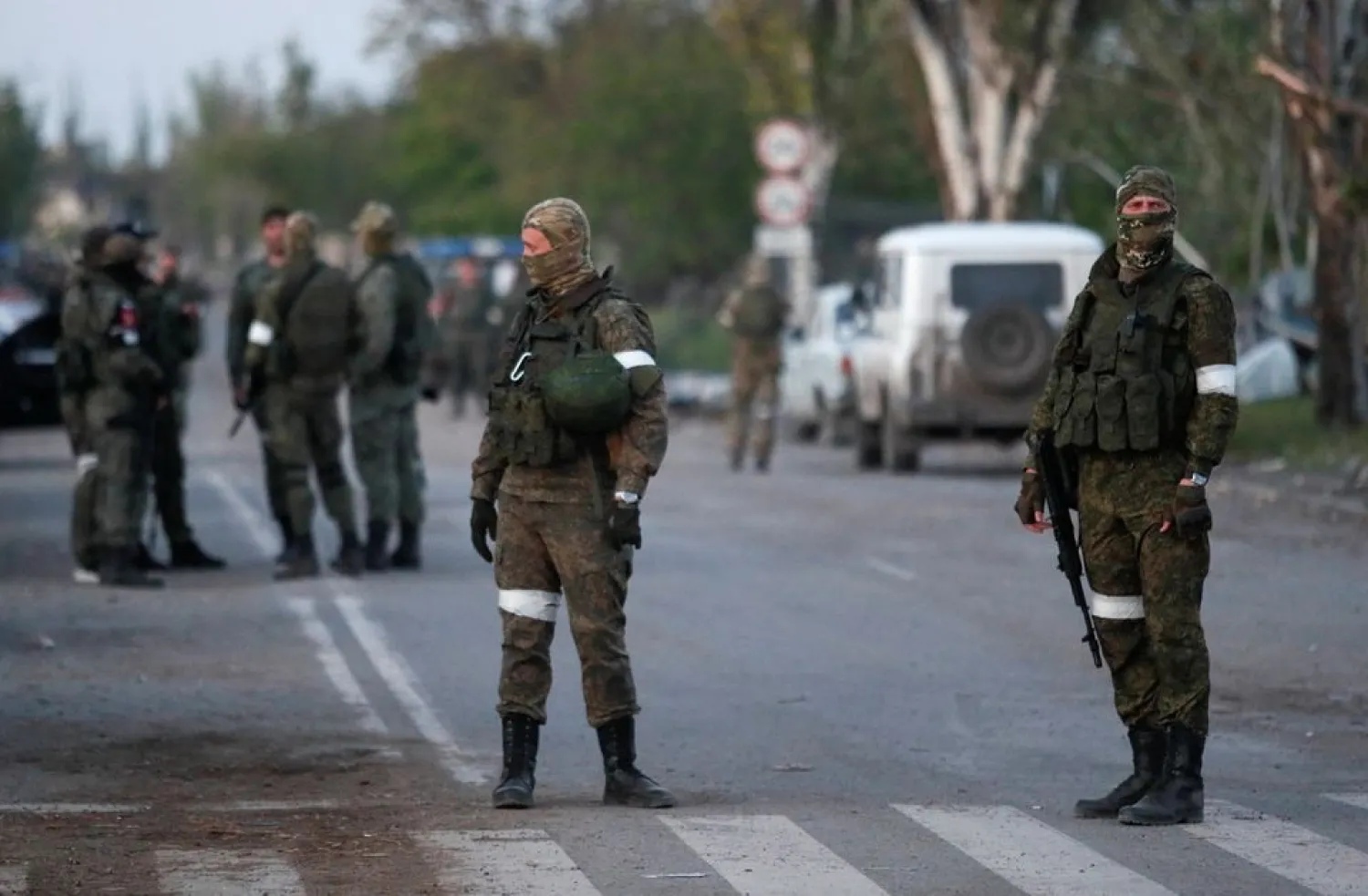
Service members of pro-Russian troops stand guard on a road before the expected evacuation of wounded Ukrainian soldiers from the besieged Azovstal steel mill in the course of Ukraine-Russia conflict in Mariupol, Ukraine May 16, 2022. REUTERS/Alexander Ermochenko
TT

Russia Says Mariupol Battle at End as Ukrainian Defenders Surrender

Service members of pro-Russian troops stand guard on a road before the expected evacuation of wounded Ukrainian soldiers from the besieged Azovstal steel mill in the course of Ukraine-Russia conflict in Mariupol, Ukraine May 16, 2022. REUTERS/Alexander Ermochenko

Russia has declared victory in its months-long operation to capture the strategic port of Mariupol after Ukraine ordered the last of its troops holed up in the city's Azovstal steelworks to lay down their arms.

Moscow's flattening of Mariupol has drawn multiple accusations of war crimes, including over a deadly attack on a maternity ward, and Ukraine has begun a legal reckoning for captured Russian troops, said AFP.

The first post-invasion trial of a Russian soldier for war crimes neared its climax in Kyiv on Friday, after 21-year-old sergeant Vadim Shishimarin admitted to killing an unarmed civilian early in the offensive. The verdict is due Monday.

Shishimarin told the court he was "truly sorry". But his lawyer said in closing arguments that the young soldier was "not guilty" of premeditated murder and war crimes.

Since Ukrainian forces fended off the Russian offensive around Kyiv both eastern Ukraine and Mariupol in the south have borne the brunt of a remorseless ground and artillery attack.

The fighting is fiercest in the eastern region of Donbas, a Russian-speaking area that has been partially controlled by pro-Kremlin separatists since 2014.

"Attempts to attack Donbas continue. They completely ruined Rubizhne, Vonokvakha, just as Mariupol," President Volodymyr Zelensky said in his nightly video address late Friday, adding the Russians were "trying to do the same with Severodonetsk and many other cities".

In the eastern city of Severodonetsk, 12 people were killed and another 40 wounded by Russian shelling, the regional governor said.

- 'End of the operation' -
Zelensky described the bombardment of Severodonetsk as "brutal and absolutely pointless", as residents cowering in basements described an unending ordeal of terror.

The city forms part of the last pocket of Ukrainian resistance in Lugansk, which along with the neighboring region of Donetsk comprises the Donbas war zone.

Moscow on Friday said the battle for the Azovstal steelworks -- a symbol of Ukraine's dogged resistance since Russian President Vladimir Putin launched the invasion on February 24 -- was now over.

Russian defense ministry spokesman Igor Konashenko said 2,439 Ukrainian personnel had surrendered at the steelworks since May 16, the final 500 on Friday.

Defence Minister Sergei Shoigu had informed Putin of "the end of the operation and the complete liberation of the (Azovstal) industrial complex and the city of Mariupol", Konashenko added.

Ukraine hopes to exchange the surrendering Azovstal soldiers for Russian prisoners. But in Donetsk, pro-Kremlin authorities are threatening to put some of them on trial.

In Washington, Pentagon spokesman John Kirby said all prisoners of war should "be treated in accordance with the Geneva Convention and the law of war".

President Joe Biden has cast the Ukraine war as part of a US-led struggle pitting democracy against authoritarianism.

The US Congress this week approved a $40-billion (38-billion-euro) aid package, including funds to enhance Ukraine's armored vehicle fleet and air defense system.

And meeting in Germany, G7 industrialized nations pledged $19.8 billion to shore up Ukraine's shattered public finances.

- Finland's price -
The war's economic repercussions were set to expand Saturday, with Russia expected to cut off its supply of natural gas to Finland.

Finnish state energy firm Gasum said the taps would be turned off when its contract with Russia's Gazprom ended at 7:00 am (0400 GMT).

The move, which Russia has blamed on the Nordic country's refusal to pay in rubles, comes days after Finland and Sweden submitted a joint application for NATO membership.

Moscow has repeatedly warned historically non-aligned Finland that applying for membership would be "a grave mistake with far-reaching consequences."

Both Finland and Sweden are seemingly on the fast track to joining the defense alliance, with Biden offering "full, total, complete backing" to their bids.

But all 30 existing NATO members must agree on any new entrants, and Turkey has condemned the Nordic neighbors' alleged toleration of Kurdish militants.

Shoigu has said the Kremlin would respond to any NATO expansion by creating more military bases in western Russia.

Saturday's expected halt to gas shipments follows Moscow cutting off Poland and Bulgaria last month in a move the EU described as "blackmail".

- Underground living -
While the invasion that sparked the potential NATO expansion has ebbed around the northeastern city of Kharkiv, it remains in Russian artillery range, and hundreds of people are refusing to leave the relative safety of its metro system.

"We're tired. You can see what home comforts that we have," said Kateryna Talpa, 35, pointing to mattresses and sheets on the ground, and some food in a cardboard box.

She and her husband Yuriy are doing their best to cope in the Soviet-era station called "Heroes of Labor", alongside their cats Marek and Sima.

"They got used to it," Talpa said.

In the town of Lozova, at least eight people, including a child, were wounded Friday when a powerful Russian missile strike gutted a newly repaired cultural center, the largest in the region.

Kharkiv regional governor Oleg Sinegubov said all eight had been struck by shrapnel after three Russian missiles had been fired towards the 1,000-capacity building.



US Marines Sent to Middle East, Join 2-Week-Old War in Iran

A Marine Expeditionary Unit during training in Okinawa, Japan, last year. (Chang W. Lee/The New York Times) 
TT

US Marines Sent to Middle East, Join 2-Week-Old War in Iran

A Marine Expeditionary Unit during training in Okinawa, Japan, last year. (Chang W. Lee/The New York Times) 

By Thomas Gibbons-Neff and Eric Schmitt


The deployment of about 2,500 Marines to the Middle East represents a new phase in the two-week-old war in Iran, as Iranian forces increase their attacks on the Strait of Hormuz.

The unit, officially known as the 31st Marine Expeditionary Unit, according to two US defense officials, will be in an unusual position given the problem vexing the Pentagon: the Iranian military’s ability to mine the strait, a narrow waterway through which a fifth of the world’s oil passes.

US airstrikes have forced the Iranians to forego their larger naval vessels and deploy fast boats carrying mines that can evade aircraft. These boats would likely launch from an archipelago of islands closer to the strait.

With the arrival of the 31st Marine Expeditionary Unit from the Indo-Pacific region in the coming days, the Pentagon will be able to quickly launch raids onto the islands with infantry Marines who will have logistics and air support, said a retired senior defense official with knowledge of the unit’s capabilities.

That raises the risk of escalation. Trump has been quick to authorize smaller-scale military operations — such as the raid to capture President Nicolás Maduro of Venezuela in January — that have possible short-term payoffs but could be disastrous if things go wrong.

Trump announced on social media on Friday that the US military had conducted a large bombing raid on Kharg Island, a key port and Iran’s oil export hub.

Trump said that the raid had “totally obliterated” military forces on the island, but that he had directed the Pentagon not to damage its oil infrastructure, “for reasons of decency.”

The global price of oil has surged by 40% since the United States and Israel began the war with Iran late last month.

Though their numbers are relatively small compared to the 50,000 US troops already in the region, Marine Expeditionary Units are valued by military commanders because they can rapidly put detachments of troops and vehicles on the ground.

In the Strait of Hormuz, the Marines could also conduct counter-drone operations with jamming vehicles placed on their ships, escort tankers and other merchant ships, the retired senior defense official added.

Marine Expeditionary Units typically deploy with several ships, including a short-deck amphibious assault ship that can carry MV-22 Ospreys, transport helicopters and attack jets like the F-35 Joint Strike Fighter. Other vessels carry infantry Marines, their supporting artillery and amphibious assault vehicles for ship-to-shore landings.

With an East Coast expeditionary unit supporting the war in Venezuela and the 31st Marine Expeditionary Unit deploying to the Middle East (the 31st is usually based out of Okinawa, Japan), there will be no quick response force to aid operations in the Pacific theater, including Korea and Taiwan, the former senior US defense official said.

That leaves another gap in US defenses atop the repositioning of critical air defenses from South Korea to the Middle East.

In the past, Marine Expeditionary Units, known colloquially as “America’s 9-1-1 force,” have been deployed to combat zones, evacuated embassies and conducted counter-piracy operations. Marines from the 15th Marine Expeditionary Unit were some of the first conventional US forces on the ground during the US invasion of Afghanistan in 2001.


*The New York Times


Why France is Bolstering Military Presence in the Middle East, as Macron Prepares for Postwar Talks

France's President Emmanuel Macron delivers a speech during a joint press conference with Ukraine's President Volodymyr Zelensky (unseen) following talks focused on the support from France and European partners to help Ukraine defend itself, and on ways to increase pressure on Russia, at the Elysee Presidential Palace in Paris on March 13, 2026. (Photo by Ludovic MARIN / POOL / AFP)
TT

Why France is Bolstering Military Presence in the Middle East, as Macron Prepares for Postwar Talks

France's President Emmanuel Macron delivers a speech during a joint press conference with Ukraine's President Volodymyr Zelensky (unseen) following talks focused on the support from France and European partners to help Ukraine defend itself, and on ways to increase pressure on Russia, at the Elysee Presidential Palace in Paris on March 13, 2026. (Photo by Ludovic MARIN / POOL / AFP)

France's government is bolstering the country's military presence in the Middle East, dispatching its aircraft carrier and other warships, while President Emmanuel Macron engages with key players in the conflict, including Iran, in a bid to position Paris for future diplomatic talks.

Macron said that France’s military involvement is strictly “defensive” and aims to avoid making the country a party to the war, The Associated Press said.

He reaffirmed that position after one French soldier was killed Thursday in a drone attack in Iraq.

“We are not at war with anyone,” Macron said.

Still, the large-scale deployment of the French navy — which he described as “unprecedented” — has made France the European nation with the most prominent presence in the region.

Visiting the Charles de Gaulle aircraft carrier last week, Macron said that its presence in the Mediterranean demonstrates “France’s strength: a balancing power, a force for peace.”

Here’s what to know about Macron' strategy.

France’s large naval deployment Macron announced the deployment to the eastern Mediterranean and the wider Middle East of eight warships, two helicopter carriers and the nuclear-powered aircraft carrier Charles de Gaulle with its 20 Rafale fighter jets.

The French frigate Languedoc arrived off Cyprus, a fellow European Union member, to bolster anti-drone and anti-missile defenses. Cyprus and France signed a new strategic partnership in December. Macron also said that two French frigates have been dispatched to the Red Sea to help ensure maritime security and freedom of navigation.

Macron said that the warship deployment is intended to allow France “to respond to emergency situations” and evacuate French nationals if necessary.

France has more than 400,000 citizens in the Middle East — more than any other European country — including more than half in Israel and over 60,000 in the United Arab Emirates.

Other European nations, including Spain, Italy, the Netherlands and Greece, have deployed frigates in the region.

The French navy’s swift deployment contrasts with the United Kingdom's delay in sending the HMS Dragon destroyer, which left Portsmouth, England, on March 10.

UK opposition parties have accused Prime Minister Keir Starmer's government of moving too slowly to protect British bases in Cyprus and allies in the Middle East. The UK government also has sent Typhoon and F-35 fighter jets, helicopters and air defense systems to the region to help intercept Iranian missiles and drones.

Defending Gulf allies France has key defense agreements with several countries in the region, including Qatar, Kuwait and the UAE, where it maintains a permanent base in Abu Dhabi. France's military, which has air and naval forces there, doubled the number of Rafale fighter jets stationed on site to 12.

French authorities acknowledged that Rafale jets intercepted drones targeting the UAE since the beginning of the war.

“We stand by the side of our allies and our friends,” Macron said during his visit to the Charles de Gaulle. “There have been some interceptions that have continued in recent days.”

“We do so within the framework of our partnerships,” he said, without providing further details.

French forces are also deployed in Jordan and Iraq.

On Thursday, one French soldier was killed and several others injured in a drone attack in the region of Irbil, in northern Iraq. They were training Iraqi units as part of a multinational counterterrorism mission in the country.

Former President François Hollande, who led France from 2012 to 2017, said that it was important for France to show it can protect its nationals and reassure its partners, but warned of the risks.

“We must be careful — it’s always a risky operation — to make sure our warships are not targeted,” Hollande said. “Because if they are attacked, we have to fire back.”

Historic ties with Lebanon Macron is leading a diplomatic effort to try to halt the conflict in Lebanon, where at least 850 people have been killed and hundreds of thousands displaced as the Hezbollah militant group entered a new round of fighting with Israel. Macron urged Hezbollah to stop fighting and called on Israel to renounce any ground offensive.

France supports the Lebanese military as authorities have pledged to “take control” of positions held by Hezbollah and assume full responsibility for security in the country, Macron said. Hezbollah’s arsenal notably includes exploding drones, similar to the ones used by Iran.

France has traditionally been a key supporter of Lebanon, a former French protectorate, and maintains 800 troops in the UN peacekeeping force there. The French government provided the country with armored vehicles and operational military support.

France sent 60 tons of emergency aid to Lebanon last week on a humanitarian flight to Beirut, authorities said. The shipment included medicines, medical equipment, a mobile health unit, shelter materials, basic necessities and infant formula.

Maintaining contact with Iran Macron was the first Western leader to speak with Iranian President Masoud Pezeshkian since the war began.

He said he urged Iran to halt strikes against countries in the region. Since the phone call on March 8, this appeal had gone unanswered.

Macron stressed that “a diplomatic solution” is needed to end the escalation and said that he and Pezeshkian agreed to remain in contact.

Macron also spoke with Israeli Prime Minister Benjamin Netanyahu and US President Donald Trump, though there were no signs of de-escalation.

France hopes diplomatic efforts could bear fruit once the most intense phase of the conflict subsides, which could take weeks or months.

Macron is also promoting an international effort to secure the Strait of Hormuz, a key energy corridor, so oil, gas and goods can flow freely again “when circumstances permit.” He has suggested countries could use warships to escort tankers and container ships once fighting eases.

Political analyst Bertrand Badie, an international relations professor at Sciences Po Paris, said Macron has long sought to assert France’s role on the global stage.

With low approval ratings at home and about a year left in his term, Macron may have the most to gain among European leaders by pursuing diplomacy, Badie said.

“At this point, we are forced to scale back our expectations — drastically,” he said. “From a diplomatic standpoint, what leverage does France really have?”

“My assessment is that this crisis cannot be resolved by French remedies,” Badie said. “There is no point in having any illusions.”


Trump Pressures NATO, China over Iran's Closure of Key Waterway

FILE PHOTO: Tankers sail in the Gulf, near the Strait of Hormuz, as seen from northern Ras al-Khaimah, near the border with Oman’s Musandam governance, amid the US-Israeli conflict with Iran, in United Arab Emirates, March 11, 2026. REUTERS/Stringer//File Photo
TT

Trump Pressures NATO, China over Iran's Closure of Key Waterway

FILE PHOTO: Tankers sail in the Gulf, near the Strait of Hormuz, as seen from northern Ras al-Khaimah, near the border with Oman’s Musandam governance, amid the US-Israeli conflict with Iran, in United Arab Emirates, March 11, 2026. REUTERS/Stringer//File Photo

President Donald Trump urged NATO partners and China to help reopen the Strait of Hormuz, the critical conduit for crude that Iran has effectively closed, as major economic players began releasing oil reserves on Monday to ward off supply disruptions.

Global oil prices have surged by 40 to 50 percent after Iran choked off the waterway and attacked energy and shipping industry targets in the Gulf in retaliation for the US-Israeli war against the Iranian republic.

Crude prices were hovering around $100 on Monday as the Middle East war entered its third week, with Israel saying it still has "thousands of targets in Iran", where it was also "identifying new targets every day".

Trump said the United States was in discussions with Iran but that Tehran was not ready for a deal to end the war, although the Iranian republic's foreign minister had earlier denied any talks with Washington.

"I don't think they're ready. But they are getting pretty close," Trump said.

The US president had called on countries including China, France, Japan, South Korea and Britain at the weekend to send ships to escort tankers through the strait.

"It's only appropriate that people who are the beneficiaries of the strait will help to make sure that nothing bad happens there," Trump told the Financial Times on Sunday. Unlike the United States, Europe and China are heavily dependent on the Gulf for oil imports.

Trump threatened to delay a planned summit with Chinese leader Xi Jinping later this month if Beijing does not assist with reopening the strait.

He also warned that no response or a negative reply to his request would be "very bad for the future of NATO".

But Tokyo and Canberra both said they were not planning deployments.

- Iran warning -

Trump's comments came after Iran warned other countries against getting involved in the war, which has spread across the Middle East.

In a phone conversation with his French counterpart Jean-Noel Barrot, Tehran's top diplomat Abbas Araghchi called on other countries to "refrain from any action that could lead to escalation and expansion of the conflict".

Arguing that the US security umbrella in the region was "inviting rather than deterring trouble", Araghchi on X urged neighboring countries "to expel foreign aggressors".

Iran has launched waves of attacks on countries in the Middle East that host US forces, and Italy's military said a drone attack at Ali Al Salem airbase in Kuwait -- which hosts both US and Italian forces -- destroyed an unmanned aircraft belonging to Italy but caused no casualties.

Italy's foreign minister, Antonio Tajani, sought to play down the attack -- the second on an Italian base in the Middle East this week -- insisting: "We are not at war with anyone."

Iraqi authorities meanwhile said rockets wounded five people at Baghdad's airport, which houses a US diplomatic facility, while Iran's Revolutionary Guards said about 700 missiles and 3,600 drones had been fired at US and Israeli targets so far.

Saudi Arabia intercepted more than 60 drones since midnight, according to a tally of defense ministry figures released on Monday, while Dubai airport suspended flights briefly after a "drone-related incident" sparked a fire nearby.

And French President Emmanuel Macron told Iran's President Masoud Pezeshkian it was "unacceptable" to target French interests after an Iranian-designed drone killed a French soldier in Iraq's Kurdistan region.

The war has also spread to Lebanon, where Israel launched a new strike on Beirut's southern suburbs late on Sunday.

- Energy markets -

On the economic front, the International Energy Agency said members will begin releasing 400 million barrels of oil from their strategic reserves, with Asia Oceania nations to make stocks available immediately, and Europe and the Americas follow in the weeks to come.

Japan, which depends on the Middle East for 95 percent of its oil imports, said Monday in a notice in its official government gazette that the level of oil reserves in the country "is being lowered".

The issuance of the notice compels managers of oil reserves to release part of their stockpile to meet the new standard.

The blockade of Hormuz has been felt across the globe, with Australia officials urging the public against price-gouging and panic buying as prices soar, while India restaurants were forced to adapt their menus to save cooking gas.

On the outskirts of Sydney, landscaper Emma Futterleib, who drives up to 500 km a week, told AFP "there's definitely some penny pinching going on".

"It hurts the budget, that's for sure," she said, adding she was "trying to be a bit careful on how much we are spending on groceries."

In Tehran, some residents sought to restore some normalcy at the weekend compared to the start of the war on February 28.

Traffic was busier than last week and some cafes and restaurants had reopened, as had more than a third of stalls in the Tajrish bazaar, a popular shopping hub, with Nowruz, the Persian New Year, just days away.

Some shoppers queued at ATMs to withdraw cash. Online operations at Bank Melli, one of the country's largest, had been paralyzed in recent days.

It was a similar story outside the capital. In an interview from Tonekabon, a city in Mazandaran province on the Caspian Sea, 49-year-old Ali told AFP that shops were open and crowded despite steep price rises.

"Only the main square is closed every night, and government demonstrations take place," he said, adding that only Iran's domestic intranet was working, without outside connections.

More than 1,200 people have been killed by US and Israeli strikes, according to Iranian health ministry figures that could not be independently verified.

The UN refugee agency says up to 3.2 million people have been displaced in Iran.