

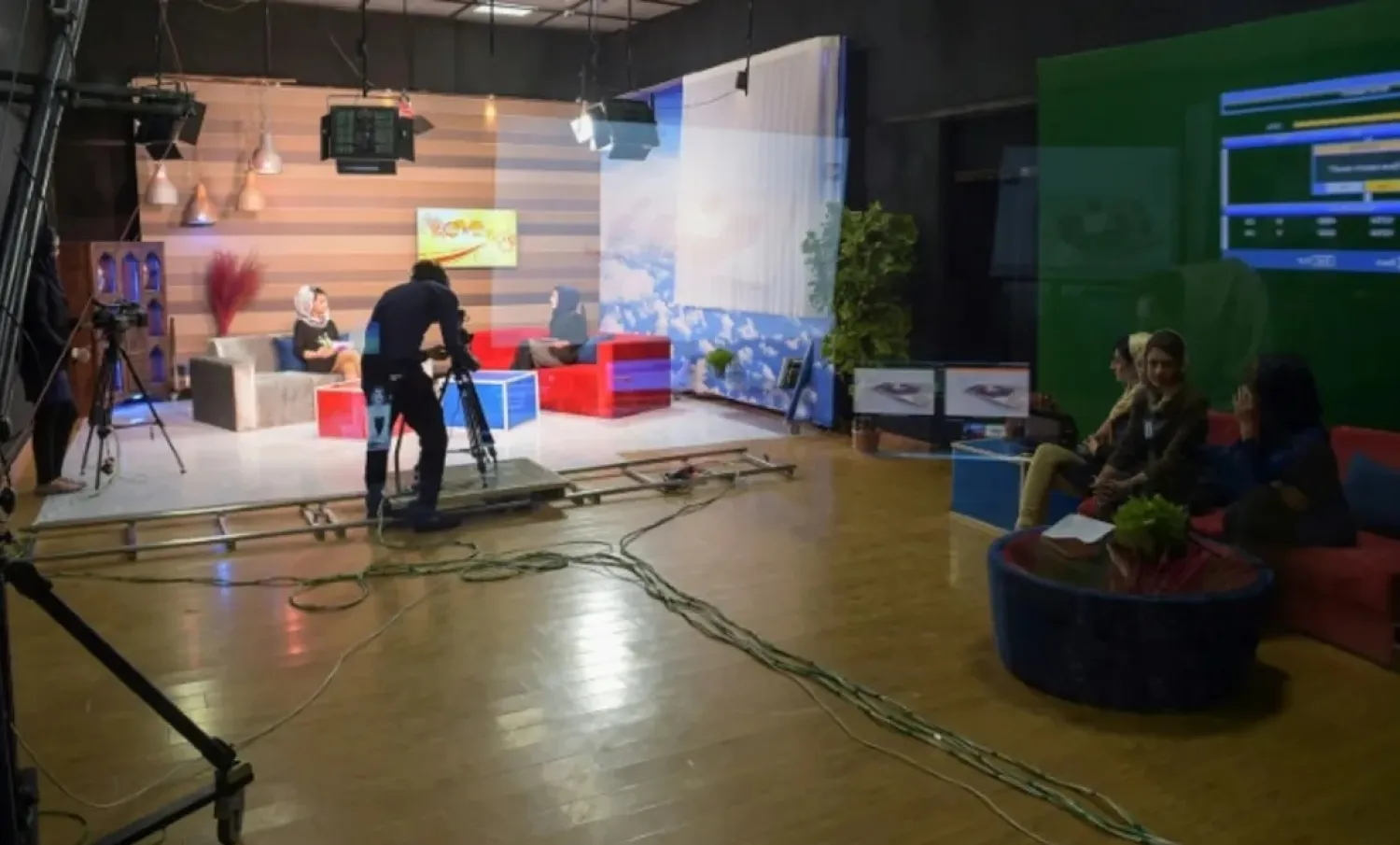

Women TV Presenters Defy Taliban Order to Cover Faces on Air

Afghan presenters record a morning TV program in Kabul in 2017. (AFP)
TT

Women TV Presenters Defy Taliban Order to Cover Faces on Air

Afghan presenters record a morning TV program in Kabul in 2017. (AFP)

Women presenters on Afghanistan's leading TV channels went on air Saturday without covering their faces, defying a Taliban order that they conceal their appearance to comply with the group's strict interpretation of Islam.

Since surging back to power last year the Taliban have imposed a slew of restrictions on civil society, many focused on reining in the rights of women and girls.

Earlier this month Afghanistan's supreme leader Hibatullah Akhundzada issued a diktat for women to cover up fully in public, including their faces, ideally with the traditional burqa.

The feared Ministry for Promotion of Virtue and Prevention of Vice ordered women TV presenters to follow suit by Saturday.

Previously they had only been required to wear a headscarf.

But broadcasters TOLOnews, Shamshad TV and 1TV all aired live programs Saturday with women presenters' faces visible.

"Our female colleagues are concerned that if they cover their faces, the next thing they will be told is to stop working," said Shamshad TV head of news Abid Ehsas.

"This is the reason they have not observed the order so far," he told AFP, adding the channel had requested further discussions with the Taliban on the issue.

Taliban orders such as this have caused many female journalists to leave Afghanistan since the hardliners stormed back to power, a woman presenter said.

"Their latest order has broken the hearts of women presenters and many now think they have no future in this country," she said, requesting not to be named.

"I'm thinking of leaving the country. Decrees like this will force many professionals to leave."

'Implement the order'

Mohammad Sadeq Akif Mohajir, spokesman for the vice ministry, said the women presenters were violating the Taliban directive.

"If they don't comply we will talk to the managers and guardians of the presenters," he told AFP.

"Anyone who lives under a particular system and government has to obey the laws and orders of that system, so they must implement the order," he said.

The Taliban have demanded that women government employees be fired if they fail to follow the new dress code.

Men working in government also risk suspension if their wives or daughters fail to comply.

Mohajir said media managers and the male guardians of defiant women presenters would also be liable for penalties if the order was not observed.

During two decades of US-led military intervention in Afghanistan, women and girls made marginal gains in the deeply patriarchal nation.

Soon after they took over, the Taliban promised a softer version of the harsh rule that characterized their first stint in power from 1996 to 2001.

Since the takeover, however, women have been banned from traveling alone and teenage girls barred from secondary schools.

In the 20 years after the Taliban were ousted from office in 2001, many women in the conservative countryside continued to wear a burqa.

But most Afghan women, including TV presenters, opted for the headscarf.

Television channels have already stopped showing dramas and soap operas featuring women, following orders from Taliban authorities.



France Accuses Iran of ‘Repression’ in Sentence for Nobel Laureate

People cross an intersection in downtown Tehran, Iran, Monday, Feb. 9, 2026. (AP)
TT

France Accuses Iran of ‘Repression’ in Sentence for Nobel Laureate

People cross an intersection in downtown Tehran, Iran, Monday, Feb. 9, 2026. (AP)

France accused Iran on Monday of "repression and intimidation" after a court handed Nobel Peace Prize laureate Narges Mohammadi a new six-year prison sentence on charges of harming national security.

Mohammadi, sentenced Saturday, was also handed a one-and-a-half-year prison sentence for "propaganda" against Iran's system, according to her foundation.

"With this sentence, the Iranian regime has, once again, chosen repression and intimidation," the French foreign ministry said in a statement, describing the 53-year-old as a "tireless defender" of human rights.

Paris is calling for the release of the activist, who was arrested before protests erupted nationwide in December after speaking out against the government at a funeral ceremony.

The movement peaked in January as authorities launched a crackdown that activists say has left thousands dead.

Over the past quarter-century, Mohammadi has been repeatedly tried and jailed for her vocal campaigning against Iran's use of capital punishment and the mandatory dress code for women.

Mohammadi has spent much of the past decade behind bars and has not seen her twin children, who live in Paris, since 2015.

Iranian authorities have arrested more than 50,000 people as part of their crackdown on protests, according to US-based Human Rights Activists News Agency (HRANA).


Iran's Supreme Leader Urges Iranians to Show 'Resolve' against Foreign Pressure

Iran's supreme leader Ali Khamenei on (File Photo/Supreme Leader's website).
TT

Iran's Supreme Leader Urges Iranians to Show 'Resolve' against Foreign Pressure

Iran's supreme leader Ali Khamenei on (File Photo/Supreme Leader's website).

Iran's supreme leader Ali Khamenei on Monday called on his compatriots to show "resolve" ahead of the anniversary of the 1979 Islamic revolution this week.

Since the revolution, "foreign powers have always sought to restore the previous situation", Ali Khamenei said, referring to the period when Iran was under the rule of shah Reza Pahlavi and dependent on the United States, AFP reported.

"National power is less about missiles and aircraft and more about the will and steadfastness of the people," the leader said, adding: "Show it again and frustrate the enemy."


UK PM's Communications Director Quits

British Prime Minister Keir Starmer delivers a speech at Horntye Park Sports Complex in St Leonards, Britain, February 05, 2026. Peter Nicholls/Pool via REUTERS
TT

UK PM's Communications Director Quits

British Prime Minister Keir Starmer delivers a speech at Horntye Park Sports Complex in St Leonards, Britain, February 05, 2026. Peter Nicholls/Pool via REUTERS

British Prime Minister Keir Starmer's director of communications Tim Allan resigned on Monday, a day after Starmer's top aide Morgan McSweeney quit over his role in backing Peter Mandelson over his known links to Jeffrey Epstein.

The loss of two senior aides ⁠in quick succession comes as Starmer tries to draw a line under the crisis in his government resulting from his appointment of Mandelson as ambassador to the ⁠US.

"I have decided to stand down to allow a new No10 team to be built. I wish the PM and his team every success," Allan said in a statement on Monday.

Allan served as an adviser to Tony Blair from ⁠1992 to 1998 and went on to found and lead one of the country’s foremost public affairs consultancies in 2001. In September 2025, he was appointed executive director of communications at Downing Street.