


Asian Markets Mixed as Inflation Fears Weigh

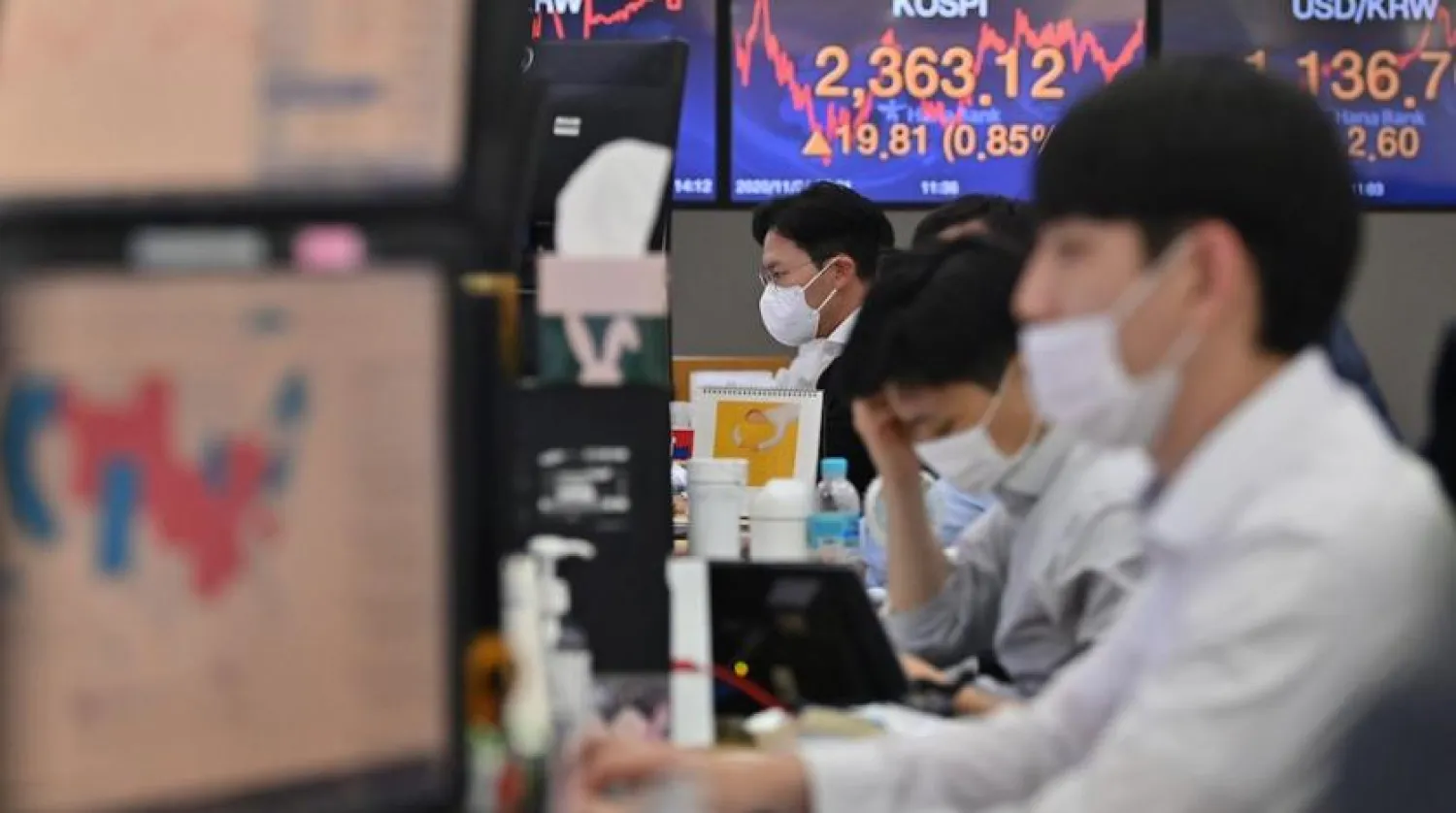
File: Traders looking at stock exchange graphs. AFP/Jung Yeon-je
TT

Asian Markets Mixed as Inflation Fears Weigh

File: Traders looking at stock exchange graphs. AFP/Jung Yeon-je

Asian stocks were mixed Monday as inflation fears and concerns about low economic growth weighed on markets.

Investors will be looking to the release on Wednesday of notes from the latest Federal Reserve committee meeting for clues on further rate hikes by the US central bank.

Wall Street ended the week essentially flat after the S&P 500 had briefly dipped into a bear market, with the index down about 19 percent from its January high, AFP said.

A Chinese interest rate cut did little to cheer Asian markets, with investors concerned about continuing Covid restrictions that are hurting the world's second-largest economy and snarling international supply chains.

Downcast earning reports from retailers have also heightened market uncertainty at a time of rising interest rates, surging energy prices and Russia's ongoing war on Ukraine, which is driving commodity prices higher.

"As macro-economic concerns stemming from aggressive monetary tightening, the Russia-Ukraine conflict and China's stringent Covid lockdowns persist, we anticipate great volatility in the market," Louise Dudley, portfolio manager global equities at Federated Hermes, said in a note, Bloomberg News reported.

In Asian trade Monday, Tokyo climbed 1.3 percent while Hong Kong slipped 1.5 percent and Shanghai was down 0.5 percent.

Seoul, Kuala Lumpur and Bangkok were higher while Singapore and Manila were down and Sydney was flat following a weekend election that saw the center-left Labor party end a decade of conservative rule.

The new government of Prime Minister Anthony Albanese is expected to undertake some policy shifts, particularly on climate change, but economists said they were unlikely to upset growth forecasts.

"In our view there was little proposed by the incoming government during the election campaign that at this stage requires us to revisit our economic forecasts," Commonwealth Bank of Australia economists said in a note.

"Put another way, our economic forecasts and call on the (Australian central bank) are unchanged despite the change of national leadership."

Oil was higher, with US crude benchmark WTI up 0.5 percent and Brent gaining 0.7 percent.

The invasion of Ukraine has shaken up the global market and the outlook for key producer Russia, which has been largely shunned by Western countries.

- Key figures at around 0300 GMT -
Tokyo - Nikkei 225: UP 1.3 percent at 26,872.01 (break)

Hong Kong - Hang Seng Index: DOWN 1.5 percent at 20,416.04

Shanghai - Composite: DOWN 0.5 percent at 3,131.23

Dollar/yen: DOWN at 127.30 from 127.86 yen on Friday

Euro/dollar: UP at $1.0592 from $1.0564

Pound/dollar: UP at $1.2543 from $1.2497

Euro/pound: DOWN at 84.45 from 84.50 pence

West Texas Intermediate: UP 0.5 percent at $110.81 per barrel

Brent North Sea crude: UP 0.7 percent at $113.29 per barrel

New York - Dow: FLAT at 31,261.90 (close)

London - FTSE 100: UP 1.2 percent at 7,389.98 (close)


Saudi-Polish Investment Forum Explores Prospects for Economic and Investment Cooperation

The forum brought together government officials, business leaders, and investors from both countries with the aim of enhancing economic cooperation - SPA
TT

Saudi-Polish Investment Forum Explores Prospects for Economic and Investment Cooperation

The forum brought together government officials, business leaders, and investors from both countries with the aim of enhancing economic cooperation - SPA

The Saudi-Polish Investment Forum was held today at the headquarters of the Federation of Saudi Chambers in Riyadh, with the participation of Minister of Investment Khalid Al-Falih, Minister of Finance of the Republic of Poland Andrzej Domański, and Vice President of the Federation of Saudi Chambers Emad Al-Fakhri.

The forum brought together government officials, business leaders, and investors from both countries with the aim of enhancing economic cooperation, expanding investment partnerships in priority sectors, and exploring high-quality investment opportunities that support sustainable growth in Saudi Arabia and Poland.

During a dedicated session, the forum reviewed economic and investment prospects in both countries through presentations highlighting promising opportunities, investment enablers, and supportive legislative environments.

Several specialized roundtables addressed strategic themes, including the development of the digital economy, with a focus on information and communication technologies (ICT), financial technologies (fintech), and artificial intelligence-driven innovation, SPA reported.

Discussions also covered the development of agricultural value chains from production to market access through advanced technologies, food processing, and agricultural machinery. In addition, participants examined ways to enhance the construction sector by developing systems and materials, improving execution efficiency, and accelerating delivery timelines. Energy security issues and the role of industrial sectors in supporting economic transformation and sustainability were also discussed.

The forum witnessed the announcement of two major investment agreements. The first aims to establish a framework for joint cooperation in supporting investment, exchanging information and expertise, and organizing joint business events to strengthen institutional partnerships.

The second agreement focuses on supporting reciprocal investments through the development of financing and insurance tools and the stimulation of joint ventures to boost investment flows.

The forum concluded by emphasizing the importance of continued coordination and dialogue between the public and private sectors in both countries to deepen Saudi-Polish economic relations and advance shared interests.


Gold Rises as Dollar Slips, Focus Turns to US Jobs Data

FILE PHOTO: An employee places ingots of 99.99 percent pure gold in a workroom at the Novosibirsk precious metals refining and manufacturing plant in the Siberian city of Novosibirsk, Russia, September 15, 2023. REUTERS/Alexander Manzyuk/File Photo
TT

Gold Rises as Dollar Slips, Focus Turns to US Jobs Data

FILE PHOTO: An employee places ingots of 99.99 percent pure gold in a workroom at the Novosibirsk precious metals refining and manufacturing plant in the Siberian city of Novosibirsk, Russia, September 15, 2023. REUTERS/Alexander Manzyuk/File Photo

Gold prices rose on Monday, buoyed by a softer dollar as investors braced for a week packed with US economic data that could offer more clues on the US Federal Reserve's monetary policy.

Spot gold rose 1.2% to $5,018.56 per ounce by 9:30 a.m. ET (1430 GMT), extending a 4% rally from Friday.

US gold futures for April delivery also gained 1.3% to $5,042.20 per ounce.

The US dollar fell 0.8% to a more than one-week low, making greenback-priced bullion cheaper for overseas buyers.

"The big mover today (in gold prices) is the US dollar," said Bart Melek, global head of commodity strategy at TD Securities, adding that expectations are growing for weak economic data, particularly on the labor front, Reuters reported.

Investors are closely watching this week's release of US nonfarm payrolls, consumer prices and initial jobless claims for fresh signals on monetary policy, with markets already pricing in at least two rate cuts of 25 basis points in 2026.

US nonfarm payrolls are expected to have risen by 70,000 in January, according to a Reuters poll.

Lower interest rates tend to support gold by reducing the opportunity cost of holding the non-yielding asset.

Meanwhile, China's central bank extended its gold buying spree for a 15th month in January, data from the People's Bank of China showed on Saturday.

"The debasement trade continues, with ongoing geopolitical risks driving people into gold," Melek said, adding that China's purchases have had a psychological impact on the market.

Spot silver climbed 2.9% to $80.22 per ounce after a near 10% gain in the previous session. It hit an all-time high of $121.64 on January 29.

Spot platinum was down 0.2% at $2,092.95 per ounce, while palladium was steady at $1,707.25.

"A slowdown in EV sales hasn't really materialized despite all the policy softening, so I do see that platinum and palladium will possibly slow down," after a bullish run in 2025, WisdomTree commodities strategist Nitesh Shah said.


Al-Rumayyan: PIF Investments in Local Content Exceed $157 Billion

Yasir Al-Rumayyan speaks to the audience in the opening speech of the Public Investment Fund Private Sector Forum (Asharq Al-Awsat)
TT

Al-Rumayyan: PIF Investments in Local Content Exceed $157 Billion

Yasir Al-Rumayyan speaks to the audience in the opening speech of the Public Investment Fund Private Sector Forum (Asharq Al-Awsat)

Yasir Al-Rumayyan, governor of Saudi Arabia’s Public Investment Fund (PIF), announced that spending by the sovereign fund’s programs, initiatives, and companies on local content reached 591 billion riyals ($157 billion) between 2020 and 2024.

He added that the fund’s private sector platform has created more than 190 investment opportunities worth over 40 billion riyals ($10 billion).

Speaking at the opening of the PIF Private Sector Forum on Monday in Riyadh, Al-Rumayyan said the fund is working closely with the private sector to deepen the impact of previous achievements and build an integrated economic system that drives sustainable growth through a comprehensive investment cycle methodology.

He described the forum as the largest platform of its kind for seizing partnership and collaboration opportunities with the private sector, highlighting the fund’s success in turning discussions into tangible projects.

Since 2023, the forum has attracted 25,000 participants from both public and private sectors and has witnessed the signing of over 140 agreements worth more than 15 billion riyals, he pointed out.

Al-Rumayyan emphasized that the meeting comes at a pivotal stage of the Kingdom’s economy, where competitiveness will reach higher levels, sectors and value chains will mature, and ambitions will be raised.

PIF Private Sector Forum aims to support the fund’s strategic initiative to engage the private sector, showcase commercial opportunities across PIF and its portfolio companies, highlight potential prospects for investors and suppliers, and enhance cooperation to strengthen the local economy.
