

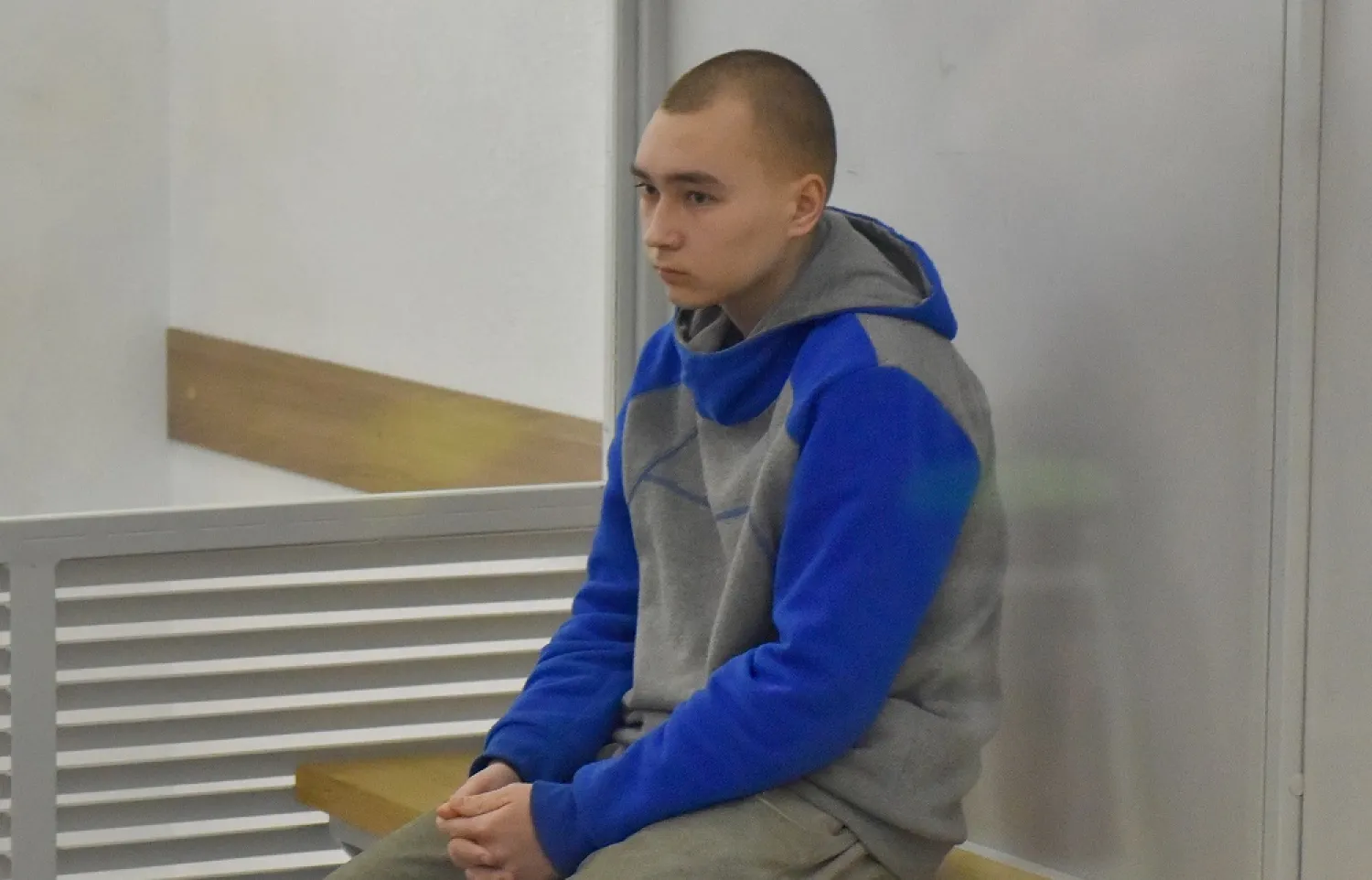

Russian Sentenced to Life in Ukraine’s 1st War Crimes Trial

Russian serviceman Vadim Shishimarin attends a court hearing in the Solomyansky district court in Kyiv, Ukraine, 23 May 2022. (EPA)
TT

Russian Sentenced to Life in Ukraine’s 1st War Crimes Trial

Russian serviceman Vadim Shishimarin attends a court hearing in the Solomyansky district court in Kyiv, Ukraine, 23 May 2022. (EPA)

A captured Russian soldier who pleaded guilty to killing a Ukrainian civilian was sentenced Monday to life in prison - the maximum - in the first war crimes trial since Moscow invaded Ukraine three months ago.

Meanwhile, in a rare public expression of opposition to the war from the ranks of the Russian elite, a veteran Kremlin diplomat resigned and sent a scathing letter to foreign colleagues in which he said, "Never have I been so ashamed of my country as on Feb. 24 of this year."

Ukrainian President Volodymyr Zelenskyy called for "maximum" sanctions against Russia in a video address to world leaders and executives at the World Economic Forum in Davos, Switzerland.

On the battlefield, heavy fighting raged in the Donbas in the east, where Moscow's forces have stepped up their bombardments. Cities not under Russian control were constantly shelled, and one Ukrainian military official said Russian forces targeted civilians trying to flee.

In the first in what could be multitudes of similar prosecutions, Russian Sgt. Vadim Shishimarin, 21, was sentenced for the killing of a a 62-year-old man who was shot in the head in a village in the northeastern Sumy region in the early days of the war. Shishimarin, a member of a tank unit, apologized to the man's widow in court.

His Ukraine-appointed defense attorney, Victor Ovsyanikov, argued his client had been unprepared for the "violent military confrontation" and mass casualties that Russian troops encountered when they invaded. He said he would appeal.

Ukrainian civil liberties advocate Volodymyr Yavorskyy said it was "an extremely harsh sentence for one murder during the war." But Aarif Abraham, a British-based human rights lawyer, said the trial was conducted "with what appears to be full and fair due process," including access to an attorney

Ukrainian prosecutors are investigating thousands of potential war crimes. Russian forces in Mariupol bombed a theater where civilians were sheltering and struck a maternity hospital. In the wake of Moscow’s withdrawal from around Kyiv weeks ago, mass graves were discovered and streets were strewn with bodies in towns such as Bucha.

Other, more difficult cases may need to go to the International Criminal Court at The Hague, in the Netherlands, said Abraham, who specializes in international criminal law at Garden Court North Chambers in Manchester.

Shishimarin had told the court that he at first disobeyed his immediate commanding officer’s order to shoot the unarmed civilian but had no choice but to follow the order when it was repeated forcefully by another officer.

Abraham, however, noted that following a order is not a defense under the law.

Before the sentencing, Kremlin spokesman Dmitry Peskov said that Moscow was unable to defend the soldier "on the ground" but will consider trying to do so "through other channels."

Russia and its allies have threatened to bring war crimes charges against Ukrainian soldiers, including the fighters who defended the steel plant in the ruined city of Mariupol before surrendering last week.

Russian authorities have repeatedly leveled vague accusations of war crimes against the fighters and have seized upon the far-right origins of one of the regiments there.

Family members of the fighters have pleaded for them to be given rights as prisoners of war and eventually returned to Ukraine. Russian Deputy Foreign Minister Andrei Rudenko said he is open to "any possibility that doesn’t contradict common sense."

Meanwhile, Boris Bondarev, a veteran Russian diplomat to the UN office at Geneva, resigned and sent a letter railing against the "aggressive war unleashed" by Russian President Vladimir Putin.

In a rare, if not unprecedented, case public criticism from Russia's diplomatic corps, Bondarev, 41, told The Associated Press: "It is intolerable what my government is doing now."

In his letter, Bondarev said those who conceived the war "want only one thing - to remain in power forever, live in pompous tasteless palaces, sail on yachts comparable in tonnage and cost to the entire Russian Navy, enjoying unlimited power and complete impunity."

He also said Russia's Ministry of Foreign Affairs is all about "warmongering, lies and hatred."

At the Davos forum, Zelenskyy said sanctions against the Kremlin need to go further. He urged an embargo on Russian oil, a complete cutoff of trade with Russia and a withdrawal of foreign companies from the country.

"This is what sanctions should be: They should be maximum, so that Russia and every other potential aggressor that wants to wage a brutal war against its neighbor would clearly know the immediate consequences of their actions," said Zelenskyy, who received a standing ovation.

On the battlefield, Russian forces increased bombardments in the Donbas, the eastern industrial heartland of coal mines and factories that Russia is bent on capturing.

The chief of the Donetsk regional military administration, Pavlo Kyrylenko, said heavy fighting continued near the Luhansk region, with Russian forces "trying to break through and capture Lyman city so as to perform its offensive toward Sloviansk and Kramatorsk." The Donbas consists of the Donetsk and Luhansk regions.

He said the Russian forces were decimating cities in their attempt to take them over. He said: "The main thing is to stop the enemy and then we can think about liberating the territories."

He said that only about 320,000 people out of the region's prewar population of 1.6 million remain and that Russian forces continue to target evacuation efforts.

"They are killing us, they are killing the locals during evacuation," Kyrylenko said.

"We haven’t been able to see the sun for three months. We are almost blind because we were in darkness for three months," said Rayisa Rybalko, who hid with her family first in their basement and then in a bomb shelter at the local school before fleeing their village of Novomykhailivka. "The world should have seen that."

Her son-in-law Dmytro Khaliapin said heavy artillery pounded the village. "Houses are being ruined," he said. "It’s a horror."



Trump Hints at Land Strike as Venezuela Pressure Mounts

A US Air Force C-130J Super Hercules aircraft approaches for landing at Rafael Hernandez Airport, amid tensions between US President Donald Trump's administration and the government of Venezuelan President Nicolas Maduro, in Aguadilla, Puerto Rico, December 28, 2025. (Reuters)
TT

Trump Hints at Land Strike as Venezuela Pressure Mounts

A US Air Force C-130J Super Hercules aircraft approaches for landing at Rafael Hernandez Airport, amid tensions between US President Donald Trump's administration and the government of Venezuelan President Nicolas Maduro, in Aguadilla, Puerto Rico, December 28, 2025. (Reuters)

A throwaway remark last week by President Donald Trump has raised questions about whether US forces may have carried their first land strike against drug cartels in Venezuela.

Trump said the US knocked out a "big facility" for producing trafficking boats, as he was discussing his pressure campaign against Venezuelan President Nicolas Maduro in an interview broadcast Friday.

"They have a big plant or a big facility where they send, you know, where the ships come from," Trump said in an interview with billionaire supporter John Catsimatidis on the WABC radio station in New York.

"Two nights ago we knocked that out. So we hit them very hard."

Trump did not say where the facility was located or give any other details. US forces have carried out numerous strikes in both the Caribbean Sea and eastern Pacific Ocean since September, killing more than 100 people.

The Pentagon referred questions about Trump's remarks to the White House. The White House did not respond to requests for comment from AFP.

There has been no official comment from the Venezuelan government.

Trump has been saying for weeks that the United States will "soon" start carrying out land strikes targeting drug cartels in Latin America, but there have been no confirmed attacks to date.

The Trump administration has been ramping up pressure on Maduro, accusing the Venezuelan leader of running a drug cartel himself and imposing an oil tanker blockade.

Maduro has accused Washington of attempting regime change.


UN Chief Says ‘Get Serious’ in Grim New Year Message

 UN Secretary-General Antonio Guterres. (AFP)
UN Secretary-General Antonio Guterres. (AFP)
TT

UN Chief Says ‘Get Serious’ in Grim New Year Message

 UN Secretary-General Antonio Guterres. (AFP)
UN Secretary-General Antonio Guterres. (AFP)

The United Nations urged global leaders Monday to focus on people and the planet in a New Year's message depicting the world in chaos.

"As we enter the new year, the world stands at a crossroads. Chaos and uncertainty surround us. Division. Violence. Climate breakdown. And systemic violations of international law," UN Secretary-General Antonio Guterres said in a video message.

In 2026, as war rages in Ukraine and elsewhere, world leaders must work to ease human suffering and fight climate change, he added.

"I call on leaders everywhere: Get serious. Choose people and planet over pain," said Guterres, criticizing the global imbalance between military spending and financing for the poorest countries.

Military spending is up nearly 10 percent this year to $2.7 trillion, which is 13 times total world spending on development aid and equivalent to the entire gross domestic product of Africa, he said.

Wars are raging at levels unseen since World War II, he added.

"In this New Year, let's resolve to get our priorities straight. A safer world begins by investing more in fighting poverty and less in fighting wars. Peace must prevail," said Guterres, who will be serving his last year as secretary general.


Türkiye and Armenia Agree to Simplify Visa Procedures to Normalize Ties

Türkiye’s President Recep Tayyip Erdogan, right, and Armenia's Prime Minister Nikol Pashinyan shake hands before a meeting at Prague Castle in Prague, Czech Republic, Thursday, Oct. 6, 2022. (Turkish Presidency via AP, File)
TT

Türkiye and Armenia Agree to Simplify Visa Procedures to Normalize Ties

Türkiye’s President Recep Tayyip Erdogan, right, and Armenia's Prime Minister Nikol Pashinyan shake hands before a meeting at Prague Castle in Prague, Czech Republic, Thursday, Oct. 6, 2022. (Turkish Presidency via AP, File)

Türkiye and Armenia have agreed to simplify visa procedures as part of efforts to normalize ties, Türkiye’s Foreign Ministry announced Monday, making it easier for their citizens to travel between the two countries.

Relations between Türkiye and Armenia have long been strained by historic grievances and Türkiye’s alliance with Azerbaijan. The two neighboring countries have no formal diplomatic ties and their joint border has remained closed since the 1990s.

The two countries, however, agreed to work toward normalization in 2021, appointing special envoys to explore steps toward reconciliation and reopening the frontier. Those talks have progressed in parallel with efforts to ease tensions between Armenia and Azerbaijan.

Türkiye supported Azerbaijan during its 2020 conflict with Armenia for control of the Karabakh region, known internationally as Nagorno-Karabakh, a territorial dispute that had lasted nearly four decades.

The Turkish Foreign Ministry said in a statement posted on social platform X that Ankara and Yerevan agreed that holders of diplomatic, special and service passports from both countries would be able to obtain electronic visas free of charge as of Jan. 1.

“On this occasion, Türkiye and Armenia reaffirm once again their commitment to continue the normalization process between the two countries with the goal of achieving full normalization without any preconditions,” the ministry said.

Türkiye and Armenia also have a more than century-old dispute over the deaths of an estimated 1.5 million Armenians in massacres, deportations and forced marches that began in 1915 in Ottoman Türkiye. Historians widely view the event as genocide.

Türkiye denies the deaths constituted genocide, saying the toll has been inflated and those killed were victims of civil war and unrest. It has lobbied to prevent countries from officially recognizing the massacres as genocide.