The UAE government announced the signing of an agreement with WEF in the development of applications of the Fourth Industrial Revolution. (Asharq Al-Awsat)
The UAE government announced the signing of an agreement with WEF in the development of applications of the Fourth Industrial Revolution. (Asharq Al-Awsat)
The UAE government has launched the "Markets of Tomorrow" initiative, in partnership with the World Economic Forum (WEF).
The initiative aims to develop new business accelerators that will prepare the UAE's national economy to embrace business activities focused on the new economy and boost its readiness to enter tomorrow's markets, utilizing the latest technological means.
The launch of the initiative is part of a comprehensive strategic partnership agreement between the UAE Ministry of Economy and WEF's New Economy and Society Center.
The UAE government also announced the signing of an agreement with WEF in the development of applications of the Fourth Industrial Revolution.
The deal was signed in the presence of Omar bin Sultan Al Olama, Minister of State for Artificial Intelligence, Digital Economy and Remote Work Applications, Deputy Managing Director of Dubai Future Foundation, Jeremy Jurgens, Managing Director & Head of the Forum's Center for the Fourth Industrial Revolution, and Sebastian Buckup, Head of Network and Partnerships, Member of the Executive Committee, WEF.
Al Olama stressed that the strategic partnership between the UAE government and WEF aims to serve communities by employing artificial intelligence, blockchain and various technologies of the future, and sharing innovative experiences and practices to provide supportive environments for the development of new ideas and projects that accelerate the process of scientific, technological, and cognitive progress.
Khalfan Belhoul, CEO of Dubai Future Foundation, said that the Center for the Fourth Industrial Revolution shapes new policies and strategies in areas such as artificial intelligence, blockchain and digital assets, among others.
Al-Jadaan: Saudi Investments in Alternative Routes Ensure Continuity of Energy Supplies and Tradehttps://english.aawsat.com/business/5329894-al-jadaan-saudi-investments-alternative-routes-ensure-continuity-energy-supplies
Al-Jadaan: Saudi Investments in Alternative Routes Ensure Continuity of Energy Supplies and Trade
General view of the Kingdom Tower in downtown Riyadh, Saudi Arabia, October 12, 2026. Picture taken with a mobile phone. REUTERS
Saudi Finance Minister Mohammed Al-Jadaan said the Kingdom’s investments in alternative routes have helped ensure the continuity of energy supplies and trade flows amid uncertainty.
He stressed that strengthening economic resilience requires diversifying sources of economic strength, protecting the foundations of growth, and maintaining the capacity to deal with recurring and prolonged disruptions.
Speaking at the third meeting of G20 Finance Ministers and Central Bank Governors under the US presidency, held Thursday in Bangkok, Al-Jadaan said the global economy had demonstrated an ability to adapt to repeated disruptions. He explained that resilience is fundamental to this adaptability, but strengthening it requires an understanding of its cost, how it can be developed, and how it should be financed.
He said the success of economic policies in confronting shocks is not limited to mitigating the impact of current challenges. It also depends on preserving the ability to support future ambitions and sustain the long-term path of economic transformation, while maintaining sufficient buffers to deal with any new developments that may arise.
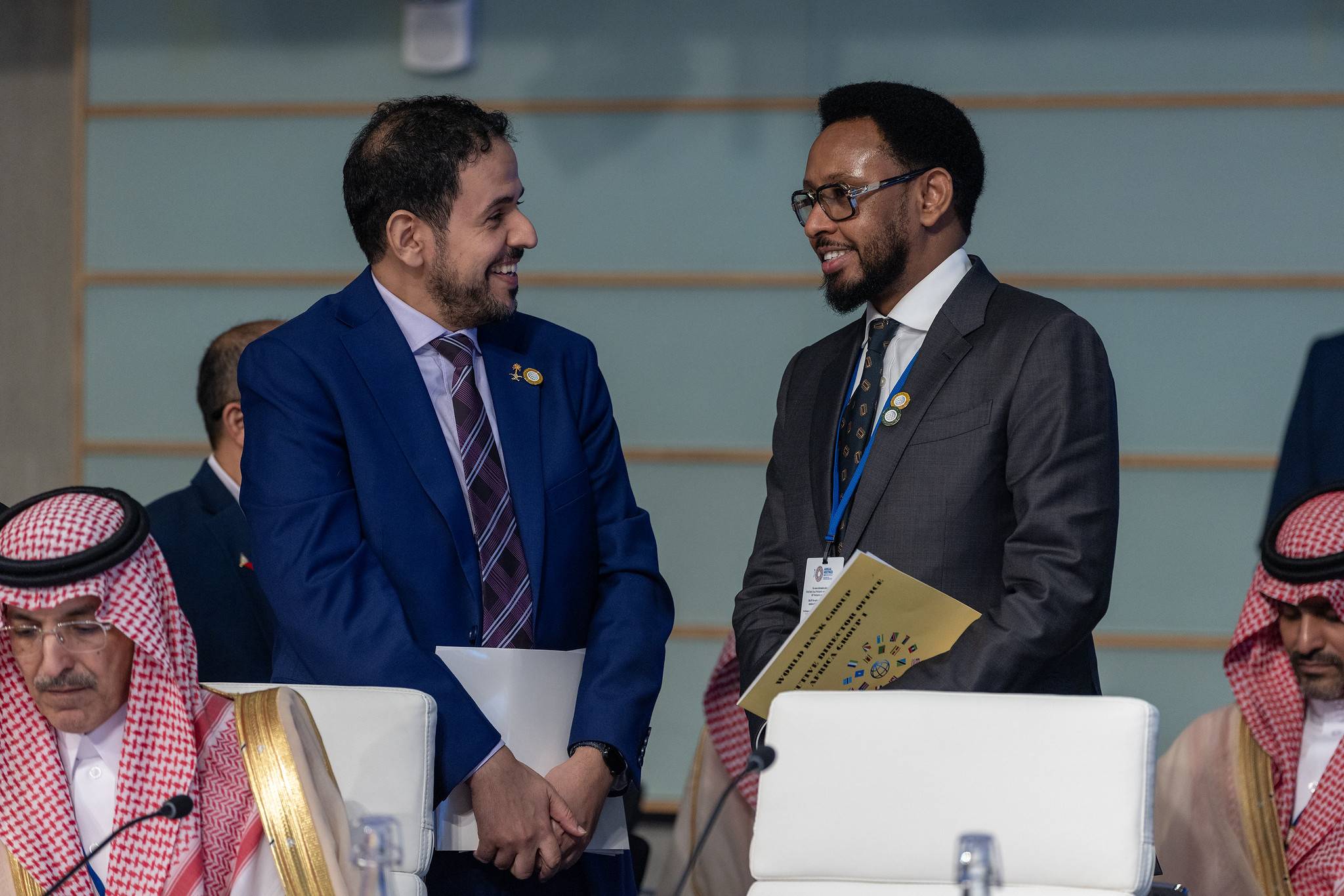
Al-Jadaan participates in one of the sessions at the annual meetings of the IMF and World Bank in Bangkok (IMF)
The Finance Minister stressed that fiscal policies must protect the foundations of growth, highlighting the importance of effective international cooperation in achieving economic stability.
He said access to reliable and affordable energy, along with the uninterrupted flow of essential goods, helps contain price pressures and ease the burden on national budgets, thereby strengthening countries’ ability to navigate uncertainty.
In this context, Al-Jadaan said the Kingdom, through its investments in alternative routes, has helped ensure the continuity of energy supplies and trade flows amid disruptions. This underscores the importance of infrastructure and transportation and supply routes in strengthening economies’ ability to withstand shocks and limiting their impact on markets and the flow of essential goods.
Managing Shocks and Strengthening Resilience
Discussing ways to enhance economic resilience, Al-Jadaan said dealing with prolonged shocks depends not only on the size of the buffers available to countries, but also on how these buffers are managed over time, while preserving sufficient capacity to respond to future developments.
He noted that strengthening economic resilience requires reducing exposure to risks through economic diversification, reinforcing energy and food security, and developing more resilient supply chains and infrastructure. These priorities have become increasingly important amid recurring disruptions affecting trade flows, the availability of essential goods, and the cost of obtaining them.
Al-Jadaan also addressed artificial intelligence, noting that it has evolved beyond a purely technological issue to become part of a broader agenda aimed at achieving sustainable growth and strengthening economic resilience. This reflects the expanding scope of policies required to build economies capable of adapting to change while preserving opportunities for long-term growth and transformation.
The Role of International Financial Institutions
The Finance Minister emphasized the important role played by multilateral financial institutions in helping economies that are most vulnerable to risk cope with financing pressures through financial and technical support programs and policy advice, thereby strengthening their ability to withstand shocks and maintain economic stability.
Al-Jadaan concluded his participation in the third meeting of G20 Finance Ministers and Central Bank Governors, held on the sidelines of the 2026 Annual Meetings of the International Monetary Fund and the World Bank Group in Thailand.
He met with a number of officials, heads of international financial institutions, and representatives of credit rating agencies. The meetings addressed developments in the global economy and policies aimed at supporting its stability, while also reviewing developments and reforms in the Saudi economy as part of the Kingdom’s efforts to strengthen its presence in international economic and financial dialogue.
Saudi Cybersecurity Market Tops $4.3 Billion in 2025https://english.aawsat.com/business/5329875-saudi-cybersecurity-market-tops-43-billion-2025
Saudi Cybersecurity Market Tops $4.3 Billion in 2025
Employees working on computers (National Cybersecurity Authority).
Saudi Arabia’s cybersecurity market reached SAR 16.3 billion ($4.3 billion) in 2025, recording a compound annual growth rate of 10.7% over the past three years, according to a new report by the National Cybersecurity Authority (NCA).
Government spending on cybersecurity products and services totaled SAR 5.1 billion, accounting for 31% of the market, while private sector expenditure reached SAR 11.2 billion, representing 69%.
The figures were released in the NCA’s report, Key Economic Indicators in Saudi Arabia’s Cybersecurity Sector 2026, which examines market size, the sector’s contribution to gross domestic product, workforce trends and other measures of growth.
Contribution to GDP
The cybersecurity sector contributed approximately SAR 20 billion to Saudi Arabia’s GDP at current prices in 2025, registering a compound annual growth rate of 13.2%, the authority reported.
Of that amount, SAR 9.7 billion represented the direct contribution of cybersecurity products and service providers, while indirect contributions totaled SAR 10.3 billion.
The sector accounted for 0.42% of the Kingdom’s overall GDP and 0.71% of non-oil GDP.
The cybersecurity workforce exceeded 22,000 specialists last year, reflecting a compound annual growth rate of 5.9%.
The report linked this expansion to specialized training initiatives and programs designed to meet the needs of vital sectors and support economic and social development.
Women accounted for 33% of cybersecurity professionals in Saudi Arabia, surpassing the global participation rate of approximately 22%.
Spending on products and services
Cybersecurity products accounted for 51% of total market spending, valued at SAR 8.3 billion, while services represented 49%, or SAR 7.9 billion.
The report identified key areas of spending, including endpoint security and management, cybersecurity systems integration, network security, data security and security operations solutions.
Public-private cooperation
The NCA highlighted efforts to strengthen competitiveness, encourage investment and innovation, and promote cooperation between the public and private sectors as key drivers of market growth.
The study classified cybersecurity offerings into 100 products and services, drawing on internationally recognized methodologies, standards and practices.
The NCA is Saudi Arabia’s designated cybersecurity authority and national reference body, tasked with protecting the Kingdom’s vital interests, national security, critical infrastructure, priority sectors, and government services and activities.
Its responsibilities also include stimulating industry growth, promoting innovation and investment, conducting research and development, and issuing periodic reports on cybersecurity at the national and sectoral levels.
Bank of England's Breeden: Cost-cutting by Firms Helping Central Bankhttps://english.aawsat.com/business/5329842-bank-englands-breeden-cost-cutting-firms-helping-central-bank
FILE PHOTO: Deputy Governor for Financial Stability, Sarah Breeden during the Bank of England financial stability report press conference, at the Bank of England, London. Picture date: Tuesday July 7, 2026. Doug Peters/Pool via REUTERS/File Photo
Bank of England's Breeden: Cost-cutting by Firms Helping Central Bank
FILE PHOTO: Deputy Governor for Financial Stability, Sarah Breeden during the Bank of England financial stability report press conference, at the Bank of England, London. Picture date: Tuesday July 7, 2026. Doug Peters/Pool via REUTERS/File Photo
Bank of England Deputy Governor Sarah Breeden said on Thursday that cost-cutting by UK companies in response to the energy price shock caused by the Iran war would make it easier for the central bank to contain inflation.
"What's really different now, relative to when we had the last energy shock in 2022, is that people aren't looking to push costs through," Breeden said in an interview with CNBC television.
"There's a desire to absorb the shock rather than just pass it on, which makes our job as monetary policymakers a bit easier in these uncertain times,” Reuters quoted her as saying
The comments about cost-cutting by companies echoed those made by BoE Governor Andrew Bailey earlier this week.
Breeden has voted with the majority of the Monetary Policy Committee to keep borrowing costs on hold since the start of the Iran war but said in September that she might change her stance if the energy price shock feeds through into broader inflation.
Investors are pricing a quarter-point rate hike by the BoE next month as a near certainty.
Breeden, in Bangkok for the semi-annual International Monetary Fund meetings, also told CNBC she hoped wages would not rise sharply as they did in 2022 after Russia's full-scale invasion of Ukraine due to weakness in the labor market now.
Earlier on Thursday, BoE Chief Economist Huw Pill said a rate hike by the central bank should not be interpreted by investors as the start of a long series of increases.
لم تشترك بعد
انشئ حساباً خاصاً بك لتحصل على أخبار مخصصة لك ولتتمتع بخاصية حفظ المقالات وتتلقى نشراتنا البريدية المتنوعة