Cholita Mona Lisa: Bolivian Artist Gives Famed Portrait Indigenous Makeover

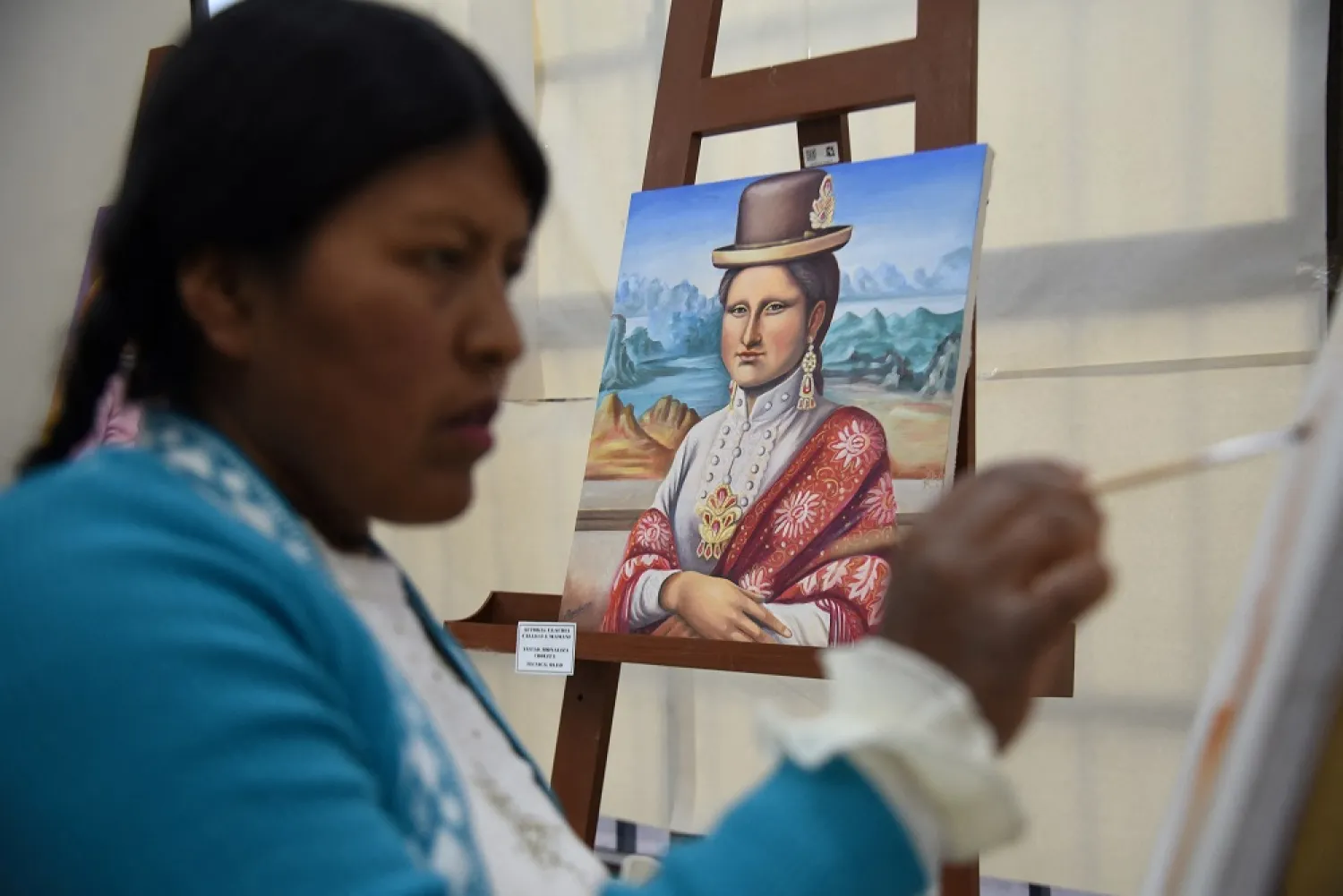
Claudia Callizaya, 32, a Bolivian painter known as Claudina, works on cholita-style Mona Lisa painting, at the El Alto Public University, in El Alto, Bolivia May 21, 2022. Picture taken May 21, 2022. (Reuters)
TT

Cholita Mona Lisa: Bolivian Artist Gives Famed Portrait Indigenous Makeover

Claudia Callizaya, 32, a Bolivian painter known as Claudina, works on cholita-style Mona Lisa painting, at the El Alto Public University, in El Alto, Bolivia May 21, 2022. Picture taken May 21, 2022. (Reuters)

High in Bolivia's Andean mountains, surrounded by small thatched roofed houses and sheep, Claudia Callizaya, 32, makes the final brushstroke to her newest piece of art: a take on the "Mona Lisa" as a local indigenous cholita woman.

Her adaptation has the same steady gaze as in Leonardo da Vinci's masterpiece portrait and a similar nose. But on her head is the traditional bowler hat of Bolivia's cholitas and she is wrapped in a colorful Andean shawl.

"There are many women in the world, with different types of clothing. I'm Cholita, and I said the Mona Lisa has to be a Cholita, just like me," Callizaya said.

Callizaya's love of art began when she used stones from the fields near her home to paint on. Now the single mother of two paints on canvas after getting a college degree in fine art.

Cholitas, usually indigenous Aymara or Quechua women, are generally from poor farming communities and have long faced marginalization in the Andean nation, which has the highest percentage of indigenous people in Latin America.

She originally wanted to be a teacher, first studying education at a public college in El Alto, but found her vocation taking classes in art history where she learned about famous works like the "Venus de Milo" sculpture and the Mona Lisa.

At the college, she came up with the idea of incorporating famous icons of feminine beauty with the features and clothing of Aymara women like herself.

"I painted the Mona Lisa, with earrings, a cholita hat, and a blanket ..., dressing the Mona Lisa as an Andean woman," she said. The portrait featured Bolivian aguayo cloth, a multi-colored material often used to carry infants.

Callizaya's family fully embraces her ambitions.

"When I see my daughter drawing and painting, I feel really happy," said Marcelina Mamani, her elderly mother. "I always cried and asked God to give her this gift."

Since April, Callizaya has moved away from farming to work full time at the local ministry of culture, and sold one of her two Cholita Mona Lisa paintings in a student exhibition.


Freezing Rain Paralyses Transport in Central Europe

Smoke from chimneys billows over snow-covered rooftops during sunrise as freezing temperatures have hit the country, in Prague, Czech Republic, January 11, 2026. (Reuters)
TT

Freezing Rain Paralyses Transport in Central Europe

Smoke from chimneys billows over snow-covered rooftops during sunrise as freezing temperatures have hit the country, in Prague, Czech Republic, January 11, 2026. (Reuters)

Freezing rain led to flights being suspended at Vienna airport on Tuesday, while neighboring Slovakia, Czech Republic and Hungary also experienced travel disruptions.

Snow and freezing temperatures buffeted Europe last week, with gale-force winds and storms claiming some 15 lives, causing travel mayhem, shutting schools, and cutting power to hundreds of thousands.

A thick layer of ice on the Vienna airport runways led to arriving flights being diverted to other airports, while all departing flights were put on hold early Tuesday.

Austria's state railway company OeBB also asked travelers to postpone non-urgent journeys, with numerous train connections facing interruptions and cancellations.

In neighboring Slovakia, the Bratislava airport was also closed early Tuesday due to bad weather.

Slovak police on Facebook urged people to avoid travel because of "extreme" ice and snow in the west of the country.

In the Czech Republic, ice was also hampering road and rail traffic.

Prague airport came to a virtual standstill, with firefighters having to de-ice the runways.

Around 50 people were treated for injuries because of the icy conditions, according to Prague's emergency services, cited by the CTK agency.

In Hungary, meteorological services also issued alerts for freezing rain and snowfall as severe winter conditions affect a large part of the country.

Trains and flights were experiencing delays, while authorities reported drift ice on the Danube and the Tisza rivers, where icebreakers have been put on alert.

Lake Balaton in the west of the country is currently frozen -- a relatively rare phenomenon seen about once every ten to fifteen years.

However, authorities warned that the ice is still too thin for skating, urging the public to be cautious.


AI Helps Fuel New Era of Medical Self-testing

Neurable research scientist Alicia Howell-Munson demonstrates the company's headset, which it says can detect early signs of Alzheimer's disease. Patrick T. Fallon / AFP
TT

AI Helps Fuel New Era of Medical Self-testing

Neurable research scientist Alicia Howell-Munson demonstrates the company's headset, which it says can detect early signs of Alzheimer's disease. Patrick T. Fallon / AFP

Beyond smart watches and rings, artificial intelligence is being used to make self-testing for major diseases more readily available -- from headsets that detect early signs of Alzheimer's to an iris-scanning app that helps spot cancer.

"The reason preventive medicine doesn't work right now is because you don't want to go to the doctor all the time to get things tested," says Ramses Alcaide, co-founder and CEO of startup Neurable.

"But what about if you knew when you needed to go to the doctor?"

Connected rings, bracelets and watches -- which were everywhere at last week's Consumer Electronics Show in Las Vegas -- can already monitor heart rate, blood pressure and glucose levels, with varying degrees of accuracy.

These gadgets are in high demand from consumers. A recent study published by OpenAI showed that more than 200 million internet users check ChatGPT every week for information on health topics.

On Wednesday, OpenAI even launched a chatbot that can draw on a user's medical records and other data collected by wearable devices, with their consent, to inform its responses.

Using electroencephalogram (EEG) technology, Neurable has developed a headset that records and deciphers brain activity.

The linked app compares data with the user's medical history to check for any deviation, a possible sign of a problem, said Alcaide.

"Apple Watch can pick up Parkinson's, but it can only pick it up once you have a tremor," Alcaide said. "Your brain has been fighting that Parkinson's for over 10 years."

With EEG technology, "you can pick these things up before you actually see physical symptoms of them. And this is just one example."

Detection before symptoms

Some people have reservations about the capabilities of such devices.

"I don't think that wearable EEG devices are reliable enough," said Anna Wexler, a University of Pennsylvania professor who studies consumer detection products, although she acknowledges that "AI has expanded the possibilities of these devices."

While Neurable's product cannot provide an actual diagnosis, it does offer a warning. It can also detect signs of depression and early development of Alzheimer's disease.

Neurable is working with the Ukrainian military to evaluate the mental health of soldiers on the front lines of the war with Russia, as well as former prisoners of war, in order to detect post-traumatic stress disorder (PTSD).

French startup NAOX meanwhile has developed EEG earbuds linked to a small box that can help patients with epilepsy.

Rather than detect seizures, which are "very rare," the device recognizes "spikes" -- quick, abnormal electrical shocks in the brain that are "much more difficult to see," said NAOX's chief of innovation Marc Vaillaud, a doctor by training.

NAOX's device -- which has been cleared by the US Food and Drug Administration -- is designed to be worn at night, to track several hours of data at a time.

The company is working with the Rothschild and Lariboisiere hospitals in Paris to try to better understand the links between these brain "spikes" and Alzheimer's disease, which have been raised in scientific papers.

Advances in AI and technology in general have paved the way for the miniaturization of cheaper detection devices -- a far cry from the heavy machinery once seen in medical offices and hospitals.

IriHealth is preparing to launch, for only about $50, a small smartphone extension that would scan a user's iris.

The gadget relies on iridology, a technique by which iris colors and markings are believed to reveal information about a person's health, but which is generally considered scientifically unreliable.

But the founders of IriHealth -- a spin-off of biometrics specialist IriTech -- are convinced that their device can be effective in detecting anomalies in the colon, and potentially the lungs or the liver.

Company spokesman Tommy Phan said IriHealth had found its device to be 81 percent accurate among patients who already have been diagnosed with colon cancer.


Hawaii's Kilauea Volcano Puts on Spectacular Lava Display

Kilauea has been regularly throwing out thousands of tonnes of molten rock and gases since it burst to life in December 2024. UNITED STATES GEOLOGICAL SURVEY/AFP
TT

Hawaii's Kilauea Volcano Puts on Spectacular Lava Display

Kilauea has been regularly throwing out thousands of tonnes of molten rock and gases since it burst to life in December 2024. UNITED STATES GEOLOGICAL SURVEY/AFP

Hawaii's Kilauea was spraying a spectacular fountain of lava on Monday, keeping up its reputation as one of the world's most active volcanoes.

For over a year now, Kilauea has been regularly throwing out thousands of tons of molten rock and gases since it burst to life in December 2024, reported AFP.

Volcanologists with the US Geological Survey said the incandescent lava was being hurled more than 1,500 feet (460 meters) into the air, with plumes of smoke and gases rising as high as 20,000 feet (six kilometers).

Eruptions such as this one tend to last around one day, the USGS said, but can still vent up to 100,000 tons of sulfur dioxide.

This gas reacts in the atmosphere to create a visible haze known as vog -- volcanic smog -- which can cause respiratory and other problems.

Tiny slivers of volcanic glass, known as "Pele's hair," are also being thrown into the air.

Named after Pele, the Hawaiian goddess of volcanoes, the strands can be very sharp and can cause irritation to the skin and eyes.

The eruption poses no immediate danger to any human settlement, with the caldera having been closed to the public for almost two decades.

Kilauea has been very active since 1983 and erupts relatively regularly.

It is one of six active volcanoes located in the Hawaiian Islands, which also include Mauna Loa, the largest volcano in the world.

Kilauea is much smaller than neighboring Mauna Loa, but it is far more active and regularly wows helicopter-riding tourists who come to see its red-hot shows.