


UK to Give Ukraine Long-range Missile Systems

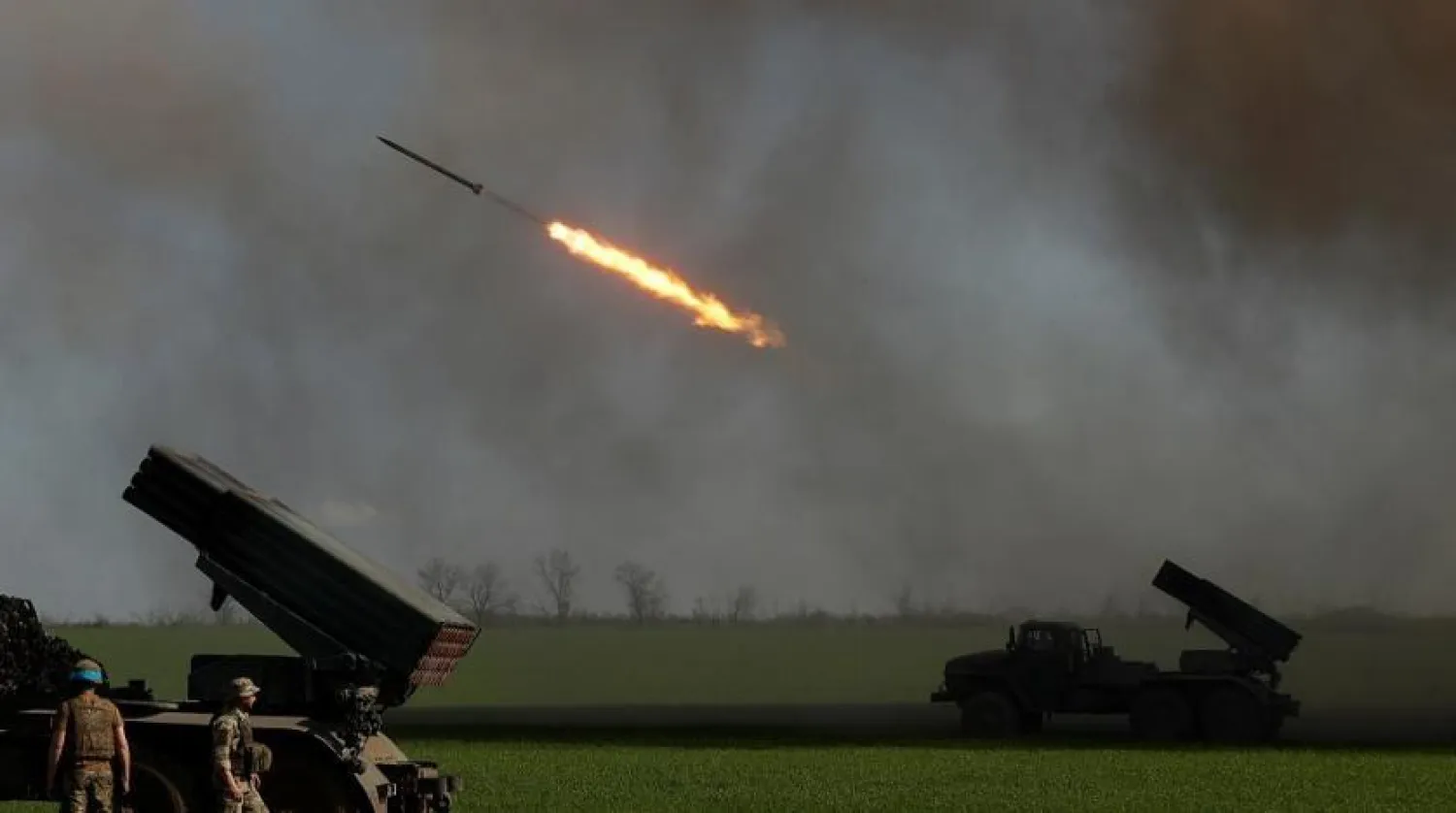
Ukrainian servicemen fire with a BM-21 Grad multiple rocket launch system, as Russia's attack on Ukraine continues, in Luhansk Region, Ukraine April 26, 2022. (Reuters)
TT

UK to Give Ukraine Long-range Missile Systems

Ukrainian servicemen fire with a BM-21 Grad multiple rocket launch system, as Russia's attack on Ukraine continues, in Luhansk Region, Ukraine April 26, 2022. (Reuters)

Britain said Monday it will mirror the United States and send long-range missile systems to Ukraine, defying warnings from Russian President Vladimir Putin against supplying Kyiv with the advanced weapons.

The UK Ministry of Defense said London had coordinated closely with Washington over its gift of the multiple-launch rocket systems, known as MLRS, to help Ukraine defend itself against Russian aggression, AFP said.

The M270 launchers, which can strike targets up to 80 kilometers (50 miles) away with precision-guided rockets, will "offer a significant boost in capability for the Ukrainian forces," the ministry added.

The US last week announced it would give Kyiv its high mobility artillery rocket system, known as HIMARS, which can simultaneously launch multiple precision-guided missiles and is superior in range and precision to existing systems Ukraine has.

However, US President Joe Biden has ruled out supplying it with systems that could reach as far as Russia, despite Kyiv's repeated demands for them.

Despite that, the US move prompted Putin to warn Sunday that Moscow will strike new unspecified "targets" if the West supplies the missiles to Ukraine and said new arms deliveries to Kyiv were aimed at "prolonging the conflict".

But unveiling the latest UK contribution, Defense Secretary Ben Wallace insisted Ukraine's Western allies must maintain their weapons deliveries to enable it to "win" its war repelling invading Russian forces.

"The UK stands with Ukraine in this fight and is taking a leading role in supplying its heroic troops with the vital weapons they need to defend their country from unprovoked invasion," he said in a statement.

"As Russia's tactics change, so must our support to Ukraine. These highly capable multiple-launch rocket systems will enable our Ukrainian friends to better protect themselves against the brutal use of long-range artillery, which Putin's forces have used indiscriminately to flatten cities."

Ukrainian troops will be trained on how to use the launchers in the UK, so they can "maximize the effectiveness of the systems", Britain's defense ministry said.

London has so far offered more than £750 million ($937 million, 874 million euros) in military support to Ukraine, including sending air defense systems, thousands of anti-tank missiles and various types of munitions, hundreds of armored vehicles and other equipment.



London Summons Envoy Over Iran’s ‘Reckless’ Actions

Ambassador from Iran, Seyed Ali Mousavi (2nd L), meets Britain's King Charles III during an audience at Buckingham Palace in London on June 12, 2025. (AFP)
TT

London Summons Envoy Over Iran’s ‘Reckless’ Actions

Ambassador from Iran, Seyed Ali Mousavi (2nd L), meets Britain's King Charles III during an audience at Buckingham Palace in London on June 12, 2025. (AFP)

Britain's foreign ministry on Monday summoned Iran's ambassador to London, Seyed Ali Mousavi, criticizing what it called Tehran's "reckless and destabilizing actions" in the UK and overseas.

"The summons follows the recent charging of two individuals, one Iranian national and one British-Iranian dual national, under the National Security Act, on suspicion of providing assistance to a foreign intelligence service," a Foreign Office spokesperson said.

"This government will take all measures necessary to protect the British people, including exposing Iran's reckless and destabilizing actions at home and abroad," the spokesperson added.

Two Iranians appeared in court in London on Thursday accused of spying on the Jewish community in London on behalf of Tehran, including by allegedly carrying out reconnaissance of potential targets such as a synagogue.

UK police, the domestic MI5 intelligence service and members of parliament have long warned about a growing threat from Iran, which is currently locked in a war with the United States and Israel.

Nematollah Shahsavani, 40, a dual Iranian-British national, and Alireza Farasati, 22, an Iranian citizen, are charged with engaging in contact likely to assist a foreign intelligence service between July 9 and August 15 last year.

Prosecutor Louise Attrill told the court last week the pair were "suspected of assisting the Iranian intelligence service by conducting hostile surveillance of locations and individuals linked to the Israeli and Jewish community".

Police on Saturday also said an Iranian man, along with a Romanian woman, had been charged over attempting to enter a Royal Navy base where Britain's nuclear submarines are based.

The pair were arrested for trying to breach the Faslane base in Scotland on Thursday, which houses the UK's Trident nuclear deterrent, made up of four submarines armed with Trident ballistic missiles.

The Iranian man has since been released from custody pending further inquiries, Scotland's public prosecution service said in a statement on Monday.

The service added there would be "no proceedings" against the Romanian woman, 31, although it reserved "the right to proceed in the future should further evidence become available".

There are fears in Britain the country could become a target over its role in the US-Israeli war on Iran.

Britain has authorized American forces to use two of its bases for some US operations against Iran, which the British government insists are purely "defensive".


‘Point of No Return’ Looming in Middle East War, Warns Red Cross

 A drone view shows a damage in a residential neighborhood, following a night of Iranian missile strikes which injured dozens of Israelis, amid the US-Israel conflict with Iran, in Dimona, southern Israel March 22, 2026. (Reuters)
A drone view shows a damage in a residential neighborhood, following a night of Iranian missile strikes which injured dozens of Israelis, amid the US-Israel conflict with Iran, in Dimona, southern Israel March 22, 2026. (Reuters)
TT

‘Point of No Return’ Looming in Middle East War, Warns Red Cross

 A drone view shows a damage in a residential neighborhood, following a night of Iranian missile strikes which injured dozens of Israelis, amid the US-Israel conflict with Iran, in Dimona, southern Israel March 22, 2026. (Reuters)
A drone view shows a damage in a residential neighborhood, following a night of Iranian missile strikes which injured dozens of Israelis, amid the US-Israel conflict with Iran, in Dimona, southern Israel March 22, 2026. (Reuters)

The International Committee of the Red Cross demanded Monday a halt to the "war on essential infrastructure" in the Middle East, warning of potential "irreversible consequences" including harm to nuclear facilities.

"What we have seen in recent days in the Middle East risks reaching a point of no return," ICRC president Mirjana Spoljaric warned in a statement.

"Most alarming is the potential harm to nuclear facilities, whether deliberate or incidental," she said.

Energy infrastructure has been repeatedly hit since the start of the war on February 28, when the United States and Israel began their attacks on Iran. Tehran has responded by striking targets in Israel and Gulf states.

Over the weekend, an Iranian strike hit the southern Israeli town of Dimona, home to a nuclear facility, in what Tehran said was in response to an earlier attack on its nuclear site at Natanz.

"Damage to these sites could trigger irreversible consequences, which is why they are afforded heightened protections under the rules of war," Spoljaric said.

She cautioned that "war on essential infrastructure is war on civilians".

"Deliberate attacks on essential services and civilian infrastructure can amount to war crimes."

Her comments came as US President Donald Trump suddenly backtracked on a threat to "obliterate" Iran's power infrastructure if it did not reopen the strategic Strait of Hormuz.

In response to Trump's initial threat, Iran had threatened to deploy naval mines in the Gulf and target power plants across the region.

On Monday, Trump said he was putting his ultimatum on hold after "very good" talks with unidentified Iranian officials, while Iranian media outlets quoted the foreign ministry in Tehran denying any negotiations and suggesting Trump was angling to bring down energy prices.

"Attacks on essential infrastructure have already punished millions of civilians both near and far from the front lines," Spoljaric said in her statement.

"This pattern, combined with an escalatory rhetoric that disregards the limits imposed by international humanitarian law, normalizes a style of warfare that strips away our shared humanity."


Iran’s True Casualty Figures Unknown as Internet Blackout Hampers Monitors

Emergency personnel work at the site of a strike on a residential building, amid the US-Israeli conflict with Iran, in Tehran, Iran, March 23, 2026. Majid Asgaripour/WANA (West Asia News Agency) via Reuters
TT

Iran’s True Casualty Figures Unknown as Internet Blackout Hampers Monitors

Emergency personnel work at the site of a strike on a residential building, amid the US-Israeli conflict with Iran, in Tehran, Iran, March 23, 2026. Majid Asgaripour/WANA (West Asia News Agency) via Reuters

Iran has not updated its official death toll figures for weeks, while human rights groups outside the country are struggling with chronic communication problems, meaning the number of people killed during the war remains largely unknown.

The last time Iran's health ministry gave a full update about casualties was on March 8, the ninth day of the conflict, when it said around 1,200 civilians had been killed in US and Israeli airstrikes across the country.

Overseas human rights groups have long been considered one of the most reliable sources of information about life inside the heavily censored country.

But with Iran's connections to the global internet cut off and phone lines down, they are struggling to reach their networks of contacts who are their eyes and ears on the ground.

The US-based Human Rights Activists News Agency (HRANA), which played an important role corroborating deaths during anti-government protests in January, estimates the civilian death toll at 1,407 people, including 214 children.

"I would say it's an absolute, absolute minimum, and that's simply because we don't have the capacity to be everywhere at one time, understanding the full extent of what's happening," HRANA deputy director Skylar Thompson told AFP.

"With the scale and the speed at which places are being targeted across the country, it's impossible to document it at the same pace," she added.

The Iranian Red Crescent is not providing casualty estimates, but its latest figures indicate 61,555 homes, 19,000 businesses, 275 medical centers, and nearly 500 schools have been damaged.

AFP journalists have been able to confirm that many civilian buildings in Tehran have been damaged, including apartment blocks caught in the blast wave of nearby missile or bomb strikes, but not beyond the city.

Reporters are unable to travel around the country without official authorization.

- Connection problems -

Distrust of Iran's official figures is high among human rights groups, particularly after the bloody crackdown on anti-government protests in January.

Although Iran acknowledged around 3,000 deaths, mostly among security forces, researchers and campaigners outside Iran estimated that anywhere from 7,000 to 35,000 people were killed in the indiscriminate shooting.

"The Islamic republic has a history of not publishing or not collecting data," Awyar Shekhi from the Norway-based human rights group Hengaw told AFP.

The problem for Hengaw and others seeking to provide a credible alternative to the incomplete official data has been the almost-total shutdown of Iran's internet connections to the outside world since the start of the war on February 28.

"The connection is worse than it ever was before, so it's really difficult to get accurate data of how many people have been killed, and the information we get is so little," Shekhi added.

Both she and Thompson stressed that Iranian authorities have been threatening and arresting people who have illegally accessed the global internet to send information abroad, sometimes accusing them of spying.

Making telephone calls to Iran from abroad is also largely impossible.

- 'Focus on the civilian harm' -

The biggest loss of life for civilians in the war so far was the airstrike on an elementary school in Minab on the first day of the war that killed at least 165 people, according to an official toll.

A US Tomahawk cruise missile hit the school because of a targeting mistake, according to the preliminary findings of a US military investigation reported by The New York Times.

Hengaw also documented an airstrike on a flour factory in the city of western Naqadeh on March 7 that killed 11 workers and injured another 21.

"I believe that the US and Israel are using a quite aggressive interpretation of what is a military target," Thompson from HRANA added.

Unlike in January, during the anti-government protests, she said there had so far been relatively little attention in the Western media on the toll of ordinary Iranians.

"There's such a focus on the geopolitics of it all, I think it's really important to have a focus on the civilian harm," she added.

Elsewhere in the region, Lebanon's health ministry said Israeli strikes had killed 1,029 people in the country.