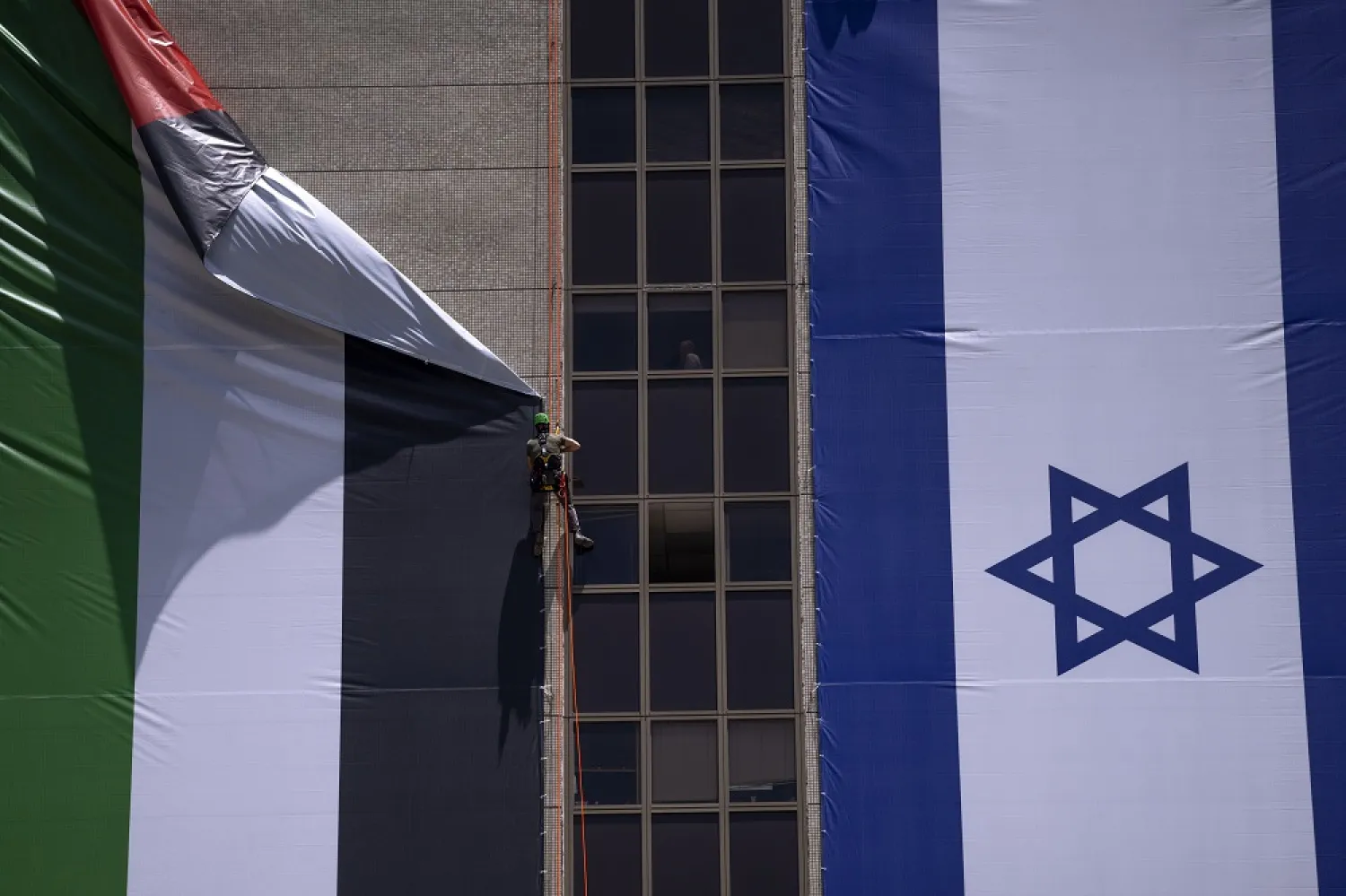
Israeli Nationalists Wage Battle against Palestinian Flag

A Palestinian flag is removed from a building by Israeli authorities after being put up by an advocacy group that promotes coexistence between Palestinians and Israelis, in Ramat Gan, Israel, Wednesday, June 1, 2022. (AP)
TT

Israeli Nationalists Wage Battle against Palestinian Flag

A Palestinian flag is removed from a building by Israeli authorities after being put up by an advocacy group that promotes coexistence between Palestinians and Israelis, in Ramat Gan, Israel, Wednesday, June 1, 2022. (AP)

It’s not a bomb or a gun or a rocket. The latest threat identified by Israel is the Palestinian flag.

Recent weeks have seen a furor by nationalists over the waving of the red, white, green and black flag by Palestinians in Israel and in Israeli-annexed east Jerusalem.

Yet the fracas over the flag tells a broader story about how much hopes for peace with the Palestinians have diminished and about the stature of the fifth of Israelis who are Palestinian. They for long have been viewed as a fifth column because of their solidarity with the Palestinian cause.

Palestinian citizens of Israel see the campaign against the flag as another affront to their national identity and their rights as a minority in the majority Jewish state.

"The Palestinian flag reminds Israelis that there is another nation here and some people don’t want to see another nation here," said Jafar Farah, who heads Mossawa, an advocacy group promoting greater rights for Palestinian citizens of Israel.

In recent weeks, Israeli authorities have gone out of their way to challenge the hoisting of the Palestinian flag. Police at a funeral in east Jerusalem last month for the well-known Palestinian-American Al Jazeera journalist Shireen Abu Akleh snatched Palestinian flags from mourners, reportedly following an order from a district police chief to make sure the Palestinian colors don’t fly at the politically-charged event.

Two Israeli universities were slammed by nationalists for allowing Palestinian flags to be waved at campus events. Israel Katz, a senior opposition lawmaker, urged flag-waving Palestinian-Israeli students to remember the war leading to Israel's establishment in 1948, saying Jews "know how to protect themselves and the concept of the Jewish state."

A group promoting coexistence between Palestinians and Israelis raised the Palestinian flag alongside the Israeli one on a high-rise outside Tel Aviv, only to have authorities remove the Palestinian flag hours later.

Those events culminated in a push by opposition legislators to ban the waving of the Palestinian flag at institutions that receive state funding, which would include universities and hospitals, among others. The bill passed overwhelmingly in its first reading on Wednesday, 63-16, although several parties in the governing coalition were absent and the coalition may seek to block the bill from moving forward.

"In the state of Israel there is room for one flag: the Israeli flag, this flag," Eli Cohen, the legislator who sponsored the bill, said from the dais of Israel’s parliament, the Knesset, as he pointed to an Israeli flag hung behind him. "This is the only flag there will be here," he said to applause from some legislators.

According to Adalah, a legal rights group for Palestinian Israelis, waving the flag is not a crime under Israeli law. A police ordinance grants officers the right to confiscate a flag if "it results in disruption of public order or breach of peace."

Israel’s Palestinian citizens make up 20% of the population and they’ve had a turbulent relationship with the state since its creation in 1948, when hundreds of thousands of Palestinians fled or were forced to flee in the events surrounding the establishment of the state.

Those who remained became citizens, but have long been viewed with suspicion by some Israelis because of their ties to Palestinians in the West Bank, Gaza Strip and east Jerusalem, territories Israel captured in the 1967 Mideast war. That sense deepened last year when mob violence erupted in mixed Jewish-Arab cities, with looting and attacks scarring residents on both sides.

Palestinian citizens have carved a life for themselves in Israeli society, reaching the highest echelons in various spheres, including health, education and public service. An Arab Islamist party for the first time in history is now a member of a governing coalition. But Palestinians in Israel are generally poorer and less educated than Jewish Israelis and they have long suffered discrimination in housing, government funding and public works.

While there have been efforts in recent governments to address that socio-economic gap, the nationalist rights of Palestinians have been slowly eroded over the years, especially as Israeli nationalist sentiment has grown.

"It is our right to raise our Palestinian flag," said Alin Nasra, an activist and student at Tel Aviv University. "This is something that distinguishes us as a minority inside Israel."

Yitzhak Reiter, president of the Middle East and Islamic Studies Association of Israel, said the uproar against the flag is part of a feeling by nationalists and some mainstream Israelis that they are "losing the state," to Palestinian nationalism from within Israel's borders.

He cited previous laws that bar municipalities or institutions from marking Israel’s Independence Day as a day of mourning or the Jewish state law that tried to strengthen Israel’s character as a Jewish state but which Palestinian citizens saw as a further downgrade of their status and a blow to their national identity. Israel’s national symbols - a biblical candelabra, the star of David on its flag - do not include Palestinian or Arab emblems and Israel's anthem speaks of the yearning of the Jewish soul.

The flag, Reiter said, "symbolizes the enemy, but waving the flag, for those who oppose it, is harmful to Israeli sovereignty."

Israel once considered the Palestinian flag that of a militant group, no different than the Palestinian Hamas or Hezbollah party in Lebanon. But after Israel and the Palestinians signed a series of interim peace agreements known as the Oslo Accords, the flag was recognized as that of the Palestinian Authority.

The left-leaning daily Haaretz chided the bill against the flag, saying Israel had an "obsession" with it because it reminds the country of "the sin of the occupation" of lands the Palestinians want for a future state.

With peace talks a distant memory and the occupation dragging on, the battle over the flag shows how far from reality Palestinian statehood is, with the nationalist narrative in Israel increasingly going mainstream.

Ronni Shaked, of Jerusalem's Harry S. Truman Research Institute for the Advancement of Peace, said he remembers a time when politicians wore lapel pins that bore both the Israeli and Palestinian flags and that even hawkish former Prime Minister Benjamin Netanyahu, the current head of the opposition and Israel’s longest serving leader, had a Palestinian flag hanging behind him during events with the Palestinian leadership when relations between the sides were less frosty.

"If we are afraid from the Palestinian flag," he said, "it means that we are afraid to make any kind of peace with the Palestinians."


Al-Mirghani: A Statesman of Peace

Mohammed Osman al-Mirghani, the late leader of Sudan’s Democratic Unionist Party.
TT

Al-Mirghani: A Statesman of Peace

Mohammed Osman al-Mirghani, the late leader of Sudan’s Democratic Unionist Party.

November 16 was no ordinary date in Sudan’s collective memory. It was the day Mohammed Osman al-Mirghani was laid to rest in Khartoum North. It was also the anniversary of the Sudanese Peace Initiative he signed 38 years earlier with Dr. John Garang in Addis Ababa, an accord known as the Mirghani-Garang Agreement.

It was as though history had chosen the day of his farewell to remind Sudan of the defining conviction he carried throughout his life: that the country could not be saved through war, but through dialogue.

This is not to place al-Mirghani, leader of the Democratic Unionist Party, beyond criticism or to dismiss the disputes and disagreements that marked his political career. But fairness demands recognition of his unwavering commitment, at decisive moments, to peace, consensus and national unity. That is why he deserves to be called a man of peace.

On November 16, 1988, al-Mirghani and Garang made political history with a remarkably brief document: barely a page long and fewer than 400 words. But its significance was immense.

The agreement called for a ceasefire, the suspension of the provisions on hudud punishments and related articles of the September 1983 laws pending a national constitutional conference, the lifting of the state of emergency, cancellation of military agreements affecting national sovereignty, and formation of a national committee to prepare for the constitutional conference.

Its central premise was fundamental: the war was not an isolated southern problem, but a manifestation of a broader Sudanese crisis that could be resolved only through dialogue on equal terms among all political and social forces.

The agreement faced open opposition from the National Islamic Front before the Constituent Assembly approved it on April 3, 1989. Then came the June 30 coup, cutting short the process before it could be completed.

It would be wrong to attribute the coup solely to the Mirghani-Garang Agreement, just as it would be impossible to assert that peace was guaranteed had democracy been allowed to run its course. But it is entirely reasonable to say that Sudan lost a genuine opportunity for peace, one that would not be forgotten.

Instead of the swift peace envisioned in a single-page document, the war continued for roughly another 16 years after the coup. It claimed hundreds of thousands of lives, forced millions from their homes and into exile, and saw the proliferation of armed groups and militias.

Ultimately, Sudan needed years of negotiations and volumes of protocols and agreements to reach the 2005 Comprehensive Peace Agreement. That accord, in turn, opened the way to self-determination, the 2011 referendum and the secession of South Sudan.

This contrast is what makes the Mirghani-Garang initiative a living document to this day. One page had outlined a broad political vision for a united country. Years later, Sudan required seemingly endless documents to reach an outcome in which it lost a cherished part of its territory and people.

Jaafar Hassan, a leading figure in the Unionist Alliance and spokesman for the Sumoud coalition, told Asharq Al-Awsat that the late al-Mirghani was “one of Sudan’s pillars and one of the few men of sound judgment.”

Hassan said al-Mirghani had pursued peace early on, drawing on his position as head of the Democratic Unionist Party and leader of the Khatmiyya Sufi order.

Al-Mirghani had put his considerable popularity among his followers at the service of peace, recognizing early the dangers of allowing the war in South Sudan to continue. He was behind the landmark agreement between the Democratic Unionist Party and the Sudan People’s Liberation Movement led by John Garang.

“Had it not been for the National Islamic Front’s coup in 1989, Sudan would still be united today,” Hassan said.

He stressed that al-Mirghani’s commitment to peace and national unity was not a fleeting political position, but of principles on which he refused to compromise.

Milestones in the pursuit of peace

The 1988 initiative was not the only landmark in al-Mirghani’s record. At least six major milestones can be identified in his pursuit of peace.

The first was his agreement with Garang. The second was his leadership of the National Democratic Alliance after the coup, bringing together political parties, trade unions and armed movements of differing orientations under one umbrella.

The third was the 1995 Asmara Conference on Fundamental Issues, which placed war, democracy, identity and the relationship between religion and the state at the heart of the national dialogue.

The fourth came at the alliance’s second conference in Massawa in 2000, when it affirmed that Sudan’s problems could be resolved only through “serious and sustained dialogue among all Sudanese political forces” in a democratic environment.

The fifth milestone came through negotiations in Jeddah and Cairo, culminating in the 2005 Cairo Agreement between the government and the National Democratic Alliance under al-Mirghani’s leadership. The agreement opened the door to ending a prolonged political confrontation and allowing opposition forces to return to political life.

In Darfur, al-Mirghani sought to narrow differences between the government and armed movements that had not signed peace agreements. He encouraged those movements to unify their positions so they could join negotiations from a stronger position.

In 2022, he again proposed an initiative for comprehensive national dialogue and returned to Khartoum after a long absence, making another attempt to bring Sudanese factions together before the country descended into its current war.

Not everyone agreed with all his political choices. But at the time of his passing, there was broad agreement that his name had been closely associated with national unity and dialogue.

Political analyst Mohamed Latif told Asharq Al-Awsat that al-Mirghani’s political record might be a subject of disagreement for some, “but it is difficult to dispute that he was one of the leaders of Sudan’s two largest religious communities.”

“He succeeded in preserving the cohesion of the Khatmiyya order inside and outside Sudan, as well as its peaceful religious mission, far removed from violence and extremism,” he added.

The Mirghani-Garang Agreement was among the most significant moments not only in al-Mirghani’s life but also in Sudan’s modern history, he went on to say.

The agreement came after more than five years of fierce war between the Sudan People’s Liberation Movement and the Sudanese army, despite repeated attempts to bring the fighting to an end.

Latif said Sudanese collective memory preserves two contrasting images from that period: the enormous crowds that welcomed al-Mirghani upon his return to Khartoum after signing the agreement in the Ethiopian capital, Addis Ababa, and the subsequent attempt to assassinate him at his home in the Khartoum 2 neighborhood.

The two episodes seemed to offer early signs of the struggle between the desire for peace and the path of violence that would later come to define Sudan.

The most meaningful tribute to al-Mirghani lies not in words of mourning alone, but in drawing lessons from his life and Sudan’s recent history.

Whenever the door to dialogue has been closed, the doors to war have opened wider. Whenever the illusion of a military solution has prevailed, the Sudanese people have paid the price in bloodshed, displacement and division.

Sudan once squandered the opportunity presented by a brief agreement that might have opened a different path. It must not squander today’s opportunity to end this devastating war.

Peace is not weakness. Negotiation is not betrayal. Ending the war is not merely one political option among many, but a national and moral duty to save what remains of Sudan.


West Bank’s Displaced Palestinians Hold Little Hope for Post-Netanyahu Era

A general view shows extensive demolitions in a neighborhood of Tulkarem refugee camp, near the city of Tulkarem in the Israeli-occupied West Bank, on November 11, 2026. (AFP)
TT

West Bank’s Displaced Palestinians Hold Little Hope for Post-Netanyahu Era

A general view shows extensive demolitions in a neighborhood of Tulkarem refugee camp, near the city of Tulkarem in the Israeli-occupied West Bank, on November 11, 2026. (AFP)

After Israeli forces pushed him and thousands of others out of the West Bank refugee camp of Tulkarem last year, Adel Darsieh held onto his hope of returning home, but it is fading fast.

Prime Minister Benjamin Netanyahu has vowed no return for the displaced people from the camp near the northern city of Jenin.

He is now fighting for his political life after his party lost seats in Israel's general election last month and former general Gadi Eisenkot was tasked with trying to form a new government.

But even the prospect of an end to Netanyahu's rule is not enough to lift Darsieh's hopes.

"Whether it's this government or a new one, what does it change?" said the 64-year-old. "They're two sides of the same coin."

The Israeli military carried out a major operation in the north of the occupied Palestinian territory in early 2025, during a temporary ceasefire in Hamas-ruled Gaza, having vowed to root out extremists.

Shortly before the election, Netanyahu announced that no one removed from Tulkarem would be allowed back.

For Palestinian families, it is a second form of displacement. The Tulkarem camp was set up in 1950 for refugees who fled or were forced out during the creation of the state of Israel two years earlier. The West Bank has been occupied by Israel since 1967.

"Successive generations have lived through displacement without being able to return to their homes. If our grandparents and parents couldn't return, how can we believe that our return will be possible?" Darsieh said.

According to UN figures, the Israeli operation launched last year displaced 12,100 people from the Tulkarem camp.

- 'Empty stomachs' -

With the Israeli military keeping up periodic operations around the region, Darsieh is living near the camp in a modest, makeshift home with a sheet metal roof. His wife uses a wheelchair.

He went to receive trays of mansaf, a dish of rice, meat and fermented yoghurt, prepared by Fazaa Kitchen, a solidarity group that serves food to the displaced.

Working from the building of the Wadi al-Hawarith charity, volunteers in orange jackets fill, seal and package portions of food in an assembly line.

The group prepares and distributes some 1,200 meals to 400 families.

"If we weren't cooking, families would be going to bed with empty stomachs," said the organization's head, Hussein al-Sheikh Ali, 60, who himself is displaced.

He described Israel's actions in the West Bank since the Gaza war -- a conflict launched in response to the unprecedented attack on Israel by Hamas on October 7, 2023 -- as "collective punishment".

Netanyahu's now-caretaker government, which includes far-right figures, rapidly expanded Israeli settlements in the West Bank which are considered illegal under international law.

"Some Palestinians hope that a new Israeli government might emerge with a less extremist, more moderate tone," Ali said.

"Yet the fear remains that the same policies towards the Palestinians will persist, even if the political figures themselves change."

Faisal Salama, who heads Tulkarem camp's popular committee, which represents residents, called Netanyahu's decision to stop residents returning illegal.

But he held out guarded hope for an end to military operations. He pointed to how Israel, soon after the election, ended an operation in Hebron that displaced 3,000 Palestinians, which was launched after gunmen shot dead two Israeli soldiers.

- 'Scale of suffering' -

Even if residents could return, much of the camp has been destroyed. Houses have been razed, buildings emptied and businesses burnt down.

Eisenkot, who commanded forces in the West Bank during the second Intifada, a Palestinian uprising from 2000 to 2005, has sought to appeal to a broad spectrum including liberals but has only taken some distance from Netanyahu on security.

Eisenkot backs the existence of the major settlements but has also spoken out forcefully against extremist settlers who have attacked Palestinians with virtual impunity.

Beth Oppenheim, a policy fellow at the European Council on Foreign Relations, said a consensus has emerged among Jewish Israelis on key policies on the West Bank, including opposition to the creation of a Palestinian state.

Still, she said that Eisenkot as prime minister could be more flexible on allowing a return to Tulkarem.

"I think that given the political atmosphere in Israel today, this will be done through a security pretext," she said.

"They would make the case that this is necessary to stabilize the situation in the West Bank and that having people displaced could create the conditions for unrest," she said.

For Asia Assaf, 44, a Fazaa Kitchen volunteer whose home was destroyed in March 2025, political debates are far away from her daily concerns.

"One cannot truly grasp the scale of suffering until one has experienced it firsthand," she said.


Spy Scandal and Midterm Defeat Heat Up Trump’s Asia Visit

US President Donald Trump waves as he attends a midterm campaign rally at Salina Regional Airport in Salina, Kansas, US, November 1, 2026. (Reuters)
TT

Spy Scandal and Midterm Defeat Heat Up Trump’s Asia Visit

US President Donald Trump waves as he attends a midterm campaign rally at Salina Regional Airport in Salina, Kansas, US, November 1, 2026. (Reuters)

US President Donald Trump heads to Asia this week, reeling from a midterm election drubbing and Chinese spy allegations that have raised the stakes for his latest face-to-face with Beijing's powerful leader, Xi Jinping.

Trump will first visit Manila for meetings with Southeast Asian and other regional leaders on Tuesday before jetting to Shenzhen for the Asia-Pacific Economic Cooperation (APEC) forum, where he will meet the Chinese president and hold three-way discussions with Xi and Russia's Vladimir Putin.

With a fragile trade-war truce between the US and China extended to early next year, and more Trump-Xi talks due in December at the G20 in Miami, some analysts had initially billed the Shenzhen meeting as a low-stakes summit.

But a backlash against Trump's Republican Party in this month's midterms and criticism that his administration failed to act on intelligence that Nvidia CEO Jensen Huang, who has close ties to Trump, had an affair with a suspected Chinese spy, have muddied those expectations.

"With less reason to worry about market reactions or electoral fallout, (Trump) may be more willing to consider disruptive measures," said Ruby Osman, a senior policy adviser on China at the Tony Blair Institute, a London-based think tank.

Washington has already signaled such willingness ahead of the meeting, urging China to live up to its commitments ‌made under the truce ‌agreed between Trump and Xi a year ago.

Chinese analysts say they are particularly concerned that the Nvidia saga, including ‌allegations that ⁠restricted semiconductors were ⁠diverted to Chinese customers, will now harden US attitudes towards China.

US House Speaker Mike Johnson said last week there was growing consensus in Congress on further limiting Chinese access to advanced chips after the scandal, and Democrats are expected to press hard on the issue when they take over the House and Senate majorities in January.

China has said the United States has fabricated the spy narrative to justify a technological blockade.

Zhu Feng, director of the Institute of International Studies at Nanjing University, said the spat could also speed up "the decoupling of AI" between the world's two superpowers even as they try to cooperate on mitigating the technology's risks.

Trump is not expected to directly raise the spy allegations with Xi, one senior US administration said on condition of anonymity, adding that the Nvidia situation "should not really have any bearing on the trip".

TRUMP'S LEGACY

Rather than picking fresh fights with China, Trump may want to ⁠focus on legacy-building endeavors such as denuclearization agreements with Beijing and Moscow, or securing another meeting with North Korea's secretive ‌leader, Kim Jong Un.

Trump sees the unprecedented summit with Xi and Putin as possibly providing movement towards ‌an agreement on nuclear arms control. But that is a non-starter for China, which has far fewer warheads than the others, Chinese analysts said.

Trump may also seek to enlist Putin ‌and Xi's support in setting up a future meeting with Kim, who has close ties to the Chinese and Russian leaders.

The president will be focused on "building his ‌legacy," said Victor Cha at the Center for Strategic and International Studies, a US think tank. A big part of that is his North Korea diplomacy, which he has devoted a lot of time to over his two terms, Cha added.

The proposed three-way meeting has drawn comparisons, particularly in Russia, with the 1945 Yalta Conference between the US, Britain and the Soviet Union that formalized spheres of influence, set the stage for the post-World War Two order and became shorthand for great-power deals imposed on smaller countries.

Such a framing is particularly worrisome for Ukraine, engaged in a ‌four-year war with Russia. Trump is not expected to raise Ukraine at the meeting, the senior US official said.

'A LOT TO LOSE'

Xi could also seek to take advantage of Trump's political weakness after his election humbling, analysts ⁠say.

Top of Beijing's wish list is ensuring ⁠that the US president doesn't approve a $14 billion arms package to Taiwan, which China claims as its own. Trump has said he is holding the arms back as a "negotiating chip" with China.

But with China's export engine humming, simply buying time may be enough for Beijing, said Jonathan Czin, a foreign policy analyst at the Brookings Institution, a US-based think tank.

"Xi just needs Trump to remain reluctant to revert toward a more competitive posture toward China for as long as possible. China will take whatever time it can get to fortify itself for the next round in the contest," said Czin, who formerly worked at the Central Intelligence Agency and as director for China at the US National Security Council.

Beijing will be acutely aware that whoever succeeds Trump when his term ends in two years time, may be less accommodating, said Czin and Osman.

Trump's Democratic predecessor, Joe Biden, repeatedly angered China with comments over human rights issues and a pledge that the US would defend Taiwan if Beijing attacked. Many of Trump's potential Republican successors, such as Secretary of State Marco Rubio, are also seen as more hawkish on China.

Both leaders will also be wary of reigniting a trade row that threatened to tank the global economy and financial markets last year, said Kurt Tong, a former senior State Department official now with the Asia Group think tank.

Despite the frustration the US has voiced on Chinese implementation of the terms of the truce, Tong expects it will be further extended beyond its January 10 expiration.

"The two sides are quite incentivized to maintain this fragile stability ... despite also having some disagreements," added senior China analyst Chim Lee at the Economist Intelligence Unit.

"They both have quite a lot to lose."